Articles Posted in Work Visas

The U.S. District Court for the Western District of Washington recently ruled in Ruiz-Diaz v. United States that a U.S. Citizenship and Immigration Services (USCIS) regulation is “unreasonable and impermissible.” A federal judge has struck down a long-standing government policy that made it tougher for religious workers from other countries to remain in the United States. Chief U.S. District Judge Robert Lasnik wrote in an order issued last week that the policy was at odds with the intent of Congress.

Ruiz-Diaz potentially provides religious workers who have filed I-360 petitions with the ability to concurrently file adjustment of status applications. This would allow religious workers whose underlying R visa status is expiring (the R is valid for five years) to remain in the U.S. as adjustment of status applicants. At present, the I-360 approval process is lengthy, after which point the religious worker can file an adjustment application, due to the need to conduct a site investigation on each filing.

Under the Department of Homeland Security’s policy, religious workers who came to the United States on a typical five-year temporary visa were not allowed to file for permanent residency — their green card — until a separate visa petition by their employer had been approved.

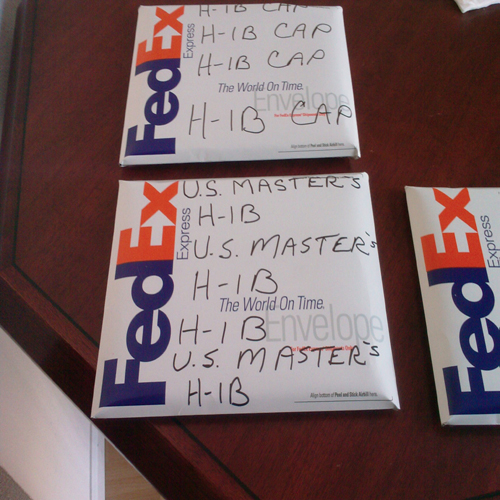
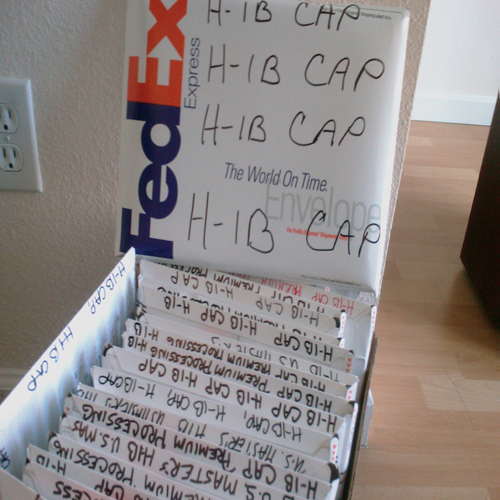
As I am writing this post, my fingers are hurting from the amount of H1B forms I had to sign today. We are almost ready with our cases. Yet, last minute clients are calling in need of our services. Tomorrow will be the last day we accept cases (I promised my wife:))

The H-1B filing season is upon us once again, fiercer than ever. The first day to file cap-subject petitions for FY 2010 is April 1, 2009. In the event that more petitions are received than the annual cap, USCIS will conduct a lottery to pick petitions to be adjudicated. Additionally, employers that are recipients of TARP funding have new requirements when filling out the newly revised Form I-129 and additional attestation requirements for the Labor Condition application.

USCIS has confirmed that if USCIS determines that they have received a sufficient number of cases in the first five business days of April to reach the cap, then the “lottery” will be based on petitions received all five days. USCIS will not begin to issue receipts, however, until a determination is made that sufficient H-1B petitions have been received within the first five business days of April, ending April 7, 2009.

Most H1B applicants assume that as long as they mail the cases on April 1, USCIS will consider it filed. Well today we have some new clarifications from USCIS. U.S. Citizenship and Immigration Services (USCIS) today announced that it will begin accepting H-1B petitions subject to the fiscal year 2010 (FY 2010) cap on April 1, 2009. Cases will be considered accepted on the date that USCIS takes possession of the petition; not the date that the petition is postmarked. Make sure to have it sent by March 31, 2009 the latest to avoid any delays.

Read more here…

We post a practice tip from AILA member Jill Bussey at Baker and McKenzie, very useful

A close review of Paragraph E of the April 2009 Visa Bulletin, issued March 9, 2009, reveals the Employment Third Preference Worldwide and Philippine cut off of March 1, 2003 was effective immediately upon issuance of the Visa Bulletin. This has been confirmed by communications with Charles Oppenheim of the State Department. Mr. Oppenheim indicated he attempted to stave the cut-off through March, however the demand for EB3 numbers was too high. Mr. Oppenheim reiterated the information found in the Bulletin, “since over 60 percent of the Worldwide and Philippines Employment Third preference CIS demand received this year has been for applicants with priority dates prior to January 1, 2004, the cut-off date has been retrogressed to 01MAR03 to help ensure that the amount of future demand is significantly reduced. As indicated in the last sentence of Item A, paragraph 1, of this bulletin, this cut-off date will be applied immediately. It should also be noted that further retrogression or “unavailability” at any time cannot be ruled out.” Mr. Oppenheim advised 85-95% of Employment Based adjudications occur through USCIS, which has been expediting the processing of Third Preference cases. He also shared that he has seen increased demand in First Preference cases from 2007. It is highly unlikely the Third Preference category will remain available in the near future. Further retrogression or “unavailability” may occur at any time.

Continue reading

In previosu Blog posts I reported the growing concerns from employers and workers with respect to the new H2A regs. The Department of Labor (DOL or the Department) now proposes to suspend for 9 months the H-2A regulations published on December 18, 2008, which became effective on January 17, 2009, that amended the rules governing the certification for temporary employment of nonimmigrant workers in agricultural occupations on a temporary or seasonal basis, and the enforcement of contractual obligations applicable to employers of such nonimmigrant workers. A suspension would provide the Department with an opportunity to review and reconsider the new requirements in light of issues that have arisen since the publication of the H-2A Final Rule, while minimizing the disruption to the Department, State Workforce Agencies (SWAs), employers, and workers.

To avoid the regulatory vacuum that would result from a suspension, the Department proposes to reinstate on an interim basis the rules that were in place on January 16, 2009, the day before the revised rules became effective.

As the H1B season coming to an end, many lawyers, like us, are busy with preparing the H1B petitions. It feels like getting ready for a race, a big race. So who is going to win the lottery this year? Last year Indian tech firms such as TCS, Infosys and Wipro apart from scandal-hit Satyam Computer Services received maximum number of H1B work permits, as these companies sent more professionals to the US.

India’s second biggest software exporter led the list of H1B visas issued last year with around 4,559 work permits, Wipro received 2,678 approvals, Satyam managed some 1,919 and TCS received around 1,539 H1B permits. According to the data released by the United States Citizenship and Immigration Services (USCIS), Microsoft, the world’s biggest software maker, stood fourth in the list of top H1B users with around 1,037 work permits for foreign workers.

Because of the grim economy, the prediction is that this year’s numbers will be lower, at the same time, companies are still in line to secure precious H1B spots.

H-1B Nonimmigrant Visa Petitions for FY2010 (October 1, 2009 through September 30, 2010) may be filed starting April 1, 2009. Here are some tips provided by AILA.

How do I get my LCA before April 1, 2009?

As you are unable to submit an LCA for certification to the DOL earlier than six months prior to the beginning date of the period of intended employment (20 CFR §655.730(b)), you must set your employment start date on the LCA prior to October 1, 2009, if you want to have an LCA in hand before the filing period for H-1B cap subject petitions begins on April 1, 2009. For example, you can file and have certified an LCA that has a start date of September 15, 2009. But remember that the LCA end date cannot be longer than 3 years from the start date, so in this example the end date would be September 15, 2009. Also remember to make sure to annotate your I-129 form with a start date of October 1, 2009, but with an expiration date that coincides with the expiration date of the LCA.

What if the U.S. Degree will not be awarded by 3/31/09?

The USCIS has approved H-1B petitions for foreign nationals who have earned degrees from U.S. institutions of higher education, where the foreign national has completed all requirements for the degree, and hence, has “earned” the degree, but the degree has not been conferred. You must submit evidence that the foreign national has completed all requirements for the degree from an official at the school who is qualified to provide that information (e.g. Dean, Registrar or Department head). Be wary of letters prepared by unauthorized employees at the school stating that the student has completed all requirements toward a degree, when in fact there are still examinations or papers to complete. Be mindful that use of such documentation when the student has not completed the program may be considered fraud and such a document may result in the case being denied on the basis of ineligibility at the time of filing.

Can multiple identical petitions be filed for the same foreign national?

The USCIS will either deny or revoke multiple petitions filed by an employer for the same H-1B worker and will not refund filing fees for duplicative or multiple H-1B petitions. The rules does not prevent related employers (such as a parent company and its subsidiary) from filing petitions on behalf of the same foreign national for different positions, based on legitimate business need. Members are reminded to include evidence and/or an explanation in each filing to demonstrate why the filing is not a duplicate.

Will an F-1 nonimmigrant student be able to remain in the U.S. if his or her F-1 status expires before 10/1/2009?

On April, 8, 2008, the USCIS issued a regulation that extended the authorized stay for all F-1 students who have properly (timely) filed an H-1B petition and change of status request whose F-1 status will expire before October 1. The student is in valid status and can continue to work while the petition is pending at the USCIS. If the case is rejected, the student’s F-1 status will dictate the continued ability to remain in the U.S. If the case is accepted under the quota, the student will have an extension that enables the student to remain in the U.S. and continue to work until the requested start date indicated in the H-1B petition takes effect. Therefore it is important to make sure you select change of status in Section 3 of the I-129 form to get this protection.

Continue reading

That was a close call for the EB5 program. The House passed legislation that would extend the regional center program. Included in the Fiscal 2009 Omnibus Appropriations bill (H.R. 1105), the law would extend the program only until September 30, 2009. This action means that Congress would need to address the issue all over again by September. The bill still must by passed by the Senate and then signed by the President.

If you check out the rules committee link and language below, you will see that the EB-5 extension language is included at the end of Division J (section 101). The language below doesn’t mention EB-5 explicitly, but it does say that section 144 of the prior continuing resolution is extended until Sept. 30, 2009. Section 144 is the provision that extended EB-5 until March 6, 2009.

.

This report was released by the American Immigration Lawyers Association today. AILA’s Business Committee has prepared this list of Frequently Asked Questions about the H-1B provisions of the American Recovery and Reinvestment Act of 2009 (ARRA or the “Stimulus Bill”) and its impact on H-1B employers. Some of the FAQs do not have clear answers, and the Committee will be working with the USCIS liaison committees to clarify these points in the coming weeks.

What Provision of the American Recovery and Reinvestment Act of 2009 Affects H-1B Employers?

Section 1611 of the ARRA, called the Employ American Workers Act, was added to the stimulus bill by Senators Sanders (I-Vt.) and Grassley (R-Iowa) to limit certain banks and other financial institutions from hiring H-1B workers unless they had offered positions to equally- or better-qualified US workers, and to prevent banks from hiring H-1B workers in occupations in which they had laid off US workers.

What Companies Are Covered by the EAWA?

The EAWA places new restrictions on H-1B petitions filed by any company that receives funding under title I of the Emergency Economic Stabilization Act of 2008 (Public Law 110-343, also known as the “TARP Bill”) or that receives funding under Section 13 of the Federal Reserve Act (12 U.S.C. § 342 et seq., authorizing the Federal Reserve’s “Discount Window” for short-term, secured loans to financial institutions and other companies).

Note that companies receiving funds under the AARA (the “stimulus bill”) itself, such as engineering companies that contract with states to build the transportation infrastructure funded by the bill, are NOT subject to any restrictions – only banks and other companies receiving TARP money, or credit directly from the Federal Reserve System, are covered.

How Do I Find Out Whether An Employer Has Received Funds Triggering Application of EAWA?

Recipients of funding under the TARP program are disclosed publicly by the US Treasury, and weekly reports are available on the Emergency Economic Stabilization Act page of the Treasury Department website.

Recipients of funding through the Federal Reserve’s Discount Window program are not disclosed to the public.

What Restrictions Are Placed On Covered Employers?

The EAWA provides that it will be unlawful for any recipient of funding to “hire” an H-1B nonimmigrant unless the recipient has complied with the extra Labor Condition Application attestations previously imposed on “H-1B dependent employers.” These extra attestations are:
that the employer has, prior to filing the H-1B petition, taken good-faith steps to recruit U.S. workers for the position for which the H-1B worker is sought, offering a wage that is at least as high as that required under law to be offered to the H-1B worker. The employer must also attest that, in connection with this recruitment, it has offered the job to any U.S. worker who applies and is equally or better qualified for the position.

that the employer has not laid off, and will not lay off, any U.S. worker in a job that is essentially equivalent to the H-1B position in the area of intended employment of the H-1B worker within the period beginning 90 days prior to the filing of the H-1B petition and ending 90 days after its filing.

Continue reading