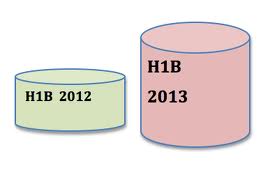
We just obtained this information based on reports from the California Service Center, Laguna Niguel, CA, on April 5, 2012, that 22,323 cap-subject H-1B petitions have been received as of April 4, 2012. Approximately 25% of these cases are for U.S. advanced degrees. According to USCIS, the number of filings received in the first few days of the H-1B season is almost double the number of filings received by USCIS during the same time last year.

We will keep you posted any new H1B case filers, better hurry up!!!

The Rome District Chapter of AILA (RDC) offered the following information from the NIV Chief in Shanghai, Mr. Mr. Richard Larsen. We specially wanted to update on the issue on non immigrant visas and in particular visitor visas for certain kind of applicants.

What is the status of B visa adjudications for pregnant mothers? B for dependent parents? Domestic Partners? What should be provided above and beyond a standard B visa applicant?

Mr. Larsen stated, The law does not prohibit pregnant mothers from applying for B visas or to have their babies in the U.S. The post reviews an application from a pregnant mother like other applications, looking for ties to China, financial resources, credibility, etc. If the post is

What I really want to know is how could this happen in the first place, and more importantly, for such a long duration – 13 years.

Earl Seth David, also known as Rabbi Avraham David, applied for legal status for 25,000 illegal aliens based on phony claims that U.S. employers had sponsored those aliens for employment.

He operated the scheme out of his Manhattan law firm for 13 years, charging the aliens exorbitant fees of as much as $30,000, prosecutors said.

In response to questions about projected priority date movement for the remainder of FY2012 posed by followers of our Blog we report based on AILA recent update, Charlie Oppenheim, DOS Chief of Immigrant Visa Control and Reporting, provided a chart with projected visa number movement based on recent patterns of USCIS number use, which recently have seen dramatic fluctuations. The following information can help with some predictions, but keep in mind these estimates are subject to change at any time.

Last week U.S. Citizenship and Immigration Services (USCIS) posted a Notice in the Federal Register requesting public comment on its plan to create an alternative process for certain immediate relatives of U.S. citizens to apply for and receive a provisional waiver of the unlawful presence ground of inadmissibility while still in the United States, if they can demonstrate that being separated from their U.S. citizen spouse or parent would cause that U.S. citizen relative extreme hardship. The goal of the proposed process change is to reduce the time that U.S. citizens are separated from their immediate relatives while those family members go through the consular process overseas to obtain an immigrant visa.

Currently, immediate relatives of U.S. citizens who have accrued a certain period of unlawful presence in the United States are barred from returning to the United States for as long as 3 or 10 years if they leave the country. Immediate relatives can obtain a waiver of the unlawful presence bar if they show that a U.S. citizen spouse or parent will experience extreme hardship if they are required to remain outside the United States. The immediate relative also would have to show that they warrant a favorable exercise of discretion. But in order to obtain the waiver, these individuals must depart the United States and wait abroad while the waiver is processed.

Under the current process, therefore, U.S. citizens suffer unnecessarily long periods of separation while family members go through consular processing overseas to obtain an immigrant visa. The proposed process change lessens the length of separation by reducing inefficiencies in the current immigrant visa process.

With a few days left before the April 2, 2012 deadline, we learned that poor filing decisions make risk your case delivery and as a result miss the H1B cap.

USCIS stated that cases are considered “accepted on the date that USCIS takes possession of a properly filed petition with the correct fee,” and that it does not rely on the date the petition is postmarked or the date the petition is delivered to a P.O. Box or USPS address.

Employers are advised that petitions that are sent to USCIS via U.S. Postal Service Express Mail, even those that are addressed to the physical address of the service center, are not actually delivered to the service center, but are instead delivered to a U.S. post office. When received at the U.S. post office, such petitions may even be “signed for” as received by a USCIS official.

We have announced the TPS for Syrians on March 23, 2012, today this is official. Due to the violent upheaval and deteriorating situation in the Syrian Arab Republic (Syria), U.S. Citizenship and Immigration Services (USCIS) announced today that eligible Syrian nationals (and persons without nationality who last habitually resided in Syria) in the United States may apply for Temporary Protected Status (TPS).

The TPS designation for Syria is effective today and will remain in effect through September 30, 2013. The designation means that eligible Syrian nationals will not be removed from the United States, and may request employment authorization. The 180-day TPS registration period begins today and ends on September 25, 2012.

To be eligible for TPS, Syrians must meet all individual requirements for TPS, including demonstrating that they have continually resided and been continually physically present in the United States since March 29, 2012. All individuals who apply for TPS will undergo a thorough security check.

Our office is busy with completing all our H1B petitions to be ready for April 1 deadline. This is a recent update regarding prevailing wage issues. Department of Labor issued revised Frequently Asked Questions (FAQ) for the H-1B 2012 filing season. I wanted to cover the Prevailing Wage topic.

Many of our readers will undergo labor certification in the process of obtaining permanent residence. Those who have been through the process know that documenting the prevailing wage is among the many challenges of a labor certification.

The prevailing wage is the average wage paid to similarly employed workers in a particular occupation in the geographic area of intended employment. In accordance with procedures issued in 1998, in most cases the State Employment Workforce Agencies (SWAs) are required to determine the prevailing wage rate based on wage surveys conducted by the Bureau of Labor and Statistics under the occupational employment statistics (OES) program. There are exceptions to this for certain positions that are covered under the Davis-Bacon Act (DBA) or other Service Contract Act (SCA), or where there is a negotiated collective bargaining agreement.

Because state laws requiring local law enforcement to verify citizenship are now tied up in the courts, some state lawmakers may focus instead on making daily life difficult for illegal immigrants. Of particular interest is a provision in Alabama’s law that invalidates all contracts entered into with illegal immigrants. “That is one that has a much greater effect than some people might expect at first glance,” said Kansas Secretary of State Kris Kobach, who helped write the law. But Karen Tumlin of the National Immigration Law Center complained the provision “has led to nothing short of chaos” in Alabama, as it has been “applied to a striking range of activities, from getting tags on your cars to getting public utilities to changing title on your cars.”

Still, that seems to be the objective for Kobach and some others: Create enough fear and uncertainty, and illegal immigrants will leave a state on their own.

An article in today’s San Diego Union Tribune confirms that, supporters of such measures said they are intended to make life difficult for the undocumented, with the goal of spurring them to return to their native countries or at least leave this region. The report, titled “Life as an Undocumented Immigrant: how restrictive local immigration policies affect daily life,” was released by the Center for American Progress, a think tank in Washington, D.C., that produces in-depth analysis of various issues targeted at policy makers and media. This study is the second in the center’s “Documenting the Undocumented” series, which began with a look at how immigration-related laws in Alabama were affecting the undocumented population there.

This is a recent update on the E2 Visa Bill for Israeli Nationals. Many investors from Israel would like nothing better than the opportunity to do so and thus earn the right to live and work in the U.S.

On February 9, 2012, legislators introduced H.R. 3992 which would allow otherwise eligible Israeli nationals to receive E–2 nonimmigrant visas if similarly situated United States nationals are eligible for similar nonimmigrant status in Israel.

On 2/28/12, the House Judiciary committee passed H.R. 3992 by a voice vote. The measure must next be scheduled for vote by the entire House of Representatives.