Articles Posted in Deportation & Removal

On June 11, 2013, AILA NBC Liaison Committee released a practice pointer, specified procedures to follow in filling and renewing an Adjustment of Status (I-485) application. When you are actually applying, make sure you check with your local immigration courts and USCIS field offices to see if there are case-specific variations to the following general procedures.

I. Initial filings

An adjustment of status (Form I-485) application can be filed by those who are in removal proceedings and are eligible, or become eligible, to have their status adjusted in one or two ways. Usually, the immigration court will determine the option applicant must follow.

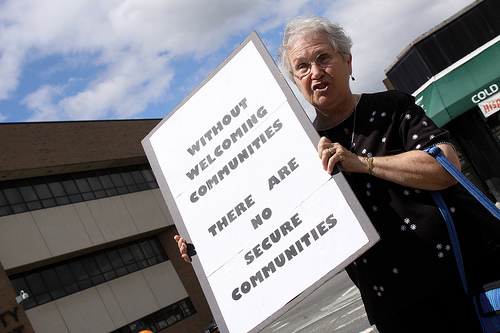
As more and more immigrant families and communities are torn apart by current U.S. detention and deportation policies, it is crucial that that everyone concerned — citizens, community members, friends and family — stand up and speak out on these issues. Great action by the Detention Watch Network for Father’s Day:

Organize a teach-in or educational event about detention in your community

Organize a public action, vigil or march

A recent case from the 11th Circuit affirmed a decision by the Board of Immigration Appeals (BIA) regarding departures from the U.S. and what is not considered a “departure” under the regulations. In 2012, the BIA decided Matter of Arrabally where they held “that an alien who has left and returned to the United States under a grant of advance parole has not made a ‘departure . . . from the United States’ within the meaning of [§ 1182(a)(9)(B)(i)(II)].”
In this recent decision by the 11 Circuit, the issue before them was whether the alien was inadmissible under 8 U.S.C. § 1182(a)(9)(B)(i)(II). Under this statute, an immigrant who is not a lawful permanent resident, has been unlawfully present in the United States for one year or more, and seeks admission to the United States within ten years of the immigrant’s departure or removal from the United States is inadmissible. In this case, The Immigration Judge found that Malpica was removable under § 1182(a)(9)(B)(i)(II) because she had left the United States on July 18, 2003. However, she left pursuant to a grant of advance parole, and was paroled back into the United States on July 31, 2003. Under Matter of Arrabally, her exit pursuant to a grant of advance parole does not qualify as a “departure” within the meaning of § 1182(a)(9)(B)(i)(II) and Malpica is, thus, not inadmissible under this section. Thus, this charge of removability cannot be sustained.

This decision by the 11th Circuit conforms with the BIA decision regarding the removability of an individual when they were admitted back to the U.S. pursuant to a grant of advanced parole. Before Matter of Arrabally had been decided, individuals who left the U.S. when they were removable under this provision were always at risk of being denied entry and removable from the U.S. Now, the BIA’s decision regarding this issue has been affirmed by one of the circuit courts. So long as the other circuit courts continue to decide the issue in this fashion, individuals who have been granted advanced parole, despite being removable under 1182(a)(9)(B)(i)(II), will not have to worry about being denied reentry or being removed under that statute once they have been admitted.

Federal immigration law prohibits the attorney general from letting a noncitizen stay in the United States for any reason if he is convicted of an aggravated felony. The immigration system has held that every conviction for marijuana distribution is such a felony.

In a victory for common sense and fairness, the Supreme Court ruled Tuesday, 7 to 2, that a conviction for marijuana distribution under state law should not in all cases result in automatic deportation.

Adrian Moncrieffe, a Jamaican citizen who arrived legally in the United States in 1984 when he was 3 years old, was ordered deported by an immigration judge because he pleaded guilty in 2008 to possession of 1.3 grams of marijuana with intent to distribute under a Georgia law; that amount is enough to make about three marijuana cigarettes.

AILA recently shared an internal email communication between ICE and other agencies. The title of the attachment in the email is: “Prospective Criminal Apprehension Initiative”. The focus of course is on criminals, but more so, the need to meet certain numbers.

ice-internal-email.png

See the complete email report here: http://www.documentcloud.org/documents/603861-ice-documents.html

Deportation numbers show that the Immigration and Customs Enforcement agency is making good on its promise to focus on the more serious offenders in the undocumented immigrant population.

In a recent case from the Board of Immigration Appeals (BIA), the BIA has held that where an alien fails to appear for a hearing because he has departed the United States, termination of the pending proceedings is not appropriate if the alien received proper notice of the hearing and is removable as charged.

The alien departed the U.S. to Mexico once removal proceedings were instituted against him. His attorney filed a motion with the court to terminate the proceedings, since he left the country. The Department of Homeland Security (DHS) objected to the motion and wanted to proceed in absentia (in absent) of the alien. The immigration judge sided with the alien and the case was terminated. DHS appealed this decision, wherein the BIA sided with DHS and concluded that it was an error to terminate the proceedings.

The BIA reasoned that under the Immigration and Nationality Act (INA), an alien does not need to be physically in the United States for the Immigration Judge to retain jurisdiction over pending proceedings and to conduct an in absentia hearing. In fact, the purpose of in absentia proceedings is to determine whether the DHS can meet its burden to establish that the alien, who did not appear, received proper notice and is removable as charged. If the DHS meets its burden, the Immigration Judge should issue an order of removal; if it cannot, the Immigration Judge should terminate proceedings.

The Fourth of July is a truly special day and means a lot to most American citizens. bit for those that aspire to become American one day, this day means so much more. This is a great article posted on Huff Post today, read more.

When I was an illegal immigrant I celebrated Independence Day as if it were a spiritual holiday. In the charged rhetoric about Latino immigration our national conversation could benefit from re-imagining our unalienable rights. Our values and moral compass would be deepened by viewing the pursuit of life, liberty and justice through the lens of our mutual pursuit of inter-dependence.

The ideal and promise of equality is more than a holy grail. Our founding document galvanizes the aspirations and hopes of immigrants and new citizens. We believe in the promise. Like U.S. citizens, we do not wish for a promised land in some after-life. We expect to be full citizens, inter-dependent with Americans of every stripe in the present, rather than cheap shots for uncourageous hapless leaders.

In an effort to decrease waiting times at our port of entries, U.S. Customs and Border Protection Office of Field Operations (CBP) has recently enacted a pilot program at the International Bridge at the Sault Ste Marie port of entry. The hope of this program is to bring vehicles to the inspection booths in less time.

“Effficacy in movement is paramount to this project’s success. We are always trying to improve the flow of legitimate traffic while enforcing the laws of the United States,” said Patrick Wilson, CBP Sault Ste. Marie Assistant Director.

The Sault Ste. Marie port of entry has a unique design that separates commercial traffic from car traffic, creating an upper and lower plaza. The focus of this project will be on the upper plaza only and will not affect the flow of traffic on the lower plaza.

With the upcoming changes to the I-601 Extreme Hardship Waiver coming this year, allowing applicants to file the Waivers inside the US, we wanted to provide some statistics on the status of cases currently filed overseas.

As you may know,if you are a U.S. citizen or legal permanent resident who is married or engaged to an undocumented immigrant you may think you can easily legalize your spouse. This may be harder than you thought. There are times when your loved one will be deemed “inadmissible” and therefore unable to simply file through you for a green card. In such a situation it may be possible to file an I-601 Application for Waiver of Grounds of Inadmissibility for them. This consists of filing an I-601 immigration form and evidence of hardship.

So what is the current approval rates and processing times for I-601 applications:

The new Policy has been expected, but now it is official. The Border Patrol this month is overhauling its approach on migrants caught illegally crossing the 1,954-mile border that the United States shares with Mexico.

The U.S. Border Patrol has announced a change in the so-called catch-and-release-policy, whereby illegal immigrants from countries other than Mexico, captured at the U.S.- Mexico border were automatically released to await a court hearing. Very few ever show up for their court hearing in reality.

The Border Patrol now feels it has enough of a handle to begin imposing more serious consequences on almost everyone it catches, from areas including Texas’ Rio Grande Valley to San Diego. The “Consequence Delivery System” — a key part of the Border Patrol’s new national strategy to be announced within weeks — relies largely on tools that have been rolled out over the last decade on parts of the border and expanded. It divides border crossers into seven categories, ranging from first-time offenders to people with criminal records.