
Some great news to report for our readers. As you may know the processing of I-601 and I-212 waivers may take a very long time, often resulting is the separation of families.

BORDER%20PIC.jpg

If you are not familiar with Waivers, some foreign nationals may be deemed inadmissible under INA 212(a), which covers bases including unlawful presence, criminal violations, and immigration fraud or misrepresentation. If a foreign national is considered inadmissible, then he or she must obtain a waiver of inadmissibility if they are seeking lawful permanent resident status. Generally, in order to successfully obtain an I-601 waiver, you must prove “extreme hardship” to a qualifying relative is moved to the applicant’s country, and that the qualifying relative can’t remain in the US without the applicant. These hardships are also weighed against “mitigating and aggravating factors.” Currently waiver cases are filed directly with specific US posts around the world resulting in different processing times depending on where the case is filed.

Beginning June 4, 2012, individuals abroad who have applied for certain visas and have been found ineligible by a U.S. Consular Officer, will be able to mail requests to waive certain grounds of inadmissibility directly to a U.S. Citizenship and Immigration Services (USCIS) Lockbox facility. This change affects where individuals abroad, who have been found inadmissible for an immigrant visa or a nonimmigrant K or V visa, must send their waiver applications.
The United States faces intense competition from foreign countries, especially China, who seek to persuade highly skilled citizens who have settled in our country to return home to start businesses there, according to a report released Tuesday by an immigration group led by Mayor Michael R. Bloomberg of New York.

“China is proving the most aggressive and ambitious” among the United States’ economic competitors in seeking to reverse a brain drain and lure back their scientists, engineers and entrepreneurs, the report by Mr. Bloomberg’s group, the Partnership for a New American Economy, found.

The report is broadly critical of the American immigration system, which says is slow, inflexible and not in sync with the nation’s labor needs. “Self-inflicted economic wounds” caused by the system, the report says, discourages foreigners from investing and blocks foreign students with advanced degrees from American universities from remaining here.

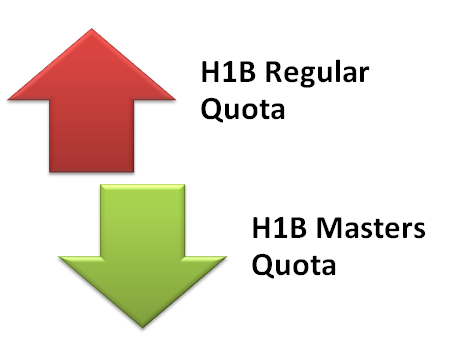
USCIS has received approximately 42,000 H-1B petitions subject to regular-cap (for bachelor’s degree holders) and 16,000 H-1B petitions subject to master-cap (for U.S. advanced degree holders).

Therefore, there are about 23,000 spots available under the regular-cap, and 4,000 spots left under the master-cap. Hurry and file fast.

H1B-visa-2013-Regular-quota-filings-up-Masters-quota-down.png

The reliability and fairness of our immigration system can be evaluated only if the government’s procedures and activities are transparent. The American Immigration Lawyers Association (AILA), the Legal Action Center, and in cooperation with counsel at Steptoe & Johnson LLP, filed a FOIA lawsuit in July 2010 against Department of Homeland Security (DHS) and United States Citizenship and Immigration Services (USCIS) seeking the public release of records concerning agency policies and procedures related to fraud investigations in the H-1B program. There was significant public interest in these records because USCIS’s H-1B practices have caused confusion and concern among U.S. businesses that legitimately depend on temporary foreign workers with specialized knowledge to operate successfully.

On Friday, May 18, 2012, after protracted litigation, DHS and USCIS released unredacted copies of all of the documents sought by AILA. The history of the litigation went as follows:

The complaint brought by AILA alleged that DHS and USCIS violated FOIA when they wrongfully withheld information responsive to two FOIA requests and failed to timely respond to AILA’s requests. The complaint asked the court to enjoin defendants from continuing to withhold information relevant to the requests, to declare the requested records are not exempt from disclosure, and to award any other relief that the court deems just and equitable.

This past April, a decision came down from the Board of Immigration Appeals (BIA) that addressed an important issue concerning Advance Parole for aliens whose unlawful presence for one year or more would trigger the 10 year ban from the U.S. The BIA decision of Matter of Arrabally and Yerrabelly has clarified what counts as a departure under the INA.

The statute that concerns all immigrants who have been in unlawful presence for one year or more is as follows: “Beginning April 1, 1997, a person who has been unlawfully present in the U.S. for one year or more consecutively and again seeks admission is barred for 10 years from the date of such person’s departure or removal from the U.S. INA section 212(a)(9)(B)(i)(II), 8 U.S.C. section 1182(a)(9)(i)(II). In order to trigger the 10-year bar, departure from the U.S. is required, H.R. Conf. Rep. 104-828, 104th Cong., 2d Sess. at 207.”

The (BIA) has clarified the term – departure — in the Matter of Arrabally on April 17, 2012 which will help thousands of immigrant applicants who like Manohar Rao Arrabally have been entangled in the web of statutes, regulations, case law, and agency memorandum.

California’s agency that licenses lawyers wants to admit an illegal immigrant to practice law, an unprecedented request that the state’s highest court decided Wednesday to review.

The State Bar of California certified Sergio C. Garcia after he passed a written test and a moral examination, sending it to the California Supreme Court for routine approval. The bar informed the court at the time that Garcia was undocumented. In a unanimous decision, the state high court ordered the bar to explain why an illegal immigrant should be given a legal license and invited briefs from other parties, opening the door to a potentially heated debate over national immigration policy.

Would the issuance of a license imply that Garcia could be legally employed as an attorney? the court asked. What are the legal and public policy limitations, if any, on an illegal immigrant’s ability to be a lawyer? May other state agencies that license professionals also admit undocumented immigrants? After reviewing the written arguments, the court may hold oral arguments on the case.

Great News for Arts groups coming to perform in the US. U.S. Citizenship and Immigration Services’ (USCIS) Administrative Appeals Office (AAO) issued a binding precedent decision addressing the term “culturally unique” and its significance in the adjudication of P petitions for performing artists and entertainers.

The P visa was created to provide opportunities for aliens primarily performing as a group and not individually to tour in the US. The P visa, like the O1 visa, was also created by the Immigration and Nationality Act of 1990. In addition to covering performing and fine artists, the P1 also covers athletes.

It is important to make clear that the O1 visa (aliens of extraordinary ability) enables individuals to enter and work in their field of specialty, the P visa does not allow individuals to work unless they meet the criteria set in the law. This having been said P visa applicants do not have to have reached the pinnacle of their careers like O1 visa applicants, but P visa applicants do need to be nationally, or internationally known. For example, the group may have performed in other countries, or tour their own country and known to the community appreciating their artistic endeavors.

In an effort to keep more and more students with science and technology backgrounds in the U.S., DHS has added more science, technology, engineering, and math designated degree programs to the list of qualifying student visa extensions.

The recently added STEM designated-degree programs include pharmaceutical sciences, econometrics and quantitative economics. These programs qualify eligible graduates on student visas for an optional practical training (OPT) extension. Generally, OPT allows eligible international students to remain in the United States for up to 12 months while they gain work experience and receive training related to their programs of study. This is great for a student wanting to gain valuable experience in their field while allowing a company a chance to see if this person would be a good fit and worth sponsoring on another work visa.

For students who graduate with a STEM designated degree, they can remain for an additional 17 months on an OPT STEM extension. A student may be eligible for the 17-Month OPT STEM extension under the following circumstances:

Sen. Marco Rubio (R-Fla.) aims to have his alternative to the DREAM Act proposal on paper in the next few weeks and passed by the end of the summer. “Our goal is to pass something this summer in time for kids who plan to go to school this fall,” Rubio press secretary Alex Conant said Monday. Rubio’s proposal would provide non-immigrant visas to illegal immigrants’ children who attend college or serve in the military.

“So just like lots of people come to the United States on work visas or on student visas or tourism visas or whatever, this would be a non-immigrant visa, so it would be a temporary one,” Conant said. “It wouldn’t be permanent. But the intent here is if they choose to remain in the United States permanently that they could apply for permanent residence just like any other immigrant would.”

Rubio’s proposal is an alternative to the Democrat-backed DREAM Act, sponsored by Sen. Dick Durbin (D-Ill.), which would grant legal status to illegal immigrants who came to the U.S. when they were young and then go to college or serve in the military. Conant said Rubio’s legislation would not mean the immigrants would be deported after their visa runs out.

Another attestation to our flawed immigration system, this time the end of a great visa program that was abused to the point of disgrace.

The J-1 Summer Work and Travel program, which allows college students to visit for up to four months, is one of the State Department’s most popular visas. Participation has boomed from about 20,000 in 1996 to a peak of more than 150,000 in 2008.

The visas are issued year-round, since students come from both hemispheres on their summer breaks. They work all over the country, at theme parks in Florida and California, fish factories in Alaska and upscale ski destinations in Colorado and Montana. The influx has been especially overwhelming for some resort towns.