Federal contractors and subcontractors will be required to begin using the U.S. Citizenship and Immigration Services’ EVerify system starting May 21, 2009, to verify their employees’ eligibility to legally work in the United States. The Civilian Agency Acquisition Council and the Defense Acquisition Regulations Council amended the Federal Acquisition Regulation (FAR) to reflect this change.

The new rule implements Executive Order 12989, as amended by President George W. Bush on June 6, 2008, directing federal agencies to require that federal contractors agree to electronically verify the employment eligibility of their employees.

Read more

It is nice to be recognized by the media from time to time. The American Bar Journal is taking an interest in Immigration law, in the February issue they feature our office and the unique H2A practice we operate.

H-2As are used by seasonal agricultural workers, who must prove that (a) they have residences in other countries they have no intention of abandoning, and that (b) they will be in the United States no longer than eight months. The ABA Journal is read by half of the nation’s 1 million lawyers every month. It covers the trends, people and finances of the legal profession from Wall Street to Main Street to Pennsylvania Avenue. We are honored.

Read the article here

Most employers know that they can submit H-1B petitions on behalf of foreign born professionals six months before October 1st , the first day of the federal fiscal year. First day of filing, April 1st is always very stressful. So following all of the instructions, day before April 1st, we law firm submit numerous of H-1B petitions for foreign born professionals, knowing that these would reach the government by, April 1st, the government’s official processing start date. If an H-1B petition is approved, foreign professionals can begin working on October 1.

What no one could have guessed was that in the past 2 years the government would receive over 140,000 such petitions, way too many for them all to be approved. In an event that sent shock waves through the immigration community, twice the available quota of H-1B visas was received by the Immigration Service on the very first day (or first 5 days under last year changes) it accepted petitions.

How does the government decide which employers get their workers on October 1st? Guess what, the answer is by a lottery. The first 65,000 foreign professionals to be randomly chosen get to work in the U.S. The rest get their petitions back in the mail and checks returned as well.

Of course, if these professionals are still interested in returning to the U.S., employers can petition for them again in April of 2010. If they don’t make the cut in 2009, they can try again in 2010, and so on year after year.

So how can one beat the lottery for H1B visas?

There are a few things that prospective H-1B employers and H-1B employees can do to improve the likelihood that the H-1B will be accepted by the USCIS. First, be sure that all of the appropriate documentation is contained in the H-1B petition. Second, be sure that the H-1B is submitted to the USCIS in a timely manner. Third, be sure that the H-1B is sent to the proper USCIS Service Center for adjudication.

Most importantly, H-1B petitioners should consider the possibility of utilizing filing multiple H-1B petitions. Be advised that the USCIS issued guidance concerning multiple H-1Bs. Filing a master’s H-1B and bachelor’s H-1B is not considered a multiple H-1B filing. Many organizations have layers and layers of subsidiaries and affiliates (different organizations with different Employer Identification Numbers) and there appears to be nothing yet in the regulations to preclude the use of those organizations as vehicles for additional H-1Bs. With each H-1B submitted, there is a statistically higher chance of one of the H-1Bs being able to “win” the lottery.

Continue reading

February 2009 Visa Bulletin shows about six months of forward movement in EB2 for India and China. There is a bit of forward movement in some of the EB3 chargeability areas.In the EB2 section China’s moved forward by almost the same amount. The cutoff date for India moved to January 1, 2004. China reflects a cutoff date of January 1, 2005.

In EB3, The cutoff date for countries under the “All Chargeability Areas Except Those Listed,” as well as for the Philippines, is stagnant, at May 1, 2005. India also remained unchanged, at October 15, 2001. The cutoff date for Mexico advanced by almost five months, to April 1, 2003. China also progressed to October 1, 2002.

U.S. Citizenship and Immigration Services (USCIS) has issued a new edition of Form I-9, Employment Eligibility Verification. The new form will take effect on February 2, 2009 and should not be used before that date. Until February 2, employers should continue to use the June 5, 2007 edition of the form. Both editions of the form are available at http://www.uscis.gov/i-9.

Revised Document List

The I-9 form was changed to reflect new employment eligibility verification requirements set forth in a recent regulation that will also take effect on February 2. The regulation revises the list of documents that employers may accept to establish a worker’s identity and employment authorization, known as List A documents. The following documents have been added to List A on the new edition of Form I-9:

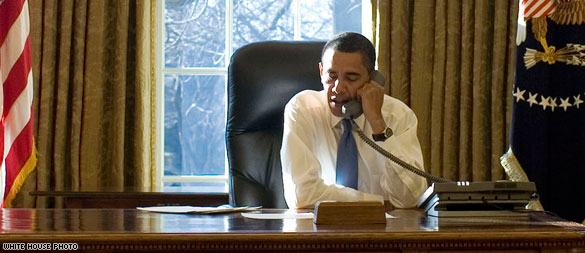
President Obama began his first full day in office by reading the note left by former President Bush. We hope that new President will take a different path in his presidency. We know the economy is important, the war must be addressed, but Immigration reform must be a priority. Can Obama push for Immigration reform?
t1wide_obama_office2_whitehouse.jpg

Even though the U.S. president is considered to be one of the most powerful leaders of the world, no U.S. president can legislate or pass a law (except in emergency circumstances as an interim measure). Enacting law is the task of the legislature, or the U.S. Congress. The president can make his viewpoint known and members of his party in the U.S. Senate or the U.S. House of Representatives may support his position, introducing bills that are often hotly debated. Once the the bill is passed by both the Senate and the House, the president then can sign the bill into law. What Obama can do, is make sure that Immigration reform will remain a key priority until such reform actually is passed. Good Luck President!!!

A national poll suggests that President-elect Barack Obama is more popular than ever despite recent speed bumps on the road to hi s inauguration. Eighty-four percent of those surveyed say they approve of how Obama is handling the presidential transition.

There have been no specific pronouncements of President-Elect Obama’s immigration law and policy position in any major speech. One can try to glean his thought process and his bent of mind from his voting record on immigration matters. A brief summary of the immigration policy and the track record of President-Elect Obama might be encapsulated as follows.

He voted for Comprehensive Immigration Reform (CIR) in July 2007, which attempted to eliminate the labor certification system and provide relief to undocumented workers, who could get in line to become U.S. immigrants, by creating a new Z class of visas. This was not an amnesty or blanket forgiveness. It was a slow process, requiring payment of hefty fines and get behind others waiting for years to obtain permanent U.S. immigration benefits.

Senate Bill 9’s stated purpose is to strengthen the U.S. economy, provide for additional border protection and security, add additional employment enforcement and reform and make clear existing avenues for legal immigration. It simply states that legislation should be enacted to achieve these purposes. This bill does not set forth the details as to how these tasks will be accomplished. The bill does acknowledge the heritage of the United States as a nation of immigrants.

Senate Bill 9 was placed on the Senate’s calendar on January 7, 2009 and will be referred to a Senate Committee for review. This bill simply seems to be an attempt to set a pace and outline basic goals for upcoming immigration legislation. It appears to support the ongoing enforcement efforts, but is not only an enforcement-only approach. We will keep you posted on this and other up coming bills.

The January 2009 Visa Bulletin has few changes over the December 2008 Visa Bulletin in the employment-based (EB) categories. There is slight forward movement in EB2 India and China. The EB3 category had a more significant change for China, and a minor change for India. The EB categories that were current in December 2008 remain current for January 2009.

For EB2, this category remains current for all countries, with the exception of India and China. The cutoff date for India moved forward by one month, and is now July 1, 2003. China moved forward by slightly more than a month, to July 8, 2004.

For EB3, The cutoff date for the “worldwide” category, as well as the Philippines, did not change, but remains at May 1, 2005. The cutoff date for Mexico advanced slightly more than two months, to November 15, 2002. China saw more significant progress, and, for the month of January 2009, has a cutoff date of June 1, 2002. India jumped forward to an October 15, 2001 cutoff date. Under EB3, this category moved forward to March 15, 2003 for all countries. As you can see the demand for visas exceeds the supply, and the visa crisis continues.