More than a million people immigrate to the U.S. every year. Their children — born in the U.S., connected to two cultures — are the focus of a new series at NPR News. It’s called “Immigrants’ Children,” and it’s an occasional look at how they make their mark and the issues that confront them.

While minority representation on TV is nothing short of abysmal, actors of South Asian descent now appear regularly on Lost, ER, Top Chef, The Office, Chuck, House, Numb3rs, Heroes, 30 Rock, Weeds and Parks and Recreation.

Read more…

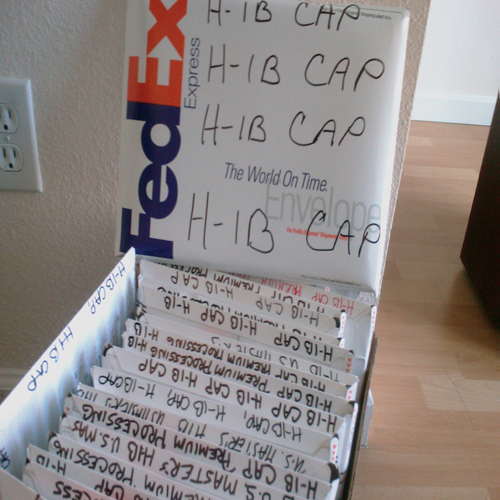
The H1B Frenzy is almost over, see below a sample of what some cases looked like before leaving our office.

It is likely that companies will file fewer H-1B visa applications for Fiscal Year 2010 as a result of the economic recession. However, there will still be demand for the talent and innovation that drives our Nation’s economy. It is unknown how may H-1B professional and specialty occupation visa petitions will be filed tomorrow (when the USCIS begins accepting petitions for FY 2010 tomorrow). It seems almost certain that all 85,000 visas will be utilized before the fiscal year begins on October 1st, 2009.

H1B-CASE1-xx2-small.jpg

H1BCASES2-xx3-small.jpg

The U.S. District Court for the Western District of Washington recently ruled in Ruiz-Diaz v. United States that a U.S. Citizenship and Immigration Services (USCIS) regulation is “unreasonable and impermissible.” A federal judge has struck down a long-standing government policy that made it tougher for religious workers from other countries to remain in the United States. Chief U.S. District Judge Robert Lasnik wrote in an order issued last week that the policy was at odds with the intent of Congress.

Ruiz-Diaz potentially provides religious workers who have filed I-360 petitions with the ability to concurrently file adjustment of status applications. This would allow religious workers whose underlying R visa status is expiring (the R is valid for five years) to remain in the U.S. as adjustment of status applicants. At present, the I-360 approval process is lengthy, after which point the religious worker can file an adjustment application, due to the need to conduct a site investigation on each filing.

Under the Department of Homeland Security’s policy, religious workers who came to the United States on a typical five-year temporary visa were not allowed to file for permanent residency — their green card — until a separate visa petition by their employer had been approved.

Yesterday, the House and Senate delivered yet another signal that the political tide for immigration reform is getting stronger with their introduction of the Development, Relief, and Education for Alien Minors (DREAM) Act [Senate] and the American Dream Act [House]. The bill is a strong bipartisan effort and a sign that the muscle for comprehensive immigration reform is getting stronger on both sides of the aisle as momentum builds.

The bill would would provide a path to U.S. citizenship for undocumented immigrants who entered the country more than five years ago while they were under the age of 16 and who complete two years of college or 2 years of military service. It aims at giving hard-working undocumented children who have always considered America “home” the opportunity to fix their status and contribute to our economy and their communities.

Senate leader Harry Reid (D-NV) praised the bill:

As I am writing this post, my fingers are hurting from the amount of H1B forms I had to sign today. We are almost ready with our cases. Yet, last minute clients are calling in need of our services. Tomorrow will be the last day we accept cases (I promised my wife:))

The H-1B filing season is upon us once again, fiercer than ever. The first day to file cap-subject petitions for FY 2010 is April 1, 2009. In the event that more petitions are received than the annual cap, USCIS will conduct a lottery to pick petitions to be adjudicated. Additionally, employers that are recipients of TARP funding have new requirements when filling out the newly revised Form I-129 and additional attestation requirements for the Labor Condition application.

USCIS has confirmed that if USCIS determines that they have received a sufficient number of cases in the first five business days of April to reach the cap, then the “lottery” will be based on petitions received all five days. USCIS will not begin to issue receipts, however, until a determination is made that sufficient H-1B petitions have been received within the first five business days of April, ending April 7, 2009.

We are reporting constantly on this program. As many of you know, On 23 February the United States Army initiated a pilot test that allows the enlistment of certain legal non citizens with foreign language abilities under the Military Accessions Vital to the National Interest

(MAVNI) Recruitment Pilot. This test is for individuals who live in New York City area.

We now have the official questions the Military is sending as part of the initial screening for MAVNI. In the mean to initiate faster processing of requests, applicants are encouraged to answer the following qualifying questions that will assist in expediting the records.

The Texas Border Sheriff’s Coalition (TBSC) has installed video cameras mostly on private properties on the Texas border and made the streaming video on its BlueServo.net website. People can register on the site for free as “Virtual Texas Deputies” to monitor the live video and anonymously report suspicious activities via e-mail to border sheriffs.

Thousands of people are now virtual Border Patrol agents — and they’re on the lookout for drug smugglers and illegal immigrants.

On Blueservo’s Web site, each camera focuses on an area that’s known for illegal crossing. Next to a real-time view of a grassy meadow is the message: “Look for individuals on foot carrying backpacks.” A shot of a border highway says, “If you see movement from the right to the left, please report this activity.”