Articles Posted in Advance Parole

3209934849_5f5faed197_b
It is our pleasure to bring you the latest in immigration news including recent USCIS announcements, workload updates, tips, and important reminders to avoid delays in application processing or rejections. For more information please contact our office.

Comment Period for Proposed USCIS Form Revisions:

The Department of Homeland Security (DHS) and United States Citizenship and Immigration Services (USCIS) have proposed changes to the following USCIS forms. DHS and USCIS invite the general public, organizations, and federal agencies to submit comments on the proposed revisions by the deadlines outlined below:

flag

On September 9th the Department of State and USCIS jointly announced new procedures that will allow family-based and employment-based applicants stuck in immigrant visa backlogs to apply for an immigrant visa (adjustment of status) before their priority date becomes current and an immigrant visa becomes immediately available to them. These new procedures will be implemented beginning October 1, 2015 as part of President Barack Obama’s executive actions on immigration with the purpose of modernizing and streamlining our legal immigration system for the 21st century. These new changes were introduced in the October Visa Bulletin. 

What is the Visa Bulletin?

The Department of State publishes a monthly report of visa availability known as the ‘Visa Bulletin.’ The Visa Bulletin is essentially a guide to be used by applicants and consular officials denoting visa availability for the issuance of visas at consulates and embassies worldwide. USCIS utilizes the Visa Bulletin to determine whether Form I-485, Application to Register Permanent Residence or Adjust Status, can be accepted for filing and processing. In order to file Form I-485 a prospective immigrant must determine whether a visa is available to them at the time the Form I-485 is filed and at the time Form I-485 is approved. The Department of State and Department of Homeland Security work together to revise the Visa Bulletin on a monthly basis estimating immigrant visa availability for prospective adjustment of status applicants. The DOS allocates available visas by providing visa numbers according to the prospective immigrant’s preference category, country of birth and priority date. This allows distribution of visas for all preference categories. A prospective immigrant’s priority date can be found on Form I-797 Notice of Action or ‘Receipt Notice’ for the petition filed on the applicant’s behalf.

What is a Priority Date?

A priority date is generally defined as the “date when your relative or employer properly filed the immigrant visa petition on your behalf with USCIS.”  For employment-based petitions, “if a labor certification is required to be filed with your immigrant visa petition, the priority date is the date the labor certification application was accepted for processing by the Department of Labor.”

Continue reading

6866225170_c5546bf450

You have Questions, We have your Answers. Here are answers to 5 of your Frequently Asked Questions

In this blog we are answering 5 of your frequently asked questions in detail. Please remember that every case and every story is different and unique. You should not compare your situation to anyone else’s. We hope that our answers will provide you with further guidance on your immigration journey. For any further questions please visit our website or call our office for a free legal consultation. We thank you for your continued trust in our law office.

Q: I am visiting the United States as a tourist from a non-visa waiver country. My duration of stay will expire in approximately 1 month. Is it possible for me to extend my stay in the United States?

A: Yes, it is possible to extend your duration of stay if you plan to remain in the United States for purposes of tourism, leisure, or medical treatment. In order to extend your duration of stay you must file Form I-539. The process can be confusing for some, we recommend that all applicants seek counsel from an accredited legal representative or attorney to guarantee success.  In order to extend your duration of stay, you must be able to provide documentation proving that they have strong ties home including but not limited to: proof of employment, proof of academic enrollment, deed of property ownership, proof of financial obligations, etc. You must also be prepared to provide documented evidence supporting the fact that your stay will be for temporary purposes of tourism and/or leisure including a detailed personal statement establishing the fact that you will be in the United States for a temporary period of time, and will be returning back to your home country at the conclusion of your trip. Lastly, you must provide evidence that you have the sufficient finances to support yourself in the United States. The more evidence you can provide to support your claims, the better chances of your application being approved.

Continue reading

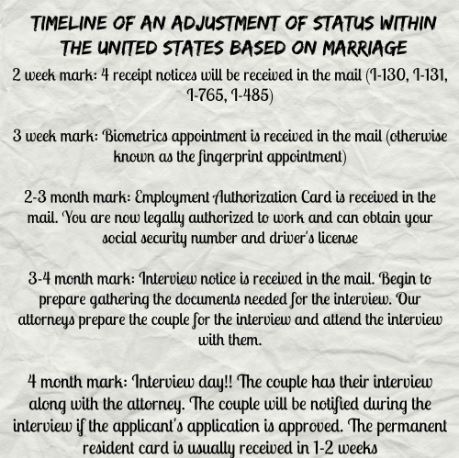
Prospective clients often ask our law office, how long does the adjustment of status to permanent resident usually take? At what point can I legally work in the United States? How can I obtain my social security number and driver’s license? When can I travel internationally?

Below is an approximate timeline that will give you an idea on what the current wait times are for the adjustment of status process, based on your marriage to a U.S. Citizen:

Capture
During the 2-3 month mark, the applicant will receive a very important document in the mail, known as the employment authorization card. The employment authorization card is important for a variety of reasons:

10012162166_cde34d427e_z
The Department of State (DOS) and U.S. Customs and Border Protection (CBP) have announced a joint initiative, in response to the technical problems the U.S. Department of State’s Consular Consolidated Database (CCD)—responsible for the issuance of visas—has been experiencing. These technical problems have had a significant impact on the department’s ability to process nonimmigrant visas, causing worldwide delays. Together the DOS and CBP will waive the visa requirements for nonimmigrant visa applicants seeking admission into the United States on a case by case basis. Applicants who have applied for but have not been issued non-immigrant visas, due to such delays, may request consideration from DOS and CBP for special travel permission to the United States under the following conditions:

The applicant’s travel to the United States must be considered urgent, involving a bona fide emergency, such as urgent humanitarian travel and life and death situations, or a situation that impacts U.S. national interests. DOS and CBP will respond to such requests via their joint task force teams. Travel permission that has been approved will be facilitated by the DOS.

All individuals requesting emergency travel are required to have a pending visa application with the DOS that has not been approved as a result of delays caused by the Consular Consolidated Database.

8011274458_95ea582e2f_z

By Marie Puertollano, Esq. 

Form 1-131 Application for Travel Document is the form you must file with immigration when requesting a travel authorization from USCIS. This Application for Travel Document can be requested in various situations for the purposes of obtaining a reentry permit or advance parole.

One of the most common Form I-131 application’s we file within our practice, is the advance parole for an applicant who has a pending I-485 Application to Register Permanent Residence or Adjust Status application for a green card. While awaiting a decision from USCIS about the green card application, the applicant CANNOT leave the United States without a travel authorization issued by USCIS, or the application will be considered abandoned.  Given that many applicants need to travel while their green card application is pending, we submit an I-485 Application to Register Permanent Residence or Adjust Status application along with Form I-131 Application for Travel Document to request an advance parole which will allow the green card applicant to travel once it is issued by USCIS, approximately 60-90 days after being filed. The applicant need not pay any fees for the I-131 Application for Travel Document, if it was submitted with an I-485 Application to Register Permanent Residence or Adjust Status, to obtain a green card.