Articles Posted in Free Consultation

10859690426_d0bde482b7_z

What is the purpose of filing an I-751 Petition for Removal of Conditions?

If you were granted conditional residence based on your marriage to a U.S. Citizen or legal permanent resident, you must file the I-751 Petition to Remove Conditions on your Permanent Resident Card. This form allows the conditional resident to request USCIS to remove the conditions on their residence. For conditional residents who are still married, the petition must be filed jointly with your spouse through with you gained your conditional residence.

But what happens when the marriage ends in divorce, annulment, or other factors?

The conditional resident can request for waiver of the joint filing requirement IF any of the following applies:

  1. You entered the marriage in good faith but your spouse died
  2. You entered the marriage in good faith, but the marriage was later terminated through divorce or annulment
  3. You entered the marriage in good faith, but were battered or the victim of ‘extreme cruelty’ by the spouse with whom you gained conditional residence
  4. Your conditional resident parent entered the marriage in good faith, but you have been battered or the victim of ‘extreme cruelty’ by your parent’s U.S. Citizen or permanent resident spouse or by your conditional resident parent or
  5. The termination of your conditional resident status and removal would result in extreme hardship 

For the purposes of this segment, we will focus on what must be proven when a conditional resident’s marriage ends in divorce or annulment.

Continue reading

By Marie Puertollano, Esq.

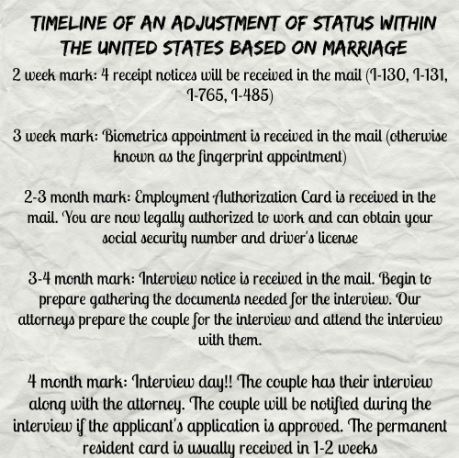
When an immigrant gets married with a U.S citizen, the immigrant can obtain a green card either through consular processing, if the immigrant is outside the United States, or through adjustment of status within the United States, if the immigrant entered with a visa and is present in the United States. This article will focus on the interview that will be the last step of the adjustment of status and will take place at a USCIS field office within the United States.

Why are we interviewed?

9677860781_8f985a6513
On August 23rd the Chief of the Department of State’s Immigrant Visa Control and Reporting Division, Charles Oppenheim, made an important announcement regarding significant changes made to the EB-5 preference category. Oppenheim announced that for the first time since the creation of the EB-5 category, the EB-5 preference category would become unavailable to Chinese applicants for the 2014 fiscal years.

What does it mean for the EB-5 preference category to become unavailable? 

What the department means is that, the maximum number of EB-5 immigrant visas available to Chinese applicants for the fiscal year of 2014 have already been issued. Thus, there are no longer any available EB-5 immigrant visas for the 2014 fiscal year.

6263551146_8d70e2698c_z
You are a H-1B visa holder from a country with a backlogged employment based category and you are currently living and working in the United States. You have applied for permanent residence through your employer. You have been working for the same employer for years and have extensive experience in your field. Despite all of these factors, you are still waiting in line for your priority date to become current, and what’s more, your spouse has not been eligible to apply for their employment authorization due to the restrictions on their visa. What, if anything, can be done to receive your permanent resident card sooner?

Thousands of immigrants are in the same hypothetical situation. Comprehensive Immigration Reform is necessary not just for undocumented immigrants living in the United States, but also for such specialty workers who regularly contribute to our economy and society, but are stuck in limbo awaiting their permanent residency. Comprehensive immigration reform is also necessary because specialty occupation workers often run out of their H-1B status while they are in line for their priority date to become current. If the specialty occupation worker is married, chances are their spouse has not had the opportunity or privilege to legally obtain employment while the primary applicant has been in line waiting to adjust their status. Many immigrants who have found themselves in similar situations fear international travel due to the risk they may run in not being able to return to the United States.

Bypassing the Quota System

4097699785_073813177e_z
Much of the deliberation surrounding immigration reform has largely occurred behind closed doors, despite pressure from the booming immigrant population in the United States to become more transparent. In a much anticipated June speech, President Obama announced that he would be utilizing executive action to bring about comprehensive immigration reform in response to Congress’ inaction.

For the most part, the administration has remained mum about the process and the proposals that have been laid out on the table.

Here’s what we do know about what is happening behind closed doors:

289992273_ece293954b_z

By Lupe Lopez

Francis was excited.  As a student of holistic nutrition, he had excelled and the school he was attending wanted him to stay on to work with them as an assistant instructor. The school Francis was attending in the M1 status was pleased with his depth of knowledge and his ability to work with people.  They wanted to find a way for Francis to work with them and to help other students achieve the level of knowledge that he had and so willingly shared.  Also, Francis not only had previous education, he had years of experience in a community clinic using holistic nutrition and alternative medicine to heal people of serious ailments.

Francis called us excitedly looking to learn about his employment options.  The school had not ever offered optional practical training (OPT) to their foreign students and although they are SEVIS certified (schools are required to be certified to enroll foreign students), they were not able to answer the questions that Francis had relative to employment authorization.

It is a pleasure for our law office to introduce associate attorney Nadia Galash to our readers

Bio: Nanadiadia Galash has been a California licensed attorney since 2009 and has been practicing immigration law since 2011. Nadia Galash specializes in adjustment of status/permanent resident processing; citizenship; deportation and removal proceedings before Immigration Court; law and motion work; and immigration appeals. Her practice although limited also includes criminal defense and family law matters.

Nadia is a Russian attorney with 3 children. In her free time she enjoys yoga and meditation.

4461975475_0327d6d722_z

Secretary of the Department of Homeland Security Jeh Johnson

On June 05, 2014 the Secretary of the Department of Homeland Security, Jeh Johnson, announced the renewal process for enrollment in the program, Deferred Action for Childhood Arrivals (DACA). Effective immediately, USCIS will begin to accept renewal requests, as well as initial requests from DACA applicants who have not yet benefitted from the program. The first DACA applications that were approved by USCIS will expire in September 2014. USCIS recommends that initial DACA approved applicants file their renewal requests approximately 4 months before their current DACA expires. Following the renewal process, these applicants will be able to remain lawfully present in the United States and apply for an employment authorization valid for up to 2 years. According to USCIS, more than 560,000 applicants have already been approved under DACA since April of this year. The Secretary of the Department of Homeland Security, Jeh Johnson, added that children who crossed the border illegally with their parent(s) in search of a better life, should not be punished as adult offenders and should thus receive different treatment, given that they did not have a choice in the matter.

NOTE: Individuals who have not resided continuously within the United States since June 15, 2007 are not eligible to apply for DACA.