11697209523_14b9817f14
Since the year 1990, USCIS has administered the Immigrant Investor Program, better known as ‘EB-5’. The program was first launched by Congress with the goal of expanding the U.S. economy by encouraging job creation and capital investment through foreign investment. It has now become known for its Regional Center pilot immigration program, with the purpose of allocating certain EB-5 visas to investors in Regional Centers designated by USCIS. These Regional Centers support the goal of economic growth. Recently, the program director of the pilot immigration program, Nicholas Colucci, held a conference with EB-5 stakeholders assuring them that he is committed to revitalizing the program. This action by Colucci signals an interest in making the EB-5 process more efficient, transparent, and resourceful. First a brief overview of the EB-5 visa process:

General Guidelines:

  • Under section 203 (b)(5) of the Immigration and Nationality Act also known as INA, 10,000 EB-5 immigrant visas are allocated per year

By Ekaterina Powell, Esq.

In the recent case Caremax Inc. v. Holder (N.D. Cal., 2014), the court granted the government’s motion for summary judgment and ruled that Public Relations Specialist offered to the beneficiary is not an H-1B caliber position.

The H-1B employer and the employee filed a declaratory relief action asking the District Court to determine whether the position of PR Specialist offered to the beneficiary constitutes a “specialty occupation” under the INA and if so whether the employee meets the qualifications to be employed in the position.

5486338003_22baa78f1b_z

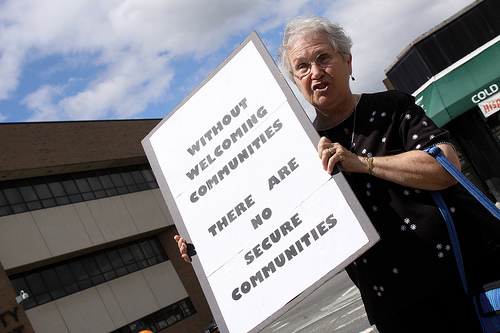
The Law Offices of Jacob J. Sapochnick bring you the most recent developments in immigration policy at the judiciary level. We express our concern at the hesitation the federal judicial system and our federal legislative system has shown in their reluctance to address the issue of comprehensive immigration reform. Recently, two appeals have come before the Supreme Court from the towns of Hazelton in Pennsylvania and Farmers Branch in Texas. These appeals are important because they signal a conflict that has arisen time and time again between state and federal judiciaries regarding immigration policy. Such conflict can only be rectified by calling upon the national government to take a firm stance in clearly delineating immigration law, ultimately setting a precedent for state judiciaries to follow.

Fortunately, the federal government has begun to feel the pressure from the people in hearing such appeals. These appeals clearly bring the issue of comprehensive immigration reform to the forefront specifically in the cases of City of Hazelton v. Lozano (13-531) and City of Farmers Branch V. Villas at Parkside Partners (13-516).

City of Hazelton v. Lozano and City of Farmers Branch v. Villas at Parkside Partners

On April 17th, USCIS announced that premium processing for H-1B petitions, subject to the fiscal cap year of 2015, would begin on April 28, including petitions qualifying for the advanced degree exemption. Additionally, USCIS guarantees a processing time of 15 calendar days for such petitions.

By Yingfei Zhou, Esq.

Q: How can I apply for EB-5 visa?

A: There are two requirements on foreign investors seeking a green card. First, you must invest sufficient funds in an approved project of your choice. Second, ten new full-time jobs must be created as a direct result of that investment. The investment must be either in a new business or an existing business and the investment will spur either a 40% increase in net worth or employees of the existing business.

Beginning September of 2012, USCIS began granting what is known as deferred action to children who arrived to the United States before reaching the age of 16, having met other various requirements. Eligible deferred action applicants received an employment authorization good for a period of up to two years from USCIS. Applicants who applied for deferred action early on are now facing the expiration of their initial two year employment authorization granted to them by USCIS. Due to this, a DACA renewal process is currently underway, giving qualified applicants the opportunity to request and extend their deferred action, in order to avoid unlawful presence in the United States and be able to continue their employment. Details regarding the renewal process will be released in late May 2014, at which time USCIS anticipates that Form I-821D will be used for the dual purpose of initiating DACA petitions and renewal requests. All DACA applicants who wish to file a renewal request must wait until USCIS releases the new form designated for that purpose. Applicants that wish to file an initial deferred action request and not a renewal, can continue to file using the form currently available.

6885947248_6bb1a6d849
On April 07, 2014, in a much awaited public announcement, U.S. Citizenship and Immigration Services announced that it had already reached the statutory cap of H-1B petitions allotted for the 2015 fiscal year. According to the announcement, on the first five days USCIS began to count H-1B petitions, it was already flooded with more than 65,000 of regular cap H-1B petitions and more than 20,000 H-1B petitions qualifying for the advanced degree exemption.

USCIS began accepting H-1B petitions subject to the 2015 fiscal year cap on April 01, 2014. The H1-B visa program is utilized by U.S. businesses seeking to employ foreign workers in what are known as ‘specialty occupations’. Specialty occupations are those that necessitate highly specialized knowledge, whether theoretical or practical, as stated on the USCIS website. Specialty occupations include but are not limited to scientists, doctors, mathematicians, or engineers.

According to the announcement, USCIS completed initial intakes for all filings received by the filing deadline (April 07, 2014), and will conduct a random computer generated selection process also known as a lottery system of selection. Under this process, USCIS will select the number of petitions necessary to fulfill the 65,000 visa cap limit for the general category, and the 20,000 visa cap limit under the advanced degree exemption. Those whose cap-based petitions are not selected will have their cases rejected and filing fees returned to them. As stated by USCIS, the computer generated selection process will consider the advanced degree exemption first. Advanced degree petitions that are not accepted through the initial lottery system will be subjected to the lottery system for the general category.

Now that the H-1B cases have been filed, we are anxiously waiting to get the news from USCIS on the cap count.

Last year, USCIS announced on April 5 that it received approximately 124,000 H-1B petitions during the five day filing period, including petitions filed for the advanced degree exemption. Then, on April 7, 2013, USCIS used a computer-generated random selection process (commonly known as a “lottery”) to select for processing a sufficient number of petitions needed to meet the caps of 65,000 for the general category and 20,000 under the advanced degree exemption limit.

What to Expect This Year

Our office receives many inquiries from start-up companies that want to hire employees under H-1B visa. As the H-1B season has begun, we would like to provide our readers with the updates and important considerations for this category of H-1B visas.

The following article was prepared by attorney Ekaterina Powell from our office and was featured as the cover article in VOICE, the American Immigration Lawyers Association publication.

Start-up Companies Still Fight for H-1Bs

Recently, the Israeli government approved a proposal from Interior Minister Gideon Sa’ar for American investors who wish to visit Israel on a more frequent basis.  It is a new arrangement that is part of a recent program to allow Israelis seeking to invest in the U.S. and who wish to stay to develop and manage their business, will be given similar special conditions.

The approval of the plan by the American embassy in Israel is conditioned on the granting of benefits to American investors in Israel. According to this plan, Israeli investors who obtain approval from American authorities will be offered a fast track entry into the US and will receive E2 visas that allow stays of up to two years in the United States.

This new plan will be implemented within the next few months, after several legislative amendments required to complete it are made. Following the approval of the plan, Sa’ar said that the “US is a major economic partner for Israel. It is the main source of foreign investment in Israel and is at the same time one of the major destinations for investments by Israelis. Investor visas constitute another stage in the United States-Israel Free Trade Agreement and will promote the economic cooperation of the two countries”, Sa’ar added.