Articles Posted in EAD

8425492426_e2cd908a3f_z

As previously reported, the STEM Optional Practical Training (OPT) rule that had been in place since 2008, was invalidated following a court order requesting the Department of Homeland Security to issue a new replacement rule. The court gave the DHS until February 12, 2016 to come up with a replacement rule in order for the STEM OPT program to continue. In order for a new replacement rule to be put in place, DHS was required to publish the final rule 60 days before its effective date, according to procedural rules established by the Administrative Procedures Act. In order to meet such a deadline, DHS needed to have published the final rule by December 14, 2015 in order for it to be enforced by the February deadline. Luckily, the government filed a motion to extend the stay of the court order—to May 10, 2016, thus requesting an additional 90 days for the government to implement a final rule. In order for the motion to be successful the government must establish that exceptional circumstances warrant such relief to be given. The government has argued that there is an unprecedented amount of comments that cannot be reviewed and analyzed by the February deadline. During the comment period, DHS received over 50,000 comments that it must review, revise, and finally publish a final rule. The court is not expected to rule on the motion until early 2016. Meanwhile the plaintiffs of the original suit have filed an appeal before the DC Circuit Court arguing that the OPT program is not within the authority of the DHS.

If the motion is unsuccessful, the government may file a motion at the district court level or request a stay of the court’s injunction at the circuit court level. In any case, those affected should be aware that the government still has several avenues through which relief may be granted: (1) the Judge may grant the government its requested 90-day delay on the present motion; (2) the Judge may later grant a complete stay pending appeal of the injunction; or (3) the DC Circuit may stay the Judge’s injunction while it considers the merits of her rulings in the underlying case.  CIS has not yet released official correspondence explaining whether students affected will be granted a STEM extension after the February deadline.

For more information please contact us.

3021087753_980feb0669_z

Yesterday night, in a 2-1 vote the United States Fifth Circuit Court of Appeals voted to uphold the lower court’s decision in Texas v. United States blocking President Obama’s extended Deferred Action for Childhood Arrivals (DACA) and Deferred Action for Parents of Americans and Lawful Permanent Residents (DAPA) programs from going into effect.

The expanded DACA and new DAPA provisions were announced November of last year as part of Obama’s executive actions on immigration giving eligible undocumented individuals a legal status in the United States. The expanded DACA program would have made millions of law abiding undocumented aliens (with no criminal history) eligible for employment authorization and social security benefits. To qualify, expanded DACA applicants would need to provide documented evidence proving their continuous physical presence in the United States from January 1, 2010 onward. In exchange, the United States government would recognize these individuals as law abiding residents and safeguard them against deportation. The move was significant since it would mean that undocumented individuals would no longer need to live on the fringes of society. By granting these individuals an immigration classification, insurance companies would become accessible to them for the first time ever.

Similarly, Obama’s DAPA program would have extended eligibility of deferred action to parents of US Citizens and Lawful Permanent Residents born or or before November 20, 2014 the date of the DAPA program’s announcement. As part of the application process, DAPA applicants would be required to undergo extensive background checks and prove continuous residence since January 1, 2010 among other provisions. Click here for more information on DAPA.

Continue reading

1

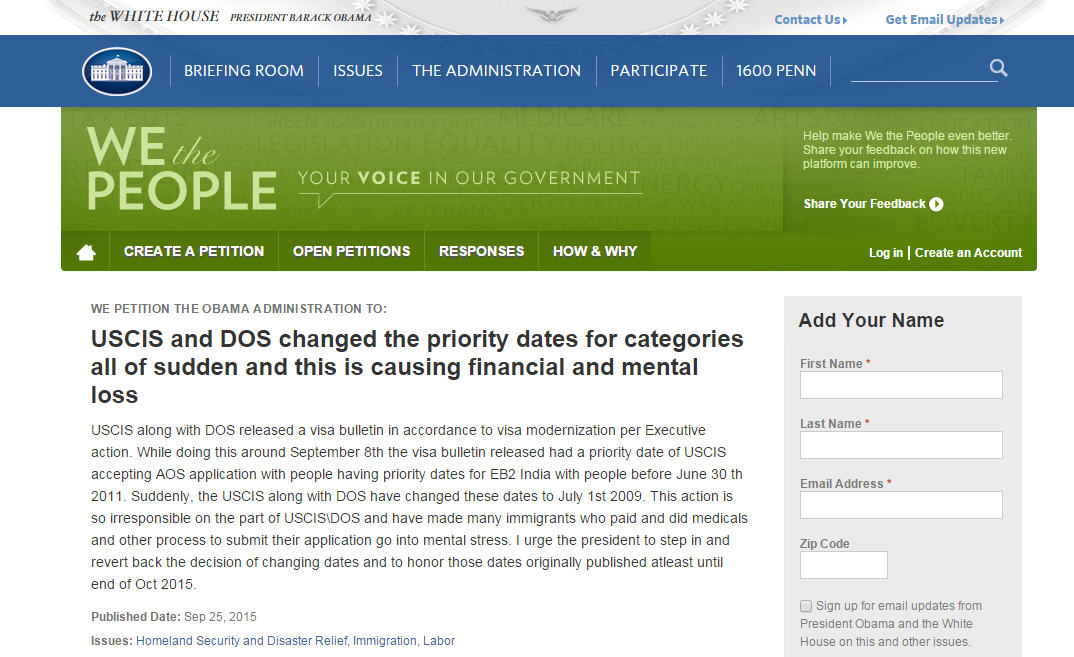
Last week, we reported to our readers that on September 25th the Department of State and USCIS re-issued the October Visa Bulletin and changed the date of filing chart drastically, rolling back the ‘Dates of Filing’ for heavily used visa categories, including employment based and family-sponsored petitions. The American Immigration Lawyers Association, along with policymakers, and immigration advocates, are urging Congress, the White House, USCIS, and Department of State to restore the initial dates of filing that were authorized and released on September 9th 2015 with the October Visa Bulletin.

If you would like to pressure the government to honor the initial dates of filing, released on September 9th, we invite you to sign the White House petition by clicking here. We must hold the government accountable for their actions by advocating for the restoration of the initial dates of filing. With the release of the October Visa Bulletin, the DOS introduced a dual chart system for the first time in history which included a new ‘date of filing’ chart. The new date of filing chart would have allowed thousands of foreign nationals to file their adjustment of status and employment authorization applications, before a visa became available to them. This action was made by the DOS in an effort to modernize and streamline our immigration system as part of President Obama’s Executive Actions on Immigration announced on November 20th of last year. Due to the recent drastic changes that have been made to the date of filing chart, we encourage you to become involved by signing the petition or writing to your local Congressman/Congresswoman. Thousands of foreign workers and family members of foreign nationals have been impacted by the recent changes, given that the majority of applicants who would have been eligible to file for their green card applications and employment authorization cards, will no longer be able to do so. They must continue to wait until their priority date becomes current on the date of filing chart.

Continue reading

5574911181_eb81bfcce7_z

USCIS has published statistics concerning the volume of Deferred Action of Childhood Arrivals applications received from fiscal year 2012 through fiscal year 2015.

In fiscal year 2012 USCIS accepted 152,424 applications out of 157,819 applications received. That year, 5,395 applications were rejected during initial intake. 1,685 applications were approved during case review at the end of the fiscal year. Remaining applications either remained pending at the end of the fiscal year or were denied.

In fiscal year 2013 USCIS accepted 427,601 applications out of 443,953 applications received. That year, 16,352 applications were rejected during initial intake. 471,196 applications were approved during case review at the end of the fiscal year. Remaining applications either remained pending at the end of the fiscal year or were denied.

In fiscal year 2014 USCIS accepted 238,895 applications out of 263,784 applications received. That year, 24,889 applications were rejected during initial intake. 158,188 applications were approved during case review at the end of the fiscal year. Remaining applications either remained pending at the end of the fiscal year or were denied.

Continue reading

DACA Update

On July 15, 2015 USCIS announced that it mistakenly issued approximately 2,100 employment authorization cards to DACA recipients that were printed with a three-year validity period instead of a two-year period, following a court injunction prohibiting USCIS from doing so.

To correct the error, USCIS sent these recipients a notice of intent to terminate deferred action and employment authorization. The letter describes that the three year employment authorization cards received after the injunction, are no longer valid and must be returned to USCIS by July 27, 2015 due to a federal court order Texas v. United States, which prohibits USCIS from issuing deferred action for a period exceeding 2 years.

USCIS also issued about 500 three year EAD cards to DACA applicants who were approved before the court order was enforced. These cards had been returned to USCIS as undeliverable by the United States Postal Service and were re-mailed to an updated address after the injunction went in effect on February 16, 2015. Due to this, these 3-year EAD cards are also deemed invalid.

Continue reading