Articles Posted in Start-Up Immigration

new-piktochart_843_6a8b1e61f05cd05ee2ec4001cba0911607cca5e7

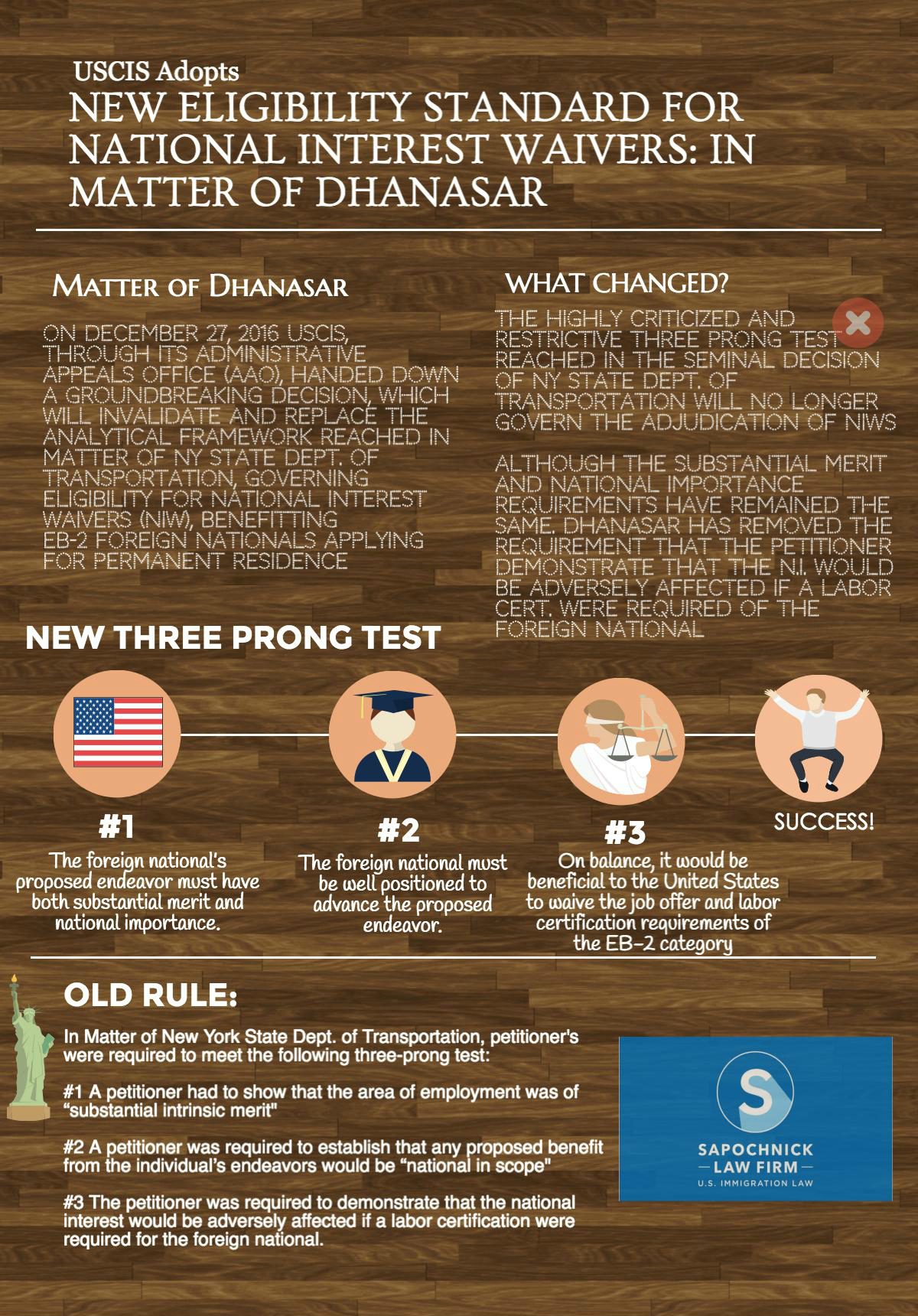
On December 27, 2016 in Matter of Dhanasar, 26 I&N Dec. 884 (AAO 2016) the USCIS Administrative Appeals Office (AAO) handed down a groundbreaking decision which has changed the analytical framework for determining eligibility of national interest waivers. This new decision will affect foreign nationals who are pursuing a green card based on employment in the EB-2 category, and who are eligible for a “national interest waiver.”

The national interest waiver is a discretionary waiver of the job offer and labor certification requirement made possible by subparagraph (A) of section 203(b)(2) of the Immigration and Nationality Act. This section of the INA states that the Secretary may, when it deems it to be in the national interest of the United States, “waive the requirements of subparagraph (A) that an alien’s services in the sciences, arts, professions, or business be sought by an employer in the United States.”  In addition to meeting a three-prong test of eligibility, to obtain a national interest waiver, the foreign national must be a member of a profession holding advanced degrees or their equivalent or prove that “because of their exceptional ability in the sciences, arts, or business they will substantially benefit prospectively the national economy, cultural or educational interests, or welfare of the United States.”

Without this discretionary waiver, EB-2 applications must be accompanied by a labor certification and their employer must go through the process of advertising the position to prove to immigration that there are no other applicants who are qualified, willing, and able to fill the position that the foreign national is expected to fill. Employers must also meet prevailing wage requirements as established by law. Establishing the national interest waiver in other words made it easier for qualifying foreign nationals in the EB-2 category to skip the job offer and labor certification requirement, streamlining their path to permanent residency.

Continue reading

6085347780_1a6eba300c_z

Today August 26, 2016 we bring entrepreneurs around the world exciting news regarding a new measure USCIS plans to implement designed to benefit entrepreneurs of startup companies. USCIS has announced a new proposal that will make it easier for certain foreign entrepreneurs to receive temporary permission to enter the United States, also known as ‘parole,’ for the purpose of starting or scaling their start-up business enterprise in the United States.

The rule has been referred to as the ‘International Entrepreneur Rule’ which will give the Department of Homeland Security (DHS) the authority to expand discretionary statutory parole status to eligible entrepreneurs of startup companies, who can demonstrate that the startup enterprise they are interested in creating, has a substantial potential to yield rapid growth, and job creation in the United States.

Under this new rule, DHS would be able to grant parole on a case-by-case basis to eligible entrepreneurs of startup companies who can demonstrate the following:

  • At least a 15 percent ownership interest in the startup enterprise in question;
  • That they take on an active and central role in the startup enterprise’s operations;
  • That the startup enterprise has been formed in the United States within the past three years; and
  • That the startup enterprise has proven to yield a substantial and demonstrated potential for rapid business growth and job creation as evidenced by:
  1. Having received a significant investment of capital of at least $345,000 from certain qualified U.S. investors that have a proven track record of success i.e. showing established records of successful investments;
  2. Having received significant awards or grants of at least $100,000 from federal, state, or local government entities; or
  3. By partially satisfying one or both of the above criteria, in addition to presenting other reliable and compelling evidence to show the startup entity’s substantial potential for rapid growth and job creation in the United States;

Continue reading