Articles Posted in Nonimmigrant Visas

10012162166_cde34d427e_z
The Department of State (DOS) and U.S. Customs and Border Protection (CBP) have announced a joint initiative, in response to the technical problems the U.S. Department of State’s Consular Consolidated Database (CCD)—responsible for the issuance of visas—has been experiencing. These technical problems have had a significant impact on the department’s ability to process nonimmigrant visas, causing worldwide delays. Together the DOS and CBP will waive the visa requirements for nonimmigrant visa applicants seeking admission into the United States on a case by case basis. Applicants who have applied for but have not been issued non-immigrant visas, due to such delays, may request consideration from DOS and CBP for special travel permission to the United States under the following conditions:

The applicant’s travel to the United States must be considered urgent, involving a bona fide emergency, such as urgent humanitarian travel and life and death situations, or a situation that impacts U.S. national interests. DOS and CBP will respond to such requests via their joint task force teams. Travel permission that has been approved will be facilitated by the DOS.

All individuals requesting emergency travel are required to have a pending visa application with the DOS that has not been approved as a result of delays caused by the Consular Consolidated Database.

13903388778_5b429faf5c_z
The American Immigration Lawyers Association (AILA) recently released a report helping foreign workers and their employers answer the following question:

Where on the ETA Form 9089 should the employer enter the foreign worker’s qualifications which show that the foreign worker does in fact meet the minimum requirements to perform the job opportunity?

Such qualifications may include certifications, licensures, or other credentials. The ETA Form is meant to establish whether the foreign worker meets all of the qualifications for the job opportunity offered by their employer. The employer must list the foreign worker’s specific skills and other requirements for the job opportunity they are offering in Section H Question 14, and demonstrate that they in fact possess those skills and or requirements by utilizing Section K, and listing the foreign worker’s qualifications to prove that the requirements for the specified job opportunity listed in Section H have been met. Examples of qualifications that can be provided in Section K are; bar admissions, medical residency, ordination, professional exams, medical board certifications, professional certifications, teaching certificates, university or professional coursework, professional insurance, etc. For each special skill or requirement listed in Section H, the employer must demonstrate its respective business necessity. If not listed elsewhere, the qualifications to fulfill the job opportunity should be entered after all jobs held in the past three years are listed under Question 9 Job Details. It is advised that Question Numbers one to eight requesting job information can be left blank.

8639003804_2bd2b5f140_z

By Ekaterina Powell, Esq.

On July 11, 2014, USCIS released new guidance on adjudication of H-1B petitions for nursing occupations, which superseded the previous USCIS Memorandum of Johnny Williams, INS Office of Field Operations, Guidance on Adjudication of H-1B Petitions filed on Behalf of Nurses, HQISD 70/6.2.8-P (November 27, 2002).

New USCIS guidance has the “Policy” designation, which means that it has to be followed by USCIS adjudicators.

9069182796_e8643422b5_z (2)
Want to track the status of a pending case? Moving to a new address? Want to report a problem with your case? No problem!

Our loyal fans and followers, who communicate with us through our various social networking sites and web page, often ask our law office how they can track or check the status of their pending case, how they can change their address with USCIS while their case is pending, and how they can report a problem with their case. These are all very important questions. It is imperative that all applicants who have pending cases with USCIS regularly check the status of their case both online and by calling USCIS. There are several ways to communicate with USCIS. You can check the status of your pending case online, submit a service request online, schedule an Infopass online, and submit a change of address online.  For time sensitive issues, applicants should check the status of their pending case or report a problem with their pending case by calling USCIS directly by phone. In this post we will walk you through the steps of how to communicate with USCIS via all of these methods.

How to check the status of a case online:

8468738832_c2ce784c7c_z
For many, the American Dream has proved to be far beyond reach. This is the story of our client, Rafael Espinoza Iniguez, as told by his wife, Maria:

Life, Liberty, and the Pursuit of Happiness are birth rights our government sought to protect through a living breathing document known as the Declaration of Independence. These “inalienable rights” have been challenged at times by life’s many obstacles and ironies, some of which are brought about by medical conditions, which are alleviated by research institutions, by economic difficulties, which are alleviated by charities, by social pressures, which are alleviated by advocacy groups, and by injustices, which are alleviated by our government; the institution which has declared to protect our rights as citizens. Our government was designed in its inception as a progressive government by our founding fathers, who were dissatisfied by the tyranny of monarchies, and created this nation with the goal of establishing a just government, recognizing the rights all human beings are entitled to. And so, in pursuing our own life, liberty, and happiness, this is our family challenge:

To present our story in order to advocate for comprehensive immigration reform that will allow entrance into the United States for law abiding and deserving individuals, who have come to this great nation in the pursuit of that same happiness our founding fathers were in search of. 

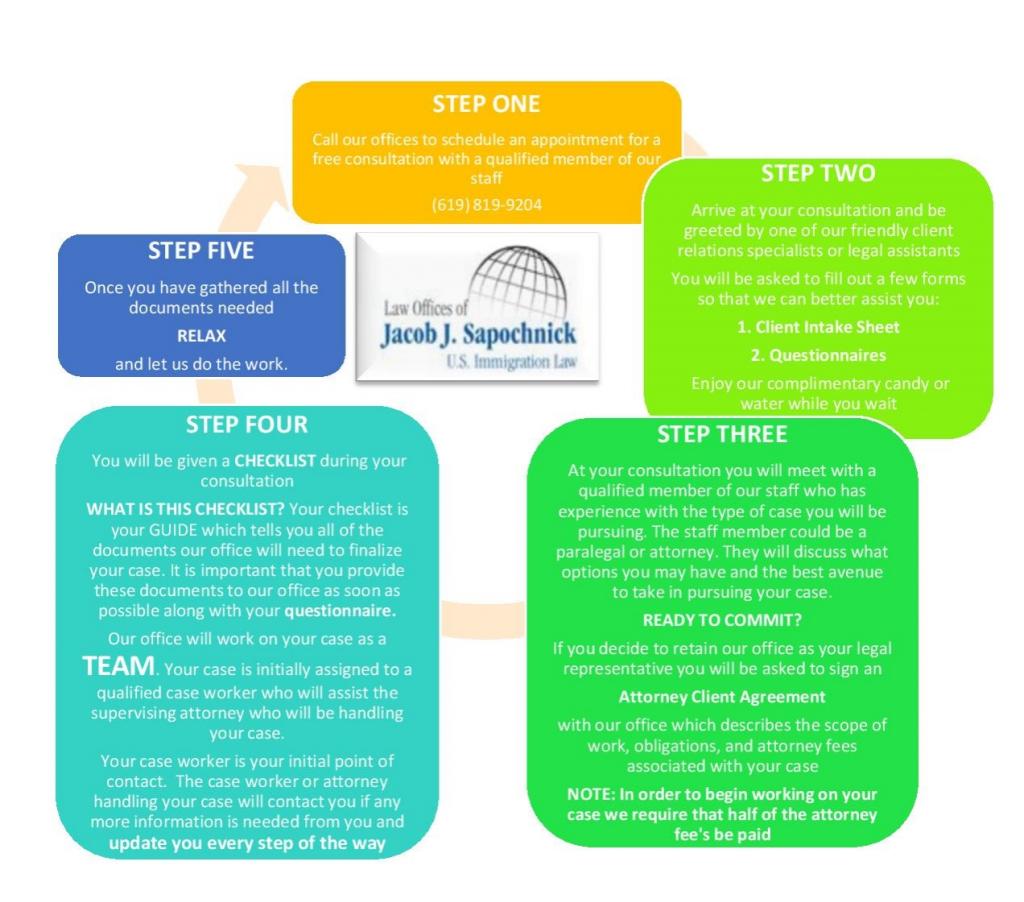
First time visitor at our office? We have you covered on what to expect during your first visit in 5 easy steps.

Newclientsblog_zps6445fb31
Our Clients

Since every client’s case is truly unique, it is important for our potential clients to attend their free consultation, where a member from our team will explain the appropriate legal process that should be taken, in addition to answering all of their questions and concerns. Please contact our office to schedule an appointment for an in person or phone consultation at (619) 819-9204 or Toll Free at 1-866-488-1554

open for business
On Tuesday May 6, 2014 the Department of Homeland Security announced the publication of two newly proposed rules designed with the purpose of attracting and retaining highly skilled foreign workers. Both initiatives seek to advance the United States economy and improve competitiveness by recruiting the best and brightest professionals the world has to offer.

Proposal to Extend Employment Authorization to Spouses of Certain H-1B Workers:

The first proposal allows spouses of certain H-1B workers to extend their employment authorization in the United States

8151523059_4914681262_z
On May 01, 2014 U.S. Customs and Border Protection launched a revamped webpage which allows non-immigrant visitors entering the United States, to access their I-94 arrival/departure record and their arrival/departure history. Prior to April 2013, non-immigrant visitors could only access and retrieve their recent I-94 arrival/departure record.

The overwhelmingly positive response to the agency’s I-94 arrival/departure online retrieval tool was what prompted the agency to also offer online travel history retrievals on the website. With this new electronic tool, travelers can access both their I-94 arrival/departure record and their arrival/departure history up to five years back from the date of their request. According to U.S. Customs and Border Protection, non-immigrant travelers may no longer need to file a Freedom of Information Act request (FOIA) to obtain their arrival/departure history thanks to this new electronic tool.

Through the website’s new function, travelers will be able to retrieve their I-94 record number, as well as their five year travel history, by entering only their name, date of birth, and passport information. It is important to note that this travel information will not reflect any changes of status, extensions of stay, or adjustments of status granted by USCIS.

On April 17th, USCIS announced that premium processing for H-1B petitions, subject to the fiscal cap year of 2015, would begin on April 28, including petitions qualifying for the advanced degree exemption. Additionally, USCIS guarantees a processing time of 15 calendar days for such petitions.

Beginning September of 2012, USCIS began granting what is known as deferred action to children who arrived to the United States before reaching the age of 16, having met other various requirements. Eligible deferred action applicants received an employment authorization good for a period of up to two years from USCIS. Applicants who applied for deferred action early on are now facing the expiration of their initial two year employment authorization granted to them by USCIS. Due to this, a DACA renewal process is currently underway, giving qualified applicants the opportunity to request and extend their deferred action, in order to avoid unlawful presence in the United States and be able to continue their employment. Details regarding the renewal process will be released in late May 2014, at which time USCIS anticipates that Form I-821D will be used for the dual purpose of initiating DACA petitions and renewal requests. All DACA applicants who wish to file a renewal request must wait until USCIS releases the new form designated for that purpose. Applicants that wish to file an initial deferred action request and not a renewal, can continue to file using the form currently available.