Articles Posted in Deferred Action and DREAM Act Students

Senate

On October 20, 2015 Democrats in the Senate successfully blocked the Republican backed bill S. 2146: Stop Sanctuary Policies and Protect Americans Act from moving forward with a vote of 54-45. At its core, the bill aimed to hold sanctuary jurisdictions accountable for noncompliance of federal orders including detainment of undocumented immigrants, increasing penalties for individuals caught re-entering the United States after their removal, and providing protection to state and local law enforcement officials cooperating with federal law enforcement officials. The bill was introduced by Republicans after an act of violence took the life of a San Franciscan woman at the hands of an alleged undocumented immigrant with a felony record, who had also been the subject of multiple removals. Public outcry ensued after the city sheriff released the perpetrator despite a federal immigration detainment order. According to Republicans, San Francisco is one of hundreds of sanctuary cities that refuse to comply with federal immigration orders to facilitate the detainment and removal of undocumented immigrants.

Among its provisions, the bill aimed to crackdown on so called ‘sanctuary cities’ notorious for their noncompliance by limiting government funding. By cutting necessary funding, Republicans hoped that this would force cooperation between local law enforcement officials and federal law enforcement officials including ICE officers. Republican Senator Vitter who introduced the bill, argued that the violent crime that occurred in San Francisco was just one example highlighting the magnitude of compliance concerns. According to Vitter, ‘sanctuary cities’ like San Francisco have repeatedly refused to comply with orders of detainment issued by the Department of Homeland Security. Prior to the vote, the White House had warned Senate Republicans that if the bill did pass with the 60 necessary votes, they could expect the President to veto the bill. Although the bill was criticized by Democrats for stereotyping undocumented immigrants and making sweeping allegations against the undocumented immigrant community, the bill raises serious competence and compliance concerns.

Continue reading

1

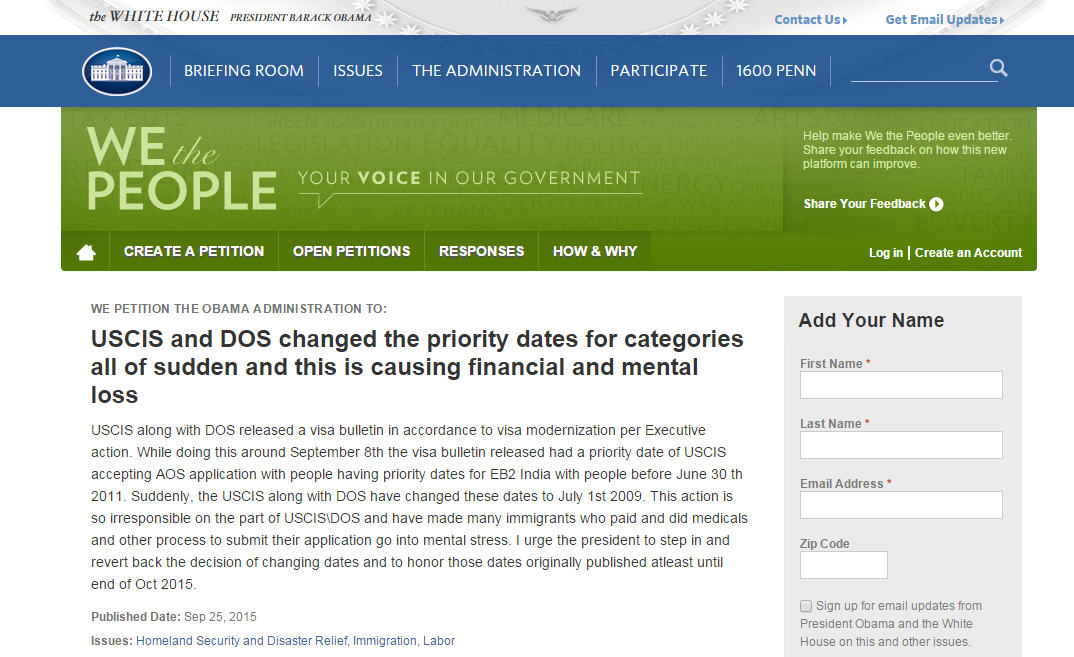
Last week, we reported to our readers that on September 25th the Department of State and USCIS re-issued the October Visa Bulletin and changed the date of filing chart drastically, rolling back the ‘Dates of Filing’ for heavily used visa categories, including employment based and family-sponsored petitions. The American Immigration Lawyers Association, along with policymakers, and immigration advocates, are urging Congress, the White House, USCIS, and Department of State to restore the initial dates of filing that were authorized and released on September 9th 2015 with the October Visa Bulletin.

If you would like to pressure the government to honor the initial dates of filing, released on September 9th, we invite you to sign the White House petition by clicking here. We must hold the government accountable for their actions by advocating for the restoration of the initial dates of filing. With the release of the October Visa Bulletin, the DOS introduced a dual chart system for the first time in history which included a new ‘date of filing’ chart. The new date of filing chart would have allowed thousands of foreign nationals to file their adjustment of status and employment authorization applications, before a visa became available to them. This action was made by the DOS in an effort to modernize and streamline our immigration system as part of President Obama’s Executive Actions on Immigration announced on November 20th of last year. Due to the recent drastic changes that have been made to the date of filing chart, we encourage you to become involved by signing the petition or writing to your local Congressman/Congresswoman. Thousands of foreign workers and family members of foreign nationals have been impacted by the recent changes, given that the majority of applicants who would have been eligible to file for their green card applications and employment authorization cards, will no longer be able to do so. They must continue to wait until their priority date becomes current on the date of filing chart.

Continue reading

5574911181_eb81bfcce7_z

USCIS has published statistics concerning the volume of Deferred Action of Childhood Arrivals applications received from fiscal year 2012 through fiscal year 2015.

In fiscal year 2012 USCIS accepted 152,424 applications out of 157,819 applications received. That year, 5,395 applications were rejected during initial intake. 1,685 applications were approved during case review at the end of the fiscal year. Remaining applications either remained pending at the end of the fiscal year or were denied.

In fiscal year 2013 USCIS accepted 427,601 applications out of 443,953 applications received. That year, 16,352 applications were rejected during initial intake. 471,196 applications were approved during case review at the end of the fiscal year. Remaining applications either remained pending at the end of the fiscal year or were denied.

In fiscal year 2014 USCIS accepted 238,895 applications out of 263,784 applications received. That year, 24,889 applications were rejected during initial intake. 158,188 applications were approved during case review at the end of the fiscal year. Remaining applications either remained pending at the end of the fiscal year or were denied.

Continue reading

DACA Update

On July 15, 2015 USCIS announced that it mistakenly issued approximately 2,100 employment authorization cards to DACA recipients that were printed with a three-year validity period instead of a two-year period, following a court injunction prohibiting USCIS from doing so.

To correct the error, USCIS sent these recipients a notice of intent to terminate deferred action and employment authorization. The letter describes that the three year employment authorization cards received after the injunction, are no longer valid and must be returned to USCIS by July 27, 2015 due to a federal court order Texas v. United States, which prohibits USCIS from issuing deferred action for a period exceeding 2 years.

USCIS also issued about 500 three year EAD cards to DACA applicants who were approved before the court order was enforced. These cards had been returned to USCIS as undeliverable by the United States Postal Service and were re-mailed to an updated address after the injunction went in effect on February 16, 2015. Due to this, these 3-year EAD cards are also deemed invalid.

Continue reading

5484331458_0d2bc4f7e9

On Monday May 4, 2015 a federal appeals court heard arguments in the case Joseph Arpaio v. Barack Obama, et al, U.S. Court of Appeals for the District of Columbia Circuit, No. 14-5325. Back in November of 2014 in the wake of Obama’s executive actions, Maricopa County Sheriff Joe Arpaio sued President Barack Obama shortly after he announced his executive order extending Deferred Action for Childhood Arrivals (DACA) and Deferred Action for Parents of Americans and Lawful Permanent Residents (DAPA)—a plan which would shield over 4.7 million eligible undocumented immigrants from removal proceedings. Arpaio along with 26 other states sued the administration claiming that the president had overstepped his executive power and that the executive actions were unconstitutional.

In the Arpaio case, two out of the three presiding judges from the District of Columbia ruled that Arpaio did not have standing to sue and that he had failed to prove that he was directly harmed by the executive actions. Arpaio had previously claimed that the executive actions directly harmed him because criminals would not be deported as a result of Obama’s executive actions. However, eligible recipients of extended DACA and DAPA would be required to demonstrate strong ties to the United States by providing documented evidence of their continuous residence in the United States, have no criminal record, and/or have U.S. born children.

Continue reading

15558329057_8c48b4a564_z

By Ekaterina Powell, Esq.

As you may already know from reading our prior posts, on February 16, 2015, the Texas federal district court issued a preliminary injunction to stop expanded DACA (expanded guidance concerning deferred action for certain individuals who came to the United States as children) and DAPA (deferred action for the parents of U.S. citizens or lawful permanent residents) from going into effect. The case is known as Texas v. United States, the Lawsuit Challenging DAPA and DACA Expansion.

The decision came only two days before USCIS was supposed to start accepting applications under Expanded DACA guidelines issued by the President in November of 2014.

The decision was a surprise to many of those who were prepared to file their applications on February 18, 2015.

What does the preliminary injunction mean?

Since the preliminary injunction was issued, USCIS cannot accept any applications under expanded DACA, which was supposed to become effective on February 18, 2015, and will not implement its policies regarding DAPA, the program that was set to start in May 2015.

This injunction also affects those who file for extension of their existing DACA. Since expanded DACA rules have not become effective, USCIS will continue to issue employment authorization documents (EADs) for renewals of existing DACA requests for two-year periods as opposed to three-year periods.

What is a solution?

After the preliminary injunction was issued, the federal government promised to appeal the decision of the Texas district court in the Court of Appeals. However, an appeal can take a considerable amount of time and delay can detrimentally harm millions of families, causing unnecessary deportation for those who could qualify under expanded DACA and DAPA relief.

In order to prevent the harm caused by the appeal’s delays, today, February 23, 2015, the federal government filed an emergency expedited motion to stay,  pending appeal, its February 16 Order.

Continue reading

7526267232_2e3a502b29_z

On Monday February 16, 2015 Judge Andrew Hanen of the U.S. District Court in Brownsville, Texas issued a preliminary injunction temporarily preventing President Obama’s executive actions on immigration (expanded deferred action) from going forward. The injunction does not make Obama’s executive actions illegal, however it does prevent the Obama administration from implementing expanded DACA and DAPA until the courts determine the constitutionality of the executive actions announced by Obama on November 20, 2014. According to Judge Hanen, 26 states brought the suit to his attention, all of whom he determined had standing to sue. A lawsuit against President Obama is expected to move its way through the court system in the coming months. The injunction claims that the President lacks the constitutional power to make such executive actions. As a result of the injunction, USCIS will no longer accept applications for DACA on February 18th the date that USCIS initially announced it would begin to accept applications. Additionally, plans to accept requests for DAPA will be suspended until further notice.

The Secretary of Homeland Security, Jeh Johnson announced that while he disagreed with the injunction, that the Department of Homeland Security would be forced to comply. Nevertheless, the Department of Justice plans to appeal on behalf of the federal government.

Will the court order affect existing DACA?

Father Holding Daughter's Hand

What is DAPA? DAPA allows eligible applicants, who do not have a criminal history, and who do not otherwise pose a threat to national security, to request deferred action having met certain conditions for a period of up to three years. DAPA allows parents of US Citizen or lawful permanent resident children to be granted an employment authorization card. DAPA also safeguards individuals against deportation.

To qualify under Obama’s executive action, an undocumented parent of a U.S. Citizen or lawful permanent resident child must meet the following conditions:

  • The applicant must have lived in the United States continuously since January 01, 2010 to the present
  • The applicant must have had a son or daughter on November 20, 2014 irrespective of age or marital status, who is either a US Citizen or lawful permanent resident
  • The applicant must have been physically present in the United States as of November 20, 2014, the date of President Obama’s announcement
  • The applicant must have had no lawful status on November 20, 2014, the date of President Obama’s announcement
  • The applicant must have been physically present in the United States on November 20, 2014 and at the time of requesting DAPA with USCIS

If you have been convicted of any of the following you may not be eligible for DAPA:

  • Felony
  • Misdemeanor or three or more other misdemeanors
  • Are a threat to national security
  • Are an enforcement priority for removal

When Can I Apply? Currently applications are not being accepted, however USCIS has indicated that requests for DAPA will begin to be accepted in mid to late May of this year.

Continue reading

8773532901_136d842e0b_z

USCIS has recently announced that applications for expanded Deferred Action for Childhood Arrivals (DACA) will begin to be accepted starting February 18, 2015. Applications will not be accepted before this date. President Obama has expanded the population eligible for DACA to unlawful individuals who entered the country before the age of 16, and who have continuously resided in the United States since January 01, 2010 regardless of their current age. The expanded DACA program will grant eligible applicant’s an employment authorization card and ‘deferred action status’ that is good for a period of three years. Previously, DACA was only good for a period of two years, had stricter age and residency requirements.

How is the Expanded DACA program different?

  • The initial DACA program was only good for a period of two years, now it is good for a period of three years
  • Expanded DACA removes the requirement that an individual must have been born before June 15, 1981
  • Expanded DACA removes the requirement that individuals must have resided in the United States continuously since June 15, 2007, the new marker is January 01, 2010

To be eligible for the Expanded DACA program you must meet the following requirements:

  • You must have entered the United States before 16 years of age
  • You must have continuously resided in the United States since January 01, 2010, up to the present time
  • You can be of any current age to benefit
  • You must have had no lawful status on June 15, 2012
  • Were physically present in the United States on June 15, 2012, and at the time of making your request for consideration of deferred action with USCIS
  • Are currently in school, have graduated or obtained a certificate of completion from high school, have obtained a General Education Development (GED) certificate, or are an honorably discharged veteran of the U.S. armed forces or U.S. Coast Guard; and
  • Have not been convicted of a felony, significant misdemeanor or three or more other misdemeanors, and do not otherwise pose a threat to national security or public safety.

Continue reading

15191703100_08df063499_z

This week the White House announced that President Obama’s executive action on immigration could stimulate California’s economy as much as $27.5 billion. According to White House advisor Cecilia Muñoz, the executive action could potentially increase wages and productivity in one of the country’s largest economies. The White House Council of Economic Advisors estimates the executive action could raise the country’s gross domestic product up to a figure of $90 billion over the next ten years.

This is not surprising given that Obama’s executive action will allow eligible applicant’s to receive employment authorization cards, thereby expanding the labor force and allowing immigrants the flexibility of seeking new jobs that were not previously available to them. A young, vibrant, employed immigrant population is sure to spark innovation and entrepreneurship at a rate that was not previously available with the restrictive DACA program. The order will allow some foreign workers who are occupying high-skilled fields the ability to benefit from employment portability while awaiting their permanent residency status. The acquisition of work permits will allow eligible immigrants to obtain better paying jobs. Higher incomes would result in greater expenditures and therefore a higher amount of taxes paid.

An analysis published by the President’s Council of Economic Advisers (CEA) revealed that the executive actions on immigration would boost economic output by an estimated figure of 0.4 to 0.9 percent over a period of time years, increasing the country’s GDP from $90 billion to $210 billion by 2024. By allowing foreign workers to come out of the shadows, the productivity of the American workforce as a whole will increase, since workers will find jobs that are best suited to their skills and potential. The White House contends that this labor shift will also allow native workers to specialize in jobs that are best suited to their skills and ability. Altogether, greater productivity and a larger workforce will result in: wage increases for all workers, increased tax revenues, and a reduction of the deficit. The analysis makes the claim that the executive actions would not adversely affect employment options for native workers. To read the complete publication please click here.

Continue reading