Articles Posted in E2 Investor Visas

inese

It is our pleasure to introduce our readers to our senior case manager, Inese Grate, one of the original members of the Law Offices of Jacob J. Sapochnick. Ms. Grate joined our firm when there were merely 2 employees working at the office. In addition to studying law in Latvia, Ms. Grate received her Master’s in Law in International Business Transactions from Temple University Beasley School of Law and attended the International Law Institute at Georgetown University School of Law.

Ms. Grate specializes in business and family immigration, corporate, international trade, and international transactions. Ms. Grate provides consultation on strategic investment in the United States for international clients and corporations to identify potential opportunities, create jobs, and develop successful businesses. Throughout her professional career, she has taken several international and U.S. startup companies from an ideation phase through to establishment and registration. Ms. Grate is unique in that she thinks outside of the box and is able to utilize her professional network of financial advisors, real estate brokers, investors and industry experts to assist our clients based on their unique needs. Throughout her career, Ms. Grate has helped numerous corporations and individuals in the United States as well as several European countries in various immigration/business related issues. Ms. Grate evaluates business plans and works on all related immigration issues including visas, licenses, and permits. She has helped in numerous cases in this area for the past few years.

Continue reading

Yingfei Photo
It is our pleasure to introduce our readers to Associate Attorney Yingfei Zhou, Esq who joined our firm in 2012. Attorney Zhou is an active member of the California State Bar, the New York State Bar, and the American Immigration Lawyers Association (AILA).

Ms. Zhou practices primarily on employment-based and investment-based immigration law. Ms. Zhou has experience in various aspects of business immigration, including employment-based permanent residence and nonimmigrant visas, as well as marriage-based immigration and citizenship matters. Specifically, she has provided counsel to clients in relation to employment in specialty occupation, nonimmigrant NAFTA professional visa, individuals with extraordinary ability and achievements, nonimmigrant trainee or special education exchange visitor visa, religious worker visa, E-2 treaty investor visa, waivers, applications for adjustment of status, employment certification (PERM) applications, motion to reopen/reconsider, re-entry permit, visa interviews, as well as extensive EB-5 investment immigration work.

Ms. Zhou received her Bachelor’s degree in Law (LL.B) from Zhejiang University, one of the top universities in China. She graduated with distinguished honor awarded by the Department of Education of Zhejiang Province and was editor-in-chief of law review of her law school in China. She subsequently attended Thomas Jefferson School of Law in San Diego, CA and obtained her Master’s degree in Law (LL.M.). Prior to joining the Law Offices of Jacob J. Sapochnick, Ms. Zhou has practiced in China for two years.

16229407771_5725895b69_z
The Department of State has issued an alert announcing that as of June 26, 2015 all visa issuing US embassies and consulates are now able to continue visa processing. Staff at US consulates and embassies were able to work over the weekend and resolve backlogs which are expected to be eliminated this week.

As you may recall between the time period of June 9, 2015 to June 19, 2014, 335,000 visas were unable to be printed due to clearance and technological issues. Of those 335,000 visas, approximately 300,000 have now been printed.

Consulates and embassies worldwide are now scheduling visa interviews and issuing non-immigrant and immigrant visas.

431619249_af1d2a3929_z


President Obama’s executive action announced on November 20, 2014 fell short in many ways than one for many people residing in the United States—both legally and illegally. Though a marginalized few have been allowed to come out of the shadows, some of the world’s best and brightest have been completely ignored by the executive action altogether. The United States would be quite a different place without our hard working immigrant population and without our foreign born innovators, movers, and shakers.

Obama’s announcement on November 20th notably left out any indication that the creation of a more expedient and efficient system would be considered— through which highly skilled and highly capable foreign workers would be able to more easily attain permanent residency and visas. Industry leaders in areas such as the Silicon Valley, seeking to employ such highly skilled and highly capable foreign workers for their startup companies, have expressed their concerns, forming groups such as FWD.us, albeit with the knowledge that Congress must act in order for an all-encompassing solution to be reached.

Though Obama’s speech shed little light on the topic, a memorandum released by the U.S. Department of Homeland Security following the speech is much more informative. The memorandum announces that inventors, researchers, and founders of start-up enterprises who do not qualify for a national interest waiver, but who have been awarded what is considered ‘substantial’ financing by a U.S. investor OR who ‘hold the promise of innovation and job creation through the development of new technologies or the pursuit of cutting edge research’ can attain parole authority under section 212(d)(5) of the INA,6 on a case-by-case basis after being assessed by the DHS. Possessing parole in this situation would authorize extraordinary inventors, researchers, or start-up entrepreneurs to temporarily conduct their research or development of innovative ideas or their business while in the United States.

Continue reading

The 27th AILA (American Immigration Lawyer Association) California Chapter Conference was held between the 13th and 15th of November 2014 at San Jose, California. Attorney Yingei Zhou, Esq. was in attendance on behalf of our law firm. The conference concentrated on several trending topics such as status of comprehensive immigration reform, consular processing and updates with border posts in Mexico and Canada, driver’s licenses for undocumented workers, unaccompanied alien children (UAC), H-1B/L-1A/O-1/EB-1 adjudications, federal litigation, and advanced family immigration issues, as well as staple subjects like evidentiary issues in removal proceedings and PERM applications.

This article provides you several important updates from the conference addressed at the conference, especially the government open forums with AILA practitioners, USCIS representatives, CBP officers, and San Francisco Asylum officers.

In the following weeks, we will post more articles to address the trends on each specific visa applications and immigration proceedings discussed in the conference.

Continue reading

5939055612_9312bc2cab_z

Start-up entrepreneurs who wish to come to the U.S. to open a business have several immigration options. It is important that you understand the requirements, benefits, and downsides of each and choose the one that best fits your situation.

B-1 Business Visa

A B-1 business visa is a non-immigrant visa issued to those who wish to enter the United States for a business purposes. You are eligible to apply for a B-1 visa if you want to consult with a business associates, participate in a required medical clerkship without any remuneration, embark on independent research which does not benefit any U.S. institution, or participate in educational, professional scientific or business conventions, seminars, or conferences.

The validity period for this visa will differ depending on your country of origin. If you are seeking entry into the U.S. for business reasons for the first time, you may be allowed to stay in the U.S. for a period of time long enough to enable you conduct your business. However, the maximum period of stay allowed per visit is 6 months. But you can also apply for another six-month extension if you needed. A B-1 visa can be used for multiple entries in so far as it has not expired.

There are certain tasks that you are and are not allowed to do while in the U.S. on a B-1 visa. If you are in the U.S. with a B-1 visa, you are allowed to negotiate business, discuss planned purchases or investment, solicit sales or investment, attend and participate fully in meetings, conduct business research, and interview and hire staff. You are not allowed to look for employment, run a business in the U.S., or to take part in sporting and entertainment events as a professional.

Continue reading

6263551146_8d70e2698c_z
You are a H-1B visa holder from a country with a backlogged employment based category and you are currently living and working in the United States. You have applied for permanent residence through your employer. You have been working for the same employer for years and have extensive experience in your field. Despite all of these factors, you are still waiting in line for your priority date to become current, and what’s more, your spouse has not been eligible to apply for their employment authorization due to the restrictions on their visa. What, if anything, can be done to receive your permanent resident card sooner?

Thousands of immigrants are in the same hypothetical situation. Comprehensive Immigration Reform is necessary not just for undocumented immigrants living in the United States, but also for such specialty workers who regularly contribute to our economy and society, but are stuck in limbo awaiting their permanent residency. Comprehensive immigration reform is also necessary because specialty occupation workers often run out of their H-1B status while they are in line for their priority date to become current. If the specialty occupation worker is married, chances are their spouse has not had the opportunity or privilege to legally obtain employment while the primary applicant has been in line waiting to adjust their status. Many immigrants who have found themselves in similar situations fear international travel due to the risk they may run in not being able to return to the United States.

Bypassing the Quota System

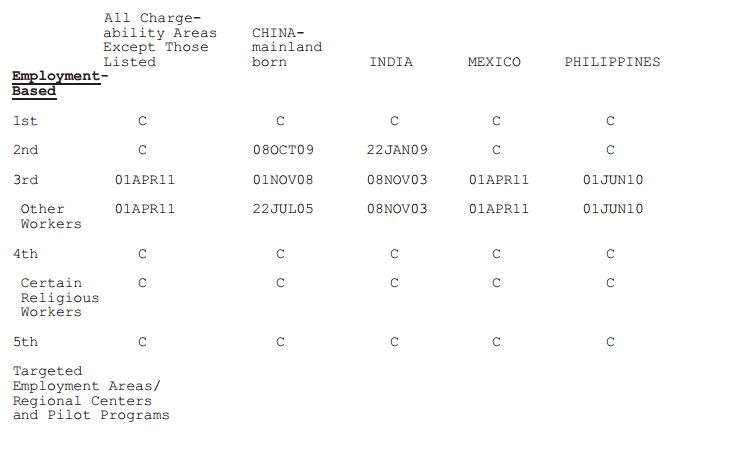
Great news for Indian Nationals! The United States Department of State Bureau of Consular Affairs recently released the August Visa Bulletin which summarizes the availability of immigrant visas for the month of August for family-based and employment-based visa preferences. According to Section 201 of the Immigration and Nationality Act (INA) the allotted number of employment based visas is set to at least 140,000 visas for the worldwide level. The Visa Bulletin for August indicates that the second preference EB-2 employment-based category for India has advanced by 5 years when compared to the Visa Bulletin in the recent year. The advancement of the employment based second preference EB-2 category provides Indian nationals whose Form I-140 Immigrant Petition for Alien Worker was approved and whose priority dates fall before January 22nd of 2009, with the opportunity to apply for their green cards beginning August 2014. For priority dates related to family sponsored preferences and diversity immigrant categories please click here to read the August Visa Bulletin. For legal questions please contact our office and we would be happy to help.

Employment Based

Many clients often ask me what is considered to be a Marginal Investment for E2 visa Purposes? The marginality of a business is also one of the most common reasons why investors in smaller businesses are denied E-2 visas. For this reason, investors must pay very close attention to this factor.

In order to qualify for E-2 status, the applicant must not have invested in a marginal enterprise solely for the purpose of earning a living for him– or herself and his or her family. A marginal business is an enterprise that does not have a present or future capacity to generate more than enough income to provide a minimal living for the treaty investor and his or her family. However, an enterprise that does not have the capacity to generate such income but does have a present or future capacity to make a significant economic contribution is not considered a marginal enterprise.

In other words, if the investment will indirectly expand job opportunities locally or otherwise have a positive significant impact on the local economy, the applicant may still qualify even though the income from the business may only be enough to sustain the investor and his or her family. For example, an investment that indirectly creates jobs in the local area should be able to establish that it is not a marginal business.

Many of our Blog readers have been inquiring about the status of the E2 visa for Israel. The following is a recent update by the American Immigration Lawyers Association.

In June 2012, President Obama signed into law legislation that adds Israel to the list of countries eligible for E-2 treaty investor visas. Regrettably, Israel nationals remain ineligible for E-2 status because of delays in implementing the new law.

The legislation is conditioned upon visa reciprocity. Accordingly, once the new law was sent to the State Department for implementation, teams from the United States and Israel began discussing the terms and conditions that E-2 status will provide to Israeli investors in the U.S. and examining whether Israel will provide similar terms and conditions for American investors in Israel. These discussions were complicated by the fact that Israeli immigration law does not currently provide for a visa category that parallels the E-2 visa.