Articles Posted in Work Visas

FullSizeRender-1
For this month’s staff spotlight, we invite you to learn more about our legal technical writer Suzanne Andersen.

Suzanne Andersen is a new addition to our firm, having joined in 2016. Ms. Andersen holds a Master of Laws degree from California Western School of Law, in addition to her law degree from the University of Southern Denmark.  Prior to attending law school, Ms. Andersen obtained a degree in Psychology from the University of Copenhagen.

Before joining the Law Offices of Jacob Sapochnick, Ms. Andersen practiced law in Denmark for three years in the area of litigation, white collar crime and immigration, contract law, tort law and human rights.

30123014595_45dba6b128_z

Image Courtesy of Gage Skidmore

USCIS has finally announced that the H-1B computer-generated lottery took place on April 11, 2017 to select the necessary petitions to meet the 65,000 visa cap for beneficiaries holding a U.S. bachelor’s degree or its equivalent, as well as the 20,000 visa cap for beneficiaries holding a U.S. master’s degree or higher. The announcement came a bit late this H-1B season, but you can now rest easy knowing that it has taken place.   On April 7th USCIS announced that they had received more than enough H-1B petitions necessary for fiscal year 2018. USCIS disclosed that they received 199,000 H-1B petitions this filing year.

Our office has already received 3 receipt notices for the “master’s” cap or advanced degree exemption, and 2 receipt notices for the “regular” cap as of April 20, 2017. 

USCIS will continue to mail receipt notices for selected petitions throughout the month of April and likely into early May.

If your petitioner has been monitoring their bank account closely and has noticed that the filing fees were charged to the account, that means that the H-1B petition was selected. Even if the filing fees have not yet been charged to your petitioner’s bank account, that does not mean that your H-1B petition was not selected. H-1B applicants must wait patiently to see if they were selected in this year’s lottery.

USCIS will not begin mailing out unselected H-1B petitions until around June through the month of July.

As a reminder, premium processing for H-1B petitions was suspended on March 3rd and will remain suspended for up to six months.

Continue reading

5662167733_75de6b1aa5_z

Earlier this year, the final rule “Retention of EB-1, EB-2 and EB-3 Immigrant Workers and Program Improvements Affecting High Skilled Nonimmigrant Workers” amended the current regulation regarding the renewal meaning extension of some work permit/ Employment Authorization (EAD) card.

USCIS made it easier for some foreigners in the U.S. who have an Employment Authorized Document (EAD) card to continue to legally work in the country while their EAD cards are in the process of being renewed. If you qualify under the 3 criteria listed below, you will only have to show your expired EAD card and the receipt notice for the renewal confirming timely filing and these documents will be enough for I-9 verification purpose.

In days past, when an EAD card expired, the foreign worker had to immediately stop working even if he or she was in the process of renewing their EAD card. Unless and until the EAD application was approved by USCIS, the employee could not legally show up to work.  As you can you imagine, this caused a major headache to both the employers and employees, who had to stop working midstream on a project and could not resume working until USCIS had given its blessing.

This partially changed on January 17, 2017. USCIS issued a rule allowing some EAD holders who have timely filed an EAD renewal application to be automatically granted authorization to legally work in the U.S for up to 180 days after their EAD cards expire.

Continue reading

25892582706_71fe9dc028_z

On Friday April 7, 2017, the United States Citizenship and Immigration Services (USCIS) announced that it has received more than enough H-1B petitions for fiscal year 2018, to meet the general cap, which allocates 65,000 visa applications to H-1B beneficiaries possessing a U.S. bachelor’s degree or its equivalent. In addition, USCIS announced that it has received more than the 20,000 visa applications necessary to count toward the U.S. advanced degree exemption for beneficiaries possessing a U.S. master’s degree or higher. This announcement has traditionally been made on April 7th each fiscal year. USCIS has not yet announced whether the randomized lottery has already occurred to select the necessary petitions to meet the general cap and master’s cap. Last H-1B season, USCIS conducted the randomized computer-generated lottery on April 9th therefore the announcement will be imminent.

How does the lottery work?

USCIS will first begin the selection process for the 20,000 available visas that will count toward the advanced degree exemption or master’s cap. Then, unselected advanced degree petitions that were not selected in the first round, will be placed in the lottery toward the general 65,000 visa cap giving these individuals a second chance of being selected.

Chances of selection

This year our office estimated that individuals who applied for the advanced degree exemption (U.S. master’s or higher) will have roughly a 65-70% chance of selection, while applicants for the general cap will have roughly a 35-40% chance of selection.

Continue reading

10499473565_c8307f7a12_z

On March 31, 2017, the United States Citizenship and Immigration Services (USCIS) issued a new policy memorandum providing new guidance relating to the adjudication of H-1B petitions for computer programmers. The new memorandum will supersede and replace the policy memorandum that had been in place since the year 2000, which previously governed adjudication procedures for H-1B computer related occupations.

The new memorandum seeks to update the outdated provisions of the 2000 memorandum because the policies set out in that memorandum no longer reflect the current policies of the agency. The main purpose for rescinding the 2000 memorandum is not to change the H-1B application process for employers who seek to employ foreign workers in computer related occupations, rather the new memorandum clarifies the proper adjudication procedures for computer related occupations at all service centers.

Why the Change?

The Occupational Outlook Handbook is a handbook published by the Department of Labor’s Bureau of Labor Statistics which includes information relating to the training and education required for various employment positions. The OOH is of particular importance for H-1B petitioners and practicing attorneys, because USCIS consults the OOH as a guide to inform their decision regarding the general qualifications necessary for a particular occupation, and whether the occupation is to be considered a “specialty occupation.” The OOH however does not on its own establish whether a position is a “specialty occupation,” rather adjudicating officers focus on the position itself and the job duties and qualifications of the beneficiary, to determine whether the position is to be considered a specialty occupation.

The main problem with the 2000 policy memorandum was that it relied on an outdated OOH description of the position of “computer programmer,” creating inconsistencies that are no longer followed by adjudicating officers today.

Continue reading

32750698354_9d40b1e039_z

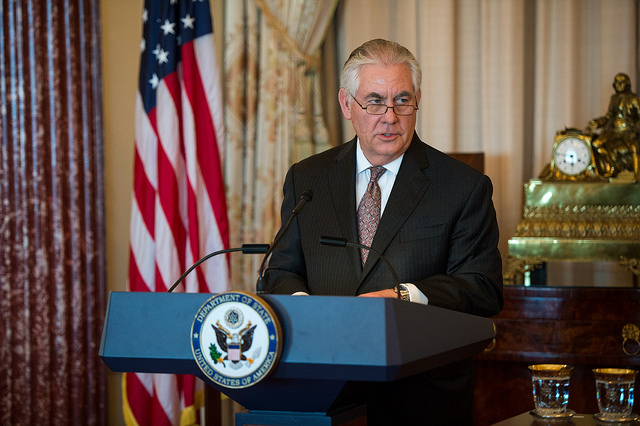
The newly appointed U.S. Secretary of State Rex Tillerson is quickly mobilizing government resources to increase scrutiny and implement tougher screening procedures for applicants who are applying for a U.S. visa or other immigration benefit at U.S. Consular posts and Embassies abroad. Reuters has reported that Secretary Tillerson has sent a series of internal cables (four in total) to consulates and embassies abroad instructing them of new measures to increase vetting of visa applicants (both immigrant and non-immigrant). These cables are as follows: (1) Cable 23338 entitled “Guidance to Visa-Issuing Posts” issued on March 10, 2017; (2) Cable 24324 entitled “Implementing Immediate Heightened Screening and Vetting of Visa Applications” issued March 15, 2017; (3) Cable 24800 entitled “Halt Implementation” of President Trump’s new travel ban due to a temporary restraining order by a federal court, issued on March 16, 2017; and finally (4) Cable 25814 entitled “Implementing Immediate Heightened Screening and Vetting of Visa Applications” issued March 17, 2017.

In these cables, Tillerson has directed U.S. consulates and embassies to specifically identify population risks that warrant “increased scrutiny” and to implement tougher screening procedures for this particular group of people. Applicants who fall into one of the identifiable population groups will be subjected to a higher-level security screening. The cable does not identify whether embassies will be coordinating to provide a uniform standard for identifying populations who pose a security risk. This is a serious cause for concern, since U.S. embassies will likely vary in how they assess which groups pose a security risk. In addition, as part of these measures, the Secretary has ordered a mandatory social media check for all applicants who have ever visited or been present in any territory that is controlled by the Islamic State. Previously, social media screening was not a part of the regular screening process for U.S. visa applicants, however this screening process has always been a discretionary measure.

In addition, the cables provided instructions for the implementation of President Trump’s newly revised executive order on immigration which sought to temporarily bar the admission of foreign nationals from Syria, Libya, Sudan, Somalia, Iran, and Yemen, as well as Syrian refugees, including mandatory enhanced visa screening procedures. Several of these cables were quickly retracted by the Secretary of State after a federal judge from the state of Hawaii issued a Temporary Restraining Order blocking Trump’s embattled executive order from proceeding as planned. The Trump administration had envisioned strict new guidelines for vetting U.S. visa applicants, and this vision was reflected in Tillerson’s cables.

Continue reading

32649529442_22f0c3b000_z

Beginning April 3, 2017, the United States Citizenship and Immigration Services (USCIS) will temporarily suspend expedited processing of H-1B visas, a service previously available to H-1B petitioners known as premium processing. The reason: to reduce overall H-1B processing times and prioritize processing of H-1B extensions nearing the 240-day mark. Premium processing previously guaranteed a 15-day processing time, or refund of the $1,225 premium processing fee. Although premium processing did not increase a petition’s chances of being selected for an H-1B visa, it gave petitioners the benefit of waiting a shorter period and allowed selected petitioners the option of upgrading their application to premium processing after filing.

Petitioners will not have the option of paying for the premium processing service for a period of at least 6 months beginning April 3, 2017. The suspension will affect all H-1B petitions filed on or after April 3, 2017 including all petitions filed for the FY18 H-1B regular cap and master’s advanced degree cap exemption. Additionally, the suspension may affect petitions that are cap-exempt, but will not apply to other eligible nonimmigrant classifications filed with Form I-129.  While the premium processing service is suspended, petitioners may not file a request for premium processing (I-907) for an I-129 Petition for H-1B worker until USCIS has announced that it has resumed premium processing for H-1B petitions. Beginning April 3, 2017 if a petitioner submits a single check combining fees for premium processing and the Form I-129 USCIS will reject both applications (not just the request for premium processing). To avoid this DO NOT submit any premium processing requests on or after April 3, 2017.

Continue reading

15270359572_f4a99b06c8_z

As you gear up for a chance to win one of the 65,000 coveted H-1B visas that will be up for grabs beginning April 1, 2017 through April 7, 2017, we bring you our top frequently asked questions—H-1B edition—to help you make the most of your H-1B filing. As always, to determine whether you qualify for an H-1B visa, please contact our office to schedule a free first time consultation.

When will USCIS begin to accept H-1B petitions for fiscal year 2018?

USCIS will begin to accept petitions for fiscal year 2018 beginning on April 1, 2017 and from then on will continue to accept H-1B petitions during the first five business days through April 7, 2017 until USCIS has received more than enough petitions necessary to fill the regular cap. An H-1B petition may be filed no more than six months before the employment start date requested for the beneficiary.

How long is the H-1B visa valid for?

The H-1B visa is issued for a three-year period that can be extended for an additional three years. Spouses of H-1B workers may live and work in the United States on an H-4 visa, for as long as the H-1B worker remains in lawful H-1B status.

What happens after USCIS receives the necessary petitions to meet the regular cap?

Once USCIS has received more than enough petitions necessary to meet the regular cap, USCIS will conduct a computer-generated lottery to select the petitions needed to meet the cap.  When the cap has been reached, USCIS will make an announcement (usually made on April 7th) indicating that the cap has been reached and that they will proceed with the selection process to fill the 65,000 cap by a randomized lottery system.

Last H-1B season, USCIS announced that the cap was reached within the first 5 business days of the H-1B filing period.

Continue reading

32876675381_f3e46f3cd9_cWe would like to wish our clients a very happy Presidents Day! Please remember that our office is closed in observance of the holiday, but will reopen tomorrow. To read more about the services we offer please visit our website.


4597450178_deae92dd6d_b-2

The H-1B visa is one of the most coveted visas in the United States for several reasons. One of the biggest perks of the H-1B visa is that it is granted for a period of three years, and can be extended for an additional three years. Recipients of the H-1B visa can also bring their dependents to live with them in the United States on an H-4 visa. The H-1B visa is also a popular option because it gives workers the flexibility of accepting and entering new employment, made possible by the portability provision of the H-1B program (8 U.S.C. § 1184(n)). The portability provision allows an H-1B worker to change jobs without having to risk falling “out of status.” Recently, USCIS also improved its portability provision with the passage of a new law that will give H-1B workers who have been laid off a 60-day grace period to transfer to a new employer. But perhaps the greatest upside to the H-1B visa however, is that it is one of the few visas that allows a nonimmigrant to apply for permanent residency as a beneficiary of an immigrant visa petition, without the immigrant petition having any negative affect on their H-1B status. This privilege is recognized in the law and is known as “dual intent.” Foreign nationals holding a “dual intent” visa such as an H-1B visa are allowed to file a green card petition, while continuing employment under the terms of their visa, and may also travel on their visa without seeking permission from USCIS.

In this sense, the H-1B visa is one of the few visas that opens a direct path to permanent residency. Other popular employment visas such as the E-2 treaty investor visa do not create a direct path to permanent residency and are not considered “dual intent” visas.

Continue reading