Articles Posted in Entrepreneur Immigration

34704808294_30d802845d_z

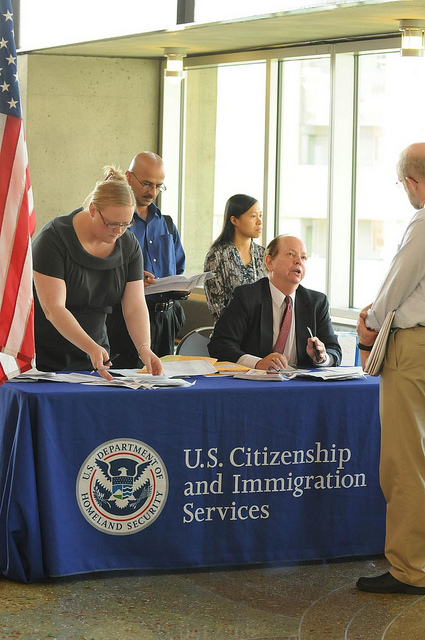
Now is a good time to file your green card application. Significant wait times are expected given a new policy passed by the Trump administration that will require in-person interviews for LPR applicants filing based on employment sponsorship

In yet another controversial move, the Trump administration has recently adopted a new policy change that will require an in-person interview for individuals wishing to obtain lawful permanent residency based on employment sponsorship. The new policy will be implemented beginning October 1st.
Previously, foreign nationals applying for permanent residency, based on employment sponsorship, were not required to attend an in-person interview, although this allowance was discretionary. In recent years, the in-person interview requirement was typically reserved for individuals applying for permanent residency based on a qualifying familial relationship, and not for individuals applying based on employment sponsorship.

A USCIS spokesperson announced the new policy change on Friday August 25th, a change that will delay the process of obtaining a green card significantly, given the increased number of individuals that will be required to attend an in-person interview. According to USCIS this change in policy will apply to any individual adjusting their status to legal permanent residency from an employment-based visa category.

What’s more, family members of refugees or asylees, holding a valid U.S. visa, will also be required to attend an in-person interview when applying for provisional status.


Continue reading

6576922689_27bf2d1f45_z

You have questions, we have your answers. Here are answers to 6 of your Frequently Asked Questions.

In this blog, we are answering 6 of your frequently asked questions in detail. Please remember that every case and every story is different and unique. You should not compare your situation to anyone else’s. We hope that our answers will provide you with further guidance on your immigration journey. For any further questions please visit our website or call our office for a free first time legal consultation. We thank you for your continued trust in our law office.

Q: Should I hire an attorney to file my green card application and go with me to the green card interview?

This will largely depend on the complexity of your individual case. For example, there are individuals that are eligible to adjust their status to permanent residence based on their marriage to a U.S. Citizen or based on a qualifying family relationship, but may be applying for permanent residence under special circumstances such as 245i or another special immigrant classification such as VAWA.

Still other individuals may be applying for their green card for a second time after being denied.

Individuals who are applying for their green card under one of these special immigrant classifications should absolutely seek the assistance of an immigration attorney to apply for permanent residence to avoid any mistakes in filing and to be well prepared for the green card interview. In these situations, any minor mistakes on the paperwork can result in major delays, or worse—require refiling the green card application altogether. In addition, for complex cases it is always important for an attorney to prepare the foreign national for the most vital part of the green card application which is the green card interview. An attorney’s presence at the green card interview is also important to ensure that the foreign national’s rights are not violated by the immigration officer.

Continue reading

15723222862_9e66f06572_z

On August 02, 2017, Republican Senators Tom Cotton (R-AR) and David Perdue (R-GA) introduced a new Act called “Reforming American Immigration for a Strong Economy” before the U.S. Senate, otherwise known as the RAISE Act, which is a new piece of legislation that has recently been backed by President Trump.

The RAISE Act aims to overhaul the employment-based immigration system and replace it with a skills-based system that awards points to immigrants based on the immigrant’s level of education, age, ability to speak the English language, future job salary, level of investment, and professional achievements. In addition, the RAISE Act would terminate the Diversity Visa Program, which awards 50,000 visas to foreign nationals from qualifying countries, and would ultimately reduce the number of family-sponsored immigrants allowed admission to the United States. The Act intends to focus on the family-based immigration of spouses and minor children and would reduce the number of refugees allowed into the United States.

Among other things the RAISE Act would:

  • Terminate the Diversity Visa Program which awards 50,000 green cards to immigrants from qualifying countries;
  • Slash the annual distribution of green cards to just over 500,000 (a change from the current issuance of over 1 million green cards annually);
  • Employment-based green cards would be awarded according to a skill-based points system that ranks applicants according to their level of education, age, ability to speak the English language, salary, level of investment, and achievements (see below);
  • The issuance of employment-based green cards would be capped at 140,000 annually;
  • Limit the maximum number of refugees admitted to the United States to 50,000;
  • Limit admission of asylees. The number of asylees admitted to the United States on any given year would be set by the President on an annual basis;
  • Amend the definition of “Immediate Relative” to an individual who is younger than 18 years of age instead of an individual who is younger than 21 years of age;
  • Adult children and extended family members of individuals living in the United States would no longer be prioritized to receive permanent residence. Instead the focus would remain on the immediate relatives of U.S. Citizens and legal permanent residents such as spouses and children under the age of 18;
  • The Act would allow sick parents of U.S. Citizens to be allowed to enter the United States on a renewable five-year visa, provided the U.S. Citizen would be financially responsible for the sick parent.

Continue reading

30618435416_0d67f54496_z

It’s official. The Department of Homeland Security has rolled out a plan to delay the effective date of the International Entrepreneur Rule, which was set to be enforced on July 17, 2017, to March 14, 2018, at which time the Department will seek comments from the public to rescind the rule, in accordance with Executive Order 13767, “Border Security and Immigration Enforcement Improvements” signed by President Trump on January 25, 2017.

Written comments from the public are due on or before 30 days from the date of publication in the federal register. It is strongly advised that all affected foreign entrepreneurs, business owners, attorneys, immigration advocates etc. leave a public comment identified by DHS Docket No. USCIS-2015-0006, online or by mail detailing the adverse effect that rescinding the rule would have on the U.S. economy and the expansion of jobs in the United States.

Public Comments

Online: Federal eRulemaking Portal: http://www.regulations.gov. Follow the website instructions for submitting comments.

This document is scheduled to be published in the Federal Register on 07/11/2017 and available online at https://federalregister.gov/d/2017-14619, and on FDsys.gov

By Mail: You may submit comments directly to U.S. Citizenship and Immigration Services (USCIS) by sending correspondence to Samantha Deshommes, Chief, Regulatory Coordination Division, Office of Policy and Strategy, UCSIS, DHS, 20 Massachusetts Avenue, NW, Washington, DC 20529. Remember to reference DHS Docket No. USCIS-2015-0006 in all mail correspondence.

Continue reading

7541767406_8bf4575705_zNew developments have recently emerged regarding the Trump administration’s decision to dramatically scale back or rescind the International Entrepreneur Rule, passed under former President Barack Obama, a rule that would have made it easier for eligible start-up entrepreneurs to obtain temporary permission to enter the United States for a period of 30 months, through a process known as “parole,” for the purpose of starting or scaling their start-up business enterprise in the United States. International entrepreneurs would have been able to apply for this benefit beginning July 17, 2017.

However, this may all change in the coming days. The San Francisco Chronicle has reported that the Trump administration plans to undo the International Entrepreneur rule, to prevent foreign entrepreneurs from coming into the United States and starting their companies. This comes as part of President Trump’s commitment to “buy American, and hire American,” and his promise to create more jobs in the United States, by encouraging American companies to expand within the United States. All of this unfortunately comes as no surprise. It is no secret that the President has consistently expressed his anti-immigrant sentiment through his immigration policies and executive orders.

An administration official has come forward on condition of anonymity disclosing that the Trump administration plans to push back the rule’s effective date from July 17, 2017 to March 2018, to give the administration enough time to dramatically scale back the rule or get rid of the rule altogether.

Continue reading

26088808064_4c922a41e9_z

In this post, we bring you the top three mistakes to avoid when applying for a B-1/B-2 non-immigrant visa at a United States consulate or embassy abroad. All too often clients contact our office feeling distraught after receiving a B-1/B-2 visa denial from a consular official. The good news is that a B visa denial can be easily avoided by understanding the common mistakes that people make when pursuing the B nonimmigrant visa.

First, it is important to understand who is eligible to apply for a B non-immigrant visa.

B-1 versus B-2

The B-1 temporary business visitor visa is reserved for individuals who seek to travel to the United States for a temporary period to participate in a business activity of a commercial or professional nature. Examples of individuals who qualify for this type of visa include: individuals consulting with business associates, individuals negotiating contracts, settling an estate, participating in short term training, entrepreneurs who wish to travel to the United States to research the market for a potential business venture, individuals traveling for a scientific, educational, professional, or business convention, or conference, etc.

Individuals who typically apply for this type of visa are entrepreneurs and investors who wish to apply for an E-2 visa in the future and who need to visit the United States to research the market or other business activities relating to researching the viability of the business venture.

B-1 temporary business visitors may be eligible to remain in the United States anywhere from 1-6 months—with 6 months being the maximum. Ultimately, it will be up to the consular/embassy official to determine the length of your period of stay. Typically, applicants are granted an initial period of stay of 6 months. B-1 visa holders may extend their stay for an additional 6 months if it is necessary for them to remain in the United States for an extended period to complete their temporary business activity.

Similarly, the B-2 temporary visitor visa is reserved for individuals who wish to enter the United States temporarily for tourism, pleasure, or visitation. Examples of individuals who qualify for this type of visa include tourists, individuals who wish to visit friends, or relatives, individuals seeking medical treatment, amateur artists, musicians, or athletes who wish to participate in events or contests that do not provide compensation, and individuals who wish to enroll in a short recreational course of study that does not count for credit toward a degree. The length of stay granted to a B-2 temporary visitor is the same as that of a B-1 temporary business visitor.

Who may not apply for a B visa?

Individuals who wish to immigrate to the United States and remain in the United States permanently, or individuals who wish to study, seek employment, etc. may not apply for a B non-immigrant visa.

Continue reading

16F211BF-4FDC-4D41-8FF7-55867BAB7DB9I first met Suman Kanuganti two years ago, back then he was working for another company but contemplating opening his own high-tech startup company and becoming an entrepreneur.

In advising him on his ambitious pursuits, I recommended that he follow his plans and dreams confidently and full-heartedly. Shortly afterwards, Suman quit his previous job and started to focus on his new company, Aira, based here in San Diego. Through the assistance of my immigration law firm, he received his H-1B visa so that he could continue focusing on his amazing work at Aira in developing assistive technology and services for the blind and visually impaired.

His work at Aira continues at a rapid and productive pace, poising the company well for future growth and success. In just two years, Suman, as Co-Founder & CEO, has transformed his startup into the leading developer of remote technology that is bringing immediate access to information and assistance to those with vision loss. This is greatly enhancing the mobility, independence and productivity of blind people in a wide range daily activities – from navigating busy streets and airports, to reading printed material, recognizing faces, catching the bus or Uber, functioning efficiently in the office or classroom, experiencing cultural and sporting events, and literally traveling the globe.

Continue reading

6224687976_e1786131a6_z

With the H-1B season quickly coming to a close, we are happy to announce that 83% of our clients were selected in this year’s master’s cap, while 56.67% of our clients were selected in the “general cap.” These estimates are above the national average. Of the petitions that were selected, the majority were filed with the California Service Center. Selections in this year’s lottery were made up until the very last minute. This fiscal year, USCIS received a total of 199,000 petitions, less than usual, and the computer-generated lottery was conducted on April 11, 2017 a bit later than usual given that the filing period opened on April 3, 2017. As in previous years, USCIS first began the selection process for the advanced degree exemption or “master’s cap,” and then proceeded with the selection process for the “general cap” to fill the 85,000-visa cap. During FY 2017, USCIS received over 236,000 petitions during the filing period which opened on April 1, 2016, and the computer-generated lottery was conducted on April 9, 2016.

USCIS has now completed data entry for all cap-subject petitions selected during fiscal year 2018. This means that USCIS will now begin the process of returning all H-1B cap-subject petitions that were not selected in this year’s lottery, along with their filing fees. While USCIS has indicated that they cannot provide a definite time frame as to when these unselected petitions will be returned, in previous years unselected petitions have traditionally been returned during mid-June to the end of June.

If you have not received a receipt notice in the mail notifying you of your selection, and your checks were not cashed by the Department of Homeland Security, between April 1st and May 3rd., unfortunately it is not likely that you were selected in this year’s lottery. For safe measure, applicants may wish to wait about a week or so to see if any late notices are received.

Continue reading

2760112757_1f649b4241_z

Background

It was only several years ago that Antoine, a French native, set his eyes on achieving his lifelong dream of starting an aviation company in the state of California, providing flight services to foreign pilots in transit to or vacationing in the state of California. With over six years of experience in the European aviation industry, as a private and commercial pilot, Antoine certainly had amassed the skills and experience necessary to launch his company. On a visit to California, Antoine identified a niche in the market and decided that he would cater to the needs of foreign pilots flying through the Los Angeles County area. With the help of the Law Offices of Jacob Sapochnick, Antoine was able to turn his lifelong dreams into reality. Today, Antoine’s company Heading West is off the ground and on its way to becoming Southern California’s leading flight service company. So how did we do it?

About the Visa

Here at the Law Offices of Jacob Sapochnick, it is no secret that our clients are our biggest inspiration. After having spoken to Antoine about his new business venture, his qualifications, and other needs, we agreed that the best option for Antoine and his family, was to apply for an E-2 Treaty Investor Visa. Although the E-2 Treaty Investor Visa does not create a path to permanent residency, it is a great visa for foreign entrepreneurs who wish to enter the United States and carry out investment and trade activities. To qualify for the treaty investor visa, the investor must be from a qualifying treaty trader country, and must invest a substantial amount of capital to develop and direct the business operations of a new commercial enterprise, or invest in an existing U.S. business. Other requirements for the E-2 visa are as follows:

  • If the investor is a company, at least 50% of the owners in the qualifying company must maintain the nationality of a treaty trader country if they are not lawful permanent residents of the U.S. If these owners are in the U.S., they must be in E-1 or E-2 status.
  • The investment funds and the applicant must come from the same Treaty Country.
  • The business in which investment is being made must provide job opportunities or make a significant economic impact tin the United States. The business should not be established solely for the purpose of earning a living for the applicant and his or her family.
  • The investment must come from the investor. The money must be “at risk”. Thus, a loan that is secured by the assets of the business itself will not qualify i.e. if loans have been taken out, they must be secured or guaranteed by the investor personally, and not by the assets of the corporation.
  • The investment must be substantial, a standard which depends on the nature of the enterprise. Generally, investment funds or assets must be committed and irrevocable. The funds or assets must be deemed sufficient to ensure the success of operations.
  • The investment must be real and active and not passive; this means that a bank account, undeveloped land or stocks, or a not-for-profit organization will not be sufficient to be considered.
  • The enterprise must be a real, operating commercial enterprise or active entrepreneurial undertaking productive of some service or commodity.

Continue reading