Articles Posted in Overstays

3261953789_cc710caaa5_o

The U.S. Citizenship and Immigration Services (USCIS) has released an updated policy manual addressing the policies and procedures associated with adjustment of status to lawful permanent residence under section 245a of the Immigration and Nationality Act. The policies set forth in the newly updated policy manual are effective beginning February 25, 2016.

Adjustment of status is the process by which an eligible foreign national may adjust their status to lawful permanent resident, based on a qualifying family relationship or employer-employee relationship. Additionally, special categories of green card applicants exist covering self-petitioning Amerasian, Widow(ers) seeking lawful permanent residence under the Violence Against Women Act (VAWA), refugees, asylees, certain U visa holders, humanitarian visa holders, and eligible diversity visa program immigrants. In order to file an adjustment of status application from within the United States the Beneficiary must 1) be living in the United States lawfully and 2) have been inspected, lawfully admitted, or paroled into the United States, (except in cases of 245i).

Foreign nationals living in the United States, who qualify for adjustment of status to lawful permanent residence, may file their adjustment of status application with USCIS, without having to travel abroad to obtain an immigrant visa through a procedure known as consular processing. Foreign nationals residing abroad, who qualify for adjustment of status, must apply for an immigrant visa at a United States Embassy or Consulate abroad. Consular processing is different from adjustment of status from within the United States in various ways. Adjustment of status within the United States is a much faster process, however the main drawback is that applicants cannot travel internationally once their application has been filed with USCIS, until they are issued an advance parole document by USCIS authorizing such travel. In order to obtain an advance parole document, the green card applicant must file Form I-131 with USCIS. The advance parole document is typically issued within 90 days of filing of Form I-131. One of the main benefits of applying for an immigrant visa abroad through consular processing, is that the individual does not have any travel restrictions. It is for this reason that businesspersons and other individuals opt for consular processing instead of adjustment of status despite living in the United States.

Continue reading


13283313123_fbd9b66cc9_z

Do’s and Don’ts

If you are considering applying for a temporary visitor visa to travel to the United States for purposes of leisure or to receive temporary medical treatment, there are several things you should be aware of. First, you should understand what you can do while on a temporary visitor visa and what you cannot do. You may travel to the United States on a visitor visa if your visit will be temporary. The proposed visit must be either for recreational purposes such as to visit your friends and relatives in the United States, receive medical treatment, attend a short course of study related to the nature of your trip, or to engage in activities of a fraternal, social, or service nature. You may not enroll in a course of study that exceeds your authorized duration of stay of is unrelated to the nature of your trip, and you may not seek employment during your stay. If approved, a visitor visa is generally authorized for a 6-month period which may be extended for an additional 6 months by filing Form I-539 Application to Extend/Change Nonimmigrant Status.

Does your country participate in the visa waiver program?

Before applying for a visitor visa , you should verify whether you are a citizen of a country that participates in the visa waiver program. Presently 38 countries participate in the visa waiver program, as shown below.

Andorra Hungary Norway
Australia Iceland Portugal
Austria Ireland San Marino
Belgium Italy Singapore
Brunei Japan Slovakia
Chile Latvia Slovenia
Czech Republic Liechtenstein South Korea
Denmark Lithuania Spain
Estonia Luxembourg Sweden
Finland Malta Switzerland
France Monaco Taiwan
Germany the Netherlands United Kingdom
Greece New Zealand

If your country of citizenship participates in the visa waiver program, you may not need to apply for a tourist visa at a US Consulate or Embassy abroad. If you have been previously denied a United States visa, the Electronic System for Travel Authorization (ESTA) will automatically deny your ESTA submission and you will not be eligible to travel under the VWP even if your country participates in the program. Note: The House of Representatives and the Senate is presently in talks to approve a bill that will block individuals who have traveled to Syria, Iraq, Iran, or Sudan during the last 5 years from using the visa waiver program.

Continue reading

District Court Denies Request for Temporary Restraining Order to Halt Syrian Re-Settlement Program in Texas

23348054250_3bfc1cd6a0_z

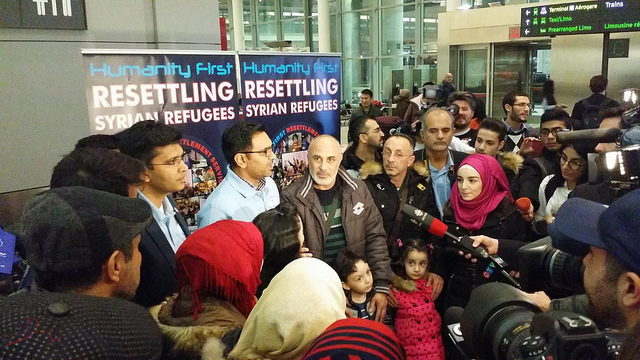
First Family of Syrian Refugees Arrives in Canada

In their December suit, Texas Health and Human Services Commission V. United States, et, al., the state of Texas alleged that the United States government and the International Rescue Committee unlawfully attempted to re-settle six Syrian refugees in the city of Dallas without prior  consultation and collaboration. According to Texas, the federal government failed to consult with the state regarding re-settlement of these refugees, and prevented them from receiving vital information relating to security risks posed by Syrian refugees prior to their re-settlement. Texas also claimed that the International Rescue Committee similarly failed to collaborate and consult with the Texas Health and Human Services Commission in advance prior to the re-settlement of these refugees. To protect itself, the state of Texas asked for an injunction and a temporary restraining order to halt the resettlement of Syrian refugees until security checks could confirm that these Syrian refugees do not pose a threat to the state of Texas.

On December 9, 2015 the U.S. district court denied the temporary restraining order, adding that the state of Texas failed to provide compelling evidence to suggest that Syrian refugees pose a substantial threat of irreparable injury to its citizens. Presiding district court Judge David C. Godbey added that, “the [Texas] commission has failed to show by competent evidence that any terrorists actually infiltrated the refugee program, much less that these particular refugees are terrorists’ intent on causing harm.” Although the lawsuit still stands and will likely not receive a final ruling until early next year, the district court set an important precedent in its denial of the temporary restraining order. Judge Godbey further maintained that it is not within the purview of the district court to assess what risk, if any, Syrian refugees pose to any particular state. Such risk can only be assessed by the federal government. On this issue Godbey stated that, “the Court has no institutional competency in assessing the risk posed by refugees. That is precisely the sort of question that is, as a general matter, committed to the discretion of the executive branch of the federal government, not to a district court.” The rest of the lawsuit remains in litigation.

Continue reading