Articles Posted in Supreme Court

us-1978465_1280Last week, the U.S. Supreme Court handed down a troubling decision that could strip legal status from hundreds of thousands of Venezuelans currently living in the United States under Temporary Protected Status (TPS).

On Friday, the Court granted the Trump administration’s request to halt a lower court ruling that found the administration’s cancellation of TPS protections for Venezuelans unlawful. The unsigned order from the Court effectively allows the government to proceed, for now, with its plans to revoke temporary protections that had shielded Venezuelan nationals from deportation and granted them employment authorization.

TPS was created in 1990 as a humanitarian safeguard for individuals whose home countries are experiencing extraordinary crises such as armed conflict, environmental disasters, or other temporary but severe disruptions. Venezuela was designated for TPS in 2021 under President Biden, in response to the country’s severe economic collapse, widespread human rights abuses, and political instability.

Since then, approximately 300,000 Venezuelans have relied on that protection to live and work legally in the U.S., building lives, paying taxes, and raising families.

Trump Administration Moves to Strip Venezuela’s TPS Designation


But the political tides have shifted. When the Trump administration returned to office, it appointed Kristi Noem as Secretary of Homeland Security. Earlier this year, Noem moved to revoke Venezuela’s TPS designation, arguing that conditions in the country had improved and that continuing the program was no longer in the national interest. That decision sparked immediate legal challenges. A coalition of Venezuelan TPS recipients and advocacy groups sued, claiming the administration’s actions were arbitrary, rushed, and in violation of federal law.

Continue reading

united-states-supreme-court-6330563_1280On May 19th the U.S. Supreme Court handed the Trump administration a legal victory after the justices agreed to lift a lower court order that had previously stopped the President’s efforts to strip Venezuelans of deportation protections granted under Temporary Protected Status (TPS).


What is TPS?


Temporary Protected Status (TPS) is a humanitarian program allowing nationals of certain countries to remain in the United States temporarily, if the government has determined that it is unsafe for them to return to their home country for humanitarian reasons, such as armed conflict or a natural disaster.

It allows nationals of designated countries to live and work in the United States for a temporary period of time, during which they are protected from deportation. Those who qualify are given temporary employment authorization, which is automatically extended if the government extends their TPS validity period.


Biden’s Designation of Venezuela for TPS


The original TPS designation for nationals of Venezuela was issued on March 9, 2021, due to extraordinary conditions preventing their safe return to Venezuela (the 2021 designation). A separate re-designation was issued on October 3, 2023 (the 2023 designation).

Before leaving office, the Biden administration extended Venezuela’s 2023 designation for an additional period of 18 months, which was meant to last from, April 3, 2025, to October 2, 2026.

Continue reading

usa-3808026_1280

In this blog post, we share with you the latest regarding the controversial immigration law from the state of Texas known as SB-4.

In a stunning turn of events, on Tuesday March 19th the Supreme Court of the United States cleared the way for the state of Texas to enforce its controversial immigration law SB4, which would allow state officials to arrest and detain those suspected of entering the country illegally.

The Supreme Court rejected the Biden administration’s request to intervene and keep Texas’s strict immigration enforcement law on hold pending litigation.

The legal challenges however did not stop there. Later that day, a federal appeals court put the controversial law back on hold, just hours after the Supreme Court would have allowed Texas to begin enforcing the new law.

The order came down from the 5th U.S. Circuit Court of Appeals in which a three-judge panel voted 2-1 to vacate a previous ruling that had put the law into effect.

The future of the law still hangs in the balance as the 5th Circuit prepares to hear arguments over the controversial law to decide once and for all whether the law is unconstitutional.

Continue reading

37171919025_64031c19eb_z

Source: Flickr, Attribution: mollyktadams

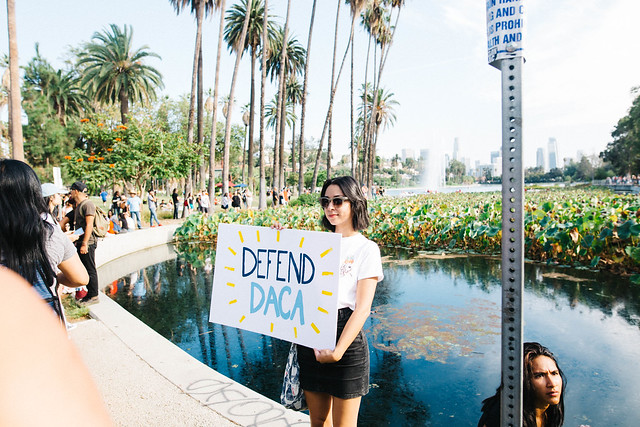
We are saddened to report that late Friday, July 16, 2021, Federal Judge Andrew Hanen of the United States District Court for the Southern District of Texas, granted the plaintiffs in the case, State of Texas, et al., vs. United States of America, et.al, a permanent injunction, pending ongoing litigation over the legality of the Deferred Action for Childhood Arrivals (DACA) program.

As a result, new first-time applications for the DACA program will no longer be approved by the United States Citizenship and Immigration Services (USCIS) following Judge Hanen’s ruling.  Friday’s decision in Texas v. United States is sure to be appealed, though there is a reasonable chance it will be upheld, especially by the conservative leaning Supreme Court of the United States.

In his ruling, Federal Judge Hanen declared that the Department of Homeland Security (DHS) violated the Administrative Procedure Act (APA) with the initial creation of the Deferred Action for Childhood Arrivals (DACA) program and its continued operation. Accordingly, he has ordered that the DACA Memorandum and the subsequent creation of the DACA program be vacated and remanded to DHS for further consideration.

This action removes protections from deportation for thousands of undocumented young adults who came to the United States as children, otherwise known as Dreamers, and casts doubt on the future of the program.

Judge Hanen specifically stated that his ruling does not impact the hundreds of thousands of DACA recipients and others who have relied on the DACA program for almost a decade. This means that while new first-time applications for DACA will no longer be adjudicated by USCIS, Hanen’s ruling will not impact current DACA recipients.

Continue reading