Articles Posted in Employment Based Petitions

9416361052_3178b0293d_z

Today April 6, 2018 the U.S. Citizenship and Immigration Services (USCIS) announced that the H-1B general bachelor’s cap has been reached for fiscal year 2019. In addition, USCIS received more than 20,000 petitions for the advanced degree exemption.

Sometime within the next week, USCIS will conduct a random computer-generated process, known as a ‘lottery,’ to select the petitions needed to fill the 65,000-bachelor’s cap. USCIS will first randomly select the petitions that will count toward the advanced degree exemption. Unselected advanced degree petitions will then be entered into the random lottery that will be conducted to fill the 65,000-bachelor’s cap. All unselected cap-subject petitions will be rejected and in turn CIS will return the H-1B packages containing filing fees and rejection notices. CIS has not yet provided any details concerning the date the lottery will be conducted. We suspect it will occur within the next week. In the meantime, cap exempt H-1B petitions will continue to be processed including H-1B worker extensions, petitions requesting a change to the terms of an H-1B workers’ employment, and petitions requesting concurrent work for an H-1B worker.

So, what’s next?

Petitions filed with regular processing

If your employer filed your petition with regular processing, you will not know whether your petition has been selected in the lottery until late April through mid-May. Petitions filed under regular processing that were selected in the lottery will receive hard copy ‘receipt notices’ from USCIS. These notices will only be received by the attorney on file and the employer. In previous years, we began to receive these receipt notices in late April.

Receiving a receipt notice is great news. It means that you have been selected in the lottery, but it does not mean that your application has been approved. Once selected, your application will undergo adjudication, which takes several months.

Continue reading

33321606943_5cfbf8a916_z

In what seems like déjà vu, today, March 20, 2018 the United States Citizenship and Immigration Services (USCIS) formally announced that the agency will be temporarily suspending premium processing service for all fiscal year 2019 cap-subject petitions, including petitions that seek an exemption for individuals who possess a U.S. master’s degree or higher. The suspension is expected to last until September 10, 2018. Based on similar announcements made by USCIS in the past, we expect premium processing service to remain suspended until at least September 10.

As some of you may remember, USCIS suspended premium processing in a similar fashion during April of last year for fiscal year 2018 cap-subject petitions, and lifted the suspension until September 18 of 2017.

Petitions not subject to FY 2019 Cap

Premium processing requests will continue to be accepted for H-1B petitions NOT subject to the FY 2019 cap. USCIS will make an announcement as we get closer to September notifying the public regarding any decision to resume premium processing for cap-subject H-1B petitions. In previous years, USCIS lifted the suspension in July for beneficiaries who were exempt from the cap, because of their employment at a qualifying cap-exempt institution, organization, or entity. We expect USCIS to follow a similar pattern in July of this year, with the temporary suspension for cap-subject petitions being lifted sometime in early September.

Continue reading

9595278129_80e622a87a_z

Tis the season to file for one of the most popular visa types: The H-1B visa. Filings for cap-subject petitions will begin to be accepted by USCIS beginning April 2nd and the filing period will end on April 6, 2018. As many of you know, the odds of being selected in the H-1B visa lottery are slim, but even those who are selected in the visa lottery have to overcome yet another hurdle, the Request for Evidence. Since President Trump issued the executive order “Buy American, Hire American,” the United States Citizenship and Immigration Services (USCIS) began scrutinizing the adjudication of H-1B visa applications more closely.

Our attorneys witnessed this phenomenon first hand. The volume of requests for evidence increased significantly and USCIS began to be more demanding in the types of documentation requested to qualify for the program.

For this reason, we advise our clients and readers to be very careful this H-1B season and be mindful of the challenges they may face as they proceed with the H-1B visa process.

Common Types of RFE’s and how to avoid them:

  • Level One Wage: Executive Order “Buy American, Hire American” directs the Department of State to ensure that H-1B visas are awarded to the most-skilled or highest-paid petition beneficiaries. USCIS has increasingly issued RFEs in which the employer is paying the H-1B worker a level 1 wage. This has prompted USCIS to question why someone with a specialty occupation would be paid the level 1 wage, a wage that is typically reserved for entry-level positions and individuals who only have a basic understanding of the occupation. Thus, it would not be appropriate for someone who has an intermediate to advanced understanding of the occupation to be paid a level 1 wage. Situations in which a level 1 wage is inappropriate also include cases where the worker will take on a complex set of job duties.

Continue reading

40115765202_7e780f7ef7_z

During December of last year, the United States Citizenship and Immigration Services (USCIS), announced that the agency was beginning to take preliminary steps to terminate H-4 Employment Authorization for certain H-4 spouses, a privilege that has been available to eligible spouses of H-1B nonimmigrant workers since 2015. As it stands, the 2015 H-4 EAD rule allows certain H-4 dependent spouses of H-1B nonimmigrant workers the ability to obtain an employment authorization card (work permit), provided the H-1B nonimmigrant worker is in the process of obtaining an employment based green card.

Proposal to Amend the 2015 H-4 EAD Rule

On December 14, 2017, a rulemaking notice was first published in the Federal Register notifying the public that the Department of Homeland Security, in conjunction with USCIS, would be reviewing and possibly amending the 2015 H-4 EAD rule, following the issuance of Executive Order 13788, “Buy American, Hire American.”

According to the notice published in the Federal Register, DHS reserves the authority to amend the 2015 H-4 EAD rule under section 102 of the Homeland Security Act of 2002 and section 103(a) of the Immigration and Nationality Act (INA). These sections of the law give the Secretary of the Department of Homeland Security the discretionary power to amend the law so that it aligns with the policies set out in the President’s executive order.

Continue reading

6104368494_6fd7405753_z

Now is the time to begin preparing for the upcoming H-1B visa lottery. USCIS will begin to accept H-1B cap-subject petitions for fiscal year 2019 beginning Monday, April 2, 2018. Please note: employers cannot file an H-1B petition for an employee more than 6 months before the employee’s intended start date. If accepted, H-1B visa workers can begin employment by October 1st. The H-1B visa is issued for up to three years but may be extended for another three years.

By law, a congressionally mandated cap exists which limits the issuance of H-1B visas to 65,000 per year. That is why the H-1B visa is commonly referred to as a ‘lottery’ visa.

Individuals (such as F-1 students) who hold advanced degrees (U.S. master’s or higher) are exempted from the 65,000 visa cap. Such applicant’s must demonstrate that they have obtained an American master’s degree or higher to be exempted from the cap, however only the first 20,000 petitions received by USCIS will benefit from this cap exemption. Initial H-1B petitions that are received by USCIS after that limit will count towards the regular 65,000 cap.

In order to qualify for an H-1B visa:

  • a foreign worker must possess both a theoretical or practical application of a body of highly specialized knowledge;
  • an employer-employee relationship must exist. Only a U.S. employer can petition the entry of a foreign employee by filing USCIS Form I-129 Petition for Non-immigrant Worker. An employer-employee relationship exists if the U.S. employer has the right to hire, pay, fire, supervise or control the work of the employee;
  • the foreign worker must possess a bachelor’s degree, its foreign equivalent, or relevant work experience. If the foreign worker does not have formal education, but has at least 12 years of relevant work experience related to the specialty occupation, they may still qualify for an H-1B visa;
  • the foreign worker must be employed in a specialty occupation related to their field of study. A specialty occupation is an occupation that requires a bachelor’s degree or its equivalent;
  • the foreign worker must be paid at least the prevailing wage for the specialty occupation in the area of intended employment;

Continue reading

4827328828_7668f5df26_z

In this post, we bring you information regarding the major provisions of the Immigration Innovation Act of 2018 affecting H-1B workers and employment-based immigrants. The Immigration Innovation Act of 2018 is a piece of legislation that was recently introduced before Congress by Republican Senators Orrin Hatch and Jeff Flake on January 25, 2018.

Much of the legislation centers around the H-1B visa worker program.

The major provisions of the Immigration Innovation Act currently being proposed in Congress are as follows:

Increases the number of H-1B visas available. Section 101 of the legislation would raise the current 65,000 H-1B statutory visa cap to 85,000 with 20,000 of those visas to be set aside for applicants possessing a U.S. Master’s and above. This provision includes a market escalator up to 195,000 and de-escalator that is based on prior fiscal years, but not lower than the statutory base. 

Exemption for U.S. Masters. Section 101 includes a provision that creates an unlimited number of exemptions for individuals with a U.S. Master’s degree or above if the U.S. employer attests that it will begin green card processing for the beneficiary within one year.

H-1B Prioritization. Per Section 101, the H-1B visa lottery would be prioritized as follows in fiscal years where enough petitions have been received within the first 5 business days of the filing period of reaching the cap:

  • Individuals with a U.S. Master’s, or higher who are subject to the numerical limitations
  • Individuals who have earned a doctoral degree outside of the U.S.
  • Individuals who have earned a U.S. Bachelor’s degree or higher in a STEM field and
  • Other petitions

Penalties for Failure to Withdraw. Section 101 proposes monetary penalties and debarment for employers who have 5 or more cap-subject petitions approved in a fiscal year, where the visa holder works in the U.S. less than 25% during the first year of approval. In cases involving higher volume users where at least 20 H-1B petitions have been approved in a fiscal year the employer may not avoid penalties even if they withdraw a percentage of approved petitions.

Continue reading

29829421110_c710ea2e3c_z

Since President Donald Trump was elected to the office of the Presidency, a lot has changed in immigration law. From the very beginning, President Trump set out to shatter the status quo with his infamous campaign slogan “Make America Great Again” and immigration was one of the targets. With the help of his campaign advisers and his larger than life personality, President Donald Trump, defeated his biggest political rival, the famed career politician Hillary Clinton. Throughout his campaign it became clear that the Donald Trump persona was not simply made for TV. Whether you agree with his policies or not, Donald Trump has proven that he is a force to be reckoned with.

As Americans headed to the polls on that fateful morning on November 8th there was a tinge of uncertainty in the air—even an odd sense of silence. For those that disagreed with President Trump’s policies, the choice was clear, but for those that had endured eight years under Barack Obama, an unfamiliar face in politics was the answer. Everyone knew Donald Trump as a wealthy real estate mogul with an affinity for the spotlight, but few knew what Donald Trump would be like as a politician, let alone President of the United States. Despite the criticism, Donald Trump became a national phenomenon, capturing the hearts and minds of the American people with his no nonsense approach to politics, and his appeal to a large and growing conservative base. From the very beginning of his presidency, Donald Trump set out to become one of the most unconventional Presidents of the modern era, using his preferred method of Tweeting to reach the American people. Although his administration is only a year old, it has been marred with scandals, dozens of firings, resignations, and abrupt departures.

Continue reading

https://www.visalawyerblog.com/files/2017/12/Screen-Shot-2017-12-21-at-4.02.27-PM.png

To our loyal readers and clients, we wish you and your families very safe and happy holidays. We would like to take this opportunity to thank you for your continued trust and loyalty in our office. Our clients continue to inspire us with their stories of hope, courage, and innovation. Although it is a very challenging time for immigration law due to our current political climate, we believe that our executive and legislative branches will work together to find a solution to pressing issues that have remain unresolved for so many years. We hope that in the new year, members of Congress will begin talks to pass comprehensive immigration reform, including legislation to protect Dreamers from deportation. Whatever happens in the new year, we will be here every step of the way to help you achieve your immigration goals. See you in the new year!

25926687911_2a45195a68_z

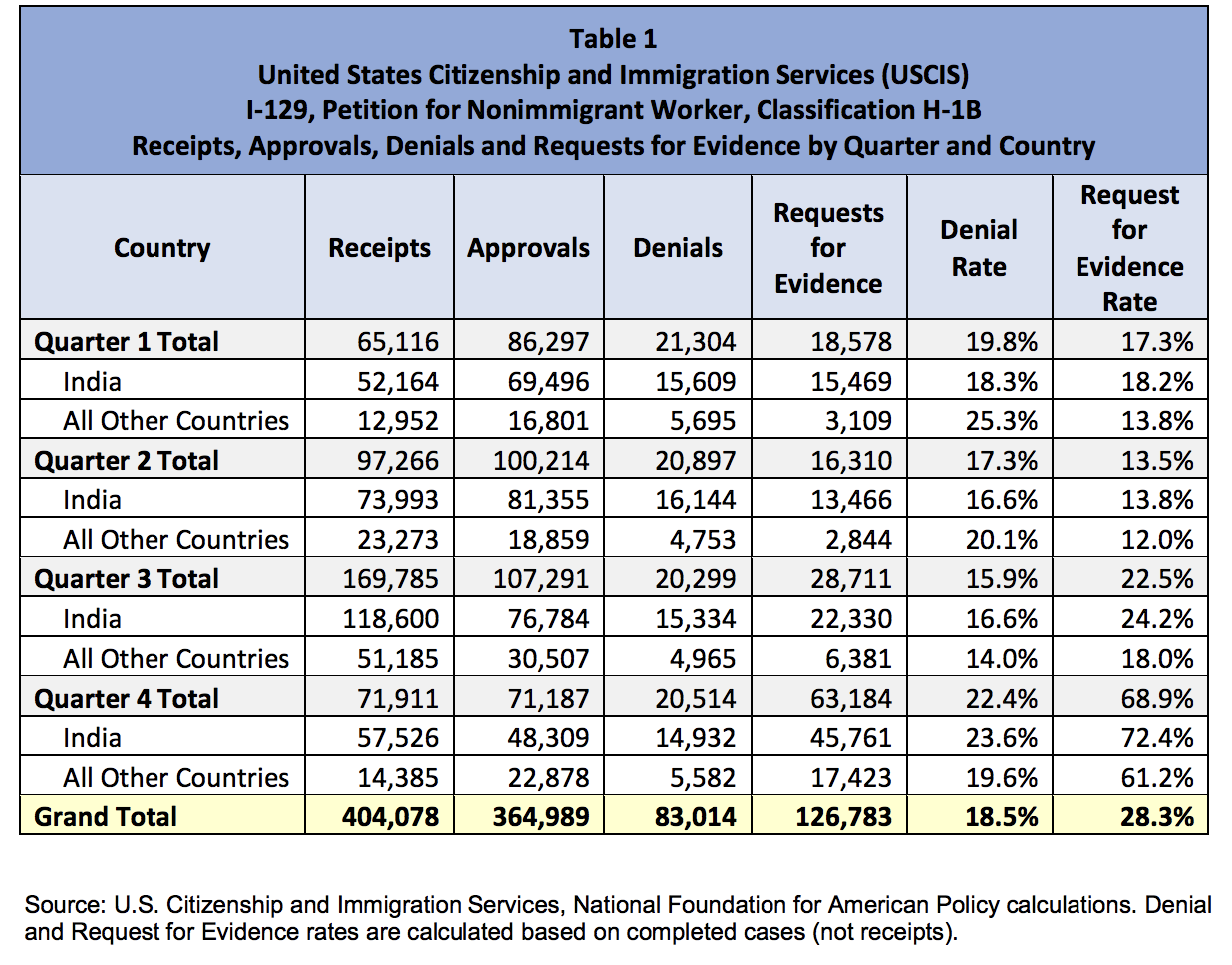
Over the course of the last few weeks, our attorneys have uncovered a disturbing trend in the adjudication of H-1B petitions (both cap subject and cap-exempt) that were upgraded to premium processing service in late October through November.

As previously reported on our blog, the United States Citizenship and Immigration Services (USCIS) has been aggressively issuing requests for evidence across the board for all H-1B petitions regardless of occupation and regardless of whether the beneficiary is seeking an H-1B visa for the first time, or an extension of their status. This drastic change was prompted in part by the enforcement of the President’s executive order “Buy American, Hire” in which the President called on the service to “ensure that H-1B visas are awarded to the most-skilled or highest-paid petition beneficiaries.” The result was that USCIS began to issue requests for evidence focusing on the beneficiary’s wage level, questioning the petitioner regarding why the beneficiary was being paid the entry level wage, instead of a higher wage if the beneficiary’s occupation was to be considered complex.

Premium Processing Upgrades

To add insult to injury, as of late, USCIS has been issuing a huge wave of denials for H-1B cases that were recently upgraded to premium processing. In the past, it was commonplace for H-1B petitions to be upgraded to premium processing, even where a response to a request for evidence was under review by USCIS. This fiscal year, however, was a bit different than previous years, because premium processing was suspended for all H-1B petitions on April 3rd. Premium processing finally re-opened for cap-subject petitions on September 18, 2017, and for all H-1B petitions on October 3, 2017.

Continue reading

Happy Thanksgiving from the Law Offices of Jacob J. Sapochnick. We give thanks to our clients for their continued trust in our office. It is our pleasure to serve you.

https://www.visalawyerblog.com/files/2017/11/Screen-Shot-2017-11-24-at-12.23.44-PM.png