10396442325_d0fe47943a_z

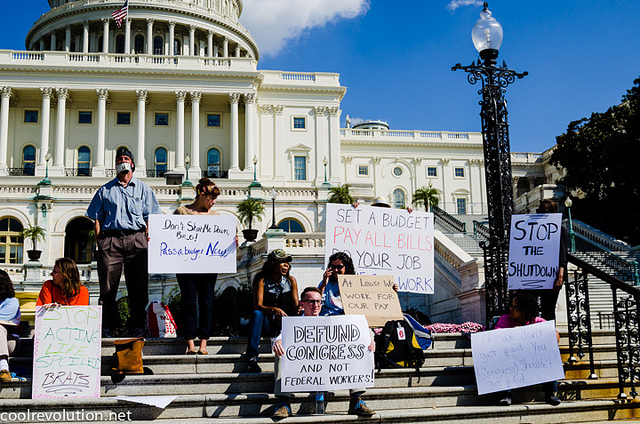
On Monday the Senate will be voting on a short-term spending bill introduced by Senate Appropriations Committee Chairman Thad Cochran. If passed, the bill will temporarily fund the government through December 11th of this year. If the bill is not passed, the country will face a government shutdown beginning on October 1, 2015. The temporary funding bill called a continuing appropriations resolution will be required to keep government agencies afloat for the remainder of the year. Congressional Republicans and Democrats have been at odds with one another since the Planned Parenthood scandal was brought to light. The non-profit organization’s involvement in the practice of procuring tissues from aborted fetuses for the purpose of medical research has been deeply contested by Republicans, who believe Planned Parenthood should no longer receive federal funding. Due to this impasse, no resolution bill has yet been agreed upon.

Repercussions on Immigration: LCA’s and PERM applications

A government shutdown would mean that various government agencies may not be operating at full capacity. Due to this we urge our clients to file urgent Labor Condition Applications or PERM applications prior to October 1, 2015. While the shutdown will have an effect on the economy, families, and business throughout the country, entities not affected by the government shutdown include USCIS, the military, airport security, FBI, Border Patrol, Social Security, Medicare, Medicaid, Food Stamps, among others.


Continue reading

inese

It is our pleasure to introduce our readers to our senior case manager, Inese Grate, one of the original members of the Law Offices of Jacob J. Sapochnick. Ms. Grate joined our firm when there were merely 2 employees working at the office. In addition to studying law in Latvia, Ms. Grate received her Master’s in Law in International Business Transactions from Temple University Beasley School of Law and attended the International Law Institute at Georgetown University School of Law.

Ms. Grate specializes in business and family immigration, corporate, international trade, and international transactions. Ms. Grate provides consultation on strategic investment in the United States for international clients and corporations to identify potential opportunities, create jobs, and develop successful businesses. Throughout her professional career, she has taken several international and U.S. startup companies from an ideation phase through to establishment and registration. Ms. Grate is unique in that she thinks outside of the box and is able to utilize her professional network of financial advisors, real estate brokers, investors and industry experts to assist our clients based on their unique needs. Throughout her career, Ms. Grate has helped numerous corporations and individuals in the United States as well as several European countries in various immigration/business related issues. Ms. Grate evaluates business plans and works on all related immigration issues including visas, licenses, and permits. She has helped in numerous cases in this area for the past few years.

Continue reading

15089979007_6d374862cf_z

In a bulletin released on September 11th the United States Citizenship and Immigration Services explains conditions relating to prioritization of interview scheduling for affirmative asylum applications. According to CIS, affirmative asylum applications began to be prioritized as of December 26, 2014 which fall under the below mentioned categories.

The categories which qualify for prioritization of interview scheduling include:

  1. Applicants who were scheduled for an interview, however the interview was rescheduled at the request of the applicant or by CIS (applicants in this category are normally scheduled promptly)
  2. Applications that were filed by children (applicants in this category are normally scheduled promptly)
  3. Pending affirmative asylum applications will be prioritized in the order they were received by CIS (first come first serve basis)

Pending affirmative asylum applications:

The following table outlines processing times for  interview scheduling by field office. The table estimates interview scheduling for applicants in the third category.

*Approximations are based on interviews scheduled during the listed month. Future estimations are determined by asylum office caseload and resources available to each office.

Continue reading

flag

On September 9th the Department of State and USCIS jointly announced new procedures that will allow family-based and employment-based applicants stuck in immigrant visa backlogs to apply for an immigrant visa (adjustment of status) before their priority date becomes current and an immigrant visa becomes immediately available to them. These new procedures will be implemented beginning October 1, 2015 as part of President Barack Obama’s executive actions on immigration with the purpose of modernizing and streamlining our legal immigration system for the 21st century. These new changes were introduced in the October Visa Bulletin. 

What is the Visa Bulletin?

The Department of State publishes a monthly report of visa availability known as the ‘Visa Bulletin.’ The Visa Bulletin is essentially a guide to be used by applicants and consular officials denoting visa availability for the issuance of visas at consulates and embassies worldwide. USCIS utilizes the Visa Bulletin to determine whether Form I-485, Application to Register Permanent Residence or Adjust Status, can be accepted for filing and processing. In order to file Form I-485 a prospective immigrant must determine whether a visa is available to them at the time the Form I-485 is filed and at the time Form I-485 is approved. The Department of State and Department of Homeland Security work together to revise the Visa Bulletin on a monthly basis estimating immigrant visa availability for prospective adjustment of status applicants. The DOS allocates available visas by providing visa numbers according to the prospective immigrant’s preference category, country of birth and priority date. This allows distribution of visas for all preference categories. A prospective immigrant’s priority date can be found on Form I-797 Notice of Action or ‘Receipt Notice’ for the petition filed on the applicant’s behalf.

What is a Priority Date?

A priority date is generally defined as the “date when your relative or employer properly filed the immigrant visa petition on your behalf with USCIS.”  For employment-based petitions, “if a labor certification is required to be filed with your immigrant visa petition, the priority date is the date the labor certification application was accepted for processing by the Department of Labor.”

Continue reading

Infographic-page-001 (1)

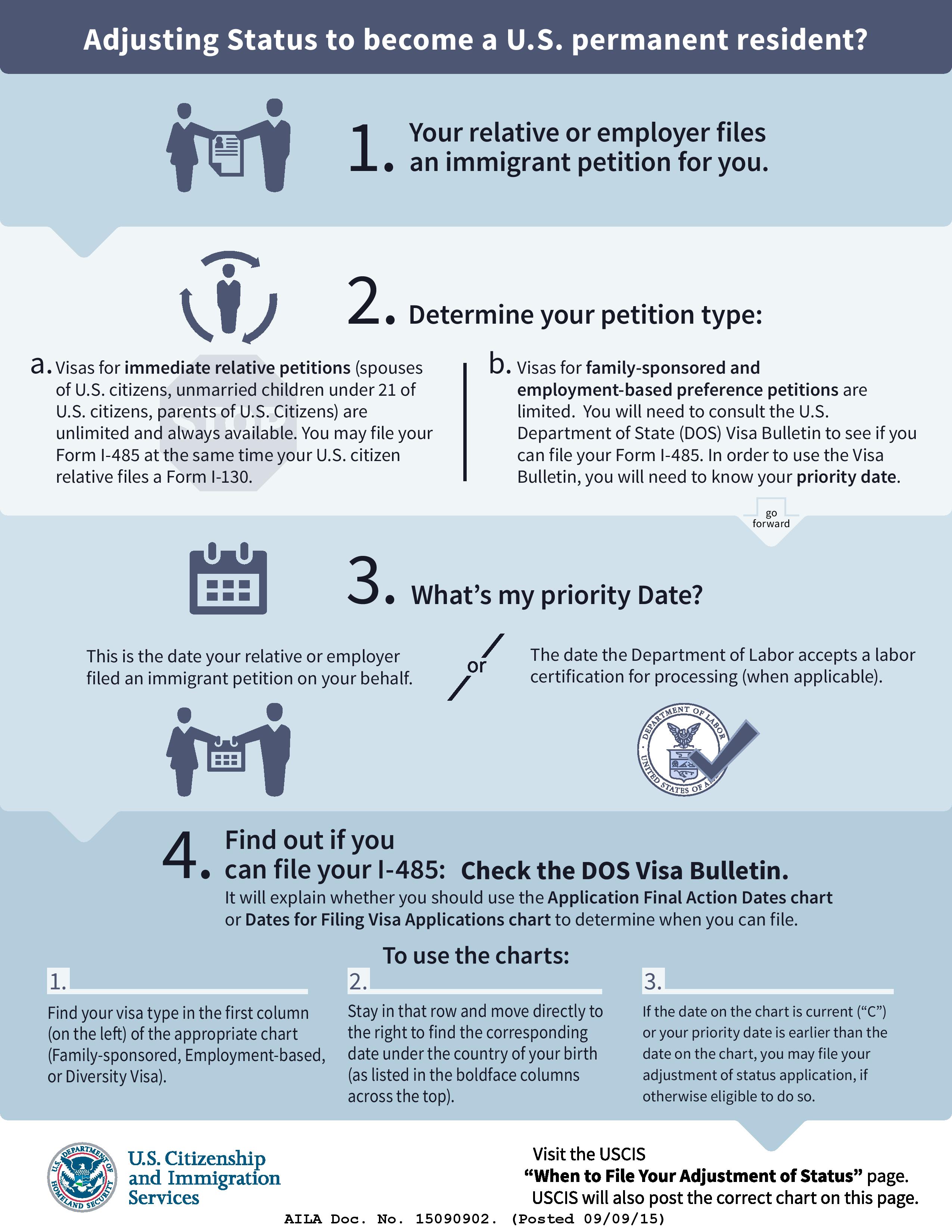
In order to apply for permanent residence, a relative or American employer must file an immigrant petition on your behalf. Family-sponsored and employment-based petitions are subject to visa limitations unlike petitions filed by immediate relatives who are US citizens. Immediate relative petitions remain unlimited and are always available. This means that if your petitioner is your immediate relative and a US Citizen you can file your I-485 at the same time as your immigrant petition.

In order to understand whether a visa is available to you and whether you can proceed with filing your application for permanent residence, you will need to keep a close eye on the Department of State’s Visa Bulletin. 

Family Sponsored Preference Categories are as follows:

FAMILY-SPONSORED PREFERENCES

First: (F1) Unmarried Sons and Daughters of U.S. Citizens:  23,400 plus any numbers not required for fourth preference.

Second: Spouses and Children, and Unmarried Sons and Daughters of Permanent Residents:  114,200, plus the number (if any) by which the worldwide family preference level exceeds 226,000, plus any unused first preference numbers:

A. (F2A) Spouses and Children of Permanent Residents:  77% of the overall second preference limitation, of which 75% are exempt from the per-country limit;

Continue reading

5574911181_eb81bfcce7_z

USCIS has published statistics concerning the volume of Deferred Action of Childhood Arrivals applications received from fiscal year 2012 through fiscal year 2015.

In fiscal year 2012 USCIS accepted 152,424 applications out of 157,819 applications received. That year, 5,395 applications were rejected during initial intake. 1,685 applications were approved during case review at the end of the fiscal year. Remaining applications either remained pending at the end of the fiscal year or were denied.

In fiscal year 2013 USCIS accepted 427,601 applications out of 443,953 applications received. That year, 16,352 applications were rejected during initial intake. 471,196 applications were approved during case review at the end of the fiscal year. Remaining applications either remained pending at the end of the fiscal year or were denied.

In fiscal year 2014 USCIS accepted 238,895 applications out of 263,784 applications received. That year, 24,889 applications were rejected during initial intake. 158,188 applications were approved during case review at the end of the fiscal year. Remaining applications either remained pending at the end of the fiscal year or were denied.

Continue reading

The American Immigration Lawyers Association will be hosting a free workshop on September 19, 2015 at various sites around the country.  The workshop will be providing assistance to lawful permanent residents who are eligible for naturalization. Each year, at sites across the country, AILA attorneys and other stakeholders provide assistance to lawful permanent residents eligible for naturalization.  Last year, AILA and its partner “ya es hora ¡Ciudadanía!” held more than 50 naturalization clinics in 22 states and the District of Columbia serving thousands of immigrants who aspired to become citizens. We will provide more updates to our community as they become available. For more information about the event please contact AILA’s Pro Bono department probono@aila.org.

Please click here for:

Continue reading

5502616867_1430fcb653_z

In order to alleviate the workload received by the Vermont Service Center, USCIS recently announced that some cases normally processed at the Vermont Service Center will be transferred to the California Service Center. Cases that may be affected include I-130 petitions for alien relatives and I-751 petitions to remove the conditions on permanent residence.

For cases that are transferred to the CSC, USCIS will issue applicants a receipt notice confirming the transfer of their application. The transfer notice will include the date of transfer and the new location where the application will be processed. The receipt number identifying your application will remain unchanged. There may be a slight delay in the processing time for cases that are transferred to a new location.

CIS has clarified that the filing location for I-130 and I-751 applications will remain the same and applicants should continue to follow the form instructions before filing their applications with CIS.

Applicants can check the status of their applications by navigating to the CIS website and entering their receipt number in the Case Status Online system. Applicants are also encouraged to continue to check the processing times published on the CIS website for the California Service Center or by calling the National Customer Service Center at 1-800-375-5283. If your application is outside of the normal processing time you should submit an e-Request inquiry on the CIS website or by calling the NCSC. When submitting the e-Request by telephone you must have your receipt number on hand and notify the customer service representative that your application has been transferred to a new location.

Continue reading

5645164344_1d072fab2f_z

In this blog we are answering 5 of your frequently asked questions in detail. Please remember that every case and every story is different and unique. You should not compare your situation to anyone else’s. We hope that our answers will provide you with further guidance while you embark on your immigration journey. For any further questions call our office for a free legal consultation. We thank you for your continued trust in our law office.

Q: I would like to understand if my case has any possibility of success. I am a Mexican citizen, my mother is a US Citizen. Years back she began the immigration process for me, but lost a notification due to a change of address. The whole process stopped. We both talked and would like to reinstate the process, can you please assist?

A: Thank you for your question. Did you save a copy of the case file that was mailed to CIS? It is important for an attorney to first evaluate your application to make sure you sent all necessary documentation along with your application. You will also need to provide copies of your receipt notices with your corresponding receipt numbers. It may be that you may have received a request for additional evidence. If you failed to change your address with CIS or if you failed to respond to CIS within the required timeframe you will need to reinstate your application. Our office has experience reinstating applications with CIS however the process can be time consuming. In some cases it is better to re-file to save time. If you have criminal history, have been deported, or detained these factors will have a profound impact on the success of your application. To determine the best strategy for you please contact our office.

Continue reading

On August 12, 2015, U.S. District Judge Ellen Segal Huvelle vacated the Department of Homeland Security’s 17-month STEM OPT Extension program that has been in existence since 2008. But because an immediate vacatur of the STEM OPT program would cause “substantial hardship” to thousands of F-1 students and create a “major labor disruption” for technology employers, the court allows the program to stay valid till February 12, 2016 and gives DHS in the next 6 months to issue a new rule and complete its notice and comment obligations by providing the public an opportunity to comment on any proposed rule.

For now, F-1 students with an approved STEM 17-month OPT extension remain eligible to work and USCIS should be still accepting and adjudicating STEM extension applications throughout the court’s stay of its ruling.

Any guidance or further action taken by the DHS and USCIS, we will update you via our blog.