5790405952_4e6dee6274_z
It is our pleasure to provide our readers with newly released statistics published by the Department of Labor’s Office of Foreign Labor Certification concerning the processing status of the PERM program and Prevailing Wage Determinations. The PERM graphic provides a breakdown for the review of applications certified during FY 2015 by the top 5 occupations, site states, industries, visa classifications, countries of citizenship, and minimum educational requirements. The graphic concerning the National Prevailing Wage Center outlines the determinations requests received for the H-1B program H-2B program, and PERM program FY 2015, breaks down prevailing wage actions, and issuance of prevailing wage determinations for PERM top 5 employers and occupations, H-1B top 5 employers and occupations, and H-2B top 5 employers and occupations.

PERM Graphic

Prevailing Wage Graphic

8515398094_f06d006859_z

National Visa Center Blunders

On July 30th the National Visa Center sent out a notification confirming reports that applicants had been receiving letters or emails from the NVC on July 29, 2015. These letters and/or emails stated that applications would be terminated or that their applications were in the process of being terminated under INA 203(g) for failure to contact the NVC within a year of receiving a notification of the availability of a visa, even if the individual or their legal representative had been in contact with the NVC during the one-year period.

The NVC is taking action to resolve these issued and will send all affected applications a follow up email confirming that their applications are still in process.

Upcoming Congressional Topics on Immigration

On August 4, 2015 the U.S. Senate Committee on Homeland Security and Governmental Affairs will be discussing challenges facing the federal prison system

On August 6, 2015 the U.S. Senate Committee on the Judiciary will hold an Executive Business meeting on the Stop Sanctuary Cities Act and Transnational Drug Trafficking

DOL Power Outage

The Department of Labor Website will be experiencing a power outage from Friday 7/31/15 to Sunday 8/2/15 with service returning on 8/2/15.

Continue reading

By Yingfei Zhou, Esq.

On July 21, 2015, USCIS issued the final guidance on when an employer must file an amended or new petition when the H-1B employee has changed or is changing his or her job location.

Except the situations listed below, the general requirement is that an employer must file an amended or new H-1B petition if the H-1B employee has changed or is changing his or her place of employment to a geographical area requiring a corresponding LCA to be certified to USCIS, even if a new LCA is already certified by the U.S. Department of Labor and posted at the new work location. Once an employer properly files the amended or new H-1B petition, the H-1B employee can immediately begin working at the new place of employment. The employer does not have to wait for a final decision on the amended or new petition for the H-1B employee to start work at the new location.

Exceptions when an employer does NOT need to file an amended petition are as follows:

  1. A move within an “area of intended employment”: If an employer’s H-1B employee is simply moving to a new job location within the same metropolitan statistical area, a new LCA is not generally required, and without material changes in the terms and conditions of employment the employer does not need to file an amended or new H-1B petition. However, the employer must still post the previously obtained LCA in the new work location.

Continue reading

8649279661_8772d73791_c
We would like to inform our readers that on July 21, 2015 the Department of Homeland Security issued a policy memorandum which provides guidance to employers and H-1B applicants regarding when to file an amended or new H-1B petition following the case law, Matter of Simeio Solutions, LLC, 26 I&N Dec. 542 (AAO 2015).

The memorandum is important because it is used to guide all determinations made by USCIS employees including adjudication procedures effective immediately.

To read the complete memorandum please click here  USCIS Policy Memorandum

Yingfei Photo
It is our pleasure to introduce our readers to Associate Attorney Yingfei Zhou, Esq who joined our firm in 2012. Attorney Zhou is an active member of the California State Bar, the New York State Bar, and the American Immigration Lawyers Association (AILA).

Ms. Zhou practices primarily on employment-based and investment-based immigration law. Ms. Zhou has experience in various aspects of business immigration, including employment-based permanent residence and nonimmigrant visas, as well as marriage-based immigration and citizenship matters. Specifically, she has provided counsel to clients in relation to employment in specialty occupation, nonimmigrant NAFTA professional visa, individuals with extraordinary ability and achievements, nonimmigrant trainee or special education exchange visitor visa, religious worker visa, E-2 treaty investor visa, waivers, applications for adjustment of status, employment certification (PERM) applications, motion to reopen/reconsider, re-entry permit, visa interviews, as well as extensive EB-5 investment immigration work.

Ms. Zhou received her Bachelor’s degree in Law (LL.B) from Zhejiang University, one of the top universities in China. She graduated with distinguished honor awarded by the Department of Education of Zhejiang Province and was editor-in-chief of law review of her law school in China. She subsequently attended Thomas Jefferson School of Law in San Diego, CA and obtained her Master’s degree in Law (LL.M.). Prior to joining the Law Offices of Jacob J. Sapochnick, Ms. Zhou has practiced in China for two years.

DACA Update

On July 15, 2015 USCIS announced that it mistakenly issued approximately 2,100 employment authorization cards to DACA recipients that were printed with a three-year validity period instead of a two-year period, following a court injunction prohibiting USCIS from doing so.

To correct the error, USCIS sent these recipients a notice of intent to terminate deferred action and employment authorization. The letter describes that the three year employment authorization cards received after the injunction, are no longer valid and must be returned to USCIS by July 27, 2015 due to a federal court order Texas v. United States, which prohibits USCIS from issuing deferred action for a period exceeding 2 years.

USCIS also issued about 500 three year EAD cards to DACA applicants who were approved before the court order was enforced. These cards had been returned to USCIS as undeliverable by the United States Postal Service and were re-mailed to an updated address after the injunction went in effect on February 16, 2015. Due to this, these 3-year EAD cards are also deemed invalid.

Continue reading

8595641020_e7cc3a68f1_z

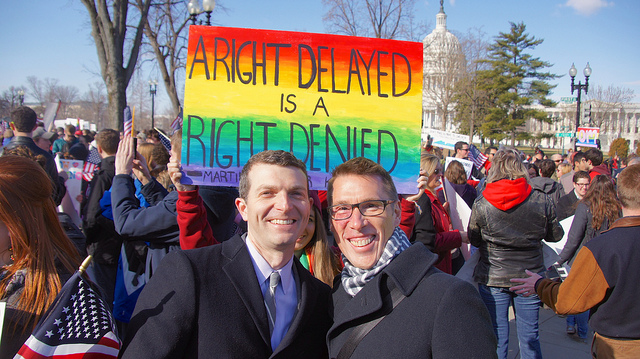
By now you may have heard that on the morning of June 26, the Supreme Court of the United States ruled in a landmark 5-4 decision (Obergefell v Hodges) that same-sex couples have a constitutional right to marriage, a right that cannot be denied by the laws of any state.

Prior to the ruling, same sex couples could only be married in 36 states and the District of Columbia. Marriage equality for same sex couples has been a controversial subject for decades, making the ruling all the more historic.

In 2013 the Supreme Court made a similar ruling which declared the Defense of Marriage Act (DOMA) unconstitutional. DOMA was initially enacted by Congress in 1996, defining marriage as the union between a man and a woman. DOMA essentially barred the federal government from recognizing same-sex marriages. Despite the ruling, the rights of same sex couples continued to be abridged by individual state laws. Even after DOMA was declared unconstitutional, many conservative states continued to deny same sex couples the right to marry. Due to this, thousands of law suits flooded into the courts to settle the issue once and for all. One of these suits was brought to court by Jim Obergefell, a widower demanding that his legal marriage to his partner of 21 years, be recognized in his state of residency, the state of Ohio. The June 26th SCOTUS decision has now put the debate to rest, though a long journey still lies ahead.

Continue reading

16229407771_5725895b69_z
The Department of State has issued an alert announcing that as of June 26, 2015 all visa issuing US embassies and consulates are now able to continue visa processing. Staff at US consulates and embassies were able to work over the weekend and resolve backlogs which are expected to be eliminated this week.

As you may recall between the time period of June 9, 2015 to June 19, 2014, 335,000 visas were unable to be printed due to clearance and technological issues. Of those 335,000 visas, approximately 300,000 have now been printed.

Consulates and embassies worldwide are now scheduling visa interviews and issuing non-immigrant and immigrant visas.

3934526517_8d71c74523_z

What are the most challenging questions for couples at a STOKES/Fraud Interview?

By Attorney Marie Puertollano, Esq.

What happens when a US Citizen Spouse and the intending immigrant spouse fail an interview pending an application for permanent residence?

Normally couples who have failed to provide sufficient documentation to an immigration officer, for the purpose of establishing their bona fide marriage—in other words that the marriage between both parties was entered in good faith and NOT to obtain an immigration benefit—may receive an appointment for a second interview also known as the STOKES or fraud interview. In some cases however a couple may be scheduled for a STOKES or fraud interview the very first time around. There are multiple reasons a couple may be scheduled for a STOKES/fraud interview. Couples should note that the burden of proof always rests on the couple. So what happens at this fraud interview? During the STOKES/fraud interview the couple is separated in different rooms and interrogated by an immigration officer. The officer will first interrogate one of the parties in a separate room. Then, the officer will question the other party asking the same exact questions.

Fraud interviews are lengthy and very complex. Officers ask very detailed questions that are challenging even for couples who have been together for many years. Our attorneys have successfully represented couples at hundreds of fraud interviews. Here are the most challenging questions that almost all couples are unprepared to answer despite having been together for many years. It is important that if a question is unclear or if the context of the question is unclear that the party ask the immigration officer for clarification.

Continue reading

11400978_10153396425248766_3904864215081914789_n

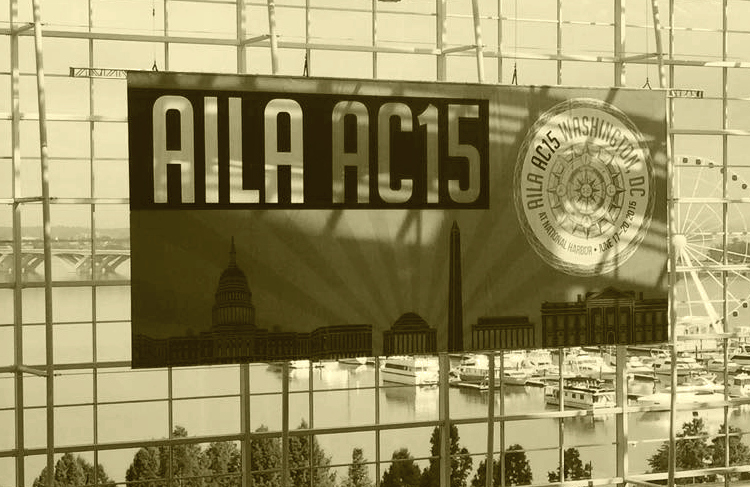
Presently, attorneys Jacob Sapochnick, Esq., Ekaterina Powell, Esq., and Yingfei Zhou, Esq. from our office are in attendance at the 2015 American Immigration Lawyers Association (AILA) Conference on Immigration Law taking place in Washington, DC. Together, they have had the privilege of being present for an open forum where officials from the Department of State and the National Visa Center provided valuable information in regards to modernization of PERM, improvements in visa processing at the National Visa Center, technical issues experienced at U.S. Consulates abroad, H-1B fee announcements, and more!

Technical issues experienced at U.S. Consulates worldwide

1. In regards to technical issues causing delays in visa issuance at U.S. Consulates worldwide, visa issuance is currently frozen. No visas are currently being issued at any U.S. Consulates worldwide. U.S. Consulates are rescheduling appointments for visas that were affected by the technical issues. The DOS is working to repair the hardware, however it will not be until next week when all issues will be resolved. Due to this, there will be a backlog for visa issuance and it will take longer to schedule a consular appointment for a visa.

2. If a visa applicant was affected by the technical issues at a U.S. Consulate abroad and they need to retrieve their passport urgently, they will be able to retrieve their passport, however, in doing so, applicants will forfeit the visa fees they have paid, and will be issued a 221(g) visa denial letter. If applicants are still interested in receiving a visa, they must re-apply and re-pay any visa fees. Applicants who are re-applying must note on future applications that their visa was denied due to a technical glitch. Applicants from visa waiver countries who are concerned that the visa denial will automatically result in an ESTA denial can rest assured. ESTA submissions will not be denied based on the technical glitch. DOS has responded that the technical issues will not affect future visa applications. Continue reading