Articles Posted in Court Injunction

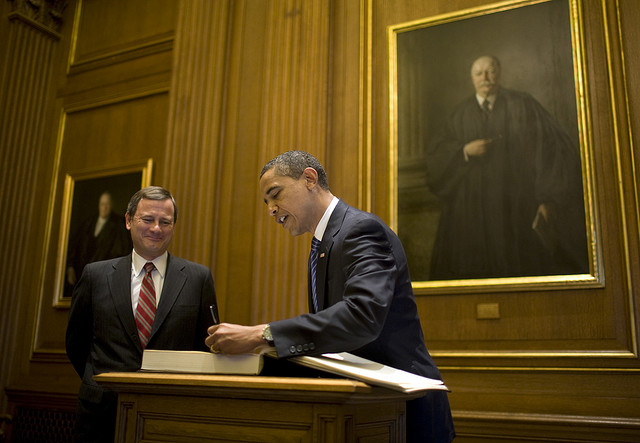
The Obama administration may announce its choice for the Supreme Court nomination as early as this week. We have learned that there are three contenders being considered for the Supreme Court nomination. All three candidates serve as judges for the United States Court of Appeals for the District of Columbia, and are well respected by both parties. They include Sri Srinivasan, Merrick Garland, and Paul Watford, who is rumored to be at the top of the President’s list. The Supreme Court nominee will be required to face a Republican Senate, in order to be formally appointed to the Supreme Court. Senate Republicans have already warned the White House that they will not hold hearings for any Supreme Court nominee suggested by President Barack Obama. As soon as Republicans heard of the passing of Justice Antonin Scalia, they urged caution from the White House. Senate Republicans anticipate that the next President of the United States will be the party’s Presidential nominee. It is for this reason that they claim that the Supreme Court nomination should be made by the next President of the United States, and not by Barack Obama. In a televised announcement, following the death of Antonin Scalia, President Obama made it very clear that his intentions were to choose the Supreme Court nomination, despite warnings from Republicans. Senate Republicans responded by stating that they would block any of the President’s advancements.

President Obama will need to choose a Justice that will have a tendency to vote liberally in order for his expanded Deferred Action for Childhood Arrivals (DACA) program and new Deferred Action for Parents of Americans and Lawful Permanent Residents (DAPA) program to survive. The expanded DACA and new DAPA program were introduced in November 2014 as part of President Obama’s executive actions on immigration. These programs have been temporarily suspended following a federal court order filed by Texas and other states. The Supreme Court is expected to hear oral arguments in the case, United States v. Texas, this April with a final ruling made by summer time.

Continue reading

6000446155_1d67582412_z

The fate of the President’s executive actions on immigration now rests in the hands of eight justices on the Supreme Court, absent Justice Antonin Scalia. The Supreme Court will begin to hear oral arguments for the case, United States v. Texas on April 18th of this year, with a final ruling expected by summertime. Nearly a year and a half ago, President Obama announced a series of executive actions on immigration including the expanded Deferred Action of Childhood Arrivals (DACA) program, the new Deferred Action for Parents of Americans and Lawful Permanent Residents (DAPA) program, and other measures to enhance border security, prioritize deportations, and modernize the immigration system. USCIS was expected to begin accepting applications for the expanded DACA and DAPA program on February 18th. The excitement surrounding the expanded DACA and DAPA program however was very short lived. A federal court order filed by Texas and other states on February 16th temporarily suspended these programs from going into effect.

Since then, the federal government and the State of Texas have been battling one another in court. The Fifth Circuit court determined that Texas and at least 25 other states had sufficient ‘standing’ to challenge both programs from being implemented. The state of Texas along with other states, argue that these programs are not only outside the purview of the President’s constitutional power, but that the States would be substantially burdened, should the programs go into effect. Texas states that as a result of these programs, the State would suffer increased health-care, law enforcement, and educational costs which would come out of the State budget and more importantly the pockets of Texas residents, who do not take kindly to these programs. Additionally, Texas claims that it would suffer additional financial burden in having to issue more drivers’ licenses to individuals qualifying for expanded DACA and DAPA, a state-subsidized benefit. If the Supreme Court decides in favor of the federal government, nearly 5 million immigrants residing in the United States unlawfully will be shielded from deportation, and States will be forced to bear the costs to accommodate their new ‘deferred’ status. Deferred status will grant individuals the right to legally obtain employment, obtain a social security number, a driver’s license, and an education, but it is not a path to citizenship. As it stands, it is unlikely that a new Supreme Court Justice will be appointed before oral arguments begin in this case, especially with mounting political pressure from Republicans seeking to block the President from making a nomination.

Continue reading

3198083648_b5276e02c4_z

This morning, the Supreme Court announced that it would hear arguments for and against the extended Deferred Action for Childhood Arrivals (DACA) program and the new Deferred Action for Parents of U.S. Citizens and Lawful Permanent Residents (DAPA) program. If the government succeeds in its appeal, millions of undocumented immigrants will be granted temporary employment authorization, ‘deferred status’ meaning that these individuals will no longer need to fear deportation, and other benefits such as the ability to apply for a social security number. This decision is a victory for the Obama administration since it leaves open the possibility that the Supreme Court will lay down an important legal precedent in the midst of the presidential campaign and Obama’s exit from the White House.

  • To learn how expanded DACA is different than the initial DACA program click here.
  • To learn about the DAPA program click here.

3198083750_597c4a4e90_z
The Supreme Court justices are currently in deliberations, to decide the fate of Barack Obama’s expanded Deferred Action for Childhood Arrivals (DACA) and Deferred Action for Parents of U.S. Citizens and Lawful Permanent Residents (DAPA) announced November 2014, as part of the President’s executive actions on immigration. At issue is whether or not the Court will hear arguments for and against lifting the temporary court injunction, which prevented the expanded DACA program and the new DAPA program from moving forward as initially anticipated.

The extended DACA and DAPA provisions were scheduled to go into effect on February 18, 2015, but were quickly blocked by a temporary injunction filed by Texas and 26 other states, just three days before applications for extended DACA and DAPA would have been accepted by USCIS. What has resulted has been a near two-year legal battle between the federal government and the states in question.

Timeline of legal action between the federal government and plaintiffs:

8425492426_e2cd908a3f_z

As previously reported, the STEM Optional Practical Training (OPT) rule that had been in place since 2008, was invalidated following a court order requesting the Department of Homeland Security to issue a new replacement rule. The court gave the DHS until February 12, 2016 to come up with a replacement rule in order for the STEM OPT program to continue. In order for a new replacement rule to be put in place, DHS was required to publish the final rule 60 days before its effective date, according to procedural rules established by the Administrative Procedures Act. In order to meet such a deadline, DHS needed to have published the final rule by December 14, 2015 in order for it to be enforced by the February deadline. Luckily, the government filed a motion to extend the stay of the court order—to May 10, 2016, thus requesting an additional 90 days for the government to implement a final rule. In order for the motion to be successful the government must establish that exceptional circumstances warrant such relief to be given. The government has argued that there is an unprecedented amount of comments that cannot be reviewed and analyzed by the February deadline. During the comment period, DHS received over 50,000 comments that it must review, revise, and finally publish a final rule. The court is not expected to rule on the motion until early 2016. Meanwhile the plaintiffs of the original suit have filed an appeal before the DC Circuit Court arguing that the OPT program is not within the authority of the DHS.

If the motion is unsuccessful, the government may file a motion at the district court level or request a stay of the court’s injunction at the circuit court level. In any case, those affected should be aware that the government still has several avenues through which relief may be granted: (1) the Judge may grant the government its requested 90-day delay on the present motion; (2) the Judge may later grant a complete stay pending appeal of the injunction; or (3) the DC Circuit may stay the Judge’s injunction while it considers the merits of her rulings in the underlying case.  CIS has not yet released official correspondence explaining whether students affected will be granted a STEM extension after the February deadline.

For more information please contact us.

District Court Denies Request for Temporary Restraining Order to Halt Syrian Re-Settlement Program in Texas

23348054250_3bfc1cd6a0_z

First Family of Syrian Refugees Arrives in Canada

In their December suit, Texas Health and Human Services Commission V. United States, et, al., the state of Texas alleged that the United States government and the International Rescue Committee unlawfully attempted to re-settle six Syrian refugees in the city of Dallas without prior  consultation and collaboration. According to Texas, the federal government failed to consult with the state regarding re-settlement of these refugees, and prevented them from receiving vital information relating to security risks posed by Syrian refugees prior to their re-settlement. Texas also claimed that the International Rescue Committee similarly failed to collaborate and consult with the Texas Health and Human Services Commission in advance prior to the re-settlement of these refugees. To protect itself, the state of Texas asked for an injunction and a temporary restraining order to halt the resettlement of Syrian refugees until security checks could confirm that these Syrian refugees do not pose a threat to the state of Texas.

On December 9, 2015 the U.S. district court denied the temporary restraining order, adding that the state of Texas failed to provide compelling evidence to suggest that Syrian refugees pose a substantial threat of irreparable injury to its citizens. Presiding district court Judge David C. Godbey added that, “the [Texas] commission has failed to show by competent evidence that any terrorists actually infiltrated the refugee program, much less that these particular refugees are terrorists’ intent on causing harm.” Although the lawsuit still stands and will likely not receive a final ruling until early next year, the district court set an important precedent in its denial of the temporary restraining order. Judge Godbey further maintained that it is not within the purview of the district court to assess what risk, if any, Syrian refugees pose to any particular state. Such risk can only be assessed by the federal government. On this issue Godbey stated that, “the Court has no institutional competency in assessing the risk posed by refugees. That is precisely the sort of question that is, as a general matter, committed to the discretion of the executive branch of the federal government, not to a district court.” The rest of the lawsuit remains in litigation.

Continue reading

8536270677_216de82424_z


Yesterday, December 2, 2015 the state of Texas brought suit against the federal government and the International Rescue Committee (IRC), before the United States District Court in Texas Health and Human Services Commission V. United States et al., 12/2/15. In its suit, the state of Texas claims that the federal government and the IRC acted unlawfully in their attempt to resettle Syrian refugees without prior consultation and direct cooperation with the state of Texas, as required by federal law. The lawsuit was brought by the Texas Health and Services Commission (THSC) representing the interests of the state of Texas in court. The THSC is an agency responsible for the administration and development of the refugee resettlement program in Texas. The state of Texas discovered in a phone call with the IRC that the Committee intended on resettling 6 Syrian refugees in Dallas, Texas on December 4, 2015 without consent. On December 1, 2015 Texas addressed the Committee in a letter requesting a halt to the resettlement of Syrian refugees until the state would receive security assurances and discuss proper screening procedures for said refugees. The IRC responded on December 2nd that it would continue the resettlement process as planned resettling the refugees in Texas.

Refugee Resettlement Program

Texas administers the refugee resettlement program along with the assistance of local government agencies responsible for the financial costs associated with the refugee’s resettlement and transition to the state of Texas.  In order to accomplish its endeavors, all federal and state agencies must adhere to strict framework’s established by the Refugee Act of 1980, which require collaborative and cooperative efforts between all entities involved in the process of refugee resettlement. According to Texas, “instead of adhering to that statutory framework, the federal government and the Committee have left Texas uninformed about refugees that could well pose a security risk to Texans and without any say in the process of resettling these refugees.”

Arguments for the state of Texas

In its suit, Texas aims to re-assert its sovereignty and obligation to protect the safety of its residents. Texas claims that the government’s failure to adhere by the law has raised legitimate security concerns involving potential complicity between refugees and terrorists.

Continue reading

logo-2

By Yingfei Zhou, Esq. 

Last week, attorneys Yingfei Zhou, Esq. and Marie Puertollano, Esq. from our office attended the 28th AILA California Chapter Conference on Immigration Law held in San Diego, California. Together, they brought our audiences the latest updates on various issues discussed at the government open forums.

  1. USCIS I-797C Receipt Notices or I-797B Approval Notices without I-94 attached are not accepted by DMV as Proof of Legal Residence

3021087753_980feb0669_z

Yesterday night, in a 2-1 vote the United States Fifth Circuit Court of Appeals voted to uphold the lower court’s decision in Texas v. United States blocking President Obama’s extended Deferred Action for Childhood Arrivals (DACA) and Deferred Action for Parents of Americans and Lawful Permanent Residents (DAPA) programs from going into effect.

The expanded DACA and new DAPA provisions were announced November of last year as part of Obama’s executive actions on immigration giving eligible undocumented individuals a legal status in the United States. The expanded DACA program would have made millions of law abiding undocumented aliens (with no criminal history) eligible for employment authorization and social security benefits. To qualify, expanded DACA applicants would need to provide documented evidence proving their continuous physical presence in the United States from January 1, 2010 onward. In exchange, the United States government would recognize these individuals as law abiding residents and safeguard them against deportation. The move was significant since it would mean that undocumented individuals would no longer need to live on the fringes of society. By granting these individuals an immigration classification, insurance companies would become accessible to them for the first time ever.

Similarly, Obama’s DAPA program would have extended eligibility of deferred action to parents of US Citizens and Lawful Permanent Residents born or or before November 20, 2014 the date of the DAPA program’s announcement. As part of the application process, DAPA applicants would be required to undergo extensive background checks and prove continuous residence since January 1, 2010 among other provisions. Click here for more information on DAPA.

Continue reading

Senate

On October 20, 2015 Democrats in the Senate successfully blocked the Republican backed bill S. 2146: Stop Sanctuary Policies and Protect Americans Act from moving forward with a vote of 54-45. At its core, the bill aimed to hold sanctuary jurisdictions accountable for noncompliance of federal orders including detainment of undocumented immigrants, increasing penalties for individuals caught re-entering the United States after their removal, and providing protection to state and local law enforcement officials cooperating with federal law enforcement officials. The bill was introduced by Republicans after an act of violence took the life of a San Franciscan woman at the hands of an alleged undocumented immigrant with a felony record, who had also been the subject of multiple removals. Public outcry ensued after the city sheriff released the perpetrator despite a federal immigration detainment order. According to Republicans, San Francisco is one of hundreds of sanctuary cities that refuse to comply with federal immigration orders to facilitate the detainment and removal of undocumented immigrants.

Among its provisions, the bill aimed to crackdown on so called ‘sanctuary cities’ notorious for their noncompliance by limiting government funding. By cutting necessary funding, Republicans hoped that this would force cooperation between local law enforcement officials and federal law enforcement officials including ICE officers. Republican Senator Vitter who introduced the bill, argued that the violent crime that occurred in San Francisco was just one example highlighting the magnitude of compliance concerns. According to Vitter, ‘sanctuary cities’ like San Francisco have repeatedly refused to comply with orders of detainment issued by the Department of Homeland Security. Prior to the vote, the White House had warned Senate Republicans that if the bill did pass with the 60 necessary votes, they could expect the President to veto the bill. Although the bill was criticized by Democrats for stereotyping undocumented immigrants and making sweeping allegations against the undocumented immigrant community, the bill raises serious competence and compliance concerns.

Continue reading