Articles Posted in Deferred Action and DREAM Act Students

5808492140_09871b9bdc_z

There is no denying that the election of Donald Trump as next President of the United States has dealt a huge blow to the immigration reform effort and diminished any hope for the passage of broader legal immigration reform. We had hoped that with the election of Hillary Clinton we would see an increase in immigration levels for highly skilled workers, as well as increased visa opportunities for entrepreneurs and investors. While the news of Donald Trump’s election was a big setback for immigration in general, polling continues to suggest that people across the United States are willing to support fairness in dealing with the undocumented immigrant population in a sensible and human way. By contrast, most Americans disapprove of passing broad legal immigration reform that would benefit foreign workers.

Donald Trump was able to win the favor of a great number of Americans because of his critical view of programs like NAFTA that he believes has allowed American jobs to go overseas. Trump has blamed the U.S. government for allowing programs like the H-1B worker program to exist, saying that foreign workers are taking American jobs. We can expect to see Donald Trump take a restrictive view on legal immigration, keeping immigration levels within historic norms. Donald Trump has until recently softened his tone on illegal immigration, claiming that his priority is to deport only dangerous criminals residing in the United States unlawfully, although his 10-point plan contradicts his recent stance.

It is likely that the Republican House and the Senate will introduce legislation designed to benefit American workers and the economy, and focus less on creating immigration opportunities for foreign workers. Similarly, the Trump administration will likely focus on job creation, and less on passing any meaningful legal immigration reform.

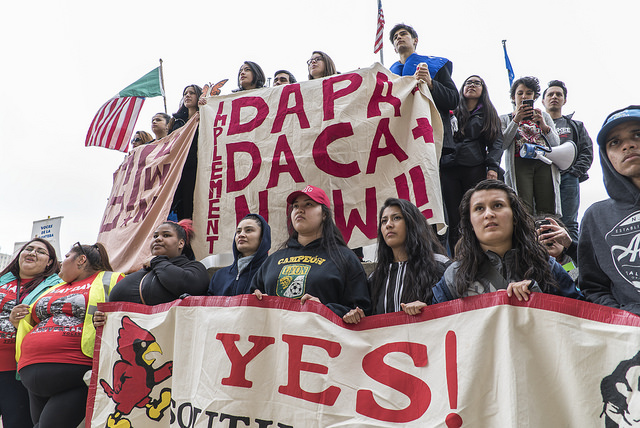
The program that may come under fire by the Trump administration is the Deferred Action for Childhood Arrivals (DACA) initiative which began on June 15, 2012 as part of an executive order introduced by President Barack Obama. Donald Trump has repeatedly said that he wants to end the Deferred Action for Childhood Arrivals (DACA) program incorrectly calling it an “amnesty.” In actuality, DACA is not amnesty and does not provide a pathway to permanent residency or even citizenship. DACA merely shields the individual from deportation and allows them to legally obtain employment in the United States for a temporary period of time.


Continue reading

Men in a Huddle

On June 15, 2012 President Barack Obama first unveiled the Deferred Action for Childhood Arrivals (DACA) initiative to the world. In his 2012 announcement the President divulged that the DACA initiative would allow certain undocumented individuals who came to the United States as children the opportunity to be shielded from deportation and the right to a temporary work permit. To be eligible individuals were required to meet several guidelines to receive ‘deferred action’ for a period of two years, subject to renewal. USCIS began to accept applications for the DACA initiative on August 15, 2012.

At its core, ‘deferred action’ is the use of prosecutorial discretion to defer removal from the United States for a certain period of time. Although deferred action grants such deferment, it does not provide the individual lawful status and it is not a path to permanent residency.

On November 20, 2014 the President unveiled two initiatives that would expand the population eligible to obtain Deferred Action. Additionally, the President announced a new initiative called Deferred Action for Parents of Americans and Lawful Permanent Residents (DAPA). To be eligible for the expanded DACA program applicants were required to a) have entered the United States before the age of 16; b) demonstrate continuous residence in the United States since January 1, 2010; and pass required background checks. The initiative would also extend the period of ‘deferred action’ and work authorization to three years rather than two years.

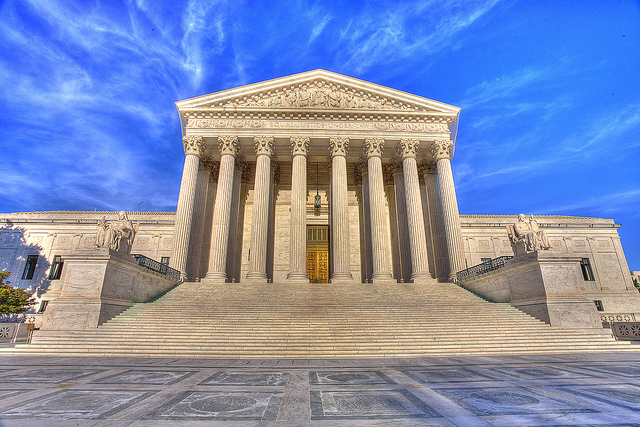
Similarly, parents of U.S. Citizens and LPRs would be also be eligible for deferred action and employment authorization for a three-year period if a) they could demonstrate continuous residence in the United States since January 1, 2010 and b) pass required backgrounds checks. On February 16, 2015 just two days before applications would begin to be accepted for the expanded DACA and DAPA programs, a temporary injunction halted these programs from going into effect. The controversy that followed regarding these programs led to a federal lawsuit known as United States v. Texas which made its way to the Supreme Court of the United States. There the Supreme Court deadlocked in a 4-4 vote preventing these programs from going into effect.

Continue reading

6071512063_e265d65eba_z

Today the Supreme Court of the United States dealt a strong blow to President Barack Obama’s executive actions on immigration issuing a single one-line decision on the ruling “the judgment of the lower court is affirmed by an equally divided court.” Nearly two years ago, President Obama announced a series of executive actions on immigration after the Republican controlled House of Representatives refused to tackle the issue of comprehensive immigration reform. As part of his executive actions on immigration, President Obama announced the expansion of the Deferred Action for Childhood Arrivals (DACA) program, and introduced a new program known as Deferred Action for Parents of Americans and Lawful Permanent Residents, (DAPA) designed to shield nearly five million undocumented immigrants from deportation. Following these initiatives, USCIS announced that applications for expanded DACA and the new DAPA program would begin to be accepted on February 18, 2015.

The DACA program would have expanded the population eligible for the Deferred Action for Childhood Arrivals (DACA) program to people of any current age who entered the United States before the age of 16 and lived in the United States continuously since January 1, 2010, and extending the period of DACA and work authorization from two years to three years. The new DAPA program would have granted parents of U.S. Citizens and lawful permanent residents the opportunity to request deferred action and employment authorization for a three year period, on the condition that they have lived in the United States continuously since January 1, 2010 and pass required background checks.

On February 16, 2015 just two days before the programs were scheduled to go into effect, Texas along with 25 other states, filed a temporary court injunction ultimately suspending both programs from going into effect. This action prompted the Obama administration to intervene. For months, the federal government and the State of Texas battled one another in federal court. The court ultimately determined that Texas and at least 25 other status had sufficient ‘standing’ to challenge these programs. In response, the federal government filed an emergency motion to stay, however the motion was eventually denied by the court. This led the government to file a writ of certiorari before the Supreme Court. The fate of Obama’s executive actions grew all the more uncertain with the sudden death of conservative Supreme Court Justice Antonin Scalia on February 13th.  President Obama made desperate attempts to fill the vacated seat by nominating Merrick Garland to the Supreme Court, the Chief Judge of the United States Court of Appeals for the District of Columbia. Efforts to fill the seat were unsuccessful as Republicans vowed to keep Garland from sitting on the bench. Thus, Scalia’s death left behind an eight-person bench, and with no one to fill his seat, the growing possibility of a deadlock within the Supreme Court.

Continue reading

2543596002_1900c6f214_z

Did you know that if you fail to provide USCIS written notice of a change of address, within 10 days of moving to your new address, you may be convicted of a misdemeanor crime?  If you currently have a case pending with USCIS, and you fail to provide written notice of a change of address to USCIS, within 10 days of moving, you could face a fine of up to $200, imprisonment up to 30 days, or both if convicted. If you are an alien (non U.S. Citizen) you could also face removal from the United States for non-compliance (INA Section 266(b)).

It is extremely important for applicants to notify USCIS immediately upon moving to a new address. Filing a change of address with USCIS is easy and it’s free. Applicants may change their address online by visiting the USCIS website and completing Form AR-11 online. In order to file a change of address online, you must know the Receipt Number (appearing on the Notice of Action) associated with your application, if your application is currently pending with USCIS. A Receipt Number is also known as the case number, identifying the petition submitted. The Receipt Number typically begins with three letters and is followed by ten digits.

The first three letters of the Receipt Number indicate the USCIS service center which is processing the petition, as follows:
– EAC – Vermont Service Center;
– WAC – California Service Center;
– LIN – Nebraska Service Center; and
– SRC – Texas Service Center

If you have filed more than one petition with USCIS (as in cases of adjustment of status for spouses of U.S. Citizens) you must provide the receipt number of each petition you have filed, when submitting the change of address online. If you do not have your receipt notice or have lost it, you should contact USCIS National Customer Service Center by telephone for assistance:

Our number is: 1 (800) 375-5283
Our TTY number is: 1 (800) 767-1833

If you are outside the United States and have filed an application or petition with a USCIS Service Center, you can call 212-620-3418 to check the status of your case.

Continue reading

26762616905_3855617f27_zAs previously reported, the Department of Justice is currently facing off in court against a federal judge from the State of Texas, who has accused federal prosecutors of misrepresenting, and withholding information in federal court, related to the implementation of the expanded Deferred Action for Childhood Arrivals (DACA) program and new Deferred Action for Parents of Americans and Lawful Permanent Residents (DAPA) program that was scheduled to take effect on February 18, 2015, as part of President Barack Obama’s executive actions on immigration. All of that changed, when Judge Hanen filed a temporary injunction in court, blocking these executive orders from taking effect, just days before February 18, 2015. Judge Hanen is asking the court to punish federal prosecutors working for the Department of Justice by forcing them to attend mandatory ethics courses.

In addition, Hanen has requested that the Department of Homeland Security hand over the names, addresses, and other information of individuals who were unlawfully granted immigration benefits under these programs. On Friday, a group of undocumented individuals came forward, asking an appellate court to respect their privacy by not turning over their personal information to the State of Texas, and other interested parties. This group of undocumented individuals is currently being represented by the American Civil Liberties Union (ACLU) and the National Immigration Law Center (NILC). Attorneys for the group are expected to argue before the U.S. Court of Appeals for the Fifth Circuit in order to block Judge Hanen’s order.

Continue reading

15531282194_c5c9b33b52_bToday May 31, 2016 the United States Department of Justice (DOJ) filed an emergency motion to prevent a federal judge from the State of Texas from imposing sanctions on DOJ prosecutors, requiring them to attend mandatory ethics classes. The federal judge in question is Andrew Hanen, the same judge who issued a temporary injunction blocking the expanded DACA and DAPA programs from taking effect on February 18, 2015, as originally intended by the Obama administration. The case United States v. Texas has made its way up to the Supreme Court of the United States. An official ruling assessing the legality of the expanded DACA and new DAPA program is expected this summer.

Judge Hanen filed the judicial order after federal prosecutors acknowledged that they were not completely transparent in regards to implementation of the expanded DACA and new DAPA program. Hanen argues that he was assured that the government would not start implementation of these programs until February 18, 2015 when in fact the government implemented a portion of the program before February and granted more than 100,000 applications. After reading government briefs acknowledging this information, Judge Hanen claimed that attorneys for the Department of Justice were not only knowledgeable of the facts, but were guilty of misrepresenting them in federal court.

In addition to ordering sanctions on federal prosecutors, Judge Hanen has ordered the Department of Homeland Security (DHS) to provide the names of individuals who were granted benefits under these programs, despite not being eligible to receive those benefits. This move would require the Department of Justice to release the records of more than 50,000 people.

Authority of Law Statue

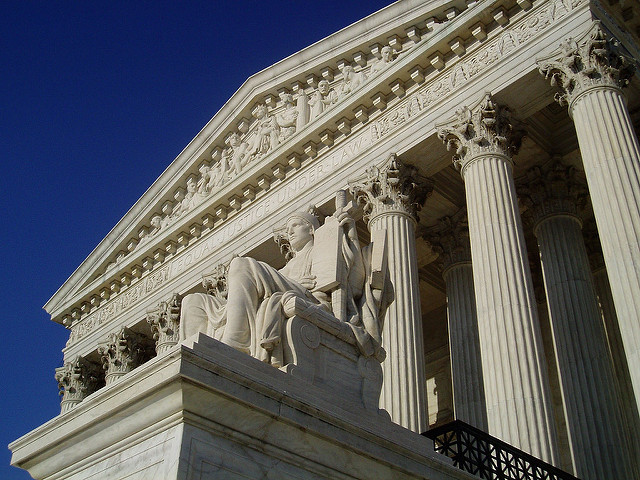
On April 18, 2016 the United States Supreme Court heard arguments in the lawsuit United States v. Texas, a lawsuit brought by 26 states, led by the state of Texas, challenging President Barack Obama’s executive actions on immigration. These executive actions include the expanded Deferred Action for Childhood Arrivals (DACA) program, and the new Deferred Action for Parents of Americans and Lawful Permanent Residents (DAPA) program announced by President Obama in November of 2014. Following this announcement, the Obama administration received push back from the Republican led House of Representatives. There was also public outcry from conservatives, when President Obama announced that these programs would not only shield eligible individuals from deportation, but allow them to obtain employment authorization. In February 2015 these initiatives came to a screeching halt, when a federal district court granted these states a preliminary injunction preventing the implementation of expanded DACA and DAPA to take place. Since then, the lawsuit has moved through the courts, and now remains at the Supreme Court. On Monday April 18th eight justices heard oral arguments in the case arguing for and against these executive actions on immigration. A final decision is expected from the justices in June. The Director of Advocacy at the American Immigration Lawyers Association (AILA) Greg Chen, AILA’s Legal Director Melissa Crow, and UCLA Law Professor Hiroshi Motomura weighed on what happened in the court Monday morning and what we can expect from the Court moving forward.

The experts identified 2 key issues that were discussed during Monday’s oral arguments.

The court mainly focused on:

  1. Threshold question: Whether or not the Supreme Court should consider the case in the first place. The court asked themselves if the plaintiff states have standing to sue in the first place to bring the case to the court.
  2. The Merits of the case: Whether or not the President has the authority to implement these executive actions based on the ‘Take Care’ clause of the constitution.

Greg Chen highlighted that this case is particularly important because for the first time in 20 years, we have not seen any real immigration reform from any of the three branches of government. Chen also noted that these executive actions on immigration, if implemented, would shield millions of undocumented immigrants from deportation. States also have a huge interest in passing these executive actions for the economic and tax revenue benefits alone, since undocumented immigrants have not been able to properly abide by tax laws due to their unlawful presence in the United States.

Melissa Crow highlighted that in Court proceedings, the traditionally four ‘liberal’ justices on the bench Breyer, Sotomayor, Ginsburg, and Kagan seemed to be sympathetic to the Obama administration in the questions they posed to the attorneys representing both sides in this lawsuit. Melissa noted that in order to overturn the federal injunction halting expanded DACA and DAPA, a fifth vote is required from the conservative camp either from Chief Justice Roberts or Justice Kennedy. The questions posed by the traditionally ‘conservative’ justices did not necessarily provide clues into their stance on these issues. Their questions simply showed that they were engaged in the issues and mostly focused on the issue of standing to sue.

Continue reading

6733401147_3a5069bba1_z
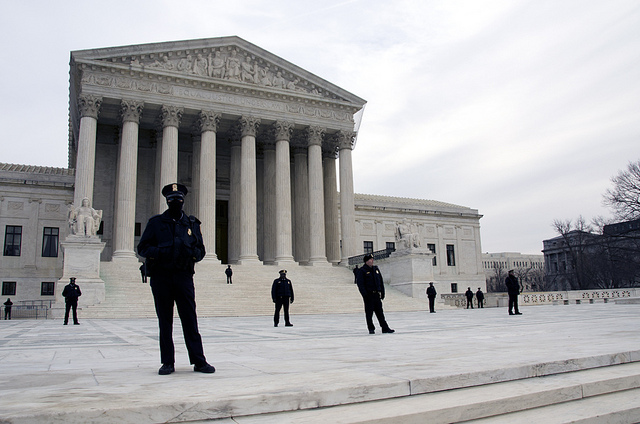
Today the Supreme Court of the United States will begin hearing arguments in the case United States v. Texas, a lawsuit challenging Obama’s executive actions on immigration. As you have heard, a federal court order temporarily froze the expanded DACA and new DAPA programs from going into effect as expected. The Supreme Court will decide the fate of these programs by June of this year.

It is truly an exciting time of the year for immigration law. United States v. Texas is the biggest immigration case of our generation. The Supreme Court’s ruling will set an important precedent for the future of immigration policy. The court will also determine whether the President had authority to enforce the executive actions on immigration. As a member of the American Immigration Lawyer’s Association (AILA), we invite you to join a live webcast with AILA experts Greg Chen,  Legal Director Melissa Crow, and UCLA School of Law Professor Hiroshi Motomura on Tuesday, April 19, 2016, at 1:00 pm (ET), as they recap and offer expert analysis of Monday’s Supreme Court oral arguments in the United States v. Texas case.

Click here to watch the live stream.

14301886764_524229d763_z

The Supreme Court is expected to hear oral arguments for United States v. Texas, a lawsuit challenging the President’s executive actions on immigration, on Monday April 18th.  We have learned that attorneys representing the Republican led House of Representatives will be given 15 minutes to argue against Obama’s executive actions on immigration, included the expanded Deferred Action of Childhood Arrivals (DACA) program, and the Deferred Action for Parents of Americans and Lawful Permanent Residents (DAPA) program. This move comes after the House of Representatives voted in favor of filing a brief before the Supreme Court challenging the executive actions on immigration. The court has also authorized a group of undocumented mothers of U.S. Citizen children to speak before the Supreme Court for 10 minutes. The Obama administration is currently at a disadvantage, given that only eight Supreme Court justices will ultimately be handing down one of the most important decisions of our generation come June. Obama had hoped that the House of Representatives would hold hearings in consideration of his Supreme Court pick, Chief Judge of the District of Columbia Court of Appeals, Merrick Garland, by the time oral arguments would begin. Unfortunately, this has not been the case. Republicans have refused to hold hearings in consideration of Judge Garland. It is likely that they will continue to delay hearings until the next President of the United States takes office next year.

Oral arguments on April 18th will be no more than 90 minutes long. The majority of the time will be divided by the Obama administration and attorneys representing Texas and 25 other states challenging the constitutionality of Obama’s executive actions on immigration. United States v. Texas is unique because it will finally put to rest the issue of whether or not the executive action on immigration is within the President’s constitutional powers. This case is also unique because it will be one of the few times that the Supreme Court has addressed the issue of illegal immigration and the rights of unlawful immigrants under the constitution.

Continue reading