Articles Posted in Executive Actions

6000446155_1d67582412_z

The fate of the President’s executive actions on immigration now rests in the hands of eight justices on the Supreme Court, absent Justice Antonin Scalia. The Supreme Court will begin to hear oral arguments for the case, United States v. Texas on April 18th of this year, with a final ruling expected by summertime. Nearly a year and a half ago, President Obama announced a series of executive actions on immigration including the expanded Deferred Action of Childhood Arrivals (DACA) program, the new Deferred Action for Parents of Americans and Lawful Permanent Residents (DAPA) program, and other measures to enhance border security, prioritize deportations, and modernize the immigration system. USCIS was expected to begin accepting applications for the expanded DACA and DAPA program on February 18th. The excitement surrounding the expanded DACA and DAPA program however was very short lived. A federal court order filed by Texas and other states on February 16th temporarily suspended these programs from going into effect.

Since then, the federal government and the State of Texas have been battling one another in court. The Fifth Circuit court determined that Texas and at least 25 other states had sufficient ‘standing’ to challenge both programs from being implemented. The state of Texas along with other states, argue that these programs are not only outside the purview of the President’s constitutional power, but that the States would be substantially burdened, should the programs go into effect. Texas states that as a result of these programs, the State would suffer increased health-care, law enforcement, and educational costs which would come out of the State budget and more importantly the pockets of Texas residents, who do not take kindly to these programs. Additionally, Texas claims that it would suffer additional financial burden in having to issue more drivers’ licenses to individuals qualifying for expanded DACA and DAPA, a state-subsidized benefit. If the Supreme Court decides in favor of the federal government, nearly 5 million immigrants residing in the United States unlawfully will be shielded from deportation, and States will be forced to bear the costs to accommodate their new ‘deferred’ status. Deferred status will grant individuals the right to legally obtain employment, obtain a social security number, a driver’s license, and an education, but it is not a path to citizenship. As it stands, it is unlikely that a new Supreme Court Justice will be appointed before oral arguments begin in this case, especially with mounting political pressure from Republicans seeking to block the President from making a nomination.

Continue reading

4668514068_02942d6921_z

“He was a jurist of captivating brilliance and wit, with a rare talent to make even the most sober judge laugh. The press referred to his “energetic fervor,” “astringent intellect,” “peppery prose,” “acumen,” and “affability,” all apt descriptions. He was eminently quotable, his pungent opinions so clearly stated that his words never slipped from the reader’s grasp” -Ruth Bader Ginsburg

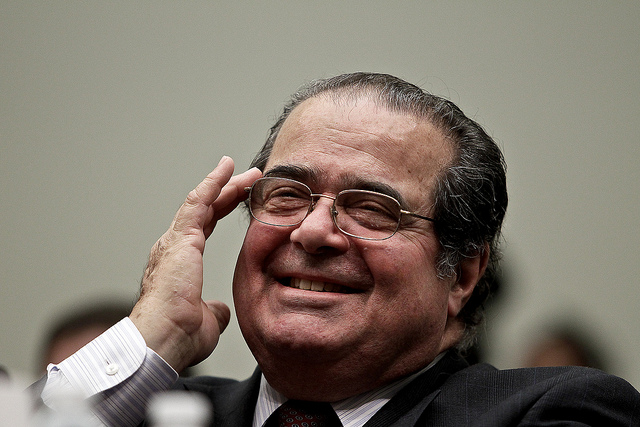
When news broke of the passing of the longest serving Justice on the Supreme Court, Antonin Scalia, a cloud of uncertainty lifted above the heads of Republican frontrunners vying for the Republican nomination for President of the United States. Indeed, the topic of conversation during the February 13th Republican Presidential Debate, which occurred on the day of Justice Scalia’s passing, focused on whether or not the current President should nominate the next Supreme Court Justice. Justice Antonin Scalia, nominated to the Supreme Court by President Ronald Reagan in 1986, was the most outspoken conservative on the bench, and not very well liked by liberal politicians and intellectuals, primarily due to the philosophy behind his jurisprudence. Scalia’s jurisprudence during his 29 years on the bench belonged to the Originalist school of thought. An Originalist’s interpretation of the Constitution denies the contention that the Constitution should be interpreted by the Court as a living, breathing document, a view that is typically shared by liberal Constructivist Justices like Ruth Bader Ginsburg. Instead, Originalists believe that the Constitution should be interpreted according to the original intent or meaning shared by the founders as it was written. This would require an Originalist to adhere to the spirit of the law as it was intended by the founders of our country, as well as an understanding of what was meant when the Constitution was originally drafted.

During his time on the bench, Scalia tenaciously criticized the liberal Constructivist view, calling this interpretation of the Constitution, judicial activism, which he viewed as inappropriate. In his view the Supreme Court must be insulated and not be swayed by the social concerns of the public. Throughout his trajectory, Scalia has gone down in history for handing down the most controversial dissents in the history of the Supreme Court, avidly supporting the right to bear arms, challenging the right to abortion, affirmative action, gay rights, and was ultimately instrumental in securing the Presidential nomination of George W. Bush in the 2000 case Bush V. Gore. Up until his untimely death, the Supreme Court held a conservative majority. The conservatives on the bench include Chief Justice, John G. Roberts Jr. nominated by President George W. Bush in 2005, Justice Clarence Thomas nominated by President George W. Bush in 1991, Justice Samuel Anthony Alito Jr nominated by President George W. Bush in 2006, Justice Anthony Kennedy, a moderate conservative swing vote nominated by President Ronald Reagan in 1988, and up until recently Antonin Scalia nominated by Ronald Reagan in 1986. Together, these conservative Justices established a 5-4 majority against liberal Justices: Ruth Bader Ginsburg, Stephen G. Breyer, and recently appointed Justices Elena Kagan and Sonia Sotomayor. Justice Antonin Scalia’s sudden death has now upset the conservative majority, creating a balance of power between conservative and liberal minds on the bench. With the death of Scalia, the bench is now evenly split ideologically 4-4 with a vacant seat ready to be filled by a liberal Justice, thereby creating a Liberal majority. This of course will not be easy, since the Senate is dominated by the Republican party, and the Senate will be in charge of vetting the President’s nominee.

Continue reading

3198083648_b5276e02c4_z

This morning, the Supreme Court announced that it would hear arguments for and against the extended Deferred Action for Childhood Arrivals (DACA) program and the new Deferred Action for Parents of U.S. Citizens and Lawful Permanent Residents (DAPA) program. If the government succeeds in its appeal, millions of undocumented immigrants will be granted temporary employment authorization, ‘deferred status’ meaning that these individuals will no longer need to fear deportation, and other benefits such as the ability to apply for a social security number. This decision is a victory for the Obama administration since it leaves open the possibility that the Supreme Court will lay down an important legal precedent in the midst of the presidential campaign and Obama’s exit from the White House.

  • To learn how expanded DACA is different than the initial DACA program click here.
  • To learn about the DAPA program click here.

3198083750_597c4a4e90_z
The Supreme Court justices are currently in deliberations, to decide the fate of Barack Obama’s expanded Deferred Action for Childhood Arrivals (DACA) and Deferred Action for Parents of U.S. Citizens and Lawful Permanent Residents (DAPA) announced November 2014, as part of the President’s executive actions on immigration. At issue is whether or not the Court will hear arguments for and against lifting the temporary court injunction, which prevented the expanded DACA program and the new DAPA program from moving forward as initially anticipated.

The extended DACA and DAPA provisions were scheduled to go into effect on February 18, 2015, but were quickly blocked by a temporary injunction filed by Texas and 26 other states, just three days before applications for extended DACA and DAPA would have been accepted by USCIS. What has resulted has been a near two-year legal battle between the federal government and the states in question.

Timeline of legal action between the federal government and plaintiffs:

9033805851_a19992134e_z

On Thursday, December 31, 2015 the Department of Homeland Security published a new proposed rule affecting highly skilled immigrant and non-immigrant workers alike. The proposed rule, introduced in last week’s federal register, aims to improve the ability of American employers to hire and retain highly skilled workers waiting to receive their employment-based lawful permanent residence in the visa bulletin backlogs. Additionally, the proposed rule aims to enhance opportunities for such workers allowing them to be more easily promoted, to accept lateral positions with their current employers, change employers, and pursue other employment. While the proposed rule is not groundbreaking, it does address important challenges employers and their highly skilled workers have faced as the law stands today and makes recommendations for such relief. The proposed rule will be open for comment until February 29, 2016.

You may remember that on November 20, 2014 the President highlighted, as part of his executive actions on immigration, that the employment-based immigration system needed to be amended to modernize, improve, and clarify immigrant and nonimmigrant visa programs in order to create more jobs, foster innovation at home, retain a highly skilled workforce that would allow the United States to compete with other countries, and to stimulate the American economy overall.  In order to modernize the employment based immigration system, USCIS would be required to work with the Department of State to modernize and simplify the immigrant visa allocation process. Part of this process would require the Department of State to make reasoned projections of employment-based immigrant visa availability on the visa bulletin, that could be relied upon by employers and their highly skilled workers.

Presently, immigrant workers from India and China are experiencing extraordinary delays in the employment-based queue for permanent residence, while other highly skilled workers are forced to wait over a five-year period to receive company sponsorship and lawful permanent residence. Furthermore, such workers are forced to remain on temporary employment-sponsored visas in the United States while waiting for an immigrant visa to become available to them. This puts the immigrant worker in a predicament giving the employer the upper hand, while restricting the employee from seeking advancement and discouraging new employment, since this would require the employer to file a new petition and incur the expensive fees required for filing. Highly skilled works facing extortionate delays in the visa backlogs have experienced hindered employer/employee career advancement and job mobility. The new rules will provide limited relief in this area.

Continue reading