Articles Posted in Immigrant Visas

4097702175_2000b12d31_z

President Obama’s executive order is looming on the horizon, as part of an alleged 10 point plan the president plans to announce as early as Friday, November 21. According to a draft proposal released by a U.S. government agency, the plan may suspend removal proceedings for millions of undocumented immigrants who came to the United States as children, as well as parents of U.S. Citizen children residing in the United States illegally, and parents of green card holders, by allowing them to benefit from a reprieve that will expand deferred action for these individuals. Among its 10 initiatives, firstly, the plan proposes to bolster border security, secondly, to improve pay for immigration officers, thirdly, to provide a 50% discount to the first 10,000 applicants whose income levels are below 200% of the poverty level in order to encourage participation, fourthly, to establish a program designed to stimulate the tech industry which could potentially offer millions of immigrants and their dependents a path to citizenship, and lastly, to prioritize removal proceedings on the basis of the severity of an immigrant’s criminal history, calling an end to the program known as ‘Secure Communities.’ This 10 point plan makes anyone who entered the United States before turning 16 and before the date of January 01, 2010, eligible for naturalization. Such a plan would thereby suspend deportation for millions of undocumented immigrants.

The proposal has not yet been announced, we would like to inform our audience to please be wary of fraudulent schemes. At this time ONLY preliminary information has been released.

Please continue to follow our blog for further updates, for more information please contact our office.  It is our goal to provide you with the most up to date immigration reform developments.

513153112_79ea77011e_z
On October 28, 2014 the U.S. Department of Homeland Security issued a policy memo regarding the effect of assisted reproductive technology (ART) on Immigration and the Acquisition of Citizenship under the INA (Immigration and Nationality Act) in an effort to shed light on the issue of genetic relationships between parents and children.

The memo outlines that under the INA, if a non-genetic gestational mother has carried and given birth to a child, and is also the child’s legal mother, that mother would possess the same legal status as that of a genetic legal mother’s under the Immigration and Nationality Act. This is groundbreaking news given that prior to this policy change, a genetic relationship between a U.S. Citizen parent and their child was required in order for the child to gain an immigration benefit and acquire citizenship at birth via their parents.

Under this policy for the purposes of immigration the following has changed:

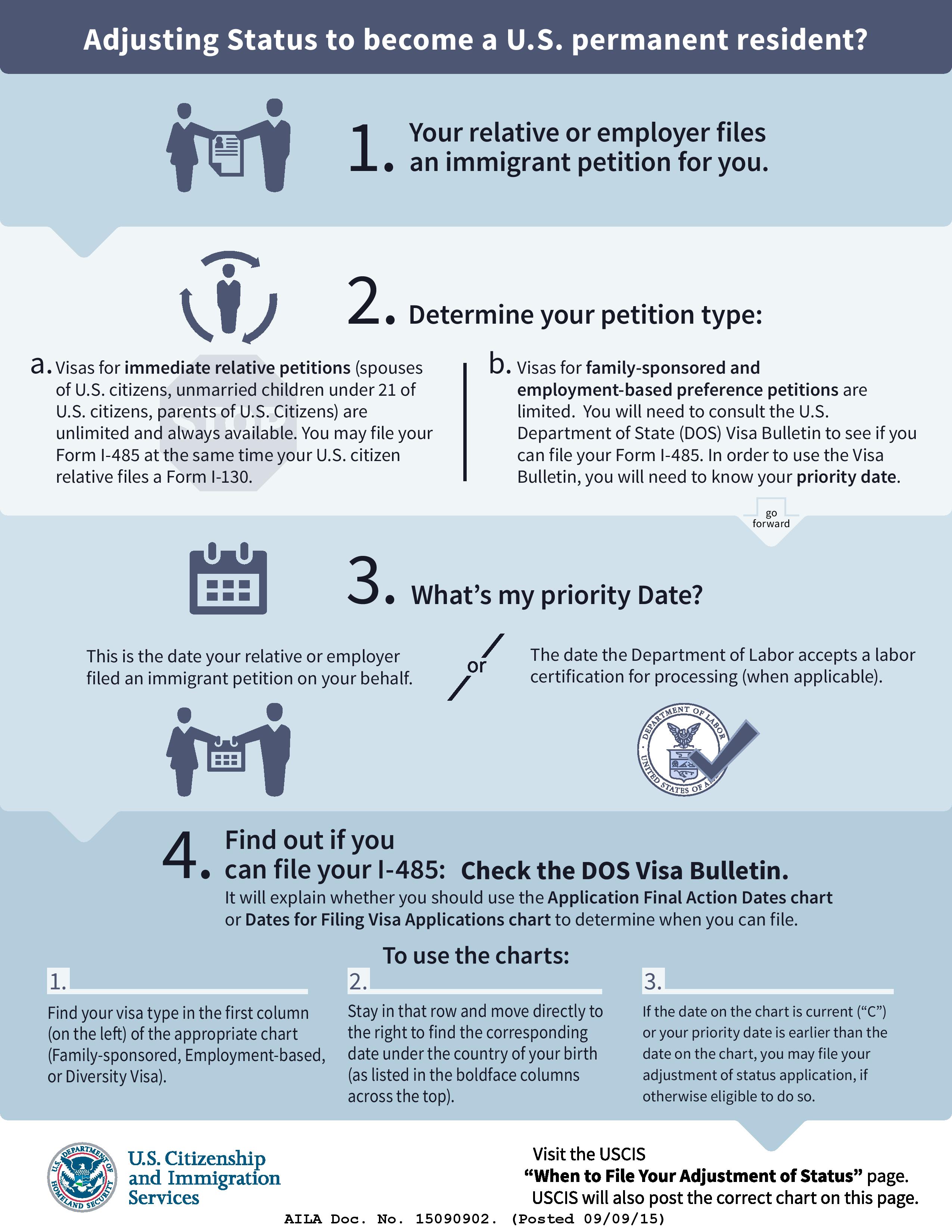
Prospective clients often ask our law office, how long does the adjustment of status to permanent resident usually take? At what point can I legally work in the United States? How can I obtain my social security number and driver’s license? When can I travel internationally?

Below is an approximate timeline that will give you an idea on what the current wait times are for the adjustment of status process, based on your marriage to a U.S. Citizen:

Capture
During the 2-3 month mark, the applicant will receive a very important document in the mail, known as the employment authorization card. The employment authorization card is important for a variety of reasons:

wedding-1353829_1920If you are adjusting your status to permanent residency, based on your marriage to a United States citizen, chances are you are already thinking and may even be dreading your interview.

All green card applicants, who have filed Form I-485 Application to Register Permanent Residence or Adjust Status, based on their marriage to a US citizen, can expect to receive an initial interview notice scheduling both the green card applicant and their US Citizen Spouse to appear at a local office on the date and time indicated on the appointment notice. The initial interview notice typically arrives in the applicant’s mailbox about 3-4 months from the receipt date. The actual interview takes place about one month after receiving the initial interview notice.

Many of our clients begin to wonder about the marriage interview early on and it is a reoccurring topic in our consultations with couples who are ready to start the process. Couples have asked us countless times ‘so are they going to ask me what side of the bed my spouse sleeps on, what color my spouse’s toothbrush is, or about the last time we were intimate.’ The answer to this question is no, not at the initial marriage interview. Like the thousands of couples who have already gone through the interview process, and the thousands more who will go through the very same process in the future, your interview will also be successful with the right preparation and representation.

Continue reading

By Lupe Lopez

8463683689_baa33ca431_z

Richard and Micaelina met when they both first started attending school at the University of California, San Diego (UCSD).  It was easy to see why Richard had fallen in love with Micaelina, an articulate and funny Italian beauty.  After two years of dating they decided to get married and begin the immigration process for Micaelina.  They had everything in order except one little thing; well, maybe not so little.  Being a full time student, Richard did not earn enough money to fulfill the requirements for the Affidavit of Support.  They would need a joint sponsor; that is, a person with enough annual earnings or assets to qualify for the affidavit.

Richard had not thought of this.  Both he and Micaelina had depended upon student loans and their parents for most of their expenses.  Although Micaelina’s parents were well off and could continue to help the young couple, they were foreigners with no legal status in the U.S. thus disqualifying them as joint sponsors.  Richard’s parents are hard-working middle class people with other children they need to support.  They are not poor, but because they already claim several dependents, they, too, did not qualify.  Most of Richard and Micaelina’s friends were students just like them and they did not earn sufficient money to help the young couple.  After many months of searching for a suitable sponsor and one who was willing to sign the Affidavit of Support contract between the sponsor and the U.S. government, Richard and Micaelina finally found a person willing to help them.

Richard and Micaelina are not alone.  In our constantly busy office, there is not a single week that goes by where we do not run into this same problem.  When the Petitioner, in this case Richard, does not earn enough or have enough assets to fulfill the requirements for the Affidavit of Support it can be more difficult than expected to find a joint sponsor.

Continue reading

5376966004_8d13877cc2_z

By Lupe Lopez

Rosario and her son Alan came into our office a few weeks ago.  Rosario had entered the country without inspection (illegal entry) many years ago.  Her son Alan was born in the United States and just turned 21.  They came in hoping that Alan would be able to help his mother obtain her green card.

We asked Rosario the usual questions.  When and how did you enter the U.S.?  Have you ever been detained or deported?  Have you committed any crimes in the U.S. or in your country?  The list goes on.  We first need to determine if Rosario will be admissible to the U.S. before we begin any paperwork.

14296756774_3318712654_z
Bill was a world renowned and very accomplished sculptor and 3d artist in his country. In 2009, Bill decided to make his first visit to the United States. It was here, in the land of opportunity, that he was able to develop his craft further and had the unique opportunity to study animation, the marketing of sculptural art, and technologies in film production. Having already been working for a famous television station in his country, it was only fitting for him to expand his studies in these fields. As a professional artist with extraordinary skills, our client was eligible to file an O-1 visa and could very well obtain his permanent residency through this avenue. After seeking legal advice, Bill decided to go forward with the process of applying for an I-129 Petition for an alien with extraordinary abilities in the arts. While his application was pending, Bill decided to visit his aunt and cousins in Los Angeles. It was through his cousin that Bill would meet his future wife, Elizabeth. After various phone calls and emails, the two decided to meet, and it was indeed love at first sight for the pair. The couple found that they shared similar interests, had a similar background, traditions, and customs.

During the following months, the couple went on frequent outings together as well as with their family members. All seemed perfect. Bill was ready to pop the question and did so in a magical way in Laguna Beach, California. Elizabeth’s parents were not only supportive of Bill’s professional work; they welcomed him into their family as a son, and allowed him to live with Elizabeth in their home during their marriage. A few months after marrying, Elizabeth and Bill decided to file for Bill’s Adjustment of Status. Elizabeth was very enthusiastic about petitioning for Bill because she felt the process would be much quicker than that of the I-129 petition that was pending. Bill completely put his trust in Elizabeth and allowed her to take the reins on his adjustment of status application.

During their marriage, Bill began to see that his wife was not the person he believed her to be. She refused to work and would spend her days chatting with friends and playing computer games until the morning hours. He also began to realize that she had no regard for his financial situation and would spend the money he earned from his family and from freelancing, on luxurious items that were unnecessary expenses. A few months later, Bill heard that his father had been diagnosed with cancer and was fighting for his life. About this time, Bill was fortunate enough to have received his permanent resident card, so he was able to travel internationally without preoccupation. Devastated, Bill traveled to his country alone to support his inconsolable mother and help his family financially. Elizabeth had chosen to stay behind with her family. While he was back in his country dealing with the stress surrounding the terminal nature of his father’s condition, Bill began to receive unrealistic and threatening demands from Elizabeth.

6334089208_b4748845fb_z

On Saturday, September 6th, the White House announced that the President would be holding off on taking executive action, to bring about immigration reform, until after November elections. Although president Obama announced that he would take executive action in June, mounting pressure from Senate Democrats prompted president Obama to abandon ship on such promises until later this year. Democrats fighting for a seat in the Senate had been fearful that if President Obama would act on the promise he had made earlier this summer, they would lose their re-election bids, and overall bargaining power in the House and Senate. White House officials expressed that if the president were to act on such a promise, before the November elections; the decision might jeopardize the sustainability of the policy and might have negative repercussions on comprehensive immigration reform as a whole. While some have considered President Obama’s move to be strategic, others have seen the decision as another empty promise and failed attempt by the Obama administration to bring about comprehensive immigration reform. In a recent interview with NBC, president Obama reiterated that he would act on immigration reform, because he feels it is the right thing. According to him however, it would be most effective to act if the public understands the facts on immigration. According to white house officials, after November elections, the pressure to act on immigration reform would take on a whole new meaning. The house and senate would be re-energized and the topic would no longer be as politicized. Within this frame of mind, Republicans and Democrats alike could maximize the odds of bringing about immigration reform by coming together with integrity on the issue, rather than at each other’s throats prior to the elections. For further updates, please continue to visit our blog. 

10859690426_d0bde482b7_z

What is the purpose of filing an I-751 Petition for Removal of Conditions?

If you were granted conditional residence based on your marriage to a U.S. Citizen or legal permanent resident, you must file the I-751 Petition to Remove Conditions on your Permanent Resident Card. This form allows the conditional resident to request USCIS to remove the conditions on their residence. For conditional residents who are still married, the petition must be filed jointly with your spouse through with you gained your conditional residence.

But what happens when the marriage ends in divorce, annulment, or other factors?

The conditional resident can request for waiver of the joint filing requirement IF any of the following applies:

  1. You entered the marriage in good faith but your spouse died
  2. You entered the marriage in good faith, but the marriage was later terminated through divorce or annulment
  3. You entered the marriage in good faith, but were battered or the victim of ‘extreme cruelty’ by the spouse with whom you gained conditional residence
  4. Your conditional resident parent entered the marriage in good faith, but you have been battered or the victim of ‘extreme cruelty’ by your parent’s U.S. Citizen or permanent resident spouse or by your conditional resident parent or
  5. The termination of your conditional resident status and removal would result in extreme hardship 

For the purposes of this segment, we will focus on what must be proven when a conditional resident’s marriage ends in divorce or annulment.

Continue reading

By Marie Puertollano, Esq.

When an immigrant gets married with a U.S citizen, the immigrant can obtain a green card either through consular processing, if the immigrant is outside the United States, or through adjustment of status within the United States, if the immigrant entered with a visa and is present in the United States. This article will focus on the interview that will be the last step of the adjustment of status and will take place at a USCIS field office within the United States.

Why are we interviewed?