Articles Posted in Policy

9291648625_319dc9bea3 (1)

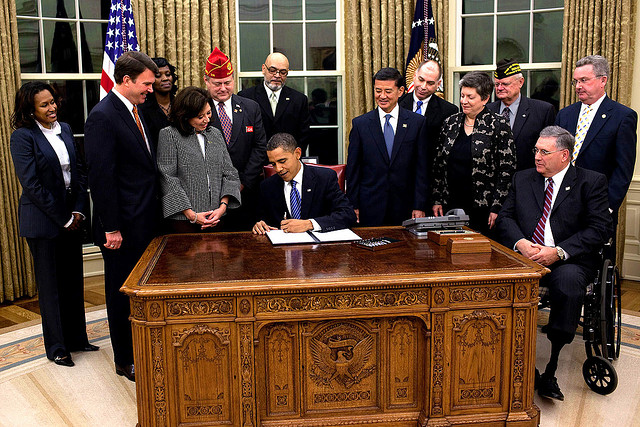
On November 20, 2014 President Barack Obama announced a series of executive actions on immigration designed to repair our country’s broken immigration system.

Among its provisions, the executive actions on immigration outline plans to: strengthen border security, expand I-601A provisional waiver eligibility, modernize visa backlogs, expand eligibility for parole in place, improve parole procedures for researchers, inventors, and foreign entrepreneurs, revise removal proceedings–making criminals and those who pose a threat to our nation’s national security a priority for deportation, expand the existing DACA (Deferred Action for Childhood Arrivals) program to include a broader population of undocumented aliens (with no prior criminal history) who have continuously resided in the United States since January 1, 2010.  The expanded DACA program, under the new policy, would last a period of 3 years, rather than the 2 year period, granted under initial DACA.

In addition to expanding DACA, Obama also proposed a new program known as DAPA (Deferred Action for Parents of U.S. Citizens and Lawful Permanent Residents) extending eligibility of deferred action to eligible parents of US Citizen or LPR children born on or before the date of the President’s announcement on November 20, 2014. To read the complete DAPA eligibility requirements please click here.

These provisions were scheduled to go into effect on February 18th of this year, however, on February 15th a temporary injunction filed by Judge Hanen along with 26 states put these initiatives on hold. Following the filing of the temporary injunction, the Department of Justice filed an appeal in defense of Obama’s executive actions and an emergency motion for stayrequesting the executive actions to go forward despite the temporary injunction.

Continue reading

imagePresident Obama closed off the year by announcing his highly anticipated executive action on November 20, 2014 which will go into effect early this year, but the executive action was only one of many important initiatives that occurred in 2014.


2014 was a big year for immigrants for several reasons:

  • AB 60 California Driver’s License Applicants: Beginning January 01, 2015 undocumented immigrants can start the process of obtaining their driver’s licenses under AB 60 at their local DMV field office
  • Executive Action: Beginning February 2015, eligible applicants can apply for the expanded DACA program which shields undocumented individuals from deportation who were brought to the United States illegally as children, our office will be providing you with further updates early this year
  • Beginning May 2015 eligible parents of U.S. Citizens and lawful permanent residents can apply for deferred action thereby protecting them for deportation and allowing millions of parents to be eligible for employment authorization

Continue reading

5809421452_8a311d10c8

The purpose of U.S. Immigration and Customs Enforcement (ICE) administrative inspection is to determine whether the employer has violated the prohibitions against hiring or continuing employment of unauthorized aliens and Form I-9 violations. Usually, a 72-hour notice will be given to employers preceding the ICE Form I-9 administrative inspection. The Notice of Inspection indicates the date, time, and place for the inspection and the documentation that the employer is requested to produce.

Form I-9 inspection may be conducted by any of the three authorized government agencies: Department of Homeland Security (DHS), the U.S. Department of Labor (DOL), or the U.S. Department of Justice Office of Special Counsel. DHS may initiate investigations after public complaints. Form I-9 inspection may be conducted either on the employer’s premises, at an agency office, or at the agency’s discretion. Employers that use electronic Form I-9 storage systems need only retrieve and reproduce the forms electronically retained in the storage system and supporting items requested by the inspecting agency.

If the employer does not comply with the request to present the forms and supporting documents, ICE may compel production by issuing a subpoena. A delay in the production of the forms and supporting documents may be considered a violation of compliance requirements. After a Form I-9 inspection, ICE will notify the employer as to its results. The current procedure is to notify the employer in writing of the result of the completed inspection. However, informal manner of notification may also been recognized as a valid notification as the Ninth Circuit has held that “even after an informal oral government notice, it is important for the employer to terminate the employee promptly to avoid knowingly continuing to employ violation.”

Continue reading

15364657104_dd44282c03_o

Jose came into our office yesterday.  He had been here before.  About a year ago he came in to have a consultation with us and it seems we didn’t have the “right” answers that he wanted to hear.  This led to Jose searching for what he really wanted to hear.

For the past year, Jose has visited several immigration attorneys to confirm the information we had already given him.  The answer was always the same; except one day he found one attorney who gave him hope.  Unfortunately, the attorney took his hope, his money, and didn’t do anything to help.

We hear this story often and there isn’t a week that goes by where we don’t see a person who has entrusted their life and their savings to an inexperienced attorney, or worst yet, to an unscrupulous attorney or immigration consultant.  There are times that we have to give people the bad news – that there is nothing that can be done to help them.  The person is usually devastated and in their desperation will state “I’ll find a better attorney and he will be able to help me.”  The truth is, if you search for the answer you want to hear, you will always find someone who are willing to help you; that is they are willing help you be separated from your money – leaving you hopeless.

Continue reading

431619249_af1d2a3929_z


President Obama’s executive action announced on November 20, 2014 fell short in many ways than one for many people residing in the United States—both legally and illegally. Though a marginalized few have been allowed to come out of the shadows, some of the world’s best and brightest have been completely ignored by the executive action altogether. The United States would be quite a different place without our hard working immigrant population and without our foreign born innovators, movers, and shakers.

Obama’s announcement on November 20th notably left out any indication that the creation of a more expedient and efficient system would be considered— through which highly skilled and highly capable foreign workers would be able to more easily attain permanent residency and visas. Industry leaders in areas such as the Silicon Valley, seeking to employ such highly skilled and highly capable foreign workers for their startup companies, have expressed their concerns, forming groups such as FWD.us, albeit with the knowledge that Congress must act in order for an all-encompassing solution to be reached.

Though Obama’s speech shed little light on the topic, a memorandum released by the U.S. Department of Homeland Security following the speech is much more informative. The memorandum announces that inventors, researchers, and founders of start-up enterprises who do not qualify for a national interest waiver, but who have been awarded what is considered ‘substantial’ financing by a U.S. investor OR who ‘hold the promise of innovation and job creation through the development of new technologies or the pursuit of cutting edge research’ can attain parole authority under section 212(d)(5) of the INA,6 on a case-by-case basis after being assessed by the DHS. Possessing parole in this situation would authorize extraordinary inventors, researchers, or start-up entrepreneurs to temporarily conduct their research or development of innovative ideas or their business while in the United States.

Continue reading

14257053711_9f4f51b925_z

Beginning January 02, 2015 in the state of California, undocumented immigrants will be able to benefit from Assembly Bill 60, The Safe and Responsible Driver Act enacted in 2013. Beginning immediately, undocumented driver’s license applicants, will be able to schedule an appointment on or after January 02, 2015 with their local DMV by calling 1-800-777-0133, online on the California DMV website www. dmv.ca.gov, or via their smart phones on the DMV NOW iPhone and Android applications.

Applicants should make sure to comply with the following in order to obtain their ‘original’ driver’s licenses:

  • Study for the driver license exam
  • Complete a driver license application form (DL 44) available at the DMV office
  • Under AB 60, applicants will need to provide DMV with:

Continue reading

4097702175_2000b12d31_z

President Obama’s executive order is looming on the horizon, as part of an alleged 10 point plan the president plans to announce as early as Friday, November 21. According to a draft proposal released by a U.S. government agency, the plan may suspend removal proceedings for millions of undocumented immigrants who came to the United States as children, as well as parents of U.S. Citizen children residing in the United States illegally, and parents of green card holders, by allowing them to benefit from a reprieve that will expand deferred action for these individuals. Among its 10 initiatives, firstly, the plan proposes to bolster border security, secondly, to improve pay for immigration officers, thirdly, to provide a 50% discount to the first 10,000 applicants whose income levels are below 200% of the poverty level in order to encourage participation, fourthly, to establish a program designed to stimulate the tech industry which could potentially offer millions of immigrants and their dependents a path to citizenship, and lastly, to prioritize removal proceedings on the basis of the severity of an immigrant’s criminal history, calling an end to the program known as ‘Secure Communities.’ This 10 point plan makes anyone who entered the United States before turning 16 and before the date of January 01, 2010, eligible for naturalization. Such a plan would thereby suspend deportation for millions of undocumented immigrants.

The proposal has not yet been announced, we would like to inform our audience to please be wary of fraudulent schemes. At this time ONLY preliminary information has been released.

Please continue to follow our blog for further updates, for more information please contact our office.  It is our goal to provide you with the most up to date immigration reform developments.

513153112_79ea77011e_z
On October 28, 2014 the U.S. Department of Homeland Security issued a policy memo regarding the effect of assisted reproductive technology (ART) on Immigration and the Acquisition of Citizenship under the INA (Immigration and Nationality Act) in an effort to shed light on the issue of genetic relationships between parents and children.

The memo outlines that under the INA, if a non-genetic gestational mother has carried and given birth to a child, and is also the child’s legal mother, that mother would possess the same legal status as that of a genetic legal mother’s under the Immigration and Nationality Act. This is groundbreaking news given that prior to this policy change, a genetic relationship between a U.S. Citizen parent and their child was required in order for the child to gain an immigration benefit and acquire citizenship at birth via their parents.

Under this policy for the purposes of immigration the following has changed:

5376966004_8d13877cc2_z

By Lupe Lopez

Rosario and her son Alan came into our office a few weeks ago.  Rosario had entered the country without inspection (illegal entry) many years ago.  Her son Alan was born in the United States and just turned 21.  They came in hoping that Alan would be able to help his mother obtain her green card.

We asked Rosario the usual questions.  When and how did you enter the U.S.?  Have you ever been detained or deported?  Have you committed any crimes in the U.S. or in your country?  The list goes on.  We first need to determine if Rosario will be admissible to the U.S. before we begin any paperwork.

10012162166_cde34d427e_z
The Department of State (DOS) and U.S. Customs and Border Protection (CBP) have announced a joint initiative, in response to the technical problems the U.S. Department of State’s Consular Consolidated Database (CCD)—responsible for the issuance of visas—has been experiencing. These technical problems have had a significant impact on the department’s ability to process nonimmigrant visas, causing worldwide delays. Together the DOS and CBP will waive the visa requirements for nonimmigrant visa applicants seeking admission into the United States on a case by case basis. Applicants who have applied for but have not been issued non-immigrant visas, due to such delays, may request consideration from DOS and CBP for special travel permission to the United States under the following conditions:

The applicant’s travel to the United States must be considered urgent, involving a bona fide emergency, such as urgent humanitarian travel and life and death situations, or a situation that impacts U.S. national interests. DOS and CBP will respond to such requests via their joint task force teams. Travel permission that has been approved will be facilitated by the DOS.

All individuals requesting emergency travel are required to have a pending visa application with the DOS that has not been approved as a result of delays caused by the Consular Consolidated Database.