Articles Posted in Trump administration

32473146652_bb782aab20_z

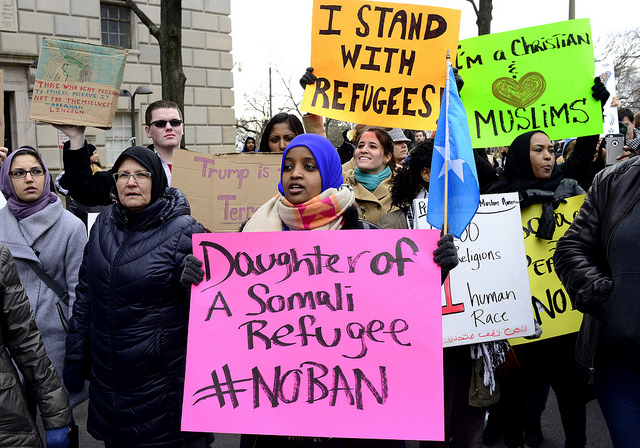
In today’s post, we will discuss how green card holders may be affected by President Trump’s Executive Order imposing a temporary travel ban on foreign nationals of seven Muslim-majority countries (Iraq, Syria, Iran, Sudan, Libya, Somalia, and Yemen), including green card holders as well as non-immigrants. Since the release of the Executive Order, several courts have issued temporary injunctions preventing green card holders (LPRs), legally authorized to enter the United States, from being detained and/or removed from the United States until a federal court can decide the constitutionality of the orders.

In response to these court orders, the Department of Homeland Security and Customs and Border Protection (CBP) has provided further guidance on the enforcement of these actions, and the impact on green card holders from these seven Muslim-majority countries. While both agencies have indicated that they are complying with the court orders, the consensus is that immigration officials will continue to enforce President Trump’s Executive Orders, and they will continue to remain in place.

What does this mean for green card holders? The Secretary of the Department of Homeland Security has stated that the entry of lawful permanent residents remains in the national interest, therefore “absent receipt of derogatory information indicating a serious threat to public safety and welfare,” lawful permanent resident status will be a deciding factor in allowing an LPR entry. The entry of lawful permanent residents will continue to be discretionary and green card holders will be evaluated on a case-by-case basis.

Continue reading

481127781_db85f31ce7

Yesterday, January 29, 2017 the Department of Homeland Security released a statement regarding President Trump’s executive order “Protecting the Nation from Terrorist Attacks by Foreign Nationals” which barred the entry of both immigrant and non-immigrant foreign nationals from 7 majority Muslim countries and suspended entry of Syrian refugees until proper vetting and security mechanisms could be put in place. The Department commented on the impact of a federal court order issued Saturday night which temporarily suspends enforcement of the executive order, until a federal judge can rule on its legality.

In their statement, the Department of Homeland Security noted that “upon issuance of the court order . . . U.S. Customs and Border Protection (CBP) immediately began taking steps to comply with the orders. Concurrently, the Department of Homeland Security continues to work with our partners in the Departments of Justice and State to implement President Trump’s executive order on protecting the nation from foreign terrorist entry into the United States. We are committed to ensuring that all individuals affected by the executive orders, including those affected by the court orders, are being provided all rights afforded under the law.  We are also working closely with airline partners to prevent travelers who would not be granted entry under the executive orders from boarding international flights to the U.S. Therefore, we do not anticipate that further individuals traveling by air to the United States will be affected.”

Continue reading

7507465248_ed7b64e022_z

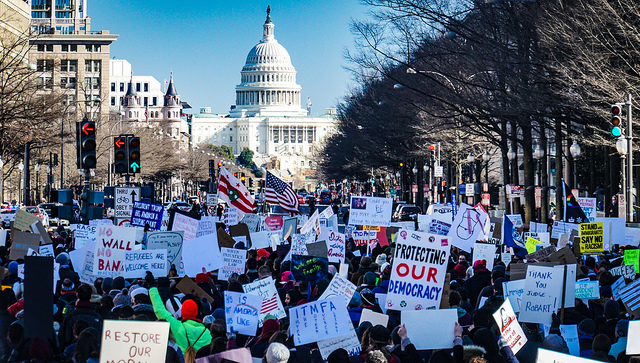
On Saturday night, a federal judge granted an emergency stay on Donald Trump’s executive orderProtecting the Nation from Terrorist Attacks by Foreign Nationals” which temporarily bans the entry of immigrant and non-immigrant foreign nationals from Syria, Iraq, Iran, Libya, Somalia, Sudan, and Yemen for a 90-day period. The stay filed by the American Civil Liberties Union, on behalf of two Iraqi men detained at New York’s John F. Kennedy airport, prevents immigration authorities from detaining foreign nationals from the 7 Muslim majority countries, who have already arrived on U.S. soil, as well as those mid-flight. The stay does not invalidate the executive order signed by Trump, but limits its enforcement on individuals who have already arrived in the United States. Individuals who have attempted to enter on valid visas, refugee status, or LPR status must be released from detention. Trump’s temporary ban on immigrants and non-immigrants from these countries sent the country into chaos, as protestors swarmed international airports across the nation calling for an end to the ban and the release of persons detained. U.S. Customs and Border Protection, and law enforcement officials are struggling with the executive order, absent clear policy and guidance from the Department of Homeland Security.

This is a developing story. More information soon. 

9613483141_0df8534105_z

Yesterday, January 27, 2017, President Donald Trump signed and handed down the controversial executive order, “Protecting the Nation from Terrorist Attacks by Foreign Nationals” on immigration to protect the nation from terrorist attacks by foreign nationals. Among its main provisions the order suspends IMMIGRANT AND NON-IMMIGRANT entry of foreign nationals from countries of “particular concern” including Syria, Iraq, Iran, Libya, Somalia, Sudan, and Yemen for 90 days, indefinitely suspends Syrian refugees from entering the United States until the U.S. refugee admissions program has been overhauled, and terminates the visa waiver interview process. The temporary ban will affect all non-U.S. Citizens from Syria, Iraq, Iran, Libya, Somalia, Sudan, and Yemen including green card holders and valid U.S. visa holders. Foreign nationals of these countries will not be allowed to return to the United States for a period of 90 days, after temporary foreign travel, even if they are green card holders or visa holders. For this reason, if you are a foreign national from one of these countries, you should not engage in temporary foreign travel until the temporary ban has been lifted. Visa and green card holders already in the United States will be allowed to remain without problems.

An exemption has been drawn for immigrants and legal permanent residents whose entry is in the U.S. national interest, however it is not yet clear how that exemption will be applied.

Below is a summary of the main provisions of the order per the OFFICIAL signed copy.

To read the complete version please click here.

  1. Suspension of Issuance of Visas and Other Immigration Benefits to Nationals of Countries of Particular Concern
  • The immigrant and nonimmigrant entry into the United States of aliens from countries designated (including Syria, Iraq, Iran, Libra, Somalia, Sudan, and Yemen) is suspended for 90 days from the date of the order January 27, 2017 (excludes foreign nationals traveling on diplomatic visas, North Atlantic Treaty Organization visas, and C-2 visas for travel to the United Nations). This means that if you are a citizen of a country of “particular concern” as outlined above, you will NOT be allowed to re-enter the United States, after temporary foreign travel, until the ban has been lifted, even if you are a legal permanent resident (immigrant) or holder of a valid visa. If you are a foreign national of one of the above countries and you are an immigrant (green card holder) or non-immigrant (valid visa holder), you must NOT travel internationally. Otherwise, you will risk being denied re-entry.
  • The Secretary of State and Homeland Security may submit to the President the names of additional countries who pose a security risk and are recommended for suspension.
  • The Secretary of Homeland Security, in consultation with the Secretary of State and the Director of National Intelligence, must immediately conduct a review to determine the information needed from any country for adjudication of any visa, admission, or other benefit under the INA adequate to confirm the identity of the individual seeking the benefit and ensure that they are not a security or public-safety threat to the United States.

Continue reading

32526771855_f1e4ccf6f8_z

President Donald Trump is expected to hand down a controversial Executive Order on immigration within the coming days to protect the nation from terrorist attacks by foreign nationals. Although the Trump administration has not made a formal announcement regarding the proposed order yet, a leaked, unsigned copy of the President’s order has been making the rounds. We do not know whether the President has made any modifications to the order since its leak, and we do not know when exactly the order will be issued. One thing is clear, an executive order on immigration is imminent. It is rumored that the executive order will include a temporary ban on refugees, the suspension of issuance of visas for citizens of Syria and six other Middle Eastern and African countries, which are rumored to include Iraq, Iran, Libya, Somalia, Sudan and Yemen, collectively referred to as “countries of particular concern,” as well as the end of Syrian refugee processing, and the visa interview waiver program.

The passage of such an executive order although extremely controversial and unpopular, would be within the President’s executive power, if his administration determines that limiting refugee admissions temporarily and restricting the issuance of visas to persons from specific countries is of significant public interest to the United States to combat the war on terror. The administration would need to balance our country’s need to secure its borders against terrorism with the need to resolve the global humanitarian crisis we face today. Donald Trump has already passed a series of executive orders on border security and immigration enforcement authorizing the construction of a U.S.-Mexico border wall, withholding federal grant money for sanctuary cities, hiring 5,000 Border Patrol agents, reinstating local and state immigration enforcement partnerships, and ending the “catch-and-release” policy for undocumented immigrants.

The leaked copy of the executive order “Protecting the Nation from Terrorist Attacks by Foreign Nationals” gives two policy reasons for enacting the executive order. First, the purpose of the order is to protect American citizens from foreign nationals who intend to enter the United States to commit acts of terrorism. Second, the order serves to prevent the admission of foreign nationals who intend to enter the United States to “exploit” the country’s immigration laws for malevolent purposes. The order highlights that following the September 11 attack on the World Trade Center, hundreds of foreign nationals have successfully entered the United States on an asylum, visitor, student, or employment visa, and have been subsequently convicted or implicated in terrorism related crimes. The order goes on to blame the State Department’s consular officials for their failure to scrutinize the visa applications of the foreign nationals who went on to commit the September 11 attacks, which resulted in the deaths of thousands of Americans.

The main provisions of the leaked order “Protecting the Nation from Terrorist Attacks by Foreign Nationals” are as follows:

Continue reading

download

With the onset of Donald Trump’s presidential inauguration, rumors have swirled about whether the newly elected President will terminate the 2012 Deferred Action for Childhood Arrivals (DACA) program for undocumented persons who came to the United States as children, otherwise known as “Dreamers.” The DACA program was made possible by Trump’s predecessor, Barack Obama, with the passage of an executive order signed into law in 2012. Although Trump has openly stated that he plans to dismantle the DACA program within his first 100 days in office, in the days following his election, he backtracked his stance on the issue in an interview for TIME magazine, and instead promised that in its place, Dreamers would receive temporary “protection” from the federal government which would allow them to remain in the United States lawfully without fear of deportation. Although Trump did not fully elaborate on the details of such governmental immunity, his remarks gave Dreamers hope that the DACA program might not end after all, or at the very least that similar temporary relief might be put in its place.

Aside from Trump’s political motivations, several senators have introduced bipartisan legislation in the form of the BRIDGE Act (Bar Removal of Individuals Who Dream and Grow our Economy). The BRIDGE Act was introduced in early December, before the inauguration of Donald Trump, and is designed to protect Dreamers from deportation by allowing them to obtain “provisional protected presence” for a three-year period similar to the “deferred status” given to Dreamers under the DACA program. If passed the BRIDGE Act will also allow Dreamers to keep their temporary employment authorization (EAD) benefits. It must be noted that at this time the BRIDGE Act is still only a bill. The BRIDGE Act has not yet been signed into law, and no other bill has yet been passed protecting Dreamers from deportation.

Many of our clients and readers are stuck in this “legal” limbo and are unsure of what the future of DACA may hold. The good news is that because the DACA program has not yet been dismantled, DACA recipients are still protected from deportation by the “deferred status” they have received from USCIS. If you have received deferred status which has not yet expired, it is recommended that you obtain a stamp in your foreign passport from the Department of Homeland Security that indicates that you have been “paroled” into the United States based on your grant of DACA or “deferred status.” A person who has been granted deferred status may seek temporary admission to the United States as a parolee. A parolee is an alien who is inadmissible to the United States, but may be allowed to enter the United States for humanitarian reasons or when the alien’s entry is determined to be for significant public benefit. The grant of “deferred” action allows a person who does not otherwise meet the technical requirements for a visa or is inadmissible to the United States, permission to enter the United States on “parole” for a temporary period of time. Dreamers may obtain a stamp in their passport as evidence of this temporary status or “parole” by appearing before a customs official at a port of entry (such as an international airport) with evidence of their approved DACA status and employment authorization card. Upon inspection, the stamp will indicate to immigration officials that you have entered the country legally and that you have been granted parole based on your DACA. Although parole will not grant Dreamers formal admission to the United States, it will grant an alien “temporary” status to remain in the country lawfully. The stamp, for now, will allow Dreamers to breathe a sigh of relief since it serves as proof of the alien’s “legal” admission to the United States. Dreamers who marry U.S. Citizens in the future may use their “parole” stamp and I-94 arrival/departure record as evidence of their legal admission to the United States to apply for permanent residency.

8589969101_af962f711d_z

On Friday December 9, 2016, Democratic Senator Dick Durbin of Illinois, and Republican Senator Lindsey Graham of South Carolina, introduced the “Bar Removal of Individuals who Dream and Grow our Economy” BRIDGE act before Congress to protect Dreamers from deportation, and allow them to keep the temporary employment authorization (EAD) they currently possess. This legislation was introduced to provide temporary relief to the young, undocumented, immigrant population that was issued Deferred Action for Childhood Arrivals (DACA) or “deferred status” by President Barack Obama in 2012. Amid mounting pressure to protect the existing DACA program, as well as feelings of fear and uncertainty surrounding the future of the program, several Democratic and Republican Senators have come together to save the program from the Trump administration including Senators Dianne Feinstein, Lisa Murkowski, and Jeff Flake. As you may remember, DACA was first introduced by President Obama in 2012 to provide undocumented immigrants who came to the United States at a young age, the opportunity to apply for employment authorization, and be protected from deportation. DACA is not a form of amnesty, and does not provide a path to permanent residency or citizenship. DACA recipients, commonly referred to as “Dreamers” in the media, are undocumented persons who came to the U.S. as young children, and are pursuing the American Dream through higher education or military service in the United States.

Last week, just before Congress went into recess before the winter holiday, Senator Graham along with other Senators introduced the “Bar Removal of Individuals who Dream and Grow our Economy” (BRIDGE) act which will give current DACA holders “provisional protected presence” for a three year period, as well as undocumented persons who are eligible for the program, but who have not yet applied.  Although this act is not a revelation, given that this “provisional protected presence” sounds a lot like “deferred status” which DACA has already conferred upon DACA recipients, the legislation does promise to protect this population of undocumented immigrants from deportation, and allow them to continue living, working, and studying in the United States without the need to fear deportation. The criteria will also be the same as the eligibility criteria for the DACA program. At the very least this piece of legislation if passed, will protect current DACA holders from losing the temporary employment authorization they already possess, and will shield young undocumented people who would otherwise be eligible for the program, from deportation under the Trump administration.

Continue reading

31170276656_209df54185_c

On the heels of being named “Person of the Year” by TIME magazine, a new interview with President-elect Donald J. Trump reveals new information regarding the former business tycoon’s stance on illegal immigration. As we have previously reported, throughout his campaign the President-elect Donald Trump vowed to crackdown on illegal immigration, claiming that he would deport the 11 million undocumented immigrants residing in the United States unlawfully during. Among other things, Trump also campaigned on the platform that he would end the Deferred Action for Childhood Arrivals (DACA) program once and for all; a program which to this date has shielded hundreds of thousands of young undocumented persons from deportation, and provided them with temporary work authorization. The lives of these young undocumented immigrants have in large part been shaped by the passage of DACA, and the false sense of security it brought them. Today, their lives are in a very fragile state, with the uncertain future of what may happen to this program under a Trump administration, and the looming possibility of their removal from the United States, given that USCIS now possesses vital information regarding their identities and whereabouts. Ever since his election, Trump has desperately attempted to unite the nation. His administration has endeavored to pick up the broken pieces that were left behind by his polarizing campaign rhetoric. In recent months, we have seen Trump dramatically soften his stance on immigration in what may be described as futile efforts to unify the country.

Continue reading

3415364650_2c6b27e94f_z

On June 23, 2016 the United States Supreme Court made headlines when it affirmed a federal court’s decision in United States v. Texas, preventing the expansion of the Deferred Action for Childhood Arrivals (DACA) program and Deferred Action for Parents of Americans and Lawful Permanent Residents (DAPA) program. An eight-person bench delivered a single one-line decision on the ruling stating, “the judgment of the lower court is affirmed by an equally divided court.” This controversial decision ultimately resulted in the halt of the expansion of the DACA and DAPA programs, leaving these programs in legal limbo. The DACA and DAPA programs were first introduced by President Barack Obama two years ago, as part of a series of executive actions on immigration. With the passage of these programs, the Obama administration hoped that the Republican controlled House of Representatives would be persuaded to discuss the issue of comprehensive immigration reform. This effort proved fruitless. Republican Congressmen and women not only refused to pass comprehensive immigration reform, they politicized the issue of immigration altogether, blocking the President’s Supreme Court nomination following the sudden death of Justice Antonin Scalia, in order to prevent the Supreme Court from becoming liberal. Together, these programs would have shielded nearly five million undocumented immigrants from deportation by giving them “deferred status,” and would have provided applicants with a temporary three-year employment authorization card. Although these measures proved short of an amnesty, they were made in response to Congress’s refusal to pass meaningful immigration reform for the undocumented population living in the United States.

The expansion of the DACA program would have increased the population eligible to apply for employment authorization to people of any current age, who had entered the United States before the age of 16, and who could demonstrate continuous residence in the United States since January 1, 2010. Similarly, the DAPA program would have shielded millions of parents of U.S. Citizens and Lawful Permanent Residents from deportation if they could demonstrate continuous residence in the United States since January 1, 2010, and pass the required background checks.

Continue reading

5808492140_09871b9bdc_z

There is no denying that the election of Donald Trump as next President of the United States has dealt a huge blow to the immigration reform effort and diminished any hope for the passage of broader legal immigration reform. We had hoped that with the election of Hillary Clinton we would see an increase in immigration levels for highly skilled workers, as well as increased visa opportunities for entrepreneurs and investors. While the news of Donald Trump’s election was a big setback for immigration in general, polling continues to suggest that people across the United States are willing to support fairness in dealing with the undocumented immigrant population in a sensible and human way. By contrast, most Americans disapprove of passing broad legal immigration reform that would benefit foreign workers.

Donald Trump was able to win the favor of a great number of Americans because of his critical view of programs like NAFTA that he believes has allowed American jobs to go overseas. Trump has blamed the U.S. government for allowing programs like the H-1B worker program to exist, saying that foreign workers are taking American jobs. We can expect to see Donald Trump take a restrictive view on legal immigration, keeping immigration levels within historic norms. Donald Trump has until recently softened his tone on illegal immigration, claiming that his priority is to deport only dangerous criminals residing in the United States unlawfully, although his 10-point plan contradicts his recent stance.

It is likely that the Republican House and the Senate will introduce legislation designed to benefit American workers and the economy, and focus less on creating immigration opportunities for foreign workers. Similarly, the Trump administration will likely focus on job creation, and less on passing any meaningful legal immigration reform.

The program that may come under fire by the Trump administration is the Deferred Action for Childhood Arrivals (DACA) initiative which began on June 15, 2012 as part of an executive order introduced by President Barack Obama. Donald Trump has repeatedly said that he wants to end the Deferred Action for Childhood Arrivals (DACA) program incorrectly calling it an “amnesty.” In actuality, DACA is not amnesty and does not provide a pathway to permanent residency or even citizenship. DACA merely shields the individual from deportation and allows them to legally obtain employment in the United States for a temporary period of time.

Continue reading