Articles Posted in Deportation & Removal

3442747012_b976263ab9_z

USCIS has announced that beginning October 5, 2016 the validity period for initial and renewal employment authorization cards (EADs) will be extended from the previous one-year validity period to a two-year validity period, for asylum applicants eligible to receive employment authorization. EAD applications pending as of October 5, 2016 and all EAD applications filed on or after October 5, 2016 will receive 2-year EAD cards.

Asylum applicants cannot apply for employment authorization with their initial asylum applications. Applicants with a pending asylum application, who have filed for asylum on or after January 4, 1995, must wait until at least 150 days have passed since filing of their asylum applications (not including any delays that were caused by them) before applying for employment authorization. Once at least 150 days have passed since filing of the asylum application, and provided the application is still pending with USCIS, applicants may apply for employment authorization by filing Form I-765 Application for Employment Authorization using the (c)(8) asylum classification. On average it takes approximately 90 days for the I-765 to be processed, and for the employment authorization card (EAD) to be mailed to the applicant. Once you receive the employment authorization card you may begin to work immediately. You may also obtain a driver’s license for the validity period of your employment authorization, and a social security number by presenting your employment authorization card at the DMV and SSA near you. There is no fee to apply for your first employment authorization card if your asylum application is pending with USCIS or you have been granted asylum. If you are applying for a renewal EAD card (it is not your first time receiving an EAD) your application is subject to the filing fee.

Continue reading

4932655275_9af8d4e8b6_z

In this segment, we answer 5 of your most frequently asked questions received on our social media platforms and our website. Please remember that every case is different and every immigration journey is unique. You should not compare your situation to anyone else’s. We hope that our answers will provide you with further guidance while you embark on your immigration journey. If you have any further questions, please call our office to schedule a free first time consultation. We serve international clients and domestic clients in all 50 states. We thank you for your continued trust in our law office. For more information on the services we offer please click here.

Fiancé Visa

Q: I am a U.S. Citizen who is planning to marry a Moroccan citizen. I am interested in applying for the K-1 fiancé visa for him. The problem is that we have not met in person and it is hard for me to travel to his country because I am a single parent. I know one of the requirements for this visa is to meet in person. Are there any other visa options available to us since we have not met in person? I have heard of people obtaining waivers due to traveling hardships. Please advise.

A: Thank you for your question. This is a very common fiancé visa question. In order to file the K-1 fiancé visa you must meet the following requirements:

  • You (the petitioner) are a U.S. citizen.
  • You intend to marry within 90 days of your fiancé(e) entering the United States.
  • You and your fiancé(e) are both free to marry and any previous marriages must have been legally terminated by divorce, death, or annulment.
  • You met each other, in person, at least once within 2 years of filing your petition. There are two exceptions that require a waiver:
    If the requirement to meet would violate strict and long-established customs of your or your fiancé(e)’s foreign culture or social practice.

    2. If you prove that the requirement to meet would result in extreme hardship to you.

As indicated above there are only two exceptions that would allow you to seek a waiver of the K-1 visa two-year meeting requirement. The first requires the petitioner to demonstrate that compliance of the two-year meeting requirement would violate strict and long-established customs of either your fiancé’s foreign culture or social practice or of your own foreign culture or social practice. While it is difficult to prove this, it is not impossible, however the couple should be aware that substantial evidence is required to prove that either your or your fiancé’s culture explicitly prohibits you from meeting the two-year requirement. Of course this element is largely at odds with traditional Western norms and practices, therefore it is extremely difficult to explain to an immigration officer why you and your fiancé cannot meet in person before you are to be married.  This waiver should only be considered in very limited circumstances.

Continue reading

16204909498_c2948b5c85_z

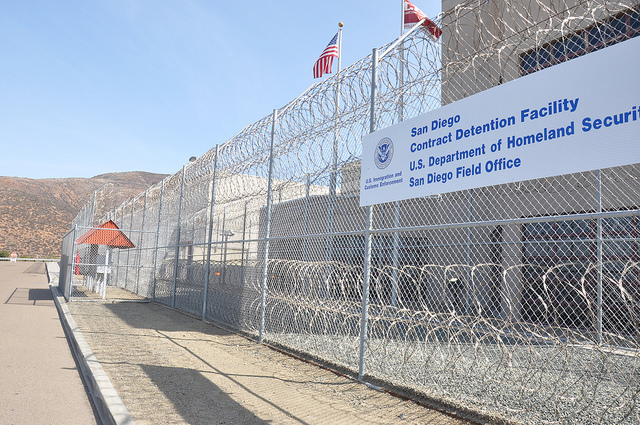
The U.S. Department of Homeland Security is expected to run a study to determine whether privately run detention facilities are unsafe for migrants. The Secretary of the Department of Homeland Security, Jeh Johnson, has stated that the administration will evaluate whether or not the agency will end the practice of privatizing immigration detention facilities, issuing a recommendation by November 30th of this year.

The announcement comes following reports that private immigration detention facilities have unlawfully withheld proper mental health and medical care from persons being detained in their immigration facilities. Presently, the two major private companies running ICE immigration detention facilities across the United States are the Corrections Corporation of America and the GEO Group. Together these private companies hold lucrative state and federal government contracts. It is estimated that the Corrections Corporation of America has earned $689 million alone from its contracts with ICE dating back to 2008, while the GEO Group has earned an estimated $1.18 billion from these contracts during that same period.

Continue reading

Men in a Huddle

On June 15, 2012 President Barack Obama first unveiled the Deferred Action for Childhood Arrivals (DACA) initiative to the world. In his 2012 announcement the President divulged that the DACA initiative would allow certain undocumented individuals who came to the United States as children the opportunity to be shielded from deportation and the right to a temporary work permit. To be eligible individuals were required to meet several guidelines to receive ‘deferred action’ for a period of two years, subject to renewal. USCIS began to accept applications for the DACA initiative on August 15, 2012.

At its core, ‘deferred action’ is the use of prosecutorial discretion to defer removal from the United States for a certain period of time. Although deferred action grants such deferment, it does not provide the individual lawful status and it is not a path to permanent residency.

On November 20, 2014 the President unveiled two initiatives that would expand the population eligible to obtain Deferred Action. Additionally, the President announced a new initiative called Deferred Action for Parents of Americans and Lawful Permanent Residents (DAPA). To be eligible for the expanded DACA program applicants were required to a) have entered the United States before the age of 16; b) demonstrate continuous residence in the United States since January 1, 2010; and pass required background checks. The initiative would also extend the period of ‘deferred action’ and work authorization to three years rather than two years.

Similarly, parents of U.S. Citizens and LPRs would be also be eligible for deferred action and employment authorization for a three-year period if a) they could demonstrate continuous residence in the United States since January 1, 2010 and b) pass required backgrounds checks. On February 16, 2015 just two days before applications would begin to be accepted for the expanded DACA and DAPA programs, a temporary injunction halted these programs from going into effect. The controversy that followed regarding these programs led to a federal lawsuit known as United States v. Texas which made its way to the Supreme Court of the United States. There the Supreme Court deadlocked in a 4-4 vote preventing these programs from going into effect.

Continue reading

7301111628_dd7c4e3fb0

Q: What qualifies as a bar of “Unlawful Presence?”

A: If you have accrued more than 180 days of unlawful presence in the United States, you are subject to a 3-year bar preventing you from being re-admitted to the United States under the Immigration and Nationality Action Section §212(a)(9)(B)(i)(I). The bar is triggered once you have departed the United States.

If you have accrued one year or more of unlawful presence in the United States, you are subject to a 10-year bar preventing you from being re-admitted to the United States under §212(a)(9)(B)(i)(II).

If upon your entry to the United States, you were not inspected, admitted, or paroled by a U.S. Customs Official, then you are ineligible to adjust your status to lawful permanent resident (LPR) within the United States, even if you have an approved visa petition. This means that in order to legalize your status, you are required to depart the United States and apply for an immigrant visa at a United States embassy or consulate abroad. Your departure from the United States will then trigger a 3- or 10-year bar to readmission, preventing you from returning to the United States, depending on the amount of “unlawful presence” you accrued prior to your departure.

There are ways to waive these 3- and 10-year bars to readmission only if you can demonstrate that your refusal of admission to the United States would cause an “extreme hardship” to your U.S. Citizen immediate relative or Legal Permanent Resident spouse or parent.

Q: Can I apply for the provisional waiver if I was previously deported, removed, or excluded from the United States?

If you received a final order of removal, deportation, or exclusion you may apply for a provisional waiver of unlawful presence, however you must first apply for the I-212 Application for Permission to Reapply for Admission into the United States After Deportation or Removal, and the application must be conditionally approved.

If ICE or CBP has reinstated a prior removal order under 8 CFR §241.8, before filing of the provisional waiver application or while the application is in process, you are no longer eligible to receive a provisional waiver of unlawful presence. A provisional waiver approval would be automatically revoked if the applicant is found inadmissible under INA §212(a)(9)(C) for unlawful return to the United States after prior removal or prior unlawful presence.

Continue reading

6991805074_a31fb26d22_c

The United States Citizenship and Immigration Services (USCIS) has published a new final rule that will expand the class of individuals who are eligible to apply for a ‘provisional’ waiver of certain grounds of inadmissibility (Form I-601A) based on their accrual of unlawful presence in the United States.

The provisional unlawful presence waiver allows certain individuals, unlawfully present in the United States, to request a provisional waiver before departing the United States for consular processing of their immigrant visas.

Previously, only immediate relatives of U.S. Citizens were eligible for this waiver. The provisional waiver is beneficial because it does not require the applicant to wait until the consular interview, to apply for a waiver, as in the case of the I-601 waiver. Provisional waivers also substantially reduce the time of separation between the applicant and his or her U.S. Citizen or legal permanent resident (LPR) relatives.

The rule was published in order to improve efficiency and reduce the amount of time that a U.S. Citizen/LPR spouse or parent is separated from his or her relatives while the relative completes the immigrant visa process. According to the 2013 rule, parents, spouses and children of U.S. Citizens were eligible to apply for provisional waivers of the 3- and 10-year unlawful presence bars before departing the United States for their immigrant visa interviews. The new rule expands upon the 2013 rule extending that benefit to family members of LPRs.

Who benefits?

The rule will expand the provisional waiver process to certain individuals who are family members of U.S. Citizens and lawful permanent residents (LPRs) who meet the statutory requirements to be eligible for an immigrant visa. The rule will expand eligibility to all individuals statutorily eligible for the waiver. In order to qualify, applicants must be able to establish that their U.S. Citizen or LPR spouse or parent would experience an “extreme hardship” if the applicant was not allowed to remain in the United States. The final rule will take effect on August 29, 2016.

Continue reading

3704180135_8cf17fa711_zA new settlement reached against the state of Texas will make it easier for undocumented parents of U.S. Citizens to obtain birth certificates for their American born children. In 2013, Nancy Hernandez, a Mexican immigrant, gave birth to a baby girl in a Texas hospital, although she was unlawfully present in the United States. After the birth, she visited a Texas county office to obtain the child’s birth certificate. Much to her surprise her request was met with resistance when county officials notified her that without presentation of proper documents, she would not be able to obtain her child’s birth certificate proving the child’s U.S. Citizenship.

In response, Hernandez along with dozens of other immigrants, filed a lawsuit against the state of Texas alleging that the state was blocking them from obtaining their children’s birth certificates, a right that is protected by the Constitution. Texas officials had previously outlined specific documents that undocumented parents needed to present, in order to obtain their children’s birth certificates.

Last week, Texas settled the lawsuit promising that the state would expand the list of documents parents were required to present in order to obtain their children’s birth certificates. Under the settlement, Mexican immigrants will be able to present a Mexican voter identification card to obtain their children’s birth certificates. These voter identification cards can be obtained from Mexican consulates in the United States. Parents from El Salvador, Guatemala, and Honduras, will be able to present documents certified by their consulates in the United States.

6071512063_e265d65eba_z

Today the Supreme Court of the United States dealt a strong blow to President Barack Obama’s executive actions on immigration issuing a single one-line decision on the ruling “the judgment of the lower court is affirmed by an equally divided court.” Nearly two years ago, President Obama announced a series of executive actions on immigration after the Republican controlled House of Representatives refused to tackle the issue of comprehensive immigration reform. As part of his executive actions on immigration, President Obama announced the expansion of the Deferred Action for Childhood Arrivals (DACA) program, and introduced a new program known as Deferred Action for Parents of Americans and Lawful Permanent Residents, (DAPA) designed to shield nearly five million undocumented immigrants from deportation. Following these initiatives, USCIS announced that applications for expanded DACA and the new DAPA program would begin to be accepted on February 18, 2015.

The DACA program would have expanded the population eligible for the Deferred Action for Childhood Arrivals (DACA) program to people of any current age who entered the United States before the age of 16 and lived in the United States continuously since January 1, 2010, and extending the period of DACA and work authorization from two years to three years. The new DAPA program would have granted parents of U.S. Citizens and lawful permanent residents the opportunity to request deferred action and employment authorization for a three year period, on the condition that they have lived in the United States continuously since January 1, 2010 and pass required background checks.

On February 16, 2015 just two days before the programs were scheduled to go into effect, Texas along with 25 other states, filed a temporary court injunction ultimately suspending both programs from going into effect. This action prompted the Obama administration to intervene. For months, the federal government and the State of Texas battled one another in federal court. The court ultimately determined that Texas and at least 25 other status had sufficient ‘standing’ to challenge these programs. In response, the federal government filed an emergency motion to stay, however the motion was eventually denied by the court. This led the government to file a writ of certiorari before the Supreme Court. The fate of Obama’s executive actions grew all the more uncertain with the sudden death of conservative Supreme Court Justice Antonin Scalia on February 13th.  President Obama made desperate attempts to fill the vacated seat by nominating Merrick Garland to the Supreme Court, the Chief Judge of the United States Court of Appeals for the District of Columbia. Efforts to fill the seat were unsuccessful as Republicans vowed to keep Garland from sitting on the bench. Thus, Scalia’s death left behind an eight-person bench, and with no one to fill his seat, the growing possibility of a deadlock within the Supreme Court.

Continue reading

2543596002_1900c6f214_z

Did you know that if you fail to provide USCIS written notice of a change of address, within 10 days of moving to your new address, you may be convicted of a misdemeanor crime?  If you currently have a case pending with USCIS, and you fail to provide written notice of a change of address to USCIS, within 10 days of moving, you could face a fine of up to $200, imprisonment up to 30 days, or both if convicted. If you are an alien (non U.S. Citizen) you could also face removal from the United States for non-compliance (INA Section 266(b)).

It is extremely important for applicants to notify USCIS immediately upon moving to a new address. Filing a change of address with USCIS is easy and it’s free. Applicants may change their address online by visiting the USCIS website and completing Form AR-11 online. In order to file a change of address online, you must know the Receipt Number (appearing on the Notice of Action) associated with your application, if your application is currently pending with USCIS. A Receipt Number is also known as the case number, identifying the petition submitted. The Receipt Number typically begins with three letters and is followed by ten digits.

The first three letters of the Receipt Number indicate the USCIS service center which is processing the petition, as follows:
– EAC – Vermont Service Center;
– WAC – California Service Center;
– LIN – Nebraska Service Center; and
– SRC – Texas Service Center

If you have filed more than one petition with USCIS (as in cases of adjustment of status for spouses of U.S. Citizens) you must provide the receipt number of each petition you have filed, when submitting the change of address online. If you do not have your receipt notice or have lost it, you should contact USCIS National Customer Service Center by telephone for assistance:

Our number is: 1 (800) 375-5283
Our TTY number is: 1 (800) 767-1833

If you are outside the United States and have filed an application or petition with a USCIS Service Center, you can call 212-620-3418 to check the status of your case.

Continue reading

5132848528_8a47684a87_z

Massachusetts Governor Charlie Baker has proposed a new policy that will allow State Police to contact federal immigration authorities for the purposes of verifying the immigration status of suspects already in custody on state criminal charges. In taking this step, Governor Baker, a Republican, is undoing the actions of his Democratic predecessor, ex-governor Deval Patrick. This new proposal will be put in place to allow federal law enforcement officials to better combat terrorism, gangs, and other activity of a criminal nature in the state of Massachusetts. This policy will affect undocumented immigrants, as well as legal permanent residents, with extensive criminal records or those convicted of serious crimes of moral turpitude.

State police will not be able to apprehend individuals based on immigration violations alone. Instead, as a result of this new policy, state troopers will be able to contact Immigration and Customs Enforcement (ICE) and inquire with ICE whether a person in custody is considered a ‘priority target.’ A ‘priority target’ is someone who has extensive criminal history or poses a security risk. By law, state police cannot enforce federal immigration law, but they will be able to assist federal law enforcement officials in detaining individuals in custody who pose a significant threat to the country’s national security.

Continue reading