Articles Posted in First Time Clients

32051521660_afee6ffc95_z

Credit: Mathia Swasik

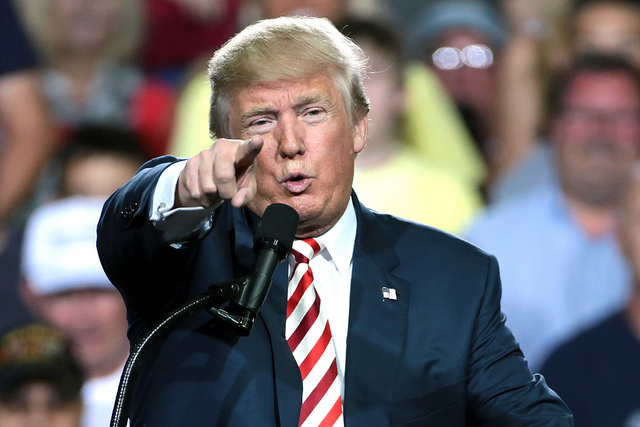
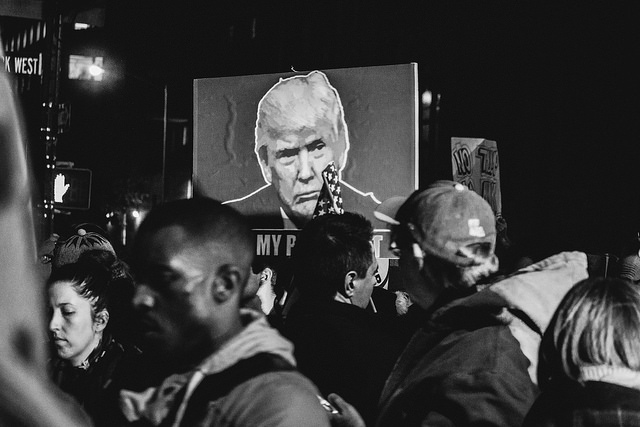
On May 23, 2017, President Donald Trump unveiled his controversial budget proposal “A New Foundation for American Greatness” for FY 2018 which intends to make good on his promise to crack down on illegal immigration and apprehend undocumented immigrants with a criminal record. In a message accompanying his budget proposal, the President stated, “In these dangerous times, our increased attention to public safety and national security sends a clear message to the world — a message of American strength and resolve. It follows through on my promise to focus on keeping Americans safe, keeping terrorists out of our nation, and putting violent offenders behind bars.” To that end, the President has requested an additional $2.7 billion in funding to bolster border security and immigration enforcement measures. In addition to tightening the southern border, the budget proposal seeks to prevent undocumented immigrants from receiving tax credits by requiring individuals claiming child tax credits to provide a verifiable Social Security Number valid for employment purposes.

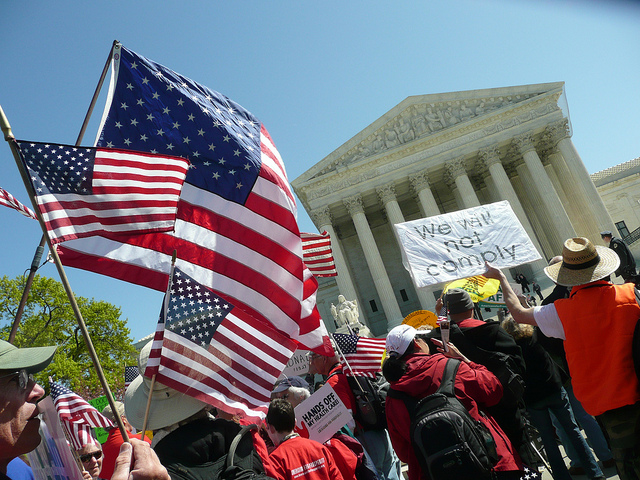
The budget also takes aim against “sanctuary cities” throughout the United States which serve as haven communities for undocumented immigrants. One of the proposals seeks to force local governments to cooperate with federal immigration authorities by detaining undocumented immigrants in local jails, and complying with orders from immigration officials to assist federal authorities in holding and detaining undocumented immigrants for removal. Noncompliance would result in withholding of federal grants.

Although federal law requires that local governments allow employees to share information about undocumented immigrants with federal officials, local governments are not required to assist federal law enforcement in the detention process, those that do, do so voluntarily. A provision in the President’s budget proposal attempts to change this by changing federal law to force local government to comply with federal requests to detain undocumented immigrants in local jails. As part of this provision, federal grants would be disseminated only to cities complying with federal authorities.

Continue reading

8168034654_b59a79c5ba_z

On May 19, 2017, the American Immigration Lawyers Association (AILA) spoke with Charles Oppenheim, the Chief of the Visa Control and Reporting Division for the U.S. Department of State, to discuss current trends and future projections for various employment and family preference categories.

Family preference and employment immigrant categories are subject to numerical limitations and are divided by preference systems and priority dates on the Visa Bulletin. Family-sponsored preference categories are limited to a minimum of 226,000 visas per year, while employment-based preference categories are limited to a minimum of 140,000 visas per year. The Visa Bulletin is a useful tool for aliens to determine when a visa will become available to them so that they may apply for permanent residence. Applicants who fall under family preference or employment categories must wait in line until a visa becomes available to them in order to proceed with their immigrant visa applications. Once the immigrant’s priority date becomes current, per the Visa Bulletin, the applicant can proceed with their immigrant visa application.

You can check the status of a visa number by checking your priority date on the Department of State’s Visa Bulletin published every month. In other words, the Visa Bulletin estimates immigrant visa availability for prospective immigrants and is revised every month.

Trends & Projections

Employment-based Preference Categories:

Current trend: There is an increase in demand across employment-based preference categories, including EB-4 and EB-5, which has decreased unused numbers that would have otherwise become available for use by EB-1 and EB-2 applicants. This means that many people will be prevented from using what would have been available numbers, due to the increase in demand in other employment categories (EB-4, EB-5).  Because of increased demand for the EB-1 Worldwide category, EB-1 India and EB-1 China will have a final action cut-off date. EB-2 China and EB-2 India numbers will be restricted to their annual limits. This trend is likely to continue in the near future.

In FY 2017, EB-2 India number usage will be subject to its annual limit of 2,803, as opposed to previous years when there were unused numbers that trickled down to EB-2 India from other employment categories. Increasing demand in other employment based preference categories will create pressure on EB-1 and EB-2 for China and India.

Continue reading

32447754372_323436bfcc_z

The United States Court of Appeals for the Fourth Circuit has handed down a ruling this morning, dealing yet another blow to the President’s embattled travel ban. The Court has refused to reinstate the President’s 90-day travel ban on Muslims from Iran, Syria, Sudan, Libya, Somalia, and Yemen and the 120-day travel ban on refugees. The Virginia court held that the President’s travel ban does not pass constitutional muster, given that it violates the establishment clause of the United States Constitution. The ruling upholds a lower court’s decision to block the President’s revised travel ban. The Fourth Circuit was forced to weigh the importance of the President’s travel ban in relation to our national security against potentially impinging on a person’s freedom of religion. In their decision, the Fourth Circuit stated that they did not believe that the President’s executive order “has more to do with national security than it does with effectuating the president’s proposed Muslim ban.”

As we previously reported, during the month of March, the President revised his travel ban after the Ninth Circuit Court rejected major portions of the travel ban declaring it unconstitutional. The President revised the travel ban hoping that the revised version would pass constitutional muster and would not be blocked by the federal courts. The revised executive order which was set to go into effect March 16, 2017, called for a 90-day travel ban on non-immigrants of six Muslim countries including Syria, Libya, Iran, Somalia, Sudan, and Yemen, and a 120-day travel ban on the admission of refugees into the United States.

Continue reading

8085501220_45c1780ed5_z

New developments have recently unfolded since the passage of Texas’ controversial SB4 law—a law that bans sanctuary cities in the state of Texas, and requires local jurisdictions and law enforcements officials to cooperate with federal immigration authorities to apprehend undocumented immigrants in the state of Texas.

The controversial bill has suffered its first blowback. The border town of El Cenizo has sued the state arguing that the ban is unconstitutional. The Mayor of El Cenizo, Raul Reyes, told reporters that the bill “hinders the relationship between police departments and the community,” and “decreases criminal activity reports which opens up the door to more domestic violence and more sexual assaults against immigrants.” The city of El Cenizo has been joined in their lawsuit against the state by Maverick county, El Paso county, and the League of United Latin American Citizens. The small town of El Cenizo, Texas first came to national attention when the Spanish language was declared the city’s official language.

The Texas Attorney General envisioned a pushback from “sanctuary cities.” At about the same time that the governor of Texas signed SB4 into law, the attorney general sought to protect the state against future challenges to the law, by filing a lawsuit against known “sanctuary cities” in the state of Texas that have limited the federal government’s power to detain undocumented immigrants by refusing to cooperate with federal immigration officials. The lawsuit was filed on May 7, 2017 in the United States District Court for the Western District of Texas. The state of Texas filed the lawsuit so that they could have a single court ruling upholding the constitutionality of SB4 that would invalidate any lawsuits filed against the state.

Among the cities which have been identified as “sanctuary cities” that have been noncompliant with the federal government’s demands are: Travis County, the city of Austin, and other local officials including Travis County Sheriff Sally Hernandez, who has limited cooperation between local law enforcement and federal immigration officials.

Continue reading

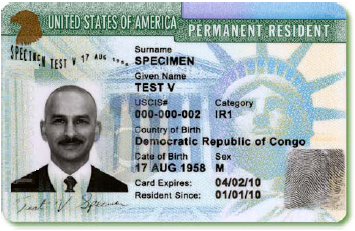
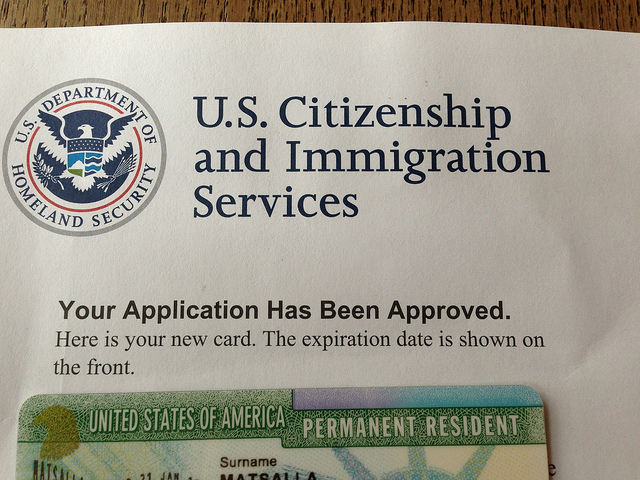
GreenCardImageBeginning May 1, 2017, the United States Citizenship and Immigration Services (USCIS) will begin issuing newly redesigned green cards and employment authorization documents with enhanced features and fraud-resistant technology to prevent tampering and fraud. The new technology has been introduced as part of the government’s ongoing effort to enhance the security of these documents and to facilitate detection of counterfeit documents.

The new green cards and employment authorization cards will

  • Display the individual’s photos on both sides;
  • Show a unique graphic image and color palette:
    • Green Cards will have an image of the Statue of Liberty and a predominately green palette;
    • EAD cards will have an image of a bald eagle and a predominately red palette;
  • Have embedded holographic images; and
  • No longer display the individual’s signature.
  • Green Cards will no longer have an optical stripe on the back.

USCIS may continue to issue some green cards and employment authorization cards with the previous design format, after May 1, 2017, until supplies for that design have run out.

EADCard

Document Validity

Existing and new green cards and employment authorization cards will remain valid until the printed expiration date indicated on the card. Older generation green cards that were issued without an expiration date will continue to remain valid and acceptable for purposes of filing Form I-9, Employment Eligibility Verification, EVerify, and Systematic Alien Verification for Entitlements (SAVE).

USCIS recommends that individuals who have an older green card that does not have an expiration date apply for a replacement card with an expiration date. Receiving a new replacement card will give individuals the benefit of having a highly secure card with fraud-resistant technology in the case the card is lost or stolen.

Continue reading

16F211BF-4FDC-4D41-8FF7-55867BAB7DB9I first met Suman Kanuganti two years ago, back then he was working for another company but contemplating opening his own high-tech startup company and becoming an entrepreneur.

In advising him on his ambitious pursuits, I recommended that he follow his plans and dreams confidently and full-heartedly. Shortly afterwards, Suman quit his previous job and started to focus on his new company, Aira, based here in San Diego. Through the assistance of my immigration law firm, he received his H-1B visa so that he could continue focusing on his amazing work at Aira in developing assistive technology and services for the blind and visually impaired.

His work at Aira continues at a rapid and productive pace, poising the company well for future growth and success. In just two years, Suman, as Co-Founder & CEO, has transformed his startup into the leading developer of remote technology that is bringing immediate access to information and assistance to those with vision loss. This is greatly enhancing the mobility, independence and productivity of blind people in a wide range daily activities – from navigating busy streets and airports, to reading printed material, recognizing faces, catching the bus or Uber, functioning efficiently in the office or classroom, experiencing cultural and sporting events, and literally traveling the globe.

Continue reading

31756508854_20f86e0ba5_z

Today in a Seattle courtroom the Ninth Circuit Court of Appeals heard arguments on Trump’s revised travel ban. As you may recall President Trump issued a revised executive order in March to salvage his embattled travel ban, barring the entry of foreign nationals from Iran, Syria, Sudan, Libya, Somalia, and Yemen for a 90-day period and refugees for 120 days. For over an hour, a three-judge panel listened to arguments from the U.S. Solicitor General Jeffrey Wall arguing on behalf of the Trump administration and Neal Katyal, an attorney representing the state of Hawaii and individuals challenging the President’s revised travel ban. The three-judge panel included Judge Ronald Gould, a moderate judge from Seattle, Washington, Judge Michael Hawkins, a moderate to liberal judge from Phoenix, Arizona, and Judge Richard Paez a liberal judge from Pasadena, California. The central question before the court was whether the President’s revised travel ban amounts to a violation of the U.S. Constitution based on religious discrimination.

https://www.youtube.com/watch?v=d7IJARo-6iI

The mood in the courtroom was contentious. Judges probed the Solicitor General to determine whether the President’s revised travel ban was specifically aimed at Muslims. The Solicitor General argued that the executive order was neutrally worded and that there were no indications in the language of the President’s executive order to indicate that there was any intent to discriminate the Muslim population. In a heated exchange, liberal Judge Richard Paez countered that even if the President’s executive order was “neutrally worded,” taking a seemingly “neutral” stance does not mean an executive order is devoid of discriminatory intent. Judge Paez noted that the executive order that interned Japanese Americans during World War II was also neutrally worded given that there was no reference to Japanese people specifically, but that the President at the time did intend to discriminate that particular demographic. During oral argument, Judge Paez commented on remarks made by the President during his campaign which have indicated his intent to target Muslims specifically with his executive order. Paez stated that Trump made references to a Muslim ban “in the midst of a highly contentious campaign” raising questions about whether the court should consider taking that into account.

Continue reading

31220284724_15651a00e7_z

On May 7, 2017 Governor Greg Abbott of Texas signed the controversial “Texas Senate Bill 4” into law which will take effect on September 1st. Among its major provisions, the bill outlaws the establishment of “sanctuary cities” which serve as safe havens for undocumented immigrants, requires local law enforcement officials to cooperate with federal immigration authorities by holding undocumented immigrants subject to deportation, and permits local law enforcement officials to question individuals regarding their immigration status in the United States. In September, the bill will be enforced by officers throughout the state of Texas including by police officers on college campuses. The bill, however, will not apply to officers contracted by religious groups, schools, government mental health care facilities, and hospitals.

More specifically SB4:

  • Blocks local entities from passing laws and/or adopting policies that prevent local law enforcement officials from inquiring about a person’s immigration status
  • The law makes it a crime for sheriffs, constables, police chiefs, and local leaders to refuse to cooperate with federal immigration authorities (Class A misdemeanor)
  • Imposes sanctions on law enforcement officials and local jurisdictions that do not comply with the law
  • Cities who fail to comply with the law may face fines of up to $25,000 per day, and the police chiefs, sheriffs, or mayors of noncompliant jurisdictions may be charged criminally and/or removed from office
  • Allows police officers to question anyone they believe to be residing in the United States unlawfully about their immigration status, including at routine traffic stops

Continue reading

6224687976_e1786131a6_z

With the H-1B season quickly coming to a close, we are happy to announce that 83% of our clients were selected in this year’s master’s cap, while 56.67% of our clients were selected in the “general cap.” These estimates are above the national average. Of the petitions that were selected, the majority were filed with the California Service Center. Selections in this year’s lottery were made up until the very last minute. This fiscal year, USCIS received a total of 199,000 petitions, less than usual, and the computer-generated lottery was conducted on April 11, 2017 a bit later than usual given that the filing period opened on April 3, 2017. As in previous years, USCIS first began the selection process for the advanced degree exemption or “master’s cap,” and then proceeded with the selection process for the “general cap” to fill the 85,000-visa cap. During FY 2017, USCIS received over 236,000 petitions during the filing period which opened on April 1, 2016, and the computer-generated lottery was conducted on April 9, 2016.

USCIS has now completed data entry for all cap-subject petitions selected during fiscal year 2018. This means that USCIS will now begin the process of returning all H-1B cap-subject petitions that were not selected in this year’s lottery, along with their filing fees. While USCIS has indicated that they cannot provide a definite time frame as to when these unselected petitions will be returned, in previous years unselected petitions have traditionally been returned during mid-June to the end of June.

If you have not received a receipt notice in the mail notifying you of your selection, and your checks were not cashed by the Department of Homeland Security, between April 1st and May 3rd., unfortunately it is not likely that you were selected in this year’s lottery. For safe measure, applicants may wish to wait about a week or so to see if any late notices are received.

Continue reading