Articles Posted in Immigrant Visas

9613483141_0df8534105_z

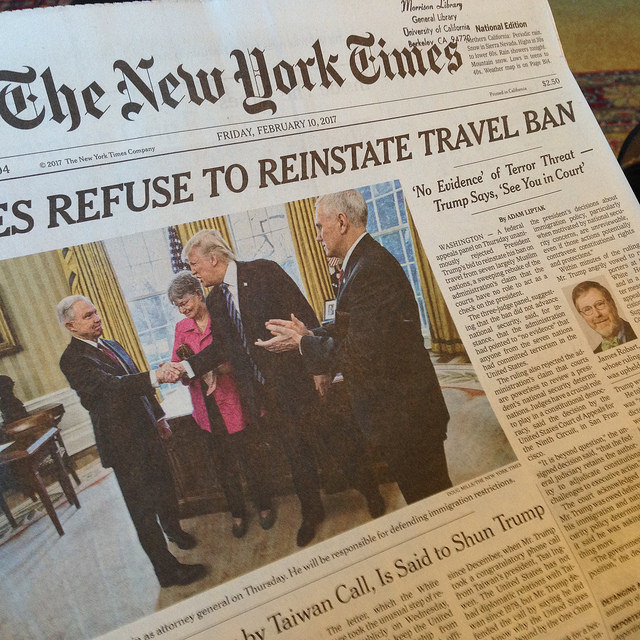
Yesterday, January 27, 2017, President Donald Trump signed and handed down the controversial executive order, “Protecting the Nation from Terrorist Attacks by Foreign Nationals” on immigration to protect the nation from terrorist attacks by foreign nationals. Among its main provisions the order suspends IMMIGRANT AND NON-IMMIGRANT entry of foreign nationals from countries of “particular concern” including Syria, Iraq, Iran, Libya, Somalia, Sudan, and Yemen for 90 days, indefinitely suspends Syrian refugees from entering the United States until the U.S. refugee admissions program has been overhauled, and terminates the visa waiver interview process. The temporary ban will affect all non-U.S. Citizens from Syria, Iraq, Iran, Libya, Somalia, Sudan, and Yemen including green card holders and valid U.S. visa holders. Foreign nationals of these countries will not be allowed to return to the United States for a period of 90 days, after temporary foreign travel, even if they are green card holders or visa holders. For this reason, if you are a foreign national from one of these countries, you should not engage in temporary foreign travel until the temporary ban has been lifted. Visa and green card holders already in the United States will be allowed to remain without problems.

An exemption has been drawn for immigrants and legal permanent residents whose entry is in the U.S. national interest, however it is not yet clear how that exemption will be applied.

Below is a summary of the main provisions of the order per the OFFICIAL signed copy.

To read the complete version please click here.

  1. Suspension of Issuance of Visas and Other Immigration Benefits to Nationals of Countries of Particular Concern
  • The immigrant and nonimmigrant entry into the United States of aliens from countries designated (including Syria, Iraq, Iran, Libra, Somalia, Sudan, and Yemen) is suspended for 90 days from the date of the order January 27, 2017 (excludes foreign nationals traveling on diplomatic visas, North Atlantic Treaty Organization visas, and C-2 visas for travel to the United Nations). This means that if you are a citizen of a country of “particular concern” as outlined above, you will NOT be allowed to re-enter the United States, after temporary foreign travel, until the ban has been lifted, even if you are a legal permanent resident (immigrant) or holder of a valid visa. If you are a foreign national of one of the above countries and you are an immigrant (green card holder) or non-immigrant (valid visa holder), you must NOT travel internationally. Otherwise, you will risk being denied re-entry.
  • The Secretary of State and Homeland Security may submit to the President the names of additional countries who pose a security risk and are recommended for suspension.
  • The Secretary of Homeland Security, in consultation with the Secretary of State and the Director of National Intelligence, must immediately conduct a review to determine the information needed from any country for adjudication of any visa, admission, or other benefit under the INA adequate to confirm the identity of the individual seeking the benefit and ensure that they are not a security or public-safety threat to the United States.

Continue reading

32526771855_f1e4ccf6f8_z

President Donald Trump is expected to hand down a controversial Executive Order on immigration within the coming days to protect the nation from terrorist attacks by foreign nationals. Although the Trump administration has not made a formal announcement regarding the proposed order yet, a leaked, unsigned copy of the President’s order has been making the rounds. We do not know whether the President has made any modifications to the order since its leak, and we do not know when exactly the order will be issued. One thing is clear, an executive order on immigration is imminent. It is rumored that the executive order will include a temporary ban on refugees, the suspension of issuance of visas for citizens of Syria and six other Middle Eastern and African countries, which are rumored to include Iraq, Iran, Libya, Somalia, Sudan and Yemen, collectively referred to as “countries of particular concern,” as well as the end of Syrian refugee processing, and the visa interview waiver program.

The passage of such an executive order although extremely controversial and unpopular, would be within the President’s executive power, if his administration determines that limiting refugee admissions temporarily and restricting the issuance of visas to persons from specific countries is of significant public interest to the United States to combat the war on terror. The administration would need to balance our country’s need to secure its borders against terrorism with the need to resolve the global humanitarian crisis we face today. Donald Trump has already passed a series of executive orders on border security and immigration enforcement authorizing the construction of a U.S.-Mexico border wall, withholding federal grant money for sanctuary cities, hiring 5,000 Border Patrol agents, reinstating local and state immigration enforcement partnerships, and ending the “catch-and-release” policy for undocumented immigrants.

The leaked copy of the executive order “Protecting the Nation from Terrorist Attacks by Foreign Nationals” gives two policy reasons for enacting the executive order. First, the purpose of the order is to protect American citizens from foreign nationals who intend to enter the United States to commit acts of terrorism. Second, the order serves to prevent the admission of foreign nationals who intend to enter the United States to “exploit” the country’s immigration laws for malevolent purposes. The order highlights that following the September 11 attack on the World Trade Center, hundreds of foreign nationals have successfully entered the United States on an asylum, visitor, student, or employment visa, and have been subsequently convicted or implicated in terrorism related crimes. The order goes on to blame the State Department’s consular officials for their failure to scrutinize the visa applications of the foreign nationals who went on to commit the September 11 attacks, which resulted in the deaths of thousands of Americans.

The main provisions of the leaked order “Protecting the Nation from Terrorist Attacks by Foreign Nationals” are as follows:

Continue reading

15859186069_103bf8055c_z

Today, January 12, 2017 the President announced that the Department of Homeland Security will be ending the “wet-foot/dry-foot” policy in a statement about Cuban Immigration Policy. Previously, Cuban nationals were allowed to apply for permanent residency within one year of reaching American soil without the need to enter the United States with a visa. After decades of making an exception for Cuban nationals, the “wet-foot/dry-foot” policy will be no more. From this point forward, Cuban nationals will be required (like all other foreign nationals) to obtain a visa in order to be lawfully admitted to the United States. Effective January 12, 2017, Cuban nationals caught attempting to enter the United States without proper documentation, who do not otherwise qualify for humanitarian relief, will be subject to removal, in accordance with the immigration laws of the United States. This change in policy comes as an effort to “normalize” U.S./Cuban relations and to make the immigration policies of the United States more consistent. As you may know, diplomatic relations between U.S. and Cuba were severed in 1961, and were only re-opened until recently. For their part the Cuban government has reached an agreement with the United States to accept Cuban nationals ordered removed from the United States.

In addition, the new policy states that effective immediately the Department of Homeland Security will terminate the Cuban Medical Professional Parole program under the rationale that this program no longer serves the interests of the United States and the Cuban people. The parole program was viewed as controversial from the very beginning because it provided preferential treatment to Cuban medical personnel. Cuban medical personnel and others will be eligible to apply for asylum at United States embassies and consulates worldwide, as has been customary for all other foreign nationals.

Continue reading

h1b_842_ba6c3410836f9e24e760abe3b25e78dda5a49a8a

As many of you know the H-1B visa lottery for fiscal year 2018 is fast approaching. As usual, the competition will be fierce, as hundreds of thousands of highly skilled professionals prepare to file their H-1B visa petitions beginning April 1st through the April 7th deadline. While filing by April 1st (the first day that applications are accepted) certainly gives applicants greater peace of mind, filing before the April 7th deadline does not necessarily increase an individual’s chances of being selected in the lottery. Throughout the years, our office has seen the selection of many petitions that were filed on or close to the April 7th deadline.  With that being said, we expect the competition this year to be even more intense, that is why we want to give you our top tips about what you should be doing NOW to prepare for H-1B season and increase your chances for success.

First some statistics on fiscal year 2017:

  • For fiscal year 2017, USCIS received over 236,000 H-1B petitions, which included petitions counting toward the general cap and advanced degree exemption; approximately 3,000 more petitions when compared to H-1B petitions received for fiscal year 2016. This trend is likely to continue, giving you all the more reason to prepare for the H-1B season early on.
  • For fiscal year 2017, the H-1B cap was reached within the first 5 business days of the H-1B filing period (April 1 to April 7). We expect this trend to continue as in previous years. During fiscal year 2017, USCIS received more than 20,000 petitions for the advanced degree exemption. This number will undoubtedly increase for fiscal year 2018.
  • For fiscal year 2017, USCIS conducted the randomized computer-generated lottery on April 9, 2016 beginning the selection process for the 20,000 available visas counting toward the advanced degree exemption first. Then, unselected advanced degree petitions were given a second chance of being selected by being placed in the lottery toward the general 65,000 cap.  Individuals holding an advanced degree from the United States thus have two shots at being selected for the lottery.

Chances of selection

The chances of being selected in the lottery for fiscal year 2017 ran at roughly 65% for foreign workers holding a U.S. advanced degree, and roughly 35% for foreign workers holding a bachelor’s degree or equivalent. Compare this to the chances of being selected in the lottery during fiscal year 2016 which ran at 60% for U.S. advanced degree holders, and 30% for bachelor’s degree holders or the equivalent. We expect the percentage of selection to continue to increase for U.S. advanced degree holders and foreign workers holding bachelor’s degree or equivalent, by roughly 5% according to recent statistics. This of course will depend on the demand for the H-1B visa for fiscal year 2018.

Office Stats

For fiscal year 2017, 35%  of H-1B cap-subject petitions that were filed by our office were selected in the H-1B randomized lottery that took place early April 2016. 13% of those petitions were filed with premium processing, while 22% were filed with regular processing. In total our office filed 55 H-1B Petitions: 15 advanced degree petitions and 40 bachelor’s cap or equivalent petitions. Of these, 46 were filed with regular processing and 15 with premium processing. The majority of these petitions were filed with the California Service Center. Of selected petitions for fiscal year 2017, the top specialty occupations included: Applications Developer, Market Research Analyst, and Software Engineer.

H-1B Overview

As in previous years H-1B petitions for fiscal year 2018 will begin to be accepted by USCIS on April 1, 2017 up until April 7, 2017. Foreign workers in specialty occupations and their employers will compete for one of the coveted 65,000 H-1B visas available each fiscal year. The H-1B visa program is limited to a 65,000 congressionally mandated visa cap. Foreign workers holding a U.S. Master’s degree or higher are exempt from the 65,000 cap, however only the first 20,000 advanced degree petitions received by USCIS will qualify for the cap exemption. In addition, certain foreign workers such as foreign workers who have been offered employment under U.S. Chile or U.S. Singapore free trade agreements, and foreign workers in the Commonwealth of the Northern Mariana Islands (CNMI) and Guam are exempt from the cap, according to the Consolidated Natural Resource Act of 2008 (CNRA). Advanced degree petitions received after the 20,000 spots have been allocated will count toward the regular cap along with foreign workers holding bachelor’s degrees (or equivalent including work experience in lieu of formal education). USCIS will receive more than the 65,000 petitions for the H-1B visa program during the first five business days that the application period is open, from April 1st to April 7th. When the cap has been reached, USCIS will make an announcement, in recent years this announcement has been made on April 7th and begin the selection process to fill the 65,000 cap through a randomized lottery system. Petitions that are not selected will be rejected along with their filing fees. Duplicate H-1B petitioners during the same fiscal year, are not allowed, and may be subject to sanctions. Employers may not file an H-1B petition on behalf of an employee more than 6 months before the employee’s intended start date. Once an H-1B visa worker has been selected and approved, the foreign worker may begin employment on October 1st of that fiscal  year. The H-1B visa is issued for a three-year period that can be extended for an additional three years.

Continue reading

new-piktochart_843_6a8b1e61f05cd05ee2ec4001cba0911607cca5e7

On December 27, 2016 in Matter of Dhanasar, 26 I&N Dec. 884 (AAO 2016) the USCIS Administrative Appeals Office (AAO) handed down a groundbreaking decision which has changed the analytical framework for determining eligibility of national interest waivers. This new decision will affect foreign nationals who are pursuing a green card based on employment in the EB-2 category, and who are eligible for a “national interest waiver.”

The national interest waiver is a discretionary waiver of the job offer and labor certification requirement made possible by subparagraph (A) of section 203(b)(2) of the Immigration and Nationality Act. This section of the INA states that the Secretary may, when it deems it to be in the national interest of the United States, “waive the requirements of subparagraph (A) that an alien’s services in the sciences, arts, professions, or business be sought by an employer in the United States.”  In addition to meeting a three-prong test of eligibility, to obtain a national interest waiver, the foreign national must be a member of a profession holding advanced degrees or their equivalent or prove that “because of their exceptional ability in the sciences, arts, or business they will substantially benefit prospectively the national economy, cultural or educational interests, or welfare of the United States.”

Without this discretionary waiver, EB-2 applications must be accompanied by a labor certification and their employer must go through the process of advertising the position to prove to immigration that there are no other applicants who are qualified, willing, and able to fill the position that the foreign national is expected to fill. Employers must also meet prevailing wage requirements as established by law. Establishing the national interest waiver in other words made it easier for qualifying foreign nationals in the EB-2 category to skip the job offer and labor certification requirement, streamlining their path to permanent residency.

Continue reading

13581667445_492623ccb9_c

The Department of Homeland Security has released its end of the year statistics for fiscal year 2016 reflecting immigration enforcement priorities for convicted criminals, threats to public safety, border and national security. The report found that during fiscal year 2016, 530,250 individuals were apprehended nationwide, and a total of 450,954 individuals were removed and returned to their countries of origin. For their part, the U.S. Border Patrol reported a total of 415,816 apprehensions nationwide, an increase in 78,699 persons, when compared to fiscal year 2015. For their part, the U.S. Immigration and Customs Enforcement (ICE) arrested 114,434 individuals during fiscal year 2016, a decrease in 10,777 persons, when compared to fiscal year 2015. During fiscal year 2016, the U.S. Customs and Border Protection (CBP) Office of Field Operations identified 274,821 inadmissible individuals at ports of entry nationwide, an increase in 21,312 persons, when compared to fiscal year 2015. Lastly, ICE reported that during fiscal year 2016 they removed or returned 240,255 individuals, an increase in 4,842 individuals when compared to fiscal year 2015.

The report highlighted that the Department of Homeland Security has successfully honored the Obama administration’s immigration enforcement priorities announced in November 2014, which prioritize the deportation of national security threats, individuals attempting to enter the United States unlawfully, and convicted criminals. As evidence of this, the report states that during fiscal year 2016, ninety-eight percent of initial enforcement actions involved individuals which fell into one of three enforcement priority categories. The report indicates that ninety-one percent of apprehensions fell within the top priority for individuals who either presented a national security threat, attempted to enter the United States unlawfully, or were convicted of a crime (including gang members).

Continue reading

2434691031_dc47fc162a_z

On December 28, 2016, the Department of State announced that original or “wet ink” signatures are no longer required on Form I-864 Affidavit of Support for immigrant visa petitions. This new measure also applies to I-864 supplements such as the I-864A, I-864W, and I-864EZ. Beginning January 1, 2017 the National Visa Center will begin to accept photocopies and scans of signed I-864 affidavit of support forms. The I-864 will still need to contain the affiant’s signature, however the signature no longer needs to be a “wet ink” signature. Typed names and electronic signatures are not acceptable. Petitioners will be required to submit an amended I-864 form to the National Visa Center if the sponsor’s name and personal information is missing and there is no signature or missing pages. Petitioners who will need to send an amended I-864 will receive a “checklist” containing the information that must be corrected on form I-864. If you receive a checklist letter prior to January 1, 2017 asking for an original signature on form I-864 please contact the National Visa Center.

Such requests will contain the following language:

[ x ] In Part 8. Sponsor’s Contract, please correct the following…

[ x ] Item 6.a. You must sign the form and your signature must be original (in ink).

These improvements will simplify the immigrant visa “consular processing” by streamlining the submission of financial evidence in support of an immigrant visa application. The Department of State hopes that this new measure will reduce the amount of immigrant visas rejected at the interview stage. The NVC will continue to use an assessment type of letter to address other inconsistencies and errors found on the I-864 form. This assessment letter indicates which issues if any appear on the affidavit of support which could potentially delay the adjudication of the immigrant visa petition. Typically, this letter will indicate either that the sponsor has completed the form incorrectly or did not provide sufficient financial documentation in support of the affidavit of support. For example, if the petitioner does not meet the income requirement based on their household size, the assessment letter will indicate that more evidence is needed to establish that the income has been met, or a joint sponsor will be required. The assessment letter asks the petitioner to correct the issues before the immigrant is scheduled for their immigrant visa interview at a U.S. Consulate or Embassy abroad. If NVC sends an assessment letter, follow the instructions on the letter. Typically, the immigrant is instructed to bring a corrected affidavit of support to the interview with the suggested documents.

Continue reading

For years you have 8276375308_d5f2721898_zput your trust in our office for all of your immigration needs and for that we thank you. We consider ourselves very fortunate to be able to serve you and your families. Throughout the years, we have helped thousands of immigrants from all over the world attain their American dream. Learning about their lives and their struggles has

always been an important part of our practice. Although many challenges lie ahead for immigration, we are confident that important changes will come about in the new year. Do not despair and know that our office will be with you every step of the way. We wish you and your families the happiest of holiday seasons.

UPDATE: Today, December 29, 2016, USCIS announced that previous editions of affected forms will continue to be accepted by USCIS until February 21, 2017, except for the N-400 Application for Naturalization. N-400 Application for Naturalization must be filed with the 12/23/16 edition date. No prior editions of form N-400 will be accepted by USCIS. Please remember that the new fee schedule will continue to be enforced. New form editions will contain an edition date of 12/23/16. Updated forms can be found at uscis.gov/forms. The complete fee schedule can be found at uscis.gov/forms/our-fees.

Continue reading

1047083584_3520848b69_z

In this segment, we answer 5 of your most frequently asked questions received from our social media platforms and website. Please remember that every case is different and every immigration journey is unique. You should not compare your situation to anyone else’s. We hope that our answers will provide you with further guidance while you embark on your immigration journey. If you have any further questions, please call our office to schedule a free first time consultation. We serve international clients and domestic clients in all 50 states. We thank you for your continued trust in our law office. Do you want us to answer your question in a future segment? Please email nathalie@h1b.biz. For more information on the services we offer please click here.

Immigrating a Foreign Spouse: Incorrect Filing of the I-130

Q: I am currently at an impasse with my wife’s immigration process. We have moved on to the NVC stage of the process, and they have notified us that they will tentatively schedule her for her immigrant visa interview in her home country, although she is currently in the US on an expired visa. Thus-far, her I-130 petition has been approved and they denied the I-129 because of the approval. How can I get the interview location changed to the US without paying for and submitting the I-485?

A: Thank you for your question. More information is needed from you to fully assess your wife’s case such as a complete copy of the I-130 petition that was filed with USCIS. It appears that at the beginning of her case you elected to begin consular processing to immigrate your wife to the United States, and she later traveled to the United States while her I-130 petition was pending with USCIS. As you know, the first step of the consular process to immigrate a foreign spouse, requires you to file the I-130 petition for alien relative. This brings us to the main problem. The I-130 petition is the petition that determines where your wife will be interviewed, whether it be for adjustment of status in the United States, or to obtain an immigrant visa. In other words, the I-130 petition is intimately tied to the location where she will have her interview. On Part C. Item number 22 of the I-130 petition, USCIS specifically asks you to provide complete information regarding whether your relative is in the United States and will apply for adjustment of status, or whether your relative is not in the United States and will instead apply for a visa abroad at an American consular post or embassy abroad. If you responded that your relative was not in the United States and would apply for an immigrant visa abroad at the time of filing, it would be a very rare circumstance that USCIS would allow a change of venue for her interview.

Continue reading