Articles Posted in Free Consultation

passport-315266_1280

TPS Updates: Re-Registration Period is Now Open for Hondurans with TPS

Current beneficiaries of Temporary Protected Status (TPS) under the Honduras country designation, who wish to maintain their TPS benefits, such as ability to continue working in the United States through the official termination date of the TPS program on January 5, 2020, must re-register for TPS benefits between June 5, 2018 and August 6, 2018.

Re-registration instructions are now available on the USCIS TPS website.

Re-registration Procedure:

Applicants must file Form I-821 Application for Temporary Protected Status as well as Form I-765 Application for Employment Authorization, preferably at the same time, but applicants may also file Form I-765 separately at a later date.

New EADs with a January 5, 2020 expiration date will be issued to Honduran TPS beneficiaries who apply within the re-registration period ending on August 6, 2018. USCIS will make every effort to issue new EADs before current EADs expire, however there are no guarantees given the amount of time required to process TPS re-registration applications.

USCIS has automatically extended the expiration date on EADs issued under the TPS designation of Honduras for 180 days, through January 1, 2019. This extension applies to individuals who have EADs that expired on January 5, 2018 and applied for a new EAD during the last re-registration period but have not yet received a new EAD.

Continue reading

file-cabinet-146157_1280
USCIS has announced that it will be processing Freedom of Information Act (FOIA) requests entirely online in the near future, as well as providing the results of those requests online.

Previously, USCIS allowed FOIA requests to be made only via mail, fax, and email and all results were provided on a compact disc by mail. USCIS will now be moving to a system of digital delivery that will take place through several stages.

Individuals who have an immigration court date pending will be able to file a FOIA request by creating an account on myUSCIS and receive the results of the request digitally. Requestors will be able to track the status of their FOIA request and receive notifications once USCIS has uploaded their records into the portal.

question-mark-2492009_1920

In this post, we would like to keep our readers informed about Visa Bulletin projections for the month of May and June. Charles Oppenheim, Chief of the Visa Control and Reporting Division of the U.S. Department of State provides a monthly analysis of each month’s Visa Bulletin including discussion of current trends and future projections for immigrant preference categories.

Below are the highlights of those trends and projections:

Check-in with DOS’s Charlie Oppenheim: May 2018

Employment Based Categories

For the month of May, the following categories remained steady with no changes in the final action dates:

  • EB-1 China and India
  • EB-2 India
  • EB-3 China and Philippines
  • EB-4 El Salvador, Guatemala, and Honduras and
  • EB-5 China

Categories that experienced some forward movement included:

  • EB-2 China to move forward one month to September 1, 2014
  • EB-3 India to advance three months to May 1, 2008
  • EB-3 Other Workers—China to move forward one month to May 1, 2007
  • EB-4 Other Workers—India to move forward about 3 months to May 1, 2008
  • EB-4 Mexico to advance 5 weeks to October 22, 2016

Continue reading

memorial-day-3432665_1920

On behalf of our Law Office, we would like to wish you a safe and Happy Memorial Day as you spend it with your loved ones. We would like to extend a thank you to our service men and women and their families this memorial day weekend. May God bless you and the United States of America.

farewell-3258939_1280

Today, May 25, 2018, the Department of Homeland Security announced that it will be publishing a proposed rule in the Federal Register on May 29th to end the International Entrepreneur Rule, a program that gives foreign entrepreneurs the opportunity to apply for parole to come to the United States for the purpose of developing or starting a business venture in the United States.

As you may be aware, during July of last year, DHS took its first steps to dismantle the program by delaying the implementation of the rule until March 14, 2018. During that time, DHS began to draft a proposal to rescind the rule. In December of 2017 however, a federal court ordered USCIS to begin accepting international entrepreneur parole applications, vacating the delay.

In an act of defiance, DHS is now seeking to eliminate the international entrepreneur rule altogether because the department believes that the rule sweeps to broadly and doesn’t provide sufficient protections for U.S. workers and investors. According to the agency, the international entrepreneur rule “is not an appropriate vehicle for attracting and retaining international entrepreneurs.” This is once again an effort by the Trump administration to undermine Obama era policies such as Deferred Action, to better align with the President’s America-first policies on immigration.

Continue reading

laptop-2557468_1280

In this post, we bring an important reminder to the attention of F-1 Students with Optional Practical Training. F-1 students who transfer to another school or begin their studies at another educational level, such as a master’s degree program after completion of the bachelor’s degree, will have their OPT automatically terminated, as well as the corresponding employment authorization document, also known as a work permit.

F-1 students who transfer schools or begin studying at another educational level, will not be otherwise affected, so long as they comply with all of the requirements necessary to maintain their student status. F-1 students must not work with a terminated/expired EAD. Doing so violates U.S. law, and will result in serious immigration consequences, such as the removal of the foreign national from the United States or barring the foreign national from re-entering the United States, in addition to other serious consequences such as the accrual of unlawful presence.

Continue reading

newspaper-154444_1280

H-1B Update: Return of Unselected Petitions

USCIS has now completed data entry for all fiscal year 2019 H-1B cap-subject petitions that were selected in this year’s H-1B visa lottery. USCIS will begin the lengthy process of returning thousands of H-1B cap-petitions that were not selected in the lottery. Although USCIS has not provided a time frame on when they will begin returning unselected petitions, in previous years, our office began receiving unselected petitions in mid-June. All unselected petitions will include an official hard copy rejection notice from USCIS.

Updated Policy Guidance regarding Adjustment of Status interviews.

USCIS has revised its policy for adjustment of status interviews. All adjustment of status applicants must be interviewed by an officer unless USCIS determines that the interview is unnecessary. The decision to waive the adjustment of status interview is determined on a case-by-case basis.

In the following circumstances the adjustment of status interview may be waived:

  1. General Waiver Categories

“USCIS officers may determine, on a case-by case-basis, that it is unnecessary to interview certain adjustment of status applicants. The following list includes, but is not limited to, categories of cases where officers may decide to waive an interview: 

Continue reading

people-2557399_1280

The United States Citizenship and Immigration Services (USCIS) has released a new policy memorandum that may soon change the way the accrual of unlawful presence is calculated for individuals currently in the United States on an F, J, or M non-immigrant visa type, as well as their dependents accompanying them in the United States.

The new policy proposes that F, J, and M nonimmigrants who fail to maintain their nonimmigrant status before August 9, 2018, will begin accruing unlawful presence on that day.

Generally, F, J, and M nonimmigrants who fail to maintain their nonimmigrant status on or after August 9, 2018, will begin to accrue unlawful presence the day after they abandon their course of study or authorized activity, or engage in an unauthorized activity.

Current Policy

Since 1997, it has been USCIS policy to begin calculating the accrual of unlawful presence, for a F or J nonimmigrant admitted to the United States in duration of status (D/S), one day after finding the nonimmigrant in violation of their nonimmigrant status while adjudicating a request for another immigration benefit (such as a change of status petition) or on the day after an immigration judge has ordered the exclusion, removal, or deportation of the nonimmigrant, whichever comes first.

F, J, and M nonimmigrants admitted for a specified date (not D/S) began to accrue unlawful presence on the day their Form I-94 expired, on the day after finding the nonimmigrant in violation of their nonimmigrant status while adjudicating a request for another immigration benefit (such as a change of status petition) or on the day after an immigration judge has ordered the exclusion, removal, or deportation of the nonimmigrant, whichever comes first.

DHS recently conducted a study to determine the number of nonimmigrants in F, J, or M status who have overstayed. For FY 2016, DHS calculated that out of a total of 1,456,556 aliens in F, J, and M nonimmigrant status expected to change status or depart the United States, 6.19% of F nonimmigrants, 3.80% of J nonimmigrants, and 11.60% of M nonimmigrants actually overstayed their status.

This minuscule percentage has caused USCIS to revise its policy and change how the accrual of unlawful presence is calculated for this demographic.

Continue reading

letters-2794672_1280

Congratulations to those of our readers who won the H-1B visa lottery for fiscal year 2019. If your checks were not cashed between April 1 and May 3, unfortunately you were not selected in the lottery for the upcoming fiscal year. Thankfully our office has prepared a helpful guide that will help you explore alternative options to the H-1B visa by clicking here.

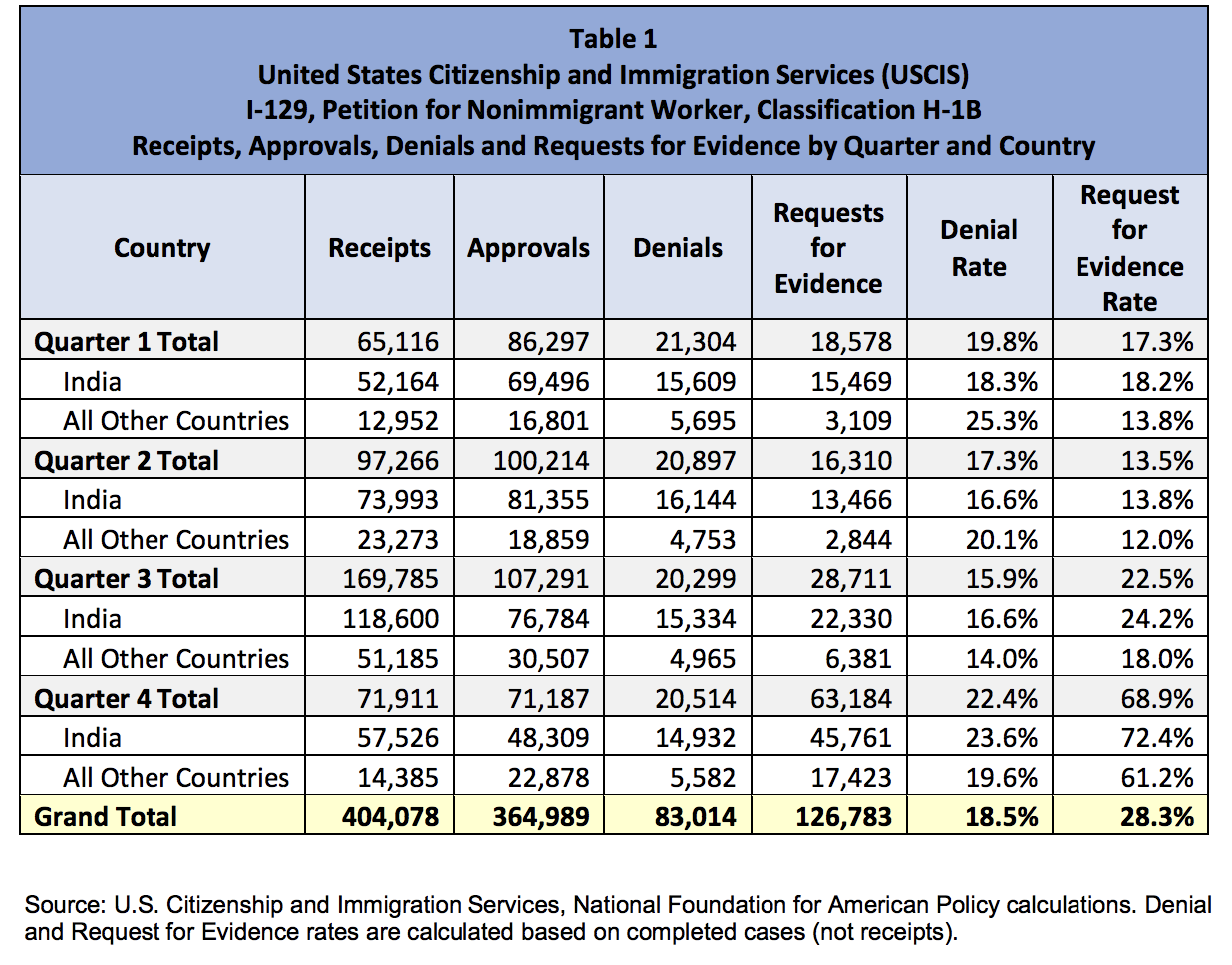
Our office continues to receive receipt notices for petitions that were selected in the lottery. As of the month of May our office has enjoyed a 66.66% success rate for petitions filed under the Master’s cap, and a 41.37% success rate for petitions filed under the Regular Bachelor’s cap, well above the national average of 35%.

If you have received a receipt notice, please keep in mind that premium processing services, for all FY 2019 cap-subject petitions, including petitions seeking an exemption for individuals with a U.S. master’s degree or higher, are suspended until September 10, 2018.

Continue reading

trump-2815558_1280

Our fears have come true. On May 4, 2018, we reported that the Department of Homeland Security would be making an official announcement terminating the TPS designation for the country of Honduras. Shortly after our report, DHS published a formal announcement terminating the Temporary Protected Status (TPS) designation for Honduras, with a delayed date of termination for a period of 18 months. The official date of termination will be January 5, 2020.

This means that nationals of Honduras living in the United States under TPS will have a period of 18 months to arrange for their departure from the United States or seek alternative legal status to remain lawfully present in the United States.

According to a statement released by DHS, the decision was made after the Secretary determined that “the disruption of living conditions in Honduras from Hurricane Mitch that served as the basis for the TPS designation” in 1999 were no longer substantial enough to justify continuation of the designation.

The report also claims that conditions in 1999 have greatly improved, and the country has made “substantial progress in post-hurricane recovery and reconstruction from the 1998 Hurricane Mitch.”

Continue reading