Articles Posted in Free Consultation

8590912474_9e4f126107_z

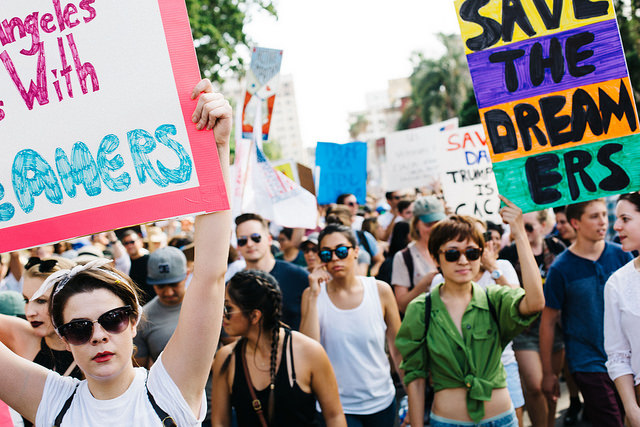
On July 26, 2017 Congresswomen Ileana Ros-Lehtinen (R-FL) and Lucille Roybal-Allard (D-CA) introduced H.R. 3440 the House version of the Dream Act of 2017, a bill that would give young people who were brought to the United States as children, a pathway to obtain conditional legal permanent residence, provided these individuals meet certain requirements.

Under this act, certain qualifying individuals would receive cancellation of removal, and the opportunity to adjust their status to conditional permanent residence, provided the individual has been a long-term resident of the United States, entered the United States as a child, and has not been convicted of serious criminal offenses.

While this Act is still in its early stages, it has received widespread bipartisan support, signaling a serious commitment to shield DREAMers from deportation on both sides of the aisle.

Requirements:

Under this act, to qualify for conditional permanent residence an alien would be required to:

  • Have continuous physical presence in the United States (4 years before the date of the enactment of the act);
  • Have been younger than 18 years of age on the date on which the alien initially entered the United States without inspection;
  • Be admitted to an institution of higher education;
  • Earned a high school diploma, or a commensurate alternative award from a public or private high school, or obtained a GED under State law, or a high school equivalency diploma in the United States, or enrolled in secondary school, or in an education program assisting students in obtaining a regular high school diploma or equivalency, or passing a GED exam or other similar State-authorized exam;
  • The alien must have been found inadmissible under paragraph (2), (3), (6)(E), (6)(G), (8), (10) (A), (10) (C), or (10) (D) of section 212(a) of the INA;

Continue reading

32476548500_cdbb09e855_z

In the United States and across the world, a climate of fear and uncertainty has taken over our day to day lives and crept its way into the politics of the country. This climate of fear has in many ways taken shape because of our President’s harsh anti-immigrant rhetoric, the series of executive orders he has signed on immigration which aim to discourage American companies from hiring foreign nationals, and which ultimately aim to deter undocumented immigrants from attempting to cross the United States border illegally. While the United States has an interest in buying American and hiring American, the President’s stance on immigration has made the best and brightest look elsewhere for the “American Dream.” Another cause for concern is the highly publicized immigration raids taking place across the country against undocumented immigrants. What is perhaps the most unsettling for undocumented immigrants is what is yet to unfold under the Trump administration. In recent weeks, we have seen the President harden his stance on immigration for both undocumented immigrants and foreign entrepreneurs with his plan to dissolve the “International Entrepreneur Rule” and his plan to build a “wall” along the Southern border.

For undocumented immigrants who have lived in the United States for more than 20 years, and who have raised their children as U.S. Citizens, there is much at stake. Living in this climate of fear has become our “new normal.”

The reality is that many families across the country are scared to remain in the United States. Some of these families have willingly returned to their countries of origin or relocated their families to other countries altogether. Still others, are being torn apart. Gone are the days when Dreamers were not made priorities for removal.

If you came to the United States illegally or no longer have a valid status country because you overstayed your visa, or just simply don’t have a status anymore, it is very important for you to take steps to protect yourself, and to realize that you have rights in this country.

Continue reading

25388721144_c637ac5a36_z

Great news for cap-exempt H-1B applicants! Effective immediately, the United States Citizenship and Immigration Services (USCIS) will resume premium processing services for certain cap-exempt H-1B petitions.

As you may recall in early April, USCIS temporarily suspended expedited processing of all H-1B petitions to reduce H-1B processing times and prioritize processing of H-1B extensions nearing the 240-day mark.

Today, July 24, 2017, USCIS announced that certain cap-exempt H-1B petitioners can now take advantage of premium processing services.

Please note that H-1B petitions filed on behalf of physicians under the Conrad 30 waiver program are not affected by the suspension.

What is premium processing?

Premium processing service refers to an optional premium processing service offered by USCIS to employers filing Form I-129 (Petition for a Non-immigrant Worker) or Form I-140 (Immigrant Petition for Alien Worker). Premium processing guarantees 15 calendar day processing to petitioners or applicants who make use of the service. Applications that are not processed within 15 calendar days otherwise receive a refund of the $1,225 premium processing fee. To make use of the service, petitioners or applicants must file Form I-907 with their application and include the appropriate fees. The I-907 request for premium processing service can be filed together with an H-1B petition or separately pending a decision.

Continue reading

2928233768_eed5819469_z

On Wednesday, July 19, 2017, the United States Supreme Court responded to the Trump administration’s motion seeking clarification regarding the Supreme Court’s June 26th preliminary ruling, which held that the President could enforce the travel ban against foreign nationals from Iran, Syria, Sudan, Libya, Yemen, and Somalia, who lack a credible “bona fide” relationship to a person residing in the United States, or entity such as an employer, religious, or academic institution.

The government sought clarification from the United States Supreme Court after the state of Hawaii challenged the government’s interpretation of a “close familial relationship,” and convinced a federal court judge that the Supreme Court intended close family members to include extended family members such as “grandparents, grandchildren, brothers-in-law, sisters-in-law, aunts, uncles, nieces, nephews, and cousins of persons in the United States.” Federal judge Watson was also convinced that refugees with a formal assurance from a resettlement agency were exempt from the travel ban.

In a brief order, the Supreme Court denied the government’s motion seeking clarification of the court’s June 26, 2017 preliminary order, and reversed judge Watson’s decision regarding the admission of refugees with a formal assurance from a resettlement agency. The Supreme Court has ruled that refugees with a formal assurance from a resettlement agency will not be granted admission to the United States pending the resolution of the government’s appeal to the Ninth Circuit Court of Appeals.

Continue reading

Last week, Thursday, July 13, 2017, U.S. District Court Judge Derrick K. Watson handed down a ruling which exempts extended family members from President Trump’s travel ban including: “grandparents, grandchildren, brothers-in-law, sisters-in-law, aunts, uncles, nieces, nephews, and cousins of persons in the United States.” These familial relationships are to be considered bona fide relationships that qualify such foreign nationals from gaining admission into the United States.  Thursday’s ruling also makes refugees with assurances from a resettlement agency, exempt from the President’s travel ban.

Last month, the U.S. Supreme Court announced that they would hear arguments challenging the President’s travel ban when the Court reconvenes in October of next year. As part of their announcement, the U.S. Supreme Court ruled that, in the interim, the President could enforce the travel ban against foreign nationals from Iran, Syria, Sudan, Libya, Yemen, and Somalia, who lack a credible “bona fide” relationship to a person residing in the United States, or entity such as an employer, religious, or academic institution.

28754197084_0ca901c9cb_z

In their ruling, the Supreme Court however provided little guidance on what types of familial relationships would qualify as a credible bona fide relationship. The Supreme Court vaguely stated that “close familial” relationships would qualify as a bona fide relationship, citing mother-in-law’s and spouses as an example of a qualifying familial relationship. However, the Court was silent regarding extended family members.

This prompted the State of Hawaii to seek clarification from federal judge Watson, regarding what types of familial relationships would be subject to the ban. The State of Hawaii argued that the Trump administration had wrongfully interpreted the Court’s ruling to exclude close family members such as grandparents, after the administration issued a diplomatic cable to U.S. consular posts and embassies abroad that defined a “close familial relationship” to include parents, children, and in-laws, but not grandparents, grandchildren, aunts, uncles, and cousins.

Continue reading

30618435416_0d67f54496_z

It’s official. The Department of Homeland Security has rolled out a plan to delay the effective date of the International Entrepreneur Rule, which was set to be enforced on July 17, 2017, to March 14, 2018, at which time the Department will seek comments from the public to rescind the rule, in accordance with Executive Order 13767, “Border Security and Immigration Enforcement Improvements” signed by President Trump on January 25, 2017.

Written comments from the public are due on or before 30 days from the date of publication in the federal register. It is strongly advised that all affected foreign entrepreneurs, business owners, attorneys, immigration advocates etc. leave a public comment identified by DHS Docket No. USCIS-2015-0006, online or by mail detailing the adverse effect that rescinding the rule would have on the U.S. economy and the expansion of jobs in the United States.

Public Comments

Online: Federal eRulemaking Portal: http://www.regulations.gov. Follow the website instructions for submitting comments.

This document is scheduled to be published in the Federal Register on 07/11/2017 and available online at https://federalregister.gov/d/2017-14619, and on FDsys.gov

By Mail: You may submit comments directly to U.S. Citizenship and Immigration Services (USCIS) by sending correspondence to Samantha Deshommes, Chief, Regulatory Coordination Division, Office of Policy and Strategy, UCSIS, DHS, 20 Massachusetts Avenue, NW, Washington, DC 20529. Remember to reference DHS Docket No. USCIS-2015-0006 in all mail correspondence.

Continue reading

7541767406_8bf4575705_zNew developments have recently emerged regarding the Trump administration’s decision to dramatically scale back or rescind the International Entrepreneur Rule, passed under former President Barack Obama, a rule that would have made it easier for eligible start-up entrepreneurs to obtain temporary permission to enter the United States for a period of 30 months, through a process known as “parole,” for the purpose of starting or scaling their start-up business enterprise in the United States. International entrepreneurs would have been able to apply for this benefit beginning July 17, 2017.

However, this may all change in the coming days. The San Francisco Chronicle has reported that the Trump administration plans to undo the International Entrepreneur rule, to prevent foreign entrepreneurs from coming into the United States and starting their companies. This comes as part of President Trump’s commitment to “buy American, and hire American,” and his promise to create more jobs in the United States, by encouraging American companies to expand within the United States. All of this unfortunately comes as no surprise. It is no secret that the President has consistently expressed his anti-immigrant sentiment through his immigration policies and executive orders.

An administration official has come forward on condition of anonymity disclosing that the Trump administration plans to push back the rule’s effective date from July 17, 2017 to March 2018, to give the administration enough time to dramatically scale back the rule or get rid of the rule altogether.

Continue reading

31373809060_9b1ec4c10a_z

ICE Memo Discusses Immigration Enforcement of EOs 13767 and 13768  

In a new memorandum entitled “Implementing the President’s Border Security and Immigration Enforcement Policies,” U.S. Immigration and Customs Enforcement (ICE), outlines the President’s policies going forward in implementing Executive Order 13767, “Border Security and Immigration Enforcement Improvements,” and Executive Order 13768 “Enhancing Public Safety in the Interior of the United States,” signed by the President on January 25, 2017.

The memorandum makes clear that enforcement and removal operations will be taken immediately against all removable aliens, prioritizing expedited removal of aliens with criminal history or prior immigration violations such as fraud or material misrepresentation. Accordingly, the Department of Homeland security “will no longer exempt classes or categories of removable aliens from potential enforcement” under EO 13767 and 13768.

Under these directives, officers will prioritize efforts to remove individuals who:

  • Have been convicted of any criminal offense;
  • Have been charged with any criminal offense that has not been resolved;
  • Have committed acts which constitute a chargeable criminal offense;
  • Have engaged in fraud or willful misrepresentation in connection with any official matter before a governmental agency;
  • Have abused any program related to receipt of public benefits;
  • Are subject to a final order of removal but have not complied with their legal obligation to depart the United States; or
  • In the judgment of an immigration officer, otherwise pose a risk to public safety or national security.

Continue reading

26088808064_4c922a41e9_z

In this post, we bring you the top three mistakes to avoid when applying for a B-1/B-2 non-immigrant visa at a United States consulate or embassy abroad. All too often clients contact our office feeling distraught after receiving a B-1/B-2 visa denial from a consular official. The good news is that a B visa denial can be easily avoided by understanding the common mistakes that people make when pursuing the B nonimmigrant visa.

First, it is important to understand who is eligible to apply for a B non-immigrant visa.

B-1 versus B-2

The B-1 temporary business visitor visa is reserved for individuals who seek to travel to the United States for a temporary period to participate in a business activity of a commercial or professional nature. Examples of individuals who qualify for this type of visa include: individuals consulting with business associates, individuals negotiating contracts, settling an estate, participating in short term training, entrepreneurs who wish to travel to the United States to research the market for a potential business venture, individuals traveling for a scientific, educational, professional, or business convention, or conference, etc.

Individuals who typically apply for this type of visa are entrepreneurs and investors who wish to apply for an E-2 visa in the future and who need to visit the United States to research the market or other business activities relating to researching the viability of the business venture.

B-1 temporary business visitors may be eligible to remain in the United States anywhere from 1-6 months—with 6 months being the maximum. Ultimately, it will be up to the consular/embassy official to determine the length of your period of stay. Typically, applicants are granted an initial period of stay of 6 months. B-1 visa holders may extend their stay for an additional 6 months if it is necessary for them to remain in the United States for an extended period to complete their temporary business activity.

Similarly, the B-2 temporary visitor visa is reserved for individuals who wish to enter the United States temporarily for tourism, pleasure, or visitation. Examples of individuals who qualify for this type of visa include tourists, individuals who wish to visit friends, or relatives, individuals seeking medical treatment, amateur artists, musicians, or athletes who wish to participate in events or contests that do not provide compensation, and individuals who wish to enroll in a short recreational course of study that does not count for credit toward a degree. The length of stay granted to a B-2 temporary visitor is the same as that of a B-1 temporary business visitor.

Who may not apply for a B visa?

Individuals who wish to immigrate to the United States and remain in the United States permanently, or individuals who wish to study, seek employment, etc. may not apply for a B non-immigrant visa.

Continue reading

31769361243_67e4218d01_z

As previously reported, the U.S. Supreme Court recently announced that the court will be hearing arguments in defense of and in opposition to the President’s controversial executive order “Protecting the Nation from Foreign Terrorist Entry into the United States,” also known as the “travel ban” in October of this year.

In the meantime, the Supreme Court has allowed some parts of the President’s executive order to take effect until it makes a final ruling later this year. This means that certain foreign nationals will be prevented from gaining admission to the United States. Today, the Department of State announced that per the Supreme Court’s instructions, the President’s 90-day temporary suspension will be implemented worldwide at 8:00 PM (EST) beginning today, June 29, 2017.

Who will be affected?

Foreign nationals from the six countries of concern mentioned in the President’s executive order, including Syria, Sudan, Somalia, Iran, Libya, and Yemen, who do not have a bona fide relationship with a person, entity (such as a religious or academic institution), or employer in the United States, will not be granted admission to the United States for a period of 90 days, beginning, June 29, 2017 8:00 PM EST, unless the foreign national can demonstrate that they have a credible qualifying bona fide relationship with a person, employer, or entity in the United States. Such individuals may qualify for a case-by-case waiver.

In addition, refugees will not be admitted to the United States for a period of 90 days, beginning June 29, 2017 8:00 PM EST, unless they can demonstrate a legitimate claim of “concrete hardship,” to be weighed against the country’s concern for its national security.

Continue reading