Articles Posted in News

3421880567_7c3cfa34f0_z

Beginning February 19, 2016 certain nonimmigrant Caribbean residents seeking admission to the United States as H-2A agricultural workers, will be required to obtain a valid passport and valid H-2B visa in order to be admitted. Spouses and children traveling with an H-2A agricultural worker will also be required to present a valid passport and H-2A visa. The H-2A nonimmigrant visa exception for Caribbean residents was first introduced during World War II in an effort to address labor shortages in the American workforce. The change, comes as part of the revised 2016 Omnibus Appropriations Bill, which eliminates the nonimmigrant visa exception for these individuals, along with other provisions that impact the H-2B nonagricultural visa program. The new rule will apply to nationals of the United Kingdom, France, the Netherlands and nationals of Barbados, Grenada, Jamaica, Trinidad and Tobago, who either maintain a residence in a territory governed by England, France, or the Netherlands located in the adjacent islands of the Caribbean, or maintain a residence in Barbados, Grenada, Jamaica, or Trinidad and Tobago. The change was validated in yesterday’s Federal Register by the Department of State and Homeland Security respectively. Removal of this visa exemption will allow the Department of State to properly screen individuals prior to their arrival in the United States, and further protect agricultural workers from employment violations and work related abuse. To learn more about the H-2A visa program click here.

Continue reading

reagan
For this month’s staff spotlight, we invite you to learn more about Legal Assistant, Reagan Volkman.

Ms. Volkman was born and raised in San Diego, California. She pursued her studies at Cuyamaca and Grossmont College graduating in December 2014 with degrees in History, the German language, and Paralegal Studies. She is fluent in German and has knowledge of American Sign Language. At the office, she assists attorneys with drafting, compiling, and filing family-based immigration petitions including applications for adjustment of status, I-130 consular processing, removal of conditions, naturalization, fiance visas, change of status petitions, and much more.

“The best part of my job is meeting and working with such a diverse group of people. It is very rewarding to be able to make a difference in the lives of others.”

387411647_96fa4d50de_z

On January 21, 2016 the Department of Homeland Security confirmed that the Visa Waiver Program Improvement and Terrorist Travel Prevention Act would begin to be implemented. As a result of the recent terrorist attacks in San Bernardino county and abroad, Congress passed the Act in an effort to protect Americans from potential attacks and to secure the border. The Act increases travel restrictions for certain nationals seeking admission to the United States via the Visa Waiver Program.

Presently, the Visa Waiver Program allows nationals from 38 designated countries to travel and seek admission to the United States without a visa, for a maximum duration of 90 days. Visa Waiver Program travelers must have an approved Electronic System for Travel Authorization (ESTA) before travel.

As of January 21, nationals of visa waiver participating countries who have traveled to or been present in Iran, Iraq, Sudan, or Syria on or after March 1, 2011 will no longer be eligible to travel or seek admission to the United States under the visa waiver program.  Nationals from visa waiver participating countries who maintain dual nationality with any of the aforementioned countries, are also excluded from traveling or seeking admission to the United States under the visa waiver program. Instead, these individuals must apply for a tourist visa at a United States Consulate or Embassy abroad before seeking admission to the United States. Part of this process will require a nonimmigrant interview to be conducted, before issuance of a tourist visa. DHS expects that this new legislation will not adversely impact visa waiver program travelers, since the Act does not ban these individuals from traveling to the United States, rather it removes the privilege of traveling under the visa waiver program, and requires these individuals to apply for a tourist visa.

Continue reading

9087166672_92316bba0a_c
On January 23, 2016 a Federal District Court Judge for the District of Columbia granted the federal government an extension for the STEM Optional Practical Training (OPT) program to resume, giving the Department of Homeland Security (DHS) more time to issue a new replacement rule. The STEM OPT program had been in place since 2008, but was recently invalidated following a court order requesting the Department of Homeland Security (DHS) to issue a new replacement rule by February 12, 2016. DHS responded by requesting an additional 90 days to implement the final rule by May 10, 2016.

As part of their request, the federal government argued that exceptional circumstances existed to warrant the extension. This was owed to an unprecedented amount of comments received by DHS, that could not be reviewed and analyzed by the February deadline. According to the Administrative Procedures Act, DHS is required to publish a final rule 60 days before its effective date. During the comment period alone, DHS received over 50,000 comments that were nearly impossible to review and revise by the February deadline. Although plaintiffs for the original suit challenged the court stating that the court did not have jurisdiction to grant the extension, the court agreed with the federal government. The court stated that it did indeed have jurisdiction over the motion and that the undue hardship that STEM OPT participants and employers would experience, absent a new replacement rule, constituted an exceptional circumstance to warrant the extension. It is estimated that approximately 434,000 international students might benefit from the new replacement rule.

Presently, 23,000 students are STEM OPT participants, while approximately 2,300 more individuals are dependents of these participants. Had the extension been denied, thousands of students, their educational institutions, and their employers would be adversely affected. Litigation will continue over the validity and issuance of the replacement rule. If your initial OPT will expire between now and the May 10 deadline, and you are still within the 120-day filing window, you should apply for your 17-month extension as soon as possible, to benefit from the 17-month extension under the 2008 OPT rule. If your OPT will expire on or after May 11, and you are still within the 120-day filing window, you may be able to receive a 17-month extension. Once the new rule is in place and you are outside of the filing window, you will need to wait for the new rule and apply for benefits under the new rule. The new rule is expected to be published by March 11, 2016.

9544847065_844609a188_z

Beginning December 18, 2015, H-1B and L-1 filing fees will increase for H-1B/L-1 dependent employers, employing 50 or more employees, with more than 50% of those employees in H-1B or L nonimmigrant status. This increase in fees comes with the passage of the Consolidated Appropriations Act, 2016 recently signed into law by President Obama, to be enforced until September 30, 2025. The new fee will apply to initial and change of employment H-1B and L petitions filed on or after December 18, 2015. The additional fee will be $4,000 for H-1B petitions and $4,500 for L petitions. USCIS will be revising Form I-129 and I-129S to reflect the new law and the additional fee. Petitioner’s are advised to accurately complete Item Numbers 1d. and 1d1. of Section 1 of the H-1B Data Collection Supplement and Item Numbers 4a. and 4b. of the L Supplement. Failure to complete this information accurately and include the appropriate fee where necessary may result in the rejection of your petition beginning February 11, 2016. CIS reserves the right to issue a request for evidence to determine if the additional fee will apply. In these cases, the original filing date will be maintained as the date of receipt of the petition.

Other fees that may be included in the H-1B petition are as follows:

  • I-129 processing fee $325;

3198083648_b5276e02c4_z

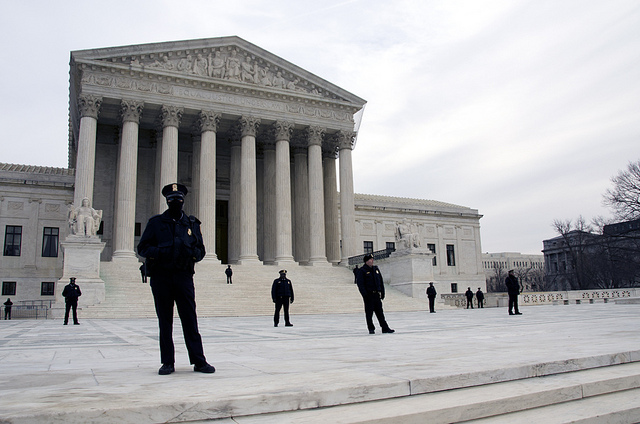
This morning, the Supreme Court announced that it would hear arguments for and against the extended Deferred Action for Childhood Arrivals (DACA) program and the new Deferred Action for Parents of U.S. Citizens and Lawful Permanent Residents (DAPA) program. If the government succeeds in its appeal, millions of undocumented immigrants will be granted temporary employment authorization, ‘deferred status’ meaning that these individuals will no longer need to fear deportation, and other benefits such as the ability to apply for a social security number. This decision is a victory for the Obama administration since it leaves open the possibility that the Supreme Court will lay down an important legal precedent in the midst of the presidential campaign and Obama’s exit from the White House.

  • To learn how expanded DACA is different than the initial DACA program click here.
  • To learn about the DAPA program click here.

3198083750_597c4a4e90_z
The Supreme Court justices are currently in deliberations, to decide the fate of Barack Obama’s expanded Deferred Action for Childhood Arrivals (DACA) and Deferred Action for Parents of U.S. Citizens and Lawful Permanent Residents (DAPA) announced November 2014, as part of the President’s executive actions on immigration. At issue is whether or not the Court will hear arguments for and against lifting the temporary court injunction, which prevented the expanded DACA program and the new DAPA program from moving forward as initially anticipated.

The extended DACA and DAPA provisions were scheduled to go into effect on February 18, 2015, but were quickly blocked by a temporary injunction filed by Texas and 26 other states, just three days before applications for extended DACA and DAPA would have been accepted by USCIS. What has resulted has been a near two-year legal battle between the federal government and the states in question.

Timeline of legal action between the federal government and plaintiffs:

2529706103_d43e75cd10_z

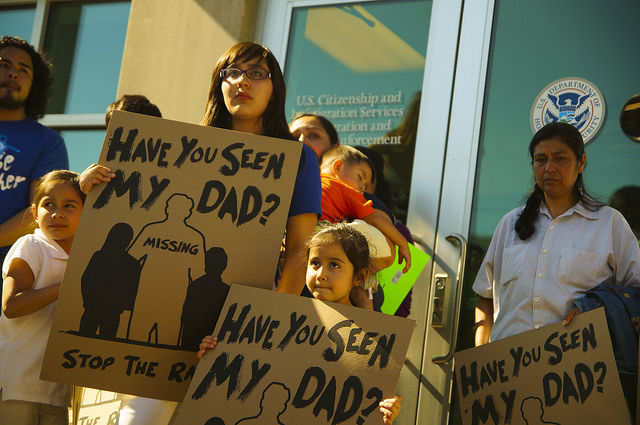
Following a recent surge in apprehensions of undocumented immigrants at the Southwest border, the Department of Homeland Security announced that, beginning January 1st Immigration and Customs Enforcement (ICE) engaged in a concerted nationwide crackdown, taking adults and some children into custody, who have evaded their orders for removal. In a recent press release, the Secretary of DHS, Jeh Johnson indicated that the crackdown occurred as a result of President Obama’s November 2014 executive action on immigration, which put in place new priorities for removal, including the removal of convicted criminals, individuals posing a threat to national security, individuals apprehended at the border or who were found to have entered the United States unlawfully after January 1, 2014. In November 2014 President Obama had implemented these new priorities in an effort to secure the border. In the press release, Jeh Johnson added, “as I have said repeatedly, our borders are not open to illegal migration; if you come here illegally, we will send you back consistent with our laws and values…individuals who constitute enforcement priorities, including families and unaccompanied children will be removed.”

According to the Department of Homeland Security, Central American migrants were removed and repatriated at an increasing rate since the summer of 2014. During this time, there was a surge in the number of families and unaccompanied children from Central America attempting to cross the southern border illegally. In response to this surge, DHS collaborated with the Mexican, Guatemalan, Honduran, and Salvadorian governments to decrease these numbers. According to Jeh Johnson the collaborative efforts were temporarily successfully. In 2015 the number of apprehensions by the U.S. Border Patrol decreased dramatically to 331, 333. Fiscal year 2015 experienced the lowest amount of apprehensions on the southern border since 1972. Recently, an increased rate of apprehensions resurfaced. This sudden spike resulted in the January 1st crackdown prompting ICE to action. As part of the crackdown, dozens of female agents and medical personnel were deployed to assist with the apprehension and removal process. According to DHS, in cases involving medical urgency or other reasons, ICE exercised prosecutorial discretion. As stated by DHS, enforcement operations will continue as needed in collaboration with state and local law enforcement.

Continue reading

8425492426_e2cd908a3f_z

As previously reported, the STEM Optional Practical Training (OPT) rule that had been in place since 2008, was invalidated following a court order requesting the Department of Homeland Security to issue a new replacement rule. The court gave the DHS until February 12, 2016 to come up with a replacement rule in order for the STEM OPT program to continue. In order for a new replacement rule to be put in place, DHS was required to publish the final rule 60 days before its effective date, according to procedural rules established by the Administrative Procedures Act. In order to meet such a deadline, DHS needed to have published the final rule by December 14, 2015 in order for it to be enforced by the February deadline. Luckily, the government filed a motion to extend the stay of the court order—to May 10, 2016, thus requesting an additional 90 days for the government to implement a final rule. In order for the motion to be successful the government must establish that exceptional circumstances warrant such relief to be given. The government has argued that there is an unprecedented amount of comments that cannot be reviewed and analyzed by the February deadline. During the comment period, DHS received over 50,000 comments that it must review, revise, and finally publish a final rule. The court is not expected to rule on the motion until early 2016. Meanwhile the plaintiffs of the original suit have filed an appeal before the DC Circuit Court arguing that the OPT program is not within the authority of the DHS.

If the motion is unsuccessful, the government may file a motion at the district court level or request a stay of the court’s injunction at the circuit court level. In any case, those affected should be aware that the government still has several avenues through which relief may be granted: (1) the Judge may grant the government its requested 90-day delay on the present motion; (2) the Judge may later grant a complete stay pending appeal of the injunction; or (3) the DC Circuit may stay the Judge’s injunction while it considers the merits of her rulings in the underlying case.  CIS has not yet released official correspondence explaining whether students affected will be granted a STEM extension after the February deadline.

For more information please contact us.

District Court Denies Request for Temporary Restraining Order to Halt Syrian Re-Settlement Program in Texas

23348054250_3bfc1cd6a0_z

First Family of Syrian Refugees Arrives in Canada

In their December suit, Texas Health and Human Services Commission V. United States, et, al., the state of Texas alleged that the United States government and the International Rescue Committee unlawfully attempted to re-settle six Syrian refugees in the city of Dallas without prior  consultation and collaboration. According to Texas, the federal government failed to consult with the state regarding re-settlement of these refugees, and prevented them from receiving vital information relating to security risks posed by Syrian refugees prior to their re-settlement. Texas also claimed that the International Rescue Committee similarly failed to collaborate and consult with the Texas Health and Human Services Commission in advance prior to the re-settlement of these refugees. To protect itself, the state of Texas asked for an injunction and a temporary restraining order to halt the resettlement of Syrian refugees until security checks could confirm that these Syrian refugees do not pose a threat to the state of Texas.

On December 9, 2015 the U.S. district court denied the temporary restraining order, adding that the state of Texas failed to provide compelling evidence to suggest that Syrian refugees pose a substantial threat of irreparable injury to its citizens. Presiding district court Judge David C. Godbey added that, “the [Texas] commission has failed to show by competent evidence that any terrorists actually infiltrated the refugee program, much less that these particular refugees are terrorists’ intent on causing harm.” Although the lawsuit still stands and will likely not receive a final ruling until early next year, the district court set an important precedent in its denial of the temporary restraining order. Judge Godbey further maintained that it is not within the purview of the district court to assess what risk, if any, Syrian refugees pose to any particular state. Such risk can only be assessed by the federal government. On this issue Godbey stated that, “the Court has no institutional competency in assessing the risk posed by refugees. That is precisely the sort of question that is, as a general matter, committed to the discretion of the executive branch of the federal government, not to a district court.” The rest of the lawsuit remains in litigation.

Continue reading