61320634_2e4c8e752c_z

Every year USCIS receives and adjudicates approximately 6 million applications from foreign nationals seeking to immigrate to the United States, and U.S. companies seeking to employ foreign workers temporarily.  According to the Department of Homeland Security’s Office of Immigration Statistics, “an estimated 13.1 million lawful permanent residents (LPRs) were living in the United States on January 1, 2013.” Of these permanent residents, more than half–8.8 million–were eligible to apply for naturalization. Additionally, the United States issues approximately 700,000 temporary non-immigrant work visas for a variety of temporary workers including: highly skilled foreign workers employed in specialty occupations in the STEM fields, fashion models, internationally acclaimed athletes and entertainers, aliens of extraordinary ability, religious workers, intra-company transferees, treaty traders/investors, foreign media workers, and agricultural and seasonal workers.

The reason the issuance of temporary worker visas is so low, when compared to the issuance of permanent resident cards, is because most of the temporary foreign worker visa programs are subject to a congressional cap, that limits the amount of non-immigrants that can be admitted per fiscal year. Additionally, certain temporary nonimmigrant worker visa classifications are granted for a specified period of time, although in most cases at least one extension may be granted. The cap applies primarily to the H nonimmigrant worker classifications, and non-minister religious workers. The H visa category accounts for approximately 54% of all visas issued for temporary workers. That is why the H visas are the most talked about visas among politicians when discussing immigration reform. The cap does not apply to treaty traders/investors, aliens of extraordinary ability, intra-company transferees, NAFTA professionals (Canada and Mexico), and foreign media workers. In comparison to developed countries, the United States admits a relatively low number of temporary foreign workers. Foreign workers are typically admitted either to fill labor shortages in the American job market, or because of their exceptional, or highly technical skills, as is the case for the H-1B visa classification.  Only highly skilled foreign nationals, aliens of extraordinary ability, aliens holding advanced degrees, high capital investors, nurses and physical therapists, doctors in undeserved area, and recipients of national interest waivers, have the unique opportunity to obtain permanent residence based on employment.

The mammoth task of meaningful immigration reform will not be easy and it will not happen overnight. The presidential nominees have failed to outline a clear strategy to overhaul our immigration system. None of the presidential candidates have addressed the most contentious areas of immigration policy that must be revised, in order to repair our broken immigration system.


Continue reading

5086531784_ed4e1a8a69_z
For this blog we are answering 5 questions we have recently received through our social media platforms and our website. Please remember that every case is different and every immigration journey is unique. You should not compare your situation to anyone else’s. We hope that our answers will provide you with further guidance while you embark on your immigration journey. If you have any further questions, please call our office for a free legal consultation. We serve international clients and domestic clients in all 50 states. We thank you for your continued trust and interest in our law office.

Change of Status B-2 to F-1

Q: I need advice regarding my change of status. I am currently in the United States on a B-2 tourist visa. I have filed a change of status application to change my status to F-1 student. My B-2 duration of stay will expire today and my change of status application to F-1 student is still pending with USCIS. I informed my school that I will be postponing my classes and was notified that I need to file a new I-20 and provide some missing information. I have time to make adjustments to my application but I would like to know the steps to correct any missing information. I also wanted to know if I need to leave the United States immediately since my F-1 application is still pending. Please assist.

The Waitress
This morning, USCIS made the announcement that it has met the H-2B Cap for temporary nonagricultural workers, beginning employment during the first half of fiscal year 2016. A congressionally mandated cap, limits the number of H-2B visas that can be issued per fiscal year to 66,000. The first half of these visas are issued to workers who will begin employment in the first half of the fiscal year (from October 1 to March 31) and the other half are issued to workers who will begin employment in the second half of the fiscal year (from April 1 to September 30). The deadline to file an H-2B worker petition, with an employment start date beginning prior to April 1, 2016, was March 15, 2016. New H-2B petitions received by USCIS after the deadline, requesting an employment start date before April 1, 2016 will be rejected by USCIS. USCIS will continue to accept and process applications for temporary nonagricultural workers who are considered cap-exempt.

The following H-2B petitions are considered cap-exempt:

  • Petitions filed for “returning workers” that have already been counted towards a previous H-2B cap in fiscal years 2013, 2014, or 2015;

7468447528_3aaed1a0bd_bH-1B season is now in full swing. H-1B petitions will begin to be accepted by USCIS on April 1, 2016 for the 2017 fiscal year. Each year, foreign workers in specialty occupations compete for one of 65,000 H-1B visas allocated each fiscal year. Foreign workers with a U.S. Master’s degree or higher are exempt from the 65,000 congressionally mandated visa cap, however only the first 20,000 petitions received by USCIS may qualify for this cap exemption. Any petitions received after the 20,000 cap-exempt petitions have been allocated will count toward the regular cap. USCIS expects to receive more than 65,000 petitions during the first five business days of the application period. Once the H-1B cap has been reached, USCIS will notify the public, and begin selecting the H-1B petitions necessary to meet the cap through a randomized computer-generated lottery system. H-1B petitions that are not selected through this system will be rejected, along with any petitions received once the visa cap has closed. Duplicate H-1B petitions that are filed on behalf of a foreign worker by the same employer in the same fiscal year will also be rejected. 8 CFR § 214.2(h)(2)(i)(G) explicitly states that “an employer may not file, in the same fiscal year, more than one H1B petition on behalf of the same alien if the alien is subject to the numerical limitations of section 214(g)(1)(A). Filing more than one H-1B petition on behalf of the same alien in the same fiscal year will result in the denial or revocation of all such petitions.” Multiple H-1B petitions filed on behalf of the same alien by different employers during the same fiscal year is permitted although approval of such petitions is discretionary. According to USCIS, petitioners may be asked to demonstrate that a ‘legitimate business need’ exists in filing more than than one H-1B petition for the same alien. In such circumstances a request for evidence, notice of intent to deny, or notice of intent to revoke may result. This is true of both cap-subject and cap-exempt petitions filed by different employers for the same alien.

H-1B petitioners (employers) may request premium processing at the same time that the H-1B petition is filed by signing and completing Form I-907 and including the corresponding fee. Alternatively, petitioners may request premium processing once CIS notifies the petitioner whether the petition has been accepted or rejected. USCIS will not begin premium processing for H-1B cap petitions until May 16, 2016. If you are an American employer who is interested in filing an H-1B petition for a foreign worker, you must act quickly. Filing an H-1B petition is a very complicated and long process. For one if you have never sponsored a foreign worker, you will be required to register your FEIN with the Department of Labor before filing the H-1B petition. Secondly, if the foreign worker you wish to hire received their foreign degree abroad, they must obtain an academic evaluation from an accredited evaluation service. If the foreign worker you wish to hire does not have formal education, but has extensive experience in the specialty occupation, they will need to obtain work experience letters from individuals who can attest to their experience. Thirdly, once an employer has registered their FEIN with the Department of Labor, they will be required to file a Labor Condition Application with the Department of Labor and include the certified LCA with the H-1B petition. Certification of the LCA takes time. The LCA is an attestation made by the employer that they will pay the foreign worker at least the actual or prevailing wage for the occupation, whichever is higher, based on the physical location where the foreign worker will be employed. Once properly submitted to the DOL, the LCA alone takes approximately 2 weeks to be certified by the LCA. This means that in order to meet the April 1st priority date of filing, employers have a very limited period of time to decide whether they will file an H-1B petition for a foreign worker for the upcoming fiscal year. When in doubt it is best not to rush the process.

Last year, our office filed approximately seventy-six H-1B petitions for fiscal year 2016. Approximately 75% of these petitions were filed for the regular Bachelor’s cap, while only 18% of these petitions were filed for individuals holding U.S. Master’s degrees or higher. Approximately 82% of these petitions were filed with the California Service Center, while only 17% of these petitions were filed with the Vermont Service Center. The top H-1B specialty occupations, filed for fiscal year 2016 included: software engineer, technical writer, general manager, market research analyst, business specialist, budget analyst, and graphic designer.

17285892371_bff2d240ff_z
This morning, President Obama announced his nominee to fill the vacant seat of Antonin Scalia on the Supreme Court. Contrary to what was believed, President Obama chose the most experienced and respected nominee among his top contenders, as opposed to the most progressive choice. The final decision came down to Chief Judge of the United States Court of Appeals for the District of Columbia, Merrick B. Garland. The President’s choice reflects political concerns to seat a Justice in time for oral arguments to begin in the case, United States v. Texas, a case that challenges the President’s modified Deferred Action for Childhood Arrivals (DACA) program and Deferred Action for Parents of Americans and Lawful Permanent Residents (DAPA) program. In the coming weeks, Judge Garland will need to face the Republicans in the Senate, who have vowed to block him from sitting on the Supreme Court. In order to be confirmed, he must receive votes from Republicans in the Senate.  It is expected that Republicans will vote in Garland’s favor since he is not inclined to take leading positions on ideological questions such as DACA/DAPA. If appointed, Garland is unlikely to take a progressive approach on the bench. Throughout his career, Garland has taken a centrist or neutral view of the law. The Supreme Court is expected to hear oral arguments for United States v. Texas in April. For more on DACA/DAPA please click here.

Profile: 

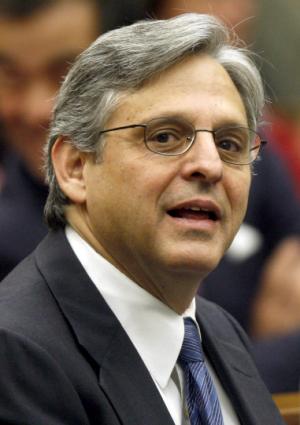
In this photo taken May 1, 2008, Judge Merrick B. Garland is seen at the federal courthouse in Washington, Thursday, May 1, 2008. Garland has been in this position before. The last time a seat opened up on the U.S. Supreme Court, in 2010, he was widely considered a top candidate for the job and interviewed with President Barack Obama. But the slot ultimately went to Justice Elena Kagan. (AP Photo/Charles Dharapak)
Chief Judge Garland was appointed to the United States Court of Appeals in April 1997 and became Chief Judge on February 12, 2013. He graduated summa cum laude from Harvard College in 1974 and magna cum laude from Harvard Law School in 1977. Following graduation, he served as law clerk to Judge Henry J. Friendly of the U.S. Court of Appeals for the Second Circuit and to U.S. Supreme Court Justice William J. Brennan, Jr. From 1979 to 1981, he was Special Assistant to the Attorney General of the United States. He then joined the law firm of Arnold & Porter, where he was a partner from 1985 to 1989 and from 1992 to 1993. He served as an Assistant U.S. Attorney for the District of Columbia from 1989 to 1992, and as Deputy Assistant Attorney General in the Criminal Division of the U.S. Department of Justice from 1993 to 1994. From 1994 until his appointment as U.S. Circuit Judge, he served as Principal Associate Deputy Attorney General, where his responsibilities included supervising the Oklahoma City bombing and UNABOM prosecutions.

The Obama administration may announce its choice for the Supreme Court nomination as early as this week. We have learned that there are three contenders being considered for the Supreme Court nomination. All three candidates serve as judges for the United States Court of Appeals for the District of Columbia, and are well respected by both parties. They include Sri Srinivasan, Merrick Garland, and Paul Watford, who is rumored to be at the top of the President’s list. The Supreme Court nominee will be required to face a Republican Senate, in order to be formally appointed to the Supreme Court. Senate Republicans have already warned the White House that they will not hold hearings for any Supreme Court nominee suggested by President Barack Obama. As soon as Republicans heard of the passing of Justice Antonin Scalia, they urged caution from the White House. Senate Republicans anticipate that the next President of the United States will be the party’s Presidential nominee. It is for this reason that they claim that the Supreme Court nomination should be made by the next President of the United States, and not by Barack Obama. In a televised announcement, following the death of Antonin Scalia, President Obama made it very clear that his intentions were to choose the Supreme Court nomination, despite warnings from Republicans. Senate Republicans responded by stating that they would block any of the President’s advancements.

President Obama will need to choose a Justice that will have a tendency to vote liberally in order for his expanded Deferred Action for Childhood Arrivals (DACA) program and new Deferred Action for Parents of Americans and Lawful Permanent Residents (DAPA) program to survive. The expanded DACA and new DAPA program were introduced in November 2014 as part of President Obama’s executive actions on immigration. These programs have been temporarily suspended following a federal court order filed by Texas and other states. The Supreme Court is expected to hear oral arguments in the case, United States v. Texas, this April with a final ruling made by summer time.

Continue reading

5162244018_51c361d054_z

The new replacement rule affecting the Optional Practical Training (OPT) program for F-1 students with degrees in science, technology, engineering, or mathematics (STEM), has been posted and is now available for inspection in the federal register. The new replacement rule will replace the previous 2008 rule and become effective beginning May 10, 2016.

The new rule authorizes F-1 STEM students pursuing a 12-month Optional Practical Training program in the United States to extend their ‘OPT’ status for a 24-month period. The 24-month extension replaces the 17-month STEM OPT extension previously available to STEM students. The 17-month STEM OPT extension will continue to be effective until May 9, 2016. The new 24-month extension applies only to F-1 STEM OPT students attending accredited United States institutions, whose employers participate in the U.S. Citizenship and Immigration Services E-verify program. Only students in a valid period of post-completion OPT may file for a STEM OPT extension. The 24-month extension, coupled with the 12-month period given with initial post-completion OPT, will give STEM students a period of 36 total months of practical training in their field. Amendments that come with the new rule include additional oversight and improvement of the program requiring formal mentoring and training plans by employers, a new STEM definition and Classification of Instructional Program Categories, provisions on previously obtained STEM degrees, Accreditation and Employer Visits, and OPT compliance. In addition, new provisions have been introduced relating to wage and protections for STEM OPT students and safeguards for American workers as described below.

The ‘Cap Gap’ provision previously available to F-1 STEM OPT students in 2008 remains in place. This provision allows students with a timely filed H-1B petition requesting a change of status, the benefit of automatically extending their F-1 status and employment authorization until October 1 of the H-1B visa fiscal year for which the student has applied. The Cap-Gap was created with intention of avoiding any disruption students might experience in their careers and personal life as a result of temporary gaps in their status.

Continue reading

6000446155_1d67582412_z

The fate of the President’s executive actions on immigration now rests in the hands of eight justices on the Supreme Court, absent Justice Antonin Scalia. The Supreme Court will begin to hear oral arguments for the case, United States v. Texas on April 18th of this year, with a final ruling expected by summertime. Nearly a year and a half ago, President Obama announced a series of executive actions on immigration including the expanded Deferred Action of Childhood Arrivals (DACA) program, the new Deferred Action for Parents of Americans and Lawful Permanent Residents (DAPA) program, and other measures to enhance border security, prioritize deportations, and modernize the immigration system. USCIS was expected to begin accepting applications for the expanded DACA and DAPA program on February 18th. The excitement surrounding the expanded DACA and DAPA program however was very short lived. A federal court order filed by Texas and other states on February 16th temporarily suspended these programs from going into effect.

Since then, the federal government and the State of Texas have been battling one another in court. The Fifth Circuit court determined that Texas and at least 25 other states had sufficient ‘standing’ to challenge both programs from being implemented. The state of Texas along with other states, argue that these programs are not only outside the purview of the President’s constitutional power, but that the States would be substantially burdened, should the programs go into effect. Texas states that as a result of these programs, the State would suffer increased health-care, law enforcement, and educational costs which would come out of the State budget and more importantly the pockets of Texas residents, who do not take kindly to these programs. Additionally, Texas claims that it would suffer additional financial burden in having to issue more drivers’ licenses to individuals qualifying for expanded DACA and DAPA, a state-subsidized benefit. If the Supreme Court decides in favor of the federal government, nearly 5 million immigrants residing in the United States unlawfully will be shielded from deportation, and States will be forced to bear the costs to accommodate their new ‘deferred’ status. Deferred status will grant individuals the right to legally obtain employment, obtain a social security number, a driver’s license, and an education, but it is not a path to citizenship. As it stands, it is unlikely that a new Supreme Court Justice will be appointed before oral arguments begin in this case, especially with mounting political pressure from Republicans seeking to block the President from making a nomination.

Continue reading

6293719129_f05a07035d_o

As previously reported, the Department of Homeland Security was given a 90-day extension earlier this year, by the Federal District Court of Columbia to issue a new replacement rule for the STEM Optional Practical Training (OPT) program to continue. The STEM OPT program, a program that had been in place since 2008, was invalidated earlier this year following a court order which required DHS to publish a new replacement rule governing the program by February 12, 2016. In response to the court order, DHS requested an additional extension arguing that exceptional circumstances warranted additional time to review the overwhelming number of comments received during the comment period. The court granted the extension, giving DHS until May 10, 2016 to implement a final rule. On March 2nd, the Office of Information and Regulatory Affairs, Office of Management and Budget (OMB) announced that review of the new OPT STEM replacement rule had been completed. DHS is expected to submit the final rule in the federal register within the next few weeks. The new rule will take precedence over the 2008 OPT STEM rule that had been in place previously. The final rule is not expected to be implemented until May 10, 2016. Once the final rule is published, we will have a better idea of where applicants will stand in relation to pending applications for employment authorization and receiving 7-month OPT extensions.

Please continue to follow our blog for more information. If you require legal advice please contact us for a consultation. 

charlesFor this month’s staff spotlight, we invite you to learn more about Associate Attorney Charles S. Ward, Esq.

Attorney Ward has been a long time attorney at the Law Offices of Jacob J. Sapochnick. Charles received his Doctorate in Jurisprudence from Southern Methodist University graduating Cum Laude. Prior to attending law school, Mr. Ward worked for Delta Air Lines in the Reservations/Sales Department, where he focused on customer service issues and problems relating to traveling arrangements. He has been a California licensed attorney since 1997 and is also licensed to practice before the Federal Court system. His area of expertise includes Immigration and Family Law.

His Favorite Quote “Time and Tide Wait for No One”