Articles Posted in DOS

bulletin-board-3655760_1920

The Department of State has released the visa bulletin for June 2020 outlining the availability of immigrant visa numbers for the upcoming month.


NOTE: Adjustment of Status Filing Charts June 2020

For Family-Sponsored Filings:
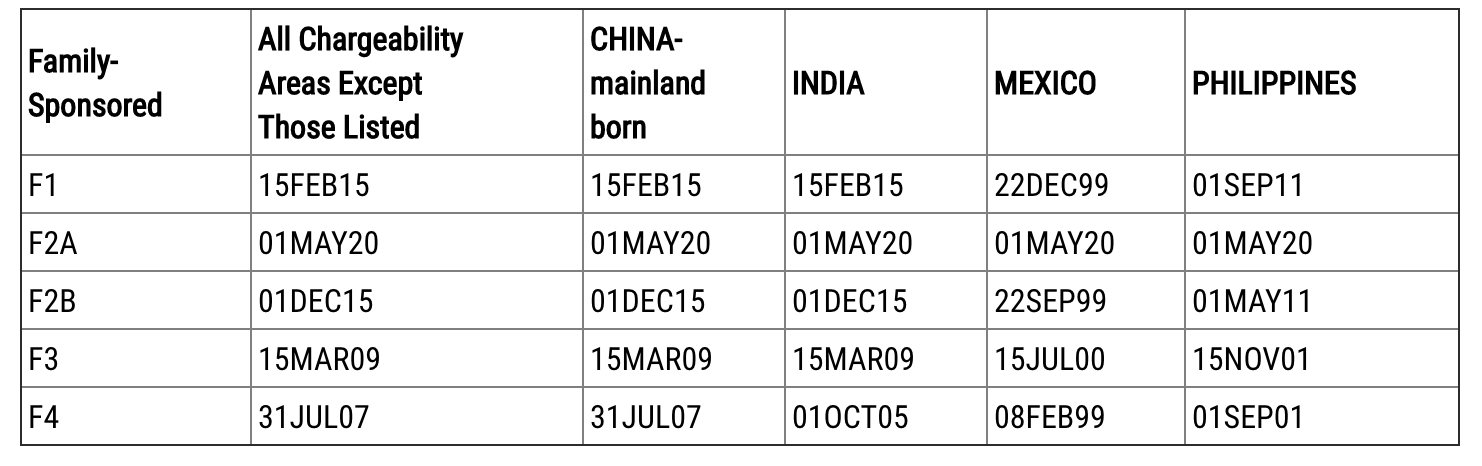
In the F2A category, there is a cutoff date on the Dates for Filing chart.  However, the category is “current” on the Final Action Dates chart.  This means that applicants in the F2A category may file for adjustment applications using the Final Action Dates chart for June 2020.

For all the other family-sponsored preference categories, you must use the Dates for Filing chart in the Department of State Visa Bulletin for June 2020

For Employment-Based Preference Filings:
For all employment-based preference categories, you must use the Final Action Dates chart in the Department of State Visa Bulletin for June 2020.


June Visa Bulletin Cutoff Dates


Employment Based Categories

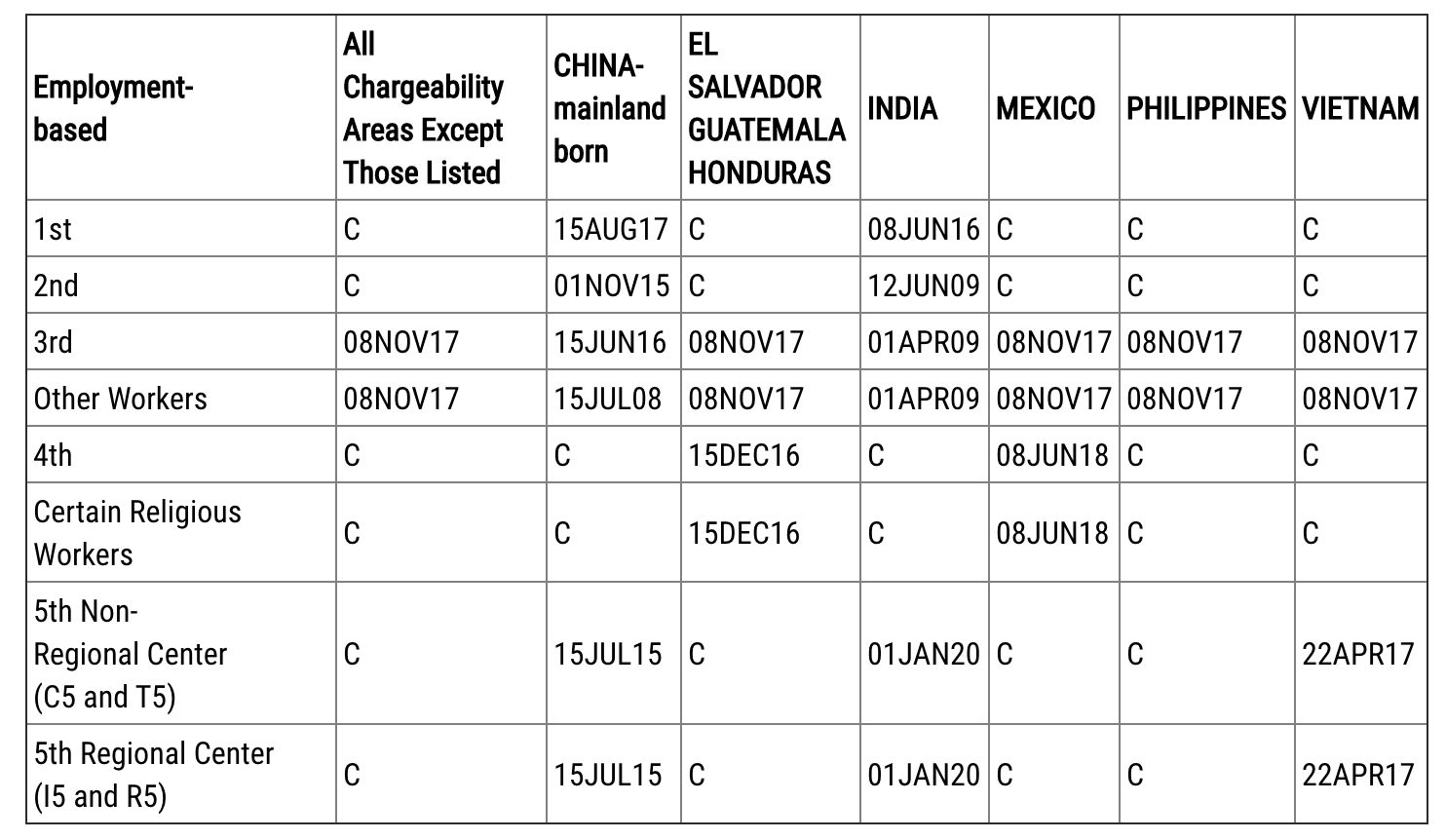
According to the Department of State’s June Visa Bulletin, the following cutoff dates will apply for the issuance of an immigrant visa for employment-based categories:

  • EB-1: All countries remain current during the month of June except for China and India. EB-1 China moved forward by one month to August 15, 2017, while EB-1 India moved forward by more than 10 months to June 8, 2016.
  • EB-2: All countries remain current during the month of June except for China and India. EB-2 China moved forward by one month to November 1, 2015, and India moved forward by 10 days to June 12, 2009.
  • EB-3 Professional and Skilled Workers: All countries remain current except for India and China. Except for India and China all countries moved forward by more than ten months to November 8, 2017. Cutoff dates for China and India advanced by one month, with China moving ahead to June 15, 2016, and India moving ahead to April 1, 2009.
  • EB-5: Most countries remain current. EB-5 China moved forward by two weeks to July 15, 2015; EB-5 India moved forward by three months to January 1, 2020; and Vietnam moved forward by three weeks to April 22, 2017.

Cutoff dates in the Dates for Filing Chart for June have remained mostly the same in comparison to the previous month, the only change is for EB-4 El Salvador, Honduras, and Guatemala which moved forward four and a half months to February 1, 2017.  USCIS will accept adjustment applications based on the Final Action Dates chart for June 2020, the same as last month.

Final Action Dates Charthttps://www.visalawyerblog.com/files/2020/05/Screen-Shot-2020-05-22-at-1.53.46-PM.png

 Family-Sponsored Categories

According to the Department of State’s June Visa Bulletin, the following cutoff dates will apply for the issuance of an immigrant visa for family-sponsored categories:

**Note only applicants in the F2A category may file using the Final Action Dates chart for June 2020 to file adjustment applications. All other family-sponsored preference categories must use the Dates for Filing chart.

Dates for Filing Charthttps://www.visalawyerblog.com/files/2020/05/Screen-Shot-2020-05-22-at-1.47.01-PM.png


Alert Regarding the April 22nd Presidential Proclamation


As you may be aware President Trump’s April 22nd presidential proclamation suspends the issuance of immigrant visas at U.S. Consulates worldwide for certain classes of immigrants until June 22, 2020, assuming the proclamation is not extended beyond this date. As Consulates worldwide begin to reopen, consular officers will enforce the presidential proclamation by refusing immigrant visas to those who were outside of the United States as of 11:59 p.m. EDT on April 23, 2020, have not been issued an immigrant visa or similar U.S. travel document, and are not otherwise exempt from the proclamation. The following types of immigrants have been specifically exempted from the proclamation and are eligible for visa issuance in June:

  • Applicants for EB-5 immigrant visas;
  • Spouses of U.S. citizens;
  • Children under 21 of U.S. citizens and prospective adoptees in the IR-4 or IH-4 visa classifications;
  • Foreign nationals seeking to enter on an immigrant visa as a physician, nurse or other healthcare professional, as well as their spouse and unmarried children under 21;
  • Foreign nationals whose entry would further important U.S. law enforcement objectives;
  • Members of the U.S. armed forces and the spouses and children of such individuals;
  • Foreign nationals seeking to enter as Special Immigrants in the SI or SQ classification, and the spouse and children of such individuals; and
  • Foreign nationals whose entry is in the U.S. national interest.

Continue reading

bulletin-board-2768204_1920

The Department of State has released the visa bulletin for May 2020 outlining the availability of immigrant visa numbers for the upcoming month.


Please note:

Unless otherwise indicated on the U.S. Citizenship and Immigration Services (USCIS) website at www.uscis.gov/visabulletininfo, individuals seeking to file applications for adjustment of status with USCIS in the Department of Homeland Security must use the “Final Action Dates” charts below for determining when they can file such applications. When USCIS determines that there are more immigrant visas available for the fiscal year than there are known applicants for such visas, USCIS will state on its website that applicants may instead use the “Dates for Filing Visa Applications” charts in this Bulletin. 


May Visa Bulletin Cutoff Dates


According to the Department of State’s May Visa Bulletin, the following cutoff dates will apply for the issuance of an immigrant visa:

  • EB-1: All countries except for China and India will become current on May 1. China will advance by five weeks to July 15, 2017, while India will advance by three months to August 1, 2015.
  • EB-2: China will advance by one month to October 1, 2015, and India will advance by one week to June 2, 2009. All other countries will remain current.
  • EB-3 Professional and Skilled Workers: All countries except India and China will remain retrogressed at January 1, 2017. Cutoff dates for China and India will advance, with China moving ahead by one month to May 15, 2016, and India moving ahead by more than five weeks to March 1, 2009.
  • EB-5: Most countries will remain current. China will advance by more than six weeks to July 1, 2015; India will advance by nine months to October 1, 2019; and Vietnam will advance by just under two months to April 1, 2017.

Employment-Based Priority Cut-off Dates for May 2020


USCIS recently announced that it will honor Final Action dates for adjustment of status filings in May. In order to file an employment-based adjustment of status application next month, employer-sponsored foreign nationals must have a priority date that is earlier than the date listed below for their preference category and country. This is the second consecutive month that USCIS has chosen the Final Action Dates chart, after several months of honoring the Dates for Filing chart.

The May Final Action Dates chart is current for EB-1 countries worldwide, after several months of retrogression.


How will the President’s Executive Order affect immigrant visas?


The President’s executive order will temporarily suspend and limit the entry of foreign nationals seeking an immigrant visa at a U.S. Consulate abroad. Although the order will apply for the next 60 days, the order will have little practical effect on immigration, given that U.S. Consulates and Embassies worldwide have suspending the issuance of all visas until the COVID-19 pandemic subsides.

If U.S. Consulates and Embassies resume operations within the next 60 days, the executive order will prevent foreign nationals from obtaining immigrant visas at U.S. Consulates worldwide. The suspension will apply to individuals who, as of Wednesday, were outside of the United States, do not have an immigrant visa, do not have official travel documents other than visas, and have not been exempted by the executive order.

Continue reading

donald-trump-4817333_1280

The long-awaited Executive Order temporarily suspending the immigration of certain aliens into the United States has been released.


WHO IS IMPACTED BY THE EXECUTIVE ORDER?


The order entitled, “Proclamation Suspending the Entry of Immigrants Who Present Risk to the U.S. Labor Market During the Economic Recovery Following the COVID-19 Outbreak,” suspends and limits the entry of the following types of aliens (for a 60-day period) beginning 11:59 p.m. eastern daylight time on April 23, 2020.


Your entry is suspended and limited if all of the following are true:

THREE PART TEST


  • You are an alien outside of the United States on the effective date of the Proclamation (April 23rd)
  • You are an alien that does not have an immigrant visa that is valid on the effective date of the Proclamation (April 23rd) and
  • You are an alien that does not have an official travel document other than a visa on the effective date of the proclamation (April 23rd) or issued on any date thereafter that permits him or her to travel to the United States and seek entry or admission
    • Official travel documents include a transportation letter, an appropriate boarding foil, or advance parole document.

ENFORCEMENT


This Proclamation shall be enforced by U.S. Consulates worldwide at their discretion giving them the power to determine whether an immigrant has established his or her eligibility and is otherwise exempted from the Proclamation. The Department of State will implement the proclamation as it applies to immigrant visas, at the discretion of the Secretary of State in consultation with the Secretary of Homeland Security.

The Department of State governs the immigration process outside of the United States, while the Department of Homeland Security governs the immigration process within the United States and guides the United States Citizenship and Immigration Services (USCIS).


WHO IS EXEMPT FROM THE EXECUTIVE ORDER?


The order expressly exempts:

  • Lawful Permanent Residents of the U.S.
  • Aliens who are the spouses of U.S. Citizens
  • Members of the U.S. Armed Forces and any spouse and child of a member of the U.S. Armed Forces
  • Aliens under 21 years of age who are children of United States Citizens and prospective adoptees
  • Aliens seeking to enter the U.S. on an immigrant visa as a physician, nurse, or other healthcare professional
  • Aliens seeking to enter the U.S. to perform medical research or other research intended to combat the spread of COVID-19
  • Any spouse any unmarried child under 21 years of age of any such alien who is accompanying or following to join the alien
  • Any alien applying for a visa pursuant to the EB-5 Immigrant Investor Program
  • Aliens whose entry furthers important United States law enforcement objectives
  • Any alien seeking entry pursuant to a Special Immigrant Visa in the SI or SQ classification, and any spouse and child of any such individual
    • SI: Certain aliens employed by the U.S. Government in Iraq or Afghanistan as translators or interpreters
    • SQ: Certain Iraqis or Afghans employed by or on behalf of the U.S. Government
  • Any alien whose entry would be in the national interest of the United States (national interest waivers)
  • Aliens seeking entry for asylum, refugee status, withholding of removal, or protection under the Convention Against Torture and Other Cruel, Inhuman or Degrading Treatment or Punishment

Continue reading

juan-encalada-2aDKr_h2PIg-unsplash

The Trump administration is ready to announce new restrictions that will make it more difficult for foreign nationals to give birth in the United States, striking a blow to the “birth tourism” industry.

In a 2015 speech in Orlando, Florida the President told supporters, “the birthright citizenship, the anchor baby …it’s over, not going to happen.” Tomorrow, the President will make good on his promise.

On January 24, 2020, the government will publish a final rule in the Federal Register that will be effective as of that date, amending current B visa regulations to establish a rebuttable presumption that a B nonimmigrant visa applicant, who a consular official has reason to believe will give birth during her stay in the United States, is traveling for the primary purpose of obtaining U.S. Citizenship for the child.

Accordingly, an applicant who fails to overcome the presumption will be denied a B nonimmigrant visa application.

This change in regulation will apply specifically to the B nonimmigrant visa classification for temporary visitors for pleasure.

An advance copy of the government’s final rule has been released which establishes that “travel to the United States with the primary purpose of obtaining U.S. citizenship for a child by giving birth in the United States is an impermissible basis for the issuance of a B nonimmigrant visa.”

Continue reading

healthcare-4235817_1920

The President has once again targeted the immigrant population by signing a Presidential Proclamation suspending the entry of any immigrant who will “financially burden the United States healthcare system.”

While the Presidential Proclamation is likely to encounter resistance in court, as it stands the Proclamation is slated to become effective on November 3, 2019.

According to the Proclamation, a person seeking to immigrate to the United States will be found to be a financial burden on the U.S. healthcare system, unless they can prove either one of the following:

  • They are covered by approved health insurance, within 30 days of their entry to the United States, or
  • They have the financial resources to pay for reasonably foreseeable medical costs.

Beginning November 3, 2019, prior to the adjudication and issuance of an immigrant visa, a non-citizen seeking to immigrate to the United States, must establish to the satisfaction of a consular officer that they will not become a burden on the health care system by either of the means outlined above.

Who does the Proclamation apply to?

Only non-citizens seeking to enter the United States pursuant to an immigrant visa.

Continue reading

handshake-2056021_1920

In its latest act of defiance against the judicial branch, the Trump administration has published an Interim Final Rule entitled “Visas: Ineligibility Based on Public Charge Grounds,” designed to give Consular officers wider discretion to deny immigrant and nonimmigrant visas to applicants on public charge grounds based on a variety of factors that could weigh positively or negatively on an applicant.

According to the rule, consular officials will now be able to weigh a variety of factors to determine whether a visa applicant is likely to become a public charge. These factors include the applicant’s age, health, educational background, and financial status. In addition, consular officers will have increased discretion to scrutinize certain applications more closely than others based on the type of visa classification sought by the applicant, as well as the duration of stay.

Applicants who are seeking a long-term visa, for example may be scrutinized more heavily than applicant’s seeking a short-term visa (such as a tourist visa).

How will these factors be weighed by Consular officials?

Age: Consular officers will consider whether the alien’s age makes the alien more likely than not to become a public charge in the totality of the circumstances, such as by impacting the alien’s ability to work. Consular officers will consider an alien’s age between 18 and 62 as a positive factor.

Health: Consular officers will consider whether the alien’s health serves as a positive or negative factor in the totality of the circumstances, including whether the alien has been diagnosed with a medical condition that is likely to require extensive medical treatment or institutionalization or that will interfere with the alien’s ability to provide and care for himself or herself, to attend school, or to work (if authorized).

Continue reading

brittani-burns-98uYQ-KupiE-unsplash

Instructions for the 2021 Diversity Immigrant Visa Program

The Diversity Immigrant Visa Program registration season is now among us. The U.S. Department of State has released instructions on how to apply for the FY 2021 Diversity Immigrant Visa Program in which 55,000 Diversity Visas (DVs) will be up for grabs. Registration will begin promptly at 12:00 pm (ET) on October 2, 2019 and will continue until 12:00 pm (ET) on November 5, 2019. There is no cost to register for the Diversity Visa Program.

Please remember that the law allows only one entry per person during each registration period. Individuals who submit more than one entry will be disqualified.

How does selection occur?

The Department of State determines selectees through a randomized computer drawing. The Department of State distributes diversity visas among six geographic regions, and no single country may receive more than seven percent of the available DVs in any one year.

Am I eligible to apply?

You are eligible to apply if you meet the following requirements:

Requirement #1: You must be a national of one of the following countries (see below) OR

If you were not born in an eligible country, you may apply if your spouse was born in a country whose natives are eligible provided that both you and your spouse are named on the selected entry, are found eligible and issued diversity visas, and enter the United States simultaneously

OR

If you were born in a country that is ineligible, but neither of your parents were born or legally residents of that country at the time of your birth, you may claim the country of their birth.

Continue reading

trump-2387091_1920

USCIS will be publishing a final rule on August 14, 2019, in the Federal Register, that expands the list of public benefits that make a foreign national ineligible to obtain permanent residence and/or an immigrant or nonimmigrant visa.

The Immigration and Nationality Act makes inadmissible and therefore (1) ineligible for a visa, (2) ineligible for admission and (3) ineligible for adjustment of status, any alien who, in the opinion of the DHS is likely at any time to become a public charge.

The process of determining whether an alien is likely to become a public charge is called a “public charge determination.”

Receipt of certain public benefits leads to a “public charge determination” meaning that the applicant is ineligible to receive the benefit they are requesting (such as permanent residence) based on the fact that they are likely to become a public charge to the United States government.

What is a public charge?

A person is a “public charge” if they are primarily dependent on the Government for subsistence, as demonstrated by either the receipt of public cash assistance for income maintenance or institutionalization for long-term care at Government expense.

The final rule expands the scope of this definition by making a public charge any alien who receives one or more designated public benefits for more than 12 months in the aggregate within any 36-month period.

Under the final rule announced today, immigration will now be taking into consideration the following benefits to determine whether an individual is or is likely to become a public charge to the U.S. government:

Reliance on or receipt of non-cash benefits such as:

  • Cash benefits for income maintenance
  • SNAP (food stamps)
  • Section 8 Housing Assistance under the Housing Choice Voucher (HCV) Program
  • Section 8 Project-Based Rental Assistance, and
  • certain other forms of subsidized housing.

In addition, the government will continue to take into consideration the following types of benefits:

  • Temporary Assistance for Needy Families (TANF)
  • Supplemental Security Income (SSI)
  • Medicaid

Continue reading

doctor-3187935_1920

In this post, we would like to keep our readers informed about Visa Bulletin projections for the coming months. Charles Oppenheim, Chief of the Visa Control and Reporting Division of the U.S. Department of State provides a monthly analysis of each month’s Visa Bulletin including discussion of current trends and future projections for immigrant preference categories.

Below are the highlights of those trends and projections for August 2019:

EB-1 Worldwide: As demand has increased in recent weeks, this category is expected to retrogress in early August, and return back to April 22, 2018 in October of this year.

EB-1 India: This category is not expected to advance prior to October 2019. During October 2019, this category is expected to return to a Final Action Date of February 22, 2017.

EB-1 China: This category is not expected to advance prior to October 2019.  

EB-2 Worldwide: Due to increased demand in recent weeks, this category is no longer expected to remain current through September 2019. A retrogression is expected in this category in early August 2019. EB-2 Worldwide is expected to become current again in October 2019.

EB-2 India: This category is expected to continue to advance slowly, by a few days or a week.

Continue reading

nordwood-themes-359015-unsplash

Foreign nationals applying for a non-immigrant or immigrant visa at a U.S. Consulate or Embassy abroad are now required to disclose information relating to their social media presence on their online nonimmigrant and immigrant visa applications known as the DS-160 and DS-260 respectively.

These changes were introduced early last week by the Department of State. Applicants must now provide information about each social media platform they have used within the last five years, including the name of the platform, and the username or handle used on that platform.

Applicants must also provide their current email and phone number, as well as email addresses and phone numbers they have had during the last five years.

Consular officials can use information found on social media during the visa adjudication process to determine whether the individual is eligible for the visa they are requesting. If officials find any information on social media that would lead them to believe the applicant is misrepresenting their true intentions or attempting to gain entry through means of fraud or deceit, the applicant’s visa application may be denied.

In the past, the Department of State only required social media information of individuals that were flagged for further inspection and individuals posing security risks to the United States. This information was provided in a supplemental questionnaire known as the DS-5535. Now, these questions are asked directly on the DS-160/DS-260 applications.

Continue reading