Articles Posted in Work Visas

mike-petrucci-c9FQyqIECds-unsplash

In this blog post we highlight the best features of E-2 Treaty Investor Visa program, for individuals seeking to live and work in the United States for a temporary period of time.

First let’s discuss what the E-2 visa is. The E-2 visa is a non-immigrant visa type, which means that it is a temporary visa option for individuals who do not wish to immigrate to the United States, but rather are interested in remaining in the United States for a limited period of time.

Secondly, the E-2 visa is a treaty investor visa. This means that in order to qualify for this visa type you must be a national of a country with which the United States maintains a treaty of commerce and navigation. This visa type allows a national of a treaty country to apply for admission to the United States under the E-2 visa category for the purpose of investing a substantial amount of capital in a United States business.

Currently, 89 countries maintain a treaty of commerce and navigation with the United States. Israel and New Zealand are the most recent countries to enter into a treaty commerce and navigation with the United States, allowing nationals of these countries to participate in the E-2 visa program. For a complete list of the countries with which the U.S. maintains a treaty of commerce and navigation, please click here.

The most frequently asked question when it comes to the E-2 visa is, how much money must I invest in order to qualify for this visa type?

The amount of money that must be invested depends on the nature of the business’ operations. USCIS defines the amount of capital to be invested as “a substantial amount of capital” interpreted as:

  • Substantial in relationship to the total cost of either purchasing an established enterprise or establishing a new one
  • Sufficient to ensure the treaty investor’s financial commitment to the successful operation of the enterprise
  • Of a magnitude to support the likelihood that the treaty investor will successfully develop and direct the enterprise.  The lower the cost of the enterprise, the higher, proportionately, the investment must be to be considered substantial.

Thirdly, to qualify for the E-2 visa the investment must be in a bona fide business enterprise that is real, active, and operating and is producing either services or goods for profit. Passive investments are not allowed.

Continue reading

paid-160126_1280

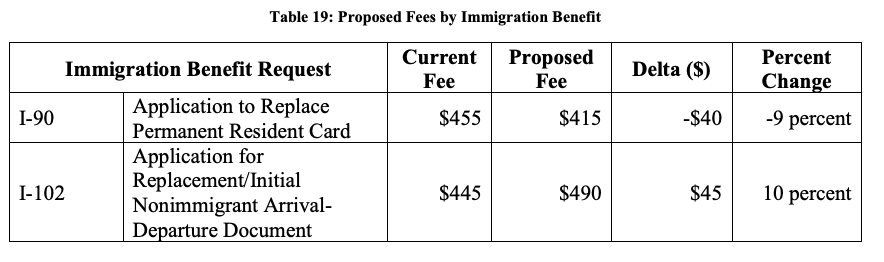
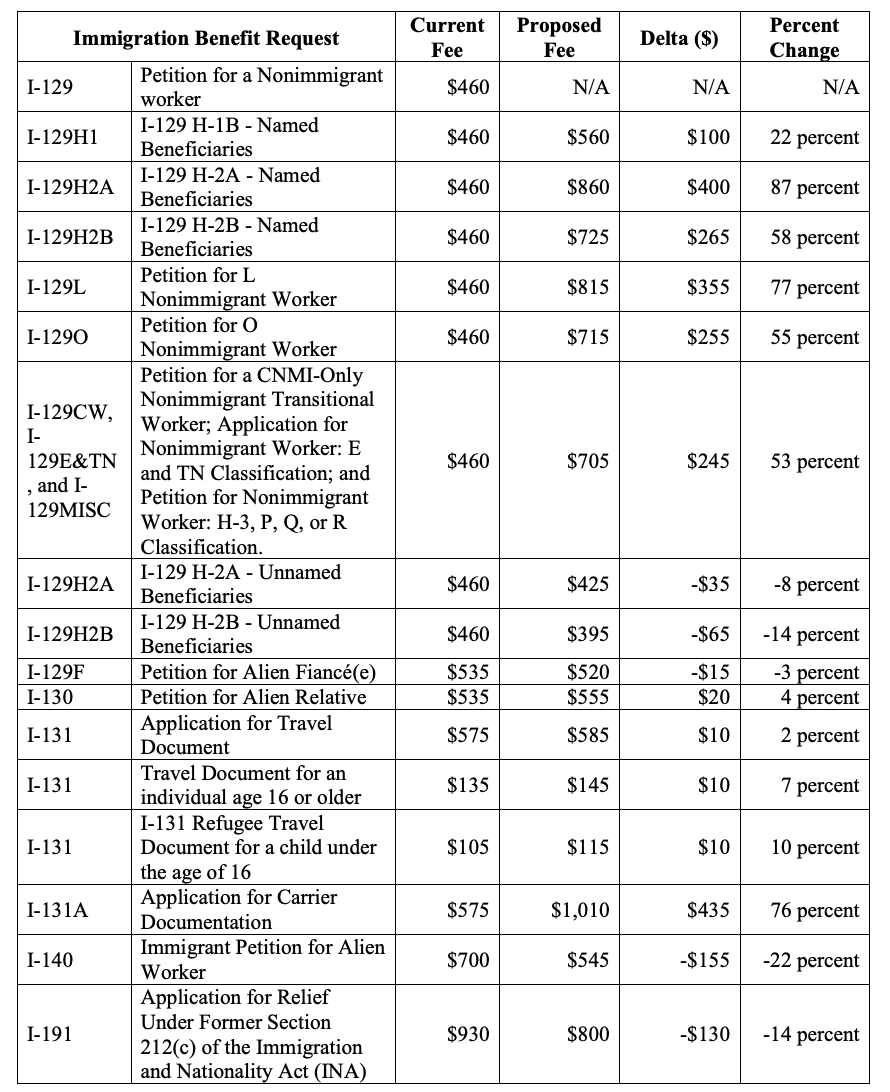
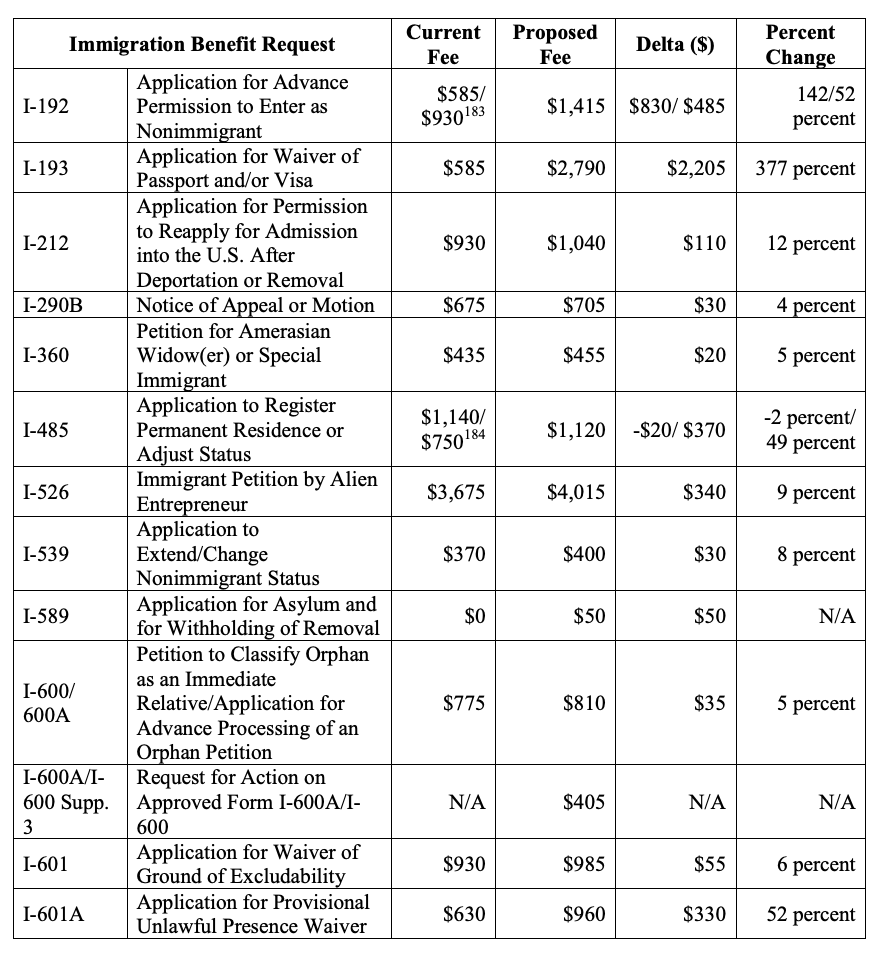
On November 14, 2019, the United States Citizenship and Immigration Services will publish a proposed rule in the Federal Register to increase immigration fees for certain petitions. After publication, the proposal will be open for a 30-day comment period. After that point the agency will review public comments and draft the final rule. At this time there is no definitive date set out in the proposed rule for enforcement of these fees. Therefore, readers should note that these fee increases will likely not take effect until well into Fiscal Year 2020.

What does the rule propose?

The rule proposes the following fee increases by immigration benefit:

https://www.immigrationlawyerblog.com/files/2019/11/Screen-Shot-2019-11-12-at-4.02.14-PM.png https://www.immigrationlawyerblog.com/files/2019/11/Screen-Shot-2019-11-12-at-4.02.20-PM.png https://www.immigrationlawyerblog.com/files/2019/11/Screen-Shot-2019-11-12-at-4.02.26-PM.png

Moreover, DHS proposes that fees for the following types of petitions be limited to a 5 percent increase above current fees:

  • Form I-290B, Notice of Appeal or Motion.
  • Form I-360, Petition for Amerasian, Widow(er) or Special Immigrant.
  • Form I-600, Petition to Classify Orphan as an Immediate Relative
  • Form I-600A, Application for Advance Processing of an Orphan Petition
  • Form I-600A/I-600, Supplement 3, Request for Action on Approved Form I-600A/I600.42
  • Form I-800, Petition to Classify Convention Adoptee as an Immediate Relative.
  • Form I-800A, Application for Determination of Suitability to Adopt a Child from a Convention Country.
  • Form I-800A, Supplement 3, Request for Action on Approved Form I-800A

Changes to Fee Waiver Requests

DHS further proposes to limit fee waivers grants to individuals who have an annual household income of less than 125 percent of the Federal Poverty Guideline as defined by the U.S. Department of Health and Human Services (HHS).

Continue reading

rupixen-com-Q59HmzK38eQ-unsplash

In this post, we discuss the latest developments in U.S. immigration news.

As you may recall, back in September USCIS issued a proposed rule requiring petitioners filing H-1B cap-subject petitions to pay a $10 registration fee for each petition submitted to USCIS for the H-1B cap selection process, beginning with the H-1B fiscal year 2021 cap season.

Today, November 7, 2019 the United States Citizenship and Immigration Services (USCIS) published the final version of this rule which will become effective beginning December 9, 2019, although the $10 fee will not be required until registrations are submitted beginning with the fiscal year 2021 H-1B cap selection process.

The final rule is scheduled to be published in the Federal Register tomorrow November 8th. An unpublished version of the rule is available here.

Extension of Temporary Protected Status

On November 4, 2019, USCIS published a notice in the federal register announcing the automatic extension of TPS-related documentation for beneficiaries under the TPS designations for El Salvador, Haiti, Honduras, Nepal, Nicaragua, and Sudan.

TPS-related documentation for individuals from these countries will remain valid through January 4, 2021.

This automatic extension will apply to all TPS-related documentation (including Employment Authorization Cards) set to expire on the following dates:

  • Beneficiaries under TPS designations for El Salvador, Haiti, and Sudan—January 2, 2020
  • Beneficiaries under TPS designations for Honduras—January 5, 2020
  • Beneficiaries under TPS designation for Nepal—March 20, 2020

A beneficiary under the TPS designation for any of these countries who has applied for a new EAD but who has not yet received his or her new EAD is covered by this automatic extension, provided that the EAD he or she possesses contains one of the expiration dates indicated above.

Continue reading

handshake-2056021_1920

In its latest act of defiance against the judicial branch, the Trump administration has published an Interim Final Rule entitled “Visas: Ineligibility Based on Public Charge Grounds,” designed to give Consular officers wider discretion to deny immigrant and nonimmigrant visas to applicants on public charge grounds based on a variety of factors that could weigh positively or negatively on an applicant.

According to the rule, consular officials will now be able to weigh a variety of factors to determine whether a visa applicant is likely to become a public charge. These factors include the applicant’s age, health, educational background, and financial status. In addition, consular officers will have increased discretion to scrutinize certain applications more closely than others based on the type of visa classification sought by the applicant, as well as the duration of stay.

Applicants who are seeking a long-term visa, for example may be scrutinized more heavily than applicant’s seeking a short-term visa (such as a tourist visa).

How will these factors be weighed by Consular officials?

Age: Consular officers will consider whether the alien’s age makes the alien more likely than not to become a public charge in the totality of the circumstances, such as by impacting the alien’s ability to work. Consular officers will consider an alien’s age between 18 and 62 as a positive factor.

Health: Consular officers will consider whether the alien’s health serves as a positive or negative factor in the totality of the circumstances, including whether the alien has been diagnosed with a medical condition that is likely to require extensive medical treatment or institutionalization or that will interfere with the alien’s ability to provide and care for himself or herself, to attend school, or to work (if authorized).

Continue reading

wei-ding-ndMOb0OBCx0-unsplash

The Trump administration’s controversial rule making certain foreign nationals inadmissible to receive permanent residence on public charge grounds, will become effective beginning October 15, 2019.

First, and foremost let’s recap what this rule is about and who it will apply to:

Under immigration law, an individual who, in the opinion of DHS is likely at any time to become a public charge is (1) ineligible for a visa (2) ineligible for admission to the United States and (3) ineligible for adjustment of status (permanent residence).

This means that the rule applies to foreign nationals applying for a U.S. visa, foreign nationals seeking admission through a port of entry, and individuals applying for adjustment of status.

When an individual applies for any immigration benefit with the government, (whether a U.S. visa or green card application), the official adjudicating the petition must determine whether that individual is or will likely become a public charge. This determination is referred to as a “public charge determination.”

What makes someone a public charge in the eyes of immigration?

A person is a “public charge” if they are primarily dependent on the Government for subsistence, as demonstrated by either the receipt of public cash assistance for income maintenance or institutionalization for long-term care at Government expense.

Continue reading

tyler-nix-V3dHmb1MOXM-unsplash
The process of getting a visa for a family member can be stressful.

The immigration system is complex. Being separated from your family can be painful and visa processing times frustrating. The law seems to change so often, it can be hard to keep track of what rules you’re supposed to follow.

Recently, the United States Department of State changed the family sponsored visa numbers for several countries. They released these new numbers in the September 2019 Visa Bulletin.

applications-2355609_1920

Fresh off the press! In this blog post we will discuss a new proposed rule that is set to be published in the Federal Register on September 4, 2019. We have reviewed an advance copy of this proposed rule and will tell you everything you need to know about the new rule.

At a Glance

The proposed rule will require petitioners filing H-1B cap-subject petitions to pay a $10 registration fee for each petition they submit to USCIS for the H-1B cap selection process beginning with the H-1B fiscal year 2021 cap season.

Overview

As you may recall, on January 31, 2019, DHS published a final rule requiring petitioners seeking to file H-1B cap-subject petitions (including those eligible for the advanced degree exemption) to first electronically register with USCIS during the designated registration period (“H-1B registration final rule”).

USCIS stated that the new H-1B registration system would be implemented beginning with H-1B fiscal year 2021 to ensure the registration system and process work correctly.

Continue reading

board-2449726_1920

Recently our firm successfully filed an H-3 visa for a Front Office Manager position with a prestigious hotel chain. Here are a few things we learned along the way to help you file a successful H-3 visa for a trainee.

Establish frequent communication with the petitioner

            In the case at issue the employer/petitioner was a major hotel chain with a great reputation, making it easier to establish the hotel as a distinguished organization with the capacity to hold such training. Our point of contact was the Director of Human Resources.

Create a detailed training plan

            Creating a tailored training plan for the employer/petitioner was by far the most difficult part of filing this case because the hotel had its own rules and regulations for approving training sessions. At first, we submitted a very detailed training plan for approval to the Hotel Managers. We went through additional drafts and revisions to have the final training plan approved. Here were the steps we took to get to the final plan:

Step 1: Communicate with the petitioner:

At the outset we established what the employer/petitioner needed to include in the training plan. In this case, we had to create a training plan from scratch, because the employer/petitioner was not satisfied with the initial draft. We started by clarifying the scope of what was being offered to the beneficiary. Our office went through several rounds of drafts before coming to an agreement of what should be included in the training plan.

Continue reading

Are you at the top of your field in the arts, sciences, education, business, or sports? Do you need to travel to the United States for your work?

The O-1 visa allows people with extraordinary abilities to work in the U.S. for a temporary time. But to get the O-1 visa, you must prove your extraordinary ability in some way.

So what do you do when you don’t have an award like an Oscar or Grammy?

masaaki-komori-iaSzwYccV28-unsplash

USCIS has announced that it will be closing all of its International Immigration Offices by March 10, 2020.

As of June 30, 2019, USCIS has already permanently closed its field office in Ciudad Juarez, Mexico, and on July 5th, the office in Manila, Philippines permanently closed.

By the end of January 2020, the majority of international USCIS field offices are expected to be closed, including offices in Mexico City, London, Athens, and Guatemala City.

The first offices to close will be those in Monterrey, Mexico, Seoul, South Korea, and Manila, Philippines, with a projected closing date of September 2019.

The following is a complete list of USCIS International Immigration Offices expected to close:

Latin America, Canada and the Caribbean (LACC) District

Continue reading