Articles Posted in Work Visas

9033805851_a19992134e_z

On Thursday, December 31, 2015 the Department of Homeland Security published a new proposed rule affecting highly skilled immigrant and non-immigrant workers alike. The proposed rule, introduced in last week’s federal register, aims to improve the ability of American employers to hire and retain highly skilled workers waiting to receive their employment-based lawful permanent residence in the visa bulletin backlogs. Additionally, the proposed rule aims to enhance opportunities for such workers allowing them to be more easily promoted, to accept lateral positions with their current employers, change employers, and pursue other employment. While the proposed rule is not groundbreaking, it does address important challenges employers and their highly skilled workers have faced as the law stands today and makes recommendations for such relief. The proposed rule will be open for comment until February 29, 2016.

You may remember that on November 20, 2014 the President highlighted, as part of his executive actions on immigration, that the employment-based immigration system needed to be amended to modernize, improve, and clarify immigrant and nonimmigrant visa programs in order to create more jobs, foster innovation at home, retain a highly skilled workforce that would allow the United States to compete with other countries, and to stimulate the American economy overall.  In order to modernize the employment based immigration system, USCIS would be required to work with the Department of State to modernize and simplify the immigrant visa allocation process. Part of this process would require the Department of State to make reasoned projections of employment-based immigrant visa availability on the visa bulletin, that could be relied upon by employers and their highly skilled workers.

Presently, immigrant workers from India and China are experiencing extraordinary delays in the employment-based queue for permanent residence, while other highly skilled workers are forced to wait over a five-year period to receive company sponsorship and lawful permanent residence. Furthermore, such workers are forced to remain on temporary employment-sponsored visas in the United States while waiting for an immigrant visa to become available to them. This puts the immigrant worker in a predicament giving the employer the upper hand, while restricting the employee from seeking advancement and discouraging new employment, since this would require the employer to file a new petition and incur the expensive fees required for filing. Highly skilled works facing extortionate delays in the visa backlogs have experienced hindered employer/employee career advancement and job mobility. The new rules will provide limited relief in this area.

Continue reading

logo-2

By Yingfei Zhou, Esq. 

Last week, attorneys Yingfei Zhou, Esq. and Marie Puertollano, Esq. from our office attended the 28th AILA California Chapter Conference on Immigration Law held in San Diego, California. Together, they brought our audiences the latest updates on various issues discussed at the government open forums.

  1. USCIS I-797C Receipt Notices or I-797B Approval Notices without I-94 attached are not accepted by DMV as Proof of Legal Residence

16205135740_83caef24c9_z

Secretary of Homeland Security Jeh Johnson

On October 28, 2015 sixteen Democrats from the House of Representatives including —Zoe Lofgren, Michael M. Honda, Judy Chu, Katherine M. Clark, Elijah E. Cummings, Anna G. Eshoo, Tulsi Gabbard, Luis V. Gutierrez, James A. Himes, Ruben Hinojosa, Eddie B. Johnson, James P. McGovern, Frank Pallone Jr., Jared Polis, David E. Price, and Alma S. Adams — issued a letter addressed to the Secretary of Homeland Security, Jeh Johnson concerning drastic revisions made to the Visa Bulletin on September 25, 2015.

In the letter, House Democrats argue that the revisions to the Visa Bulletin have compromised the integrity of the immigrant visa process, and resulted in a lose of faith in our immigration system. More over they argue that these revisions have adversely impacted the lives of thousands of immigrants, the American businesses who employ highly skilled workers, and our economy which benefits from retaining highly skilled workers.

As previously reported, the Department of State had published a dual chart system on September 9, 2015 with the addition of a new ‘date of filing chart’ which first appeared on the October Visa Bulletin. This new ‘date of filing’ chart was implemented in an effort to modernize and streamline the immigration process, as part of President Obama’s executive actions on immigration reform.

Continue reading

By Yingfei Zhou, Esq.

On July 21, 2015, USCIS issued the final guidance on when an employer must file an amended or new petition when the H-1B employee has changed or is changing his or her job location.

Except the situations listed below, the general requirement is that an employer must file an amended or new H-1B petition if the H-1B employee has changed or is changing his or her place of employment to a geographical area requiring a corresponding LCA to be certified to USCIS, even if a new LCA is already certified by the U.S. Department of Labor and posted at the new work location. Once an employer properly files the amended or new H-1B petition, the H-1B employee can immediately begin working at the new place of employment. The employer does not have to wait for a final decision on the amended or new petition for the H-1B employee to start work at the new location.

Exceptions when an employer does NOT need to file an amended petition are as follows:

  1. A move within an “area of intended employment”: If an employer’s H-1B employee is simply moving to a new job location within the same metropolitan statistical area, a new LCA is not generally required, and without material changes in the terms and conditions of employment the employer does not need to file an amended or new H-1B petition. However, the employer must still post the previously obtained LCA in the new work location.

Continue reading

11400978_10153396425248766_3904864215081914789_n

Presently, attorneys Jacob Sapochnick, Esq., Ekaterina Powell, Esq., and Yingfei Zhou, Esq. from our office are in attendance at the 2015 American Immigration Lawyers Association (AILA) Conference on Immigration Law taking place in Washington, DC. Together, they have had the privilege of being present for an open forum where officials from the Department of State and the National Visa Center provided valuable information in regards to modernization of PERM, improvements in visa processing at the National Visa Center, technical issues experienced at U.S. Consulates abroad, H-1B fee announcements, and more!

Technical issues experienced at U.S. Consulates worldwide

1. In regards to technical issues causing delays in visa issuance at U.S. Consulates worldwide, visa issuance is currently frozen. No visas are currently being issued at any U.S. Consulates worldwide. U.S. Consulates are rescheduling appointments for visas that were affected by the technical issues. The DOS is working to repair the hardware, however it will not be until next week when all issues will be resolved. Due to this, there will be a backlog for visa issuance and it will take longer to schedule a consular appointment for a visa.

2. If a visa applicant was affected by the technical issues at a U.S. Consulate abroad and they need to retrieve their passport urgently, they will be able to retrieve their passport, however, in doing so, applicants will forfeit the visa fees they have paid, and will be issued a 221(g) visa denial letter. If applicants are still interested in receiving a visa, they must re-apply and re-pay any visa fees. Applicants who are re-applying must note on future applications that their visa was denied due to a technical glitch. Applicants from visa waiver countries who are concerned that the visa denial will automatically result in an ESTA denial can rest assured. ESTA submissions will not be denied based on the technical glitch. DOS has responded that the technical issues will not affect future visa applications. Continue reading

USCIS released guidance on May 22, 2015 to clarify Administrative Appeal Office (AAO)’s precedent decision on April 9, 2015 on Matter of Simeio Solutions, LLC that all employers must file amended H-1B petitions when a new Labor Condition Application for Nonimmigrant Workers (LCA) is required due to a change in the H-1B worker’s worksite location.

When Must File an Amended Petition

In Matter of Simeio, AAO ruled than a material change occurs when an H-1B employee moves to a new location outside the geographic area of the LCA that was originally filed for the employee’s H-1B petition. Whenever there is a material change, an amended H-1B petition is required. Employers whose H-1B employees changed locations before or after this April 9 ruling to outside of the geographic area covered by the previous LCA are now all required to file amended H-1B petitions.

5632075031_8dfb19b581_b
If a petitioner filed an FY16 H-1B cap petition in a timely manner for the fiscal year 2016 and has received notification from the delivery service used suggesting that there may be a delay or damage to the package, the petitioner may file a second H-1B petition.

The second H-1B petition must contain the following: a new fee payment, an explanation as to why a second petition is being filed with supporting evidence (such as the notice from the delivery service), and a request to withdraw the first petition.

If a second petition is sent without these items, it will considered a duplicate filing. USCIS would like to remind employers that it will deny or revoke petitions that are filed in the multiple or duplicate by an employer in the same fiscal year for the same H-1B employee, and they will not refund the filing fees.

5790405952_4e6dee6274
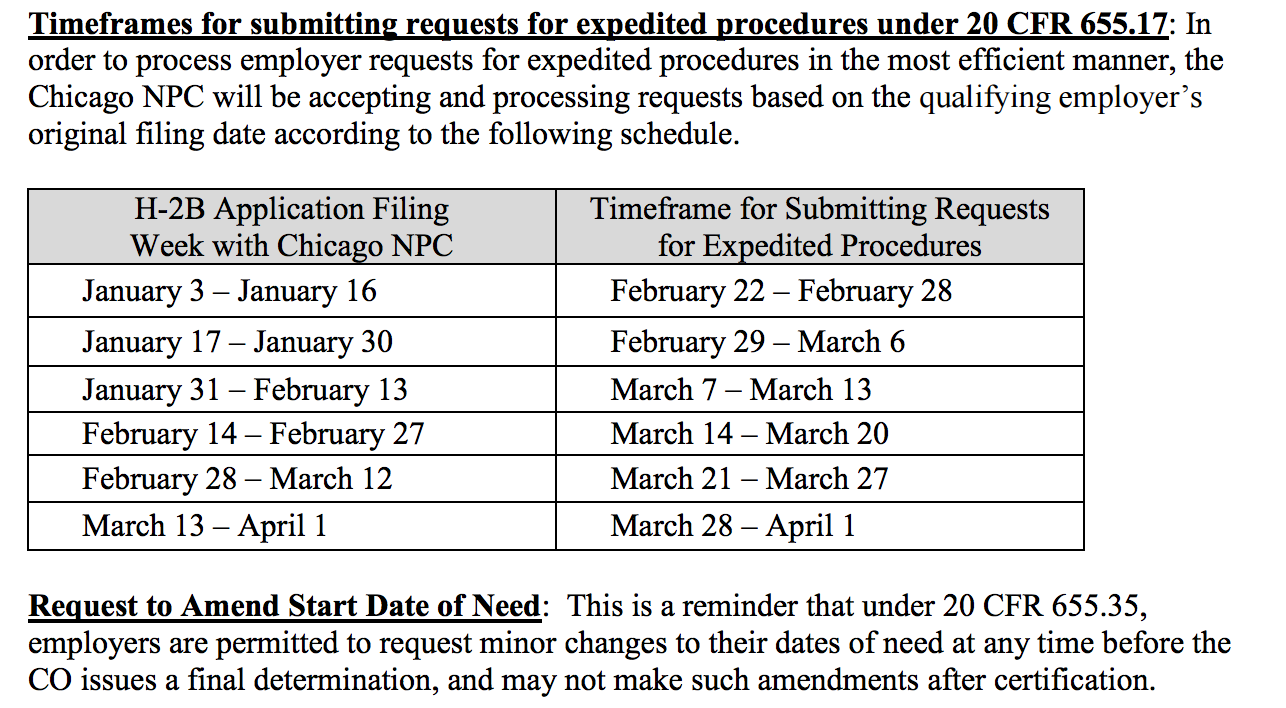
On March 4, 2015, the federal district court in the Northern District of Florida ruled in Perez v. Perez that the Department of Labor (DOL) lacks authority under the Immigration and Nationality Act (INA) to issue regulations in the H-2B program. This decision vacated and permanently enjoined DOL from enforcing the 2008 H-2B regulations. DOL was forced to immediately discontinue processing applications for temporary labor certification and can no longer accept or process requests for prevailing wage determinations or applications for labor certification.

On March 5, 2015, US Citizenship and Immigration Services (USCIS) announced that it is also temporarily suspending their adjudication of Form I-129 H-2B Petitions for Temporary Non-Agricultural Workers as these petitions require temporary labor certifications as issued by DOL. The government is considering the options to continue processing these petitions following the March 4 court decision. USCIS will continue to adjudicate H-2B petitions on Guam if those petitions are accompanied by temporary labor certifications issued by the Guam Department of Labor.

On March 6, 2015, USCIS suspended premium processing on all H-2B petitions until further notice. USCIS will issue a refund on all petitions filed using the premium processing service that were not acted upon by the agency within the 15 calendar day period.

images

By Yingfei Zhou, Esq.

The TN is a wonderful category to achieve quick entry for Canadians and Mexicans without the extra H-1B baggage of a labor condition application (LCA) or specialty occupation analysis. Canadian professionals listed in Appendix 1603. D.1 to Annex 1603 of NAFTA can apply and be admitted to the U.S. under TN work category in a 24-hour period. The TN is also useful Canadians and Mexicans who have used up their allotted L-1 and/or H-1B time.

When presenting a TN application at a POE/PFI, the application paperwork should be straightforward and streamlined. You need to bring proof of your Canadian or Mexican citizenship, a detailed letter describing the professional activity as it appears in 8 CFR 214.6, documentation of the credentials as listed in Appendix 1603.D.1 (a resume is recommended), and application fee. The application must include every item required in 8 CFR 214.6(d).


5762453888_76c84bed66_z

By Marie Puertollano, Esq.

We filed an H-1B case on April 1, 2014 for Product Line Manager, a position in the “Market Research Analyst” category of USCIS. The beneficiary has a Bachelor’s Degree in Engineering. The petitioner (the employer) is involved in high tech manufacturing. A few weeks later, we received a Request for Evidence questioning two aspects of the case.

First, USCIS questioned the fact that the position qualifies as the “specialty occupation”. Many occupations in engineering, medicine or accounting are traditionally considered specialty occupations. However, occupations in sales or marketing included in the “Market Research Analyst” category are not normally viewed to be appropriate for H-1B. USCIS uses the Occupational Outlook Handbook (OOH), a publication of the Department of Labor to determine what occupational category a particular position falls under. USCIS then tries to match the duties of a particular position with the occupational classifications found in OOH. As such, Product Line Manager position fell into Market Research Analyst classification.

Secondly, USCIS stated that the degree in Engineering of the beneficiary is unrelated to the position of Market Research Analyst. USCIS also routinely consults the OOH to determine the particular position’s educational requirements to determine whether the beneficiary’s background is relevant for the occupation. The OOH states that Market Research Analysts “typically need a bachelor’s degree in market research or a related field. Many have degrees in fields such as statistics, math, and computer science. Others have backgrounds in business administration, the social sciences, or communications.” Engineering is not mentioned as a possible field of study. This is why USCIS asked to “clarify how the beneficiary’s educational background qualified the beneficiary for the proffered position of Product Line Manager/Market Research Analyst”.

We timely answered to the Request for More Evidence (RFE) and the case was approved one week after! Here are some of the pointers we used in our RFE response.

Continue reading