Articles Posted in Employment-Based Categories

sharon-mccutcheon-jU40gA2UDmA-unsplash-scaled

The House of Representatives has introduced a new bill called the HEROES Act, (Health and Economic Recovery Omnibus Emergency Solutions Act), that provides short term financial relief during this health crisis. In this post, we discuss who would be covered under the HEROES Act and what type of relief would be provided by the Act.

To become law, the HEROES Act will need to be approved by the Senate and signed by the President. The President has openly voiced his opposition for the bill because the bill authorizes federal funds for undocumented immigrants. The bill will likely receive push back in the Republican controlled Senate or at the very least be subject to significant changes. Nonetheless if the bill fails, it will at least provide a foundation upon which Congress can reach a compromise.


What is it?


The HEROES Act is a $3 trillion bill that would provide stimulus checks to individuals who did not previously qualify for stimulus checks under the CARES Act (Coronavirus Aid, Relief, and Economic Security), such as undocumented immigrants.


Relief for Undocumented Individuals


The HEROES Act would provide temporary relief from deportation for undocumented immigrants working in essential fields such as health care workers and allow them to apply for employment authorization throughout the period of the pandemic. In addition, unlike the CARES Act, undocumented immigrants and their families would be eligible to receive stimulus checks. The HEROES Act would allow direct payments to be issued in the amount of – $1,200 for an individual, $2,400 for joint filers, and $1,200 for up to three dependents. The HEROES Act would also authorize undocumented immigrants to be eligible for the first round of stimulus checks sent out in April. The Act also proposes additional health care benefits for immigrants who are eligible for Medicaid and would require immigration authorities to release people from immigration detention where possible.


Low-Risk Detainees


The HEROES Act would require Immigration and Customs Enforcement (ICE) to evaluate the files of detained immigrants and release those who are not subject to mandatory detention, and those who do not pose a risk to national security. In the alternative the HEROES Act would encourage ICE to pursue low-cost alternatives to detention for low-risk immigrants such as requiring detainees to wear ankle bracelet monitors.

The bill would also require detention facilities to provide detainees with free and unlimited soap, as well as phone and video call accessibility to communicate with family and legal representatives.


Expedited Processing for Foreign Medical Workers


The HEROES Act would require expedited visa and green card processing for foreign medical workers seeking to practice medicine, conduct medical research, or pursue education or training to combat COVID-19. Consulates and Embassies worldwide would also be required to prioritize visa interviews for these workers, granting emergency appointments in person or teleconference appointments. Foreign doctors who have completed residency programs in the United States would be eligible to receive permanent residence on an expedited basis. Medical professionals in H-1B status would be eligible to transfer between hospital systems without having to apply for a new visa. In addition, medical students would be eligible to transfer rotations within their host institution and would be compensated for their work throughout the pandemic. In addition, such students could work outside of their approved program so long as their work relates to fighting COVID-19.

Continue reading

bulletin-board-2768204_1920

The Department of State has released the visa bulletin for May 2020 outlining the availability of immigrant visa numbers for the upcoming month.


Please note:

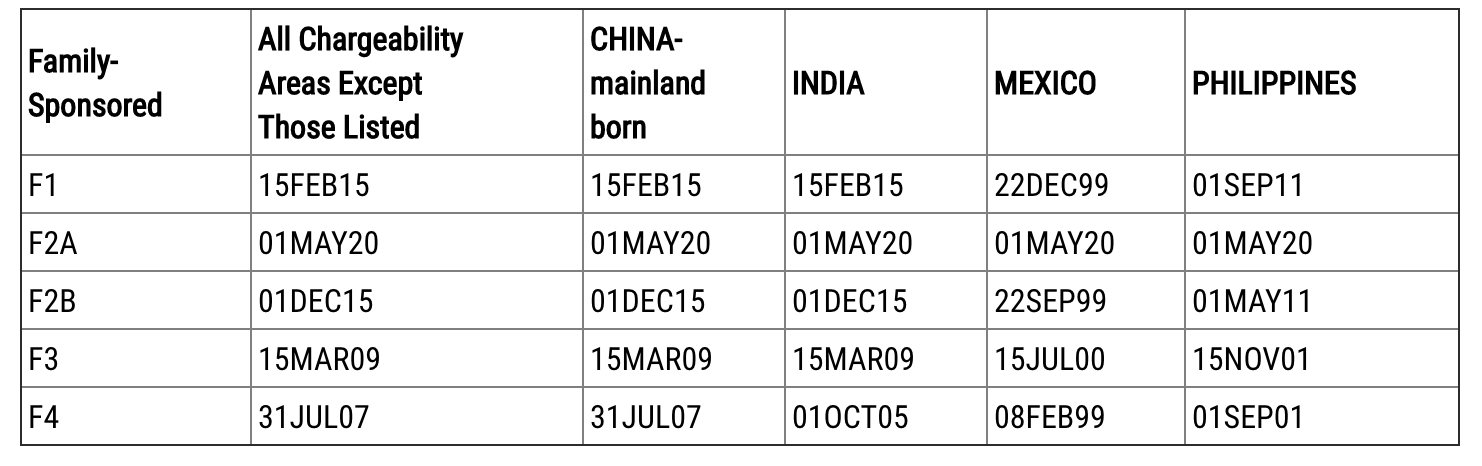
Unless otherwise indicated on the U.S. Citizenship and Immigration Services (USCIS) website at www.uscis.gov/visabulletininfo, individuals seeking to file applications for adjustment of status with USCIS in the Department of Homeland Security must use the “Final Action Dates” charts below for determining when they can file such applications. When USCIS determines that there are more immigrant visas available for the fiscal year than there are known applicants for such visas, USCIS will state on its website that applicants may instead use the “Dates for Filing Visa Applications” charts in this Bulletin. 


May Visa Bulletin Cutoff Dates


According to the Department of State’s May Visa Bulletin, the following cutoff dates will apply for the issuance of an immigrant visa:

  • EB-1: All countries except for China and India will become current on May 1. China will advance by five weeks to July 15, 2017, while India will advance by three months to August 1, 2015.
  • EB-2: China will advance by one month to October 1, 2015, and India will advance by one week to June 2, 2009. All other countries will remain current.
  • EB-3 Professional and Skilled Workers: All countries except India and China will remain retrogressed at January 1, 2017. Cutoff dates for China and India will advance, with China moving ahead by one month to May 15, 2016, and India moving ahead by more than five weeks to March 1, 2009.
  • EB-5: Most countries will remain current. China will advance by more than six weeks to July 1, 2015; India will advance by nine months to October 1, 2019; and Vietnam will advance by just under two months to April 1, 2017.

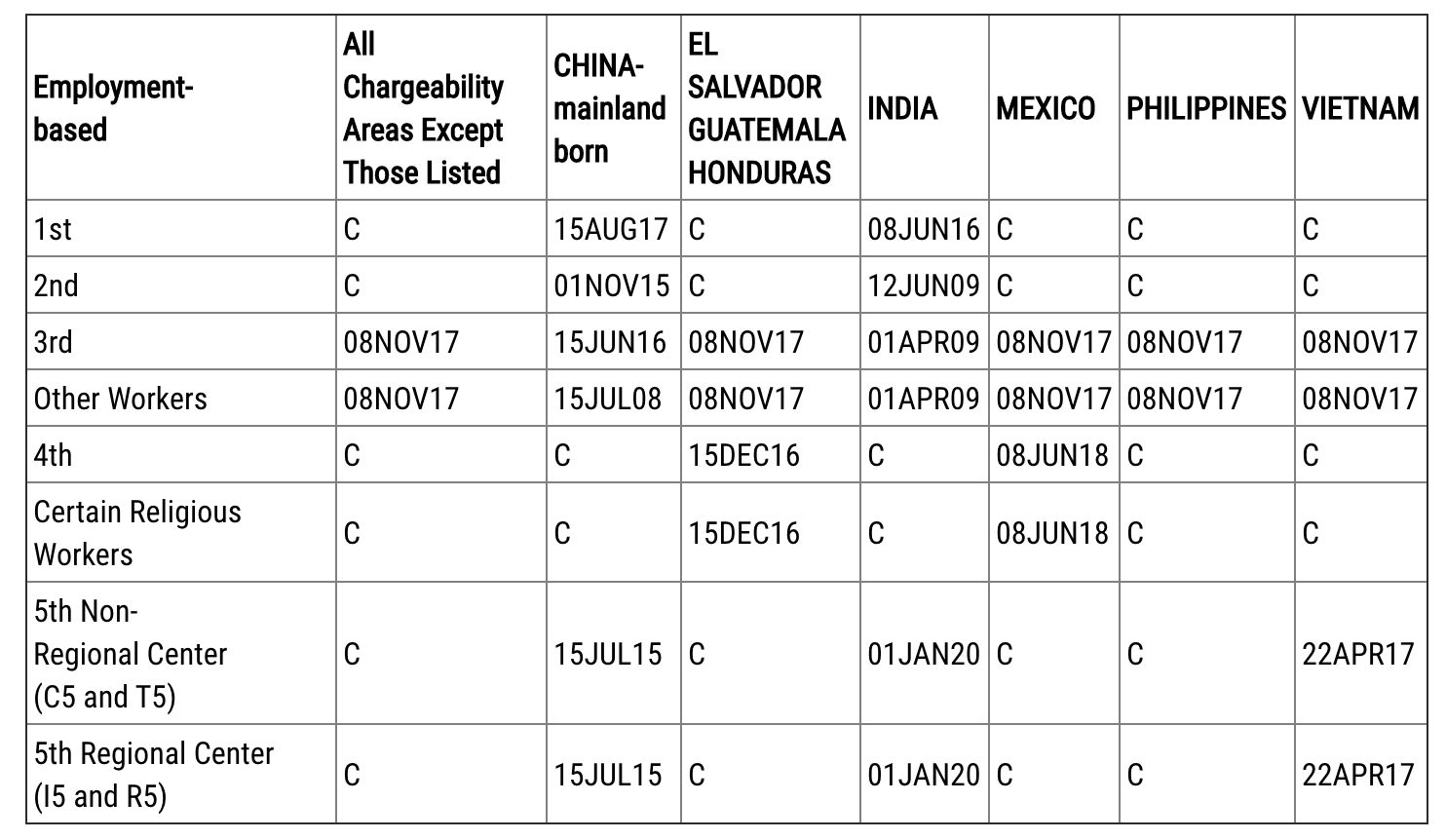
Employment-Based Priority Cut-off Dates for May 2020


USCIS recently announced that it will honor Final Action dates for adjustment of status filings in May. In order to file an employment-based adjustment of status application next month, employer-sponsored foreign nationals must have a priority date that is earlier than the date listed below for their preference category and country. This is the second consecutive month that USCIS has chosen the Final Action Dates chart, after several months of honoring the Dates for Filing chart.

The May Final Action Dates chart is current for EB-1 countries worldwide, after several months of retrogression.


How will the President’s Executive Order affect immigrant visas?


The President’s executive order will temporarily suspend and limit the entry of foreign nationals seeking an immigrant visa at a U.S. Consulate abroad. Although the order will apply for the next 60 days, the order will have little practical effect on immigration, given that U.S. Consulates and Embassies worldwide have suspending the issuance of all visas until the COVID-19 pandemic subsides.

If U.S. Consulates and Embassies resume operations within the next 60 days, the executive order will prevent foreign nationals from obtaining immigrant visas at U.S. Consulates worldwide. The suspension will apply to individuals who, as of Wednesday, were outside of the United States, do not have an immigrant visa, do not have official travel documents other than visas, and have not been exempted by the executive order.

Continue reading

artificial-intelligence-3382507_1920

A new decision issued by a federal judge in the case Itserve Alliance Inc., et al., v. L. Francis Cissna, will dramatically change the way that the United States Citizenship and Immigration Services (USCIS) adjudicates H-1B petitions for Information Technology companies.

The new ruling invalidates key provisions of the CIS 2010 Guidance Memorandum (also known as the Neufeld Memo) and the CIS 2018 Policy Memorandum (PM-602-0157) for two reasons.

Firstly, the court found that the policies outlined in these memorandums were inconsistent with previous regulations that were lawfully passed by the government through the formal notice-and-comment rule-making process, as required by law.

Secondly, the court found that USCIS violated the law when it abandoned previous regulations and began applying their own policies without first going through the required formal notice-and-rulemaking process. Since these policies were not passed through the formal rule-making process, their application was found to be unlawful and unenforceable.

Background

During the start of the Trump administration, USCIS began adopting a narrow policy designed to limit the number of H-1B petitions that would be approved. Throughout this period, our office saw the highest number of requests for evidence and denial rates ever experienced in over a decade in practice. Other immigration attorneys across the country observed the same trends.

Continue reading

Great news for FY 2021 H-1B registrants! USCIS has published step-by-step video instructions showing you how you can submit an electronic registration on the USCIS website without the use of an attorney or representative. It is not too late to register. The registration period closes noon ET on March 20, 2020.

USCIS Adds FAQs to Website

USCIS has also included a helpful and detailed FAQ section about the H-1B electronic registration process on its website addressing various topics regarding the H-1B registration process and filing process itself.

We have included these FAQs in this post for your convenience. Questions marked in red are those that we consider to be of most interest to petitioners.

For further information about the H-1B electronic registration process please click here.

Q: What happens if the prospective beneficiary does not have a last name? What do you enter into the system?

  • A: If there is only one name for a beneficiary, it should be entered as the last name. The first and middle name fields will have check boxes that indicate “Beneficiary does not have a first name” or “Beneficiary does not have a middle name.” These boxes should be checked in these instances. Do not enter placeholders, such as “FNU”, “LNU”, “Unknown”, or “No Name Given.

Q: Is there an appeal process for registrations determined to be invalid duplicates?

  • A: Registrations that are determined to be duplicates will be invalid. A registrant who submits duplicate registrations will not be able to appeal the invalidation.

Q: If you are registering for the master’s cap based on the expectation that the beneficiary will earn a qualifying advanced degree, and you are actually selected under the master’s cap, but, the beneficiary does not obtain their qualifying advanced degree, is there a risk that the cap-subject H-1B petition for that beneficiary will be denied?

  • A: If a registration is submitted requesting consideration under the INA 214(g)(5)(C) advanced degree exemption because the beneficiary has earned, or will earn prior to the filing of the petition, a master’s or higher degree from a U.S. institution of higher education, and the registration is selected under the advanced degree exemption, the beneficiary must be eligible for the advanced degree exemption at the time of filing the I-129 petition. If the beneficiary is selected under the advance degree cap and has not earned a qualifying master’s or higher degree from a U.S. institution of higher education at the time the petition is filed, the petition will be denied or rejected.

Continue reading

lotto-864035_1920-1

H-1B season has officially kicked off!

The new mandatory H-1B electronic registration system for fiscal year 2021 opened yesterday at noon ET on March 1, 2020 and will remain open until noon ET on March 20, 2020.

In order to have a chance of being selected, from now on all prospective petitioners and their authorized representatives seeking to file H-1B cap-subject petitions for FY 2021, including for beneficiaries eligible for the advanced degree exemption, must first register during the registration period (March 1, 2020 to March 20, 2020) and pay the associated $10 registration fee for each beneficiary.

Only petitioners with a selected registration may participate in the H-1B filing process.

Registering is Easy

Petitioners and their authorized representatives must create a myUSCIS online account and submit registrations for each beneficiary via their online account during the registration period.

Per USCIS:

Prospective H-1B cap-subject petitioners or their representatives are required to use a myUSCIS online account to: 1) register each beneficiary electronically for the selection process and 2) pay the associated $10 H-1B registration fee for each registration submitted on behalf of each beneficiary. Prospective petitioners or their representatives will be able to submit registrations for multiple beneficiaries in a single online session. Through the account, they will be able to prepare, edit and store draft registrations prior to final payment and submission of each registration.

Continue reading

board-157016_1280

In this blog post, we discuss visa bulletin trends and projections for the month of March. The U.S. Department of State (DOS) recently released the March 2020 Visa Bulletin revealing some good and bad news for employment based categories and family preference categories.

Adjustment of Status Filing Charts March 2020:

For Family-Sponsored Filings:
In the F2A category, there is a cutoff date on the Dates for Filing chart.  However, the category is “current” on the Final Action Dates chart.  Accordingly, applicants in the F2A category may file using the Final Action Dates chart for March 2020.

For all other family-sponsored preference categories, applicants must use the Dates for Filing chart in the Department of State Visa Bulletin for March 2020.

For Employment-Based Preference Filings:
For all employment-based preference categories, applicants must use the Dates for Filing chart in the Department of State Visa Bulletin for March 2020.

Employment-based Categories: The Highlights

China: This month, employment based categories for China experienced varying degrees of forward movement, with EB-3 experiencing the most advancement.

  • EB-1 China advanced ten days to June 1, 2017
  • EB-2 China advanced one month to August 15, 2015
  • EB-3 China advanced nearly three months to March 22, 2016

Continue reading

register-2819608_1920

Are you ready for the upcoming H1B season for fiscal year 2021?

With the registration period fast approaching, we want to make sure you know everything there is to know about the new mandatory H-1B electronic registration process for fiscal year 2021 (FY 2021).

The following FAQ provides the most up to date information regarding the mandatory electronic registration requirement.


H-1B Registration Process Timeline

Feb. 24: Prospective petitioners may begin creating H-1B registrant accounts (account creation will remain open throughout the entire registration period). Representatives may create an account at any time.

March 1: H-1B registration period opens at noon ET.

March 20: H-1B registration period closes at noon ET.

March 31: Date by which USCIS intends to notify selected registrants.

April 1: The earliest date that FY 2021 H-1B cap-subject petitions may be filed.

FAQs

Q: What is the electronic registration requirement?

A: In order to participate in the upcoming H-1B lottery, prospective petitioners seeking to file H-1B cap-subject petitions for FY 2021, including for beneficiaries eligible for the advanced degree exemption, must first electronically register and pay the associated $10 H-1B registration fee for each beneficiary.

Only those petitioners who have submitted an electronic registration and have received a “Selected” registration notification may properly file an H-1B cap-subject petition for FY 2021.

Continue reading

login-3938429_1920

It’s official. Yesterday, the United States Citizenship and Immigration Services (USCIS) published a notice in the Federal Register formally implementing the mandatory registration requirement for H1B petitioners seeking to file a cap-subject petition for Fiscal Year 2021. The notice went into effect on January 9, 2019, the date of publication.

Beginning March 1, 2020, before a petitioner can file an H-1B cap-subject petition, including petitions eligible for the advanced degree exemption, the petitioner must first electronically register with USCIS. Only petitioners with a valid registration selection will be eligible to file an H-1B petition with USCIS.

The initial registration period for FY 2021 will open on March 1, 2020 and is expected to close on March 20, 2020. The actual end date will be provided on the USCIS website.

Who must register?

H-1B cap-subject petitioners, including those eligible for the advanced degree exemption, seeking to file a FY 2021 H-1B cap petition will be required to first register electronically with USCIS and pay the associated $10 H-1B registration fee for each submission

Prospective petitioners or their authorized representatives must electronically submit a separate registration naming each alien for whom they seek to file an H-1B cap-subject petition. Duplicate registrations are prohibited.

What happens after the registration period closes?

Once the registration period closes, USCIS will conduct the initial selection process.

Continue reading

cms-265128_1920
In this blog post, we would like to remind our readers that today is the last day to submit a public comment on the USCIS proposed rule increasing immigration fees for certain petitions. Initially USCIS had set a 30-day comment period ending on December 16, 2019, however the comment period was later extended for two more weeks, ending today December 30, 2019.

Once the comment period has closed, USCIS will review all public comments and publish a final rule in the Federal Register which will contain the rule’s effective date of implementation.

The filing fees for the following petitions would increase substantially under the proposed rule:

matthew-t-rader-_d6xGOanXMs-unsplash

The House of Representatives recently made a bold move that could give undocumented farmworkers a pathway to permanent residence.

Yesterday, December 11, 2019, by a vote of 260-165, the House passed the Farm Workforce Modernization Act, a progressive bill that if approved by the Senate, would create several exciting opportunities for undocumented farmworkers as well as U.S. employers.

What does the Bill propose?

The bill would allow existing agricultural workers in the United States to legalize their status through continued agricultural employment and contribution to the United States economy.

Which workers would be eligible for Permanent Resident Status?

Earned Pathway to Legalization

  • Individuals who have worked in agriculture in the U.S. for at least 10 years before enactment of the bill, must continue to work for at least 4 more years in agriculture on Certified Agricultural Worker (CAW) status before being eligible to apply for permanent residence OR
  • Individuals who have worked in agriculture in the U.S. for less than 10 years, must work at least 8 more years in agriculture on CAW status before being eligible to apply for permanent residence
    • Applicants who qualify based on one of these criteria would be required to pay a $1,000 fine

In addition, the bill would:

  • Create a new temporary worker visa program for current unauthorized farmworkers called Certified Agricultural Worker (CAW) status. CAW visas would be renewable and five-and-a-half years in length. The number of CAW visas would be uncapped.
  • Establish eligibility requirements of the CAW visa.Unauthorized immigrants who have spent at least 180 days of the last two years in agricultural employment would be eligible for the Certified Agricultural Worker Visa.
  • With few exceptions, applicants must meet existing work visa admissibility requirements to be eligible and must pass a criminal background check.
  • Felons and those who have been convicted of multiple misdemeanors (two or more offenses of moral turpitude or three offenses in general) would not be eligible.

Continue reading