personal-3108155_1280It did not take long for President Trump to capitalize on the terrorist attack which took place several days ago in New York City, to attack the Diversity Visa Program and the process by which US Citizens, and in some cases green card holders, can petition for extended family members to immigrate to the United States.

Following the terrorist attack in New York City, which claimed the lives of 8 Americans, the President fired off a series of tweets calling on Congress to terminate the Diversity Visa Program, claiming that the perpetrator of the attack, Sayfullo Saipov, had gained admission to the United States seven years ago through the diversity immigrant visa program, a congressionally mandated program made possible by section 203(c) of the Immigration and Nationality Act (INA). According to CNN, the Department of Homeland Security has said that Saipov came to the United States in 2010 on a diversity visa. Department of Homeland Security archives confirm that Uzbekistan was a country participating in the Diversity Visa program as early as 2007, and continues to participate in the Diversity Visa Program.

The Diversity Immigrant Visa Program

The Diversity Immigrant Visa program is a program enacted by Congress, which allocates up to 50,000 immigrant visas per fiscal year to a special class of immigrants known as “diversity immigrants.” Each fiscal year diversity applicants register for the visa program electronically at no cost. Applicant entries are selected at random through a computerized “lottery” system to allocate the 50,000 available immigrant visas for the Diversity Immigrant Visa Program. Only diversity immigrants who are natives of countries with historically low rates of immigration to the United States qualify for the Diversity Immigrant Visa program. In other words, to qualify for a diversity visa, essentially a green card, you must be a native of a country participating in the diversity visa program. Countries with historically high rates of immigration to the United States DO NOT qualify.

Continue reading

13904424715_93e921ac5b_z

On October 24, 2017, the President issued Executive Order 13815 entitled, “Resuming the United States Refugee Admissions Program (USRAP) with Enhanced Vetting Capabilities.” As the title suggests, the U.S. Refugee Admissions Program also known as (USRAP) is no longer suspended and the policies set forth in section 6(a) of Executive Order 13780 also known as “Protecting the Nation from Foreign Terrorist Entry into the US,” are no longer in effect as they pertain to refugees. As outlined in Executive Order 13780, beginning October 24, 2017, “Presidential action to suspend the entry of refugees under the USRAP [is no longer needed] to protect the security and interests of the United States and its people.”

Section 6(a) of Executive Order 13780 imposed a temporary freeze on the admission of refugees to the United States, and provided for a temporary 120-day window in which the Department of Homeland Security would review the application and adjudication process for the Refugee Admissions Program to prevent foreign terrorist entry to the United States. This 120-day window expired on October 24, 2017. Section 6(a) contained a provision which stipulated that refugee travel and application decisions would resume after the 120-day window had terminated, “for stateless persons and for nationals of countries which the Secretary of State, Secretary of Homeland Security, and Director of National Intelligence jointly determine that the additional procedures identified through the USRAP review process are adequate to ensure the security and welfare of the United States.”

At this time, the Secretary of State, Secretary of Homeland Security, and Director of National Intelligence have advised the Trump administration that sufficient improvements have been made to prevent foreign terrorist entry through the Refugee Admissions Program, such as the implementation of enhanced vetting procedures. These improvements have been deemed sufficient to ensure the “security and welfare of the United States,” for the time being. In accordance with this order, the Department of Homeland Security will only apply special measures restricting the travel of refugees to those categories of refugees that “pose potential threats to the security and welfare of the United States.”

Continue reading

29496131773_a9ba5e3935_z

Unsurprisingly, this week we learned that the Trump administration is taking further steps to toughen the process of applying for an H-1B visa extension/renewal request, and that of other highly sought-after non-immigrant work visa types filed using Form I-129 Petition for Nonimmigrant Worker such as the H, O, P, L, and R work visas. The news comes as part of the President’s ongoing plan to prioritize the employment of American workers over foreign workers, outlined in the President’s Executive Order “Buy American, Hire American.”

On October 23, 2017, the United States Citizenship and Immigration Services (USCIS) announced that the agency will be updating its adjudication policy “to ensure petitioners meet the burden of proof for a non-immigrant worker extension petition.” The change in policy specifically provides that USCIS officers will “apply the same level of scrutiny to both initial petitions and extension requests” for the H-1B visa as well as other nonimmigrant visa types.

Per USCIS, this policy will now apply to “nearly all non-immigrant classifications filed using Form I-129 Petition for Nonimmigrant Worker.” This means that all nonimmigrant worker visa renewal requests, made using Form I-129, will be subject to the same level of scrutiny that was applied during the foreign worker’s initial non-immigrant work visa request.

Continue reading

32601599521_2402aed1f4_z

Just one day before Presidential Proclamation No. 9645, “Enhancing Vetting Capabilities and Processes for Detecting Attempted Entry Into the United States by Terrorists or Other Public-Safety Threats,” was set to go into effect, a federal judge in Hawaii issued a ruling blocking portions of the Presidential Proclamation from being enforced on a majority, but not ALL, of the countries, listed in the Proclamation.

The Presidential Proclamation, commonly referred to in the media as ‘travel ban 3.0’ set out to suspend the entry of foreign nationals from eight “countries of identified concern,” and the admission of foreign nationals from those countries was to remain limited until further notice.

The countries to be affected by travel ban 3.0 included: Chad, Iran, Libya, North Korea, Syria, Venezuela, Yemen, and Somalia. A federal judge from the state of Hawaii by the name of Derrick Watson has granted a temporary restraining order preventing the government from suspending the admission of foreign nationals from the following countries: Chad, Iran, Libya, Syria, Yemen, and Somalia, but DOES NOT prevent the government from suspending the admission of foreign nationals from North Korea and Venezuela, and from imposing stricter screening standards on Iraqi nationals. The restrictions on foreign nationals from North Korea, Venezuela, and Iraq will continue to be enforced according to the Proclamation, beginning today, Thursday, October 19, 2017. Restrictions on North Koreans and Venezuelans will likely remain indefinitely, given that the U.S. government has no formal diplomatic avenues for communication with those countries.

Judge Derrick Watson wrote in his opinion that the latest revision of the ban, “suffers from precisely the same maladies as its predecessor,” and “lacks the sufficient finds that the entry of more than 150 million nationals from [the] specified countries would be ‘detrimental to the interests of the United States,” and “plainly discriminates based on nationality.”

Continue reading

37000256942_8ce02a3302_z

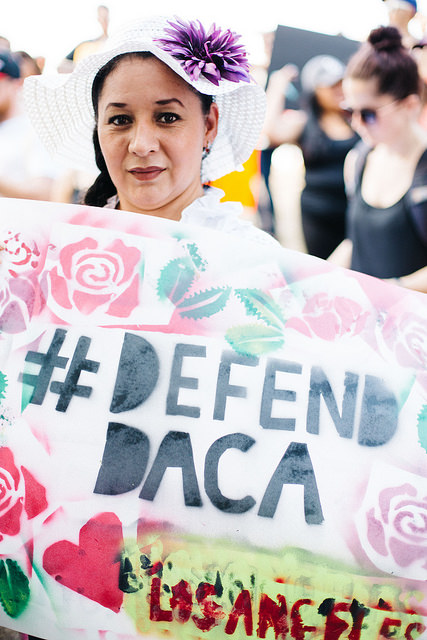
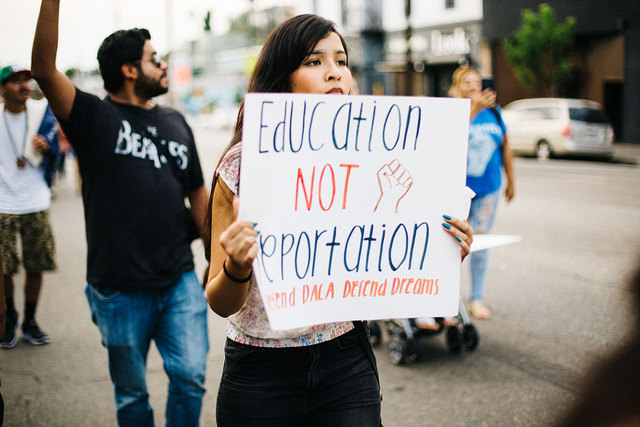
As the March 5th deadline approaches for Congress to pass legislation protecting Dreamers from deportation, new information has emerged providing insights into the President’s plans to shield Dreamers from deportation, should Congress fail to act by the March 5th deadline.

Republican Senator James Lankford recently told the press that if Congress does not act by the March 5th deadline, the President is willing to give lawmakers more time to pass legislation that would create a more permanent solution for DACA recipients to remain lawfully present in the United States.

Although the President has generally been sympathetic to the plight of undocumented immigrants who came to the United States as children, the President has made clear that any legislation that would protect Dreamers from deportation, would not include a path to permanent residency. In addition, the President recently issued a list of demands that must appear on any such legislation in order to receive his support. Some of these demands include Congress’ support for the construction of a border wall along the Southern border, cracking down on illegal immigrants, withdrawing federal funding from sanctuary cities, and cutting back on legal immigration by restricting the family based immigration system. Without these concessions, the President has stated that he will not throw his support behind the bill. It is still unclear how flexible the President’s list of demands will be. Of course, even if the President were to veto a bill that would not meet his demands, Congress can override a presidential veto by a two-thirds vote in the House and Senate.

Continue reading

15870725062_120c91470a_z

Supreme Court Dismisses One of Two Travel Ban Cases

On October 10, 2017, in a one-page order, the U.S. Supreme Court dismissed the Maryland case, Trump, President of U.S., Et Al. v. Int’l Refugee Assistance, Et Al.,  which sought to block a key provision of Executive Order No. 13,780 temporarily suspending the entry of aliens outlined under Section 2(c). The Supreme Court has dismissed the case because the provision at issue expired on September 24, 2017 and no longer presents a “live case or controversy” for the court to resolve. Accordingly, the Supreme Court vacated the judgment and sent the case back to the lower courts to dismiss the case as moot.

However, the Supreme Court did not act to remove the case, Trump, President of U.S., Et Al. v. Hawaii, Et Al., from its docket, in which the state of Hawaii joined by other states, called on the court to issue an injunction, stopping the federal government from enforcing a travel ban on individuals from six Muslim majority countries as well as refugees. The travel ban at issue, in that case, began on June 29, 2017 and expired on September 27, 2017. The refugee provision of the act however will not expire until October 24, 2017. Given the Supreme Court’s dismissal of the Maryland case, it is likely that the Court will also dismiss the Hawaii case once the refugee provision has expired.

On September 24, 2017, the President revised Executive Order No. 13,780 for a third time adding Chad, North Korea, and Venezuela to its travel ban, and removing Sudan. The third revision of the travel ban will go into effect on October 18, 2017. The Supreme Court did not address the administration’s newly revised travel ban in its order.

Continue reading

Yesterday, October 8, 2017, the United States and Turkey announced the mutual suspension of all non-immigrant visa services, putting a damper on travel between the two nations, following the arrest of a Turkish citizen, employed at the U.S. Embassy in Ankara, on suspicion of espionage.

A statement released by John Bass, the U.S. ambassador to Turkey, explained the reasons for the United States government’s decision to suspend non-immigrant visa processing for Turkish citizens. According to the ambassador the suspension will allow the United States, “to minimize the number of visitors to our embassy and consulates while we assess the commitment of the Government of Turkey to the security of our diplomatic facilities and personnel.” He continued, “last week, for the second time this year, a Turkish staff member of our diplomatic mission was arrested by Turkish authorities. Despite our best efforts to learn the reason for this arrest, we have been unable to determine why it occurred or what, if any, evidence exists against the employee. . . our colleague has not been allowed sufficient access to his attorney.”

The actions taken by the government are thus in response to Turkish hostility toward U.S. consular employees and an ongoing rift between the two countries regarding U.S. support for Kurdish fighters in Syria, accusations of U.S. involvement in a coup against President Erdogan, and the U.S. government’s refusal to extradite former Turkish minister Fethullah Gulen, accused of masterminding the Turkish coup.

Continue reading

11758888_1623749037889872_230923153_n

In 2013, as a Polish citizen who worked in Ireland, I started very seriously considering going to the United States to become a student and receive education to excel at my job. Little did I know how difficult it could actually be to cross the doorstep of the US embassy and go through the interview process. My heart broke when I experienced denial. I remember walking out of the building crying and then running through the rain towards the bus station. It felt like some horrific movie scene. 

I wanted to give up and never try again. I went back to work and tried my hardest not to think about it. Within a few days, however, my friend and I, found Jacob Sapochnick’s website. I looked up reviews instantly, and I became very excited about the idea of talking to him and his team about my situation. 

My consultation was over the phone, but Jacob did a marvelous job outlining details, and, in fact, his prognosis was very positive. I couldn’t believe that I could still be able to fulfill my dreams and, perhaps, reapply. In 2014, while I was visiting the US on a tourist visa, I met with Jacob and his team in person and decided to file a change of status application. I didn’t think twice, and we gave it a go. Everyone did an incredible job filling out all the necessary paperwork. Whenever I was worried or felt down, I could call them and get a prompt calming answer. I still remember talking to Inese, one of Jacob’s employees, and hearing how positive she was about the outcome of my case.  

Continue reading

3611622999_231315eede_z

Premium Processing Resumes for all H-1B Petitions

Today, October 3, 2017, the United States Citizenship and Immigration Services (USCIS) made an official announcement letting the public know that premium processing service has resumed for all types of H-1B petitions including H-1B extension of stay petitions.

What is premium processing?

Premium processing service refers to an optional premium processing service offered by USCIS to employers filing Form I-129 (Petition for a Non-immigrant Worker) or Form I-140 (Immigrant Petition for Alien Worker). Premium processing guarantees 15 calendar day processing to petitioners who make use of the service. Applications that are not processed within 15 calendar days, receive a refund of the $1,225 premium processing fee. To make use of the service, petitioners must file Form I-907 with their application and include the appropriate fees. The I-907 request for premium processing service can be filed together with an H-1B petition or separately pending a decision. This service has now resumed for all types of H-1B petitions.

For more information on premium processing please click here.

New I-765 Form Allows Applicants to Apply for SSN without visiting SS Office

On October 2, 2017, USCIS announced a new partnership with the Social Security Administration which will allow certain foreign nationals to apply for employment authorization and a social security number using the updated Form I-765 Application for Employment Authorization, without having to visit the Social Security office. In order to obtain lawful employment in the United States, foreign nationals are required to apply for an employment authorization card from USCIS, and a Social Security number with the Social Security Administration. Both are required to engage in lawful employment in the United states. Employment Authorization Cards are accepted as valid employment documentation by U.S. employers, the Social Security Administration, and all federal agencies including the Department of Motor Vehicles.

Continue reading