5808492140_09871b9bdc_z

There is no denying that the election of Donald Trump as next President of the United States has dealt a huge blow to the immigration reform effort and diminished any hope for the passage of broader legal immigration reform. We had hoped that with the election of Hillary Clinton we would see an increase in immigration levels for highly skilled workers, as well as increased visa opportunities for entrepreneurs and investors. While the news of Donald Trump’s election was a big setback for immigration in general, polling continues to suggest that people across the United States are willing to support fairness in dealing with the undocumented immigrant population in a sensible and human way. By contrast, most Americans disapprove of passing broad legal immigration reform that would benefit foreign workers.

Donald Trump was able to win the favor of a great number of Americans because of his critical view of programs like NAFTA that he believes has allowed American jobs to go overseas. Trump has blamed the U.S. government for allowing programs like the H-1B worker program to exist, saying that foreign workers are taking American jobs. We can expect to see Donald Trump take a restrictive view on legal immigration, keeping immigration levels within historic norms. Donald Trump has until recently softened his tone on illegal immigration, claiming that his priority is to deport only dangerous criminals residing in the United States unlawfully, although his 10-point plan contradicts his recent stance.

It is likely that the Republican House and the Senate will introduce legislation designed to benefit American workers and the economy, and focus less on creating immigration opportunities for foreign workers. Similarly, the Trump administration will likely focus on job creation, and less on passing any meaningful legal immigration reform.

The program that may come under fire by the Trump administration is the Deferred Action for Childhood Arrivals (DACA) initiative which began on June 15, 2012 as part of an executive order introduced by President Barack Obama. Donald Trump has repeatedly said that he wants to end the Deferred Action for Childhood Arrivals (DACA) program incorrectly calling it an “amnesty.” In actuality, DACA is not amnesty and does not provide a pathway to permanent residency or even citizenship. DACA merely shields the individual from deportation and allows them to legally obtain employment in the United States for a temporary period of time.


Continue reading

5439999805_474811d69f_z

Days after defeating Hillary Clinton in the biggest political upset in American history, President elect Donald J. Trump met with outgoing President Barack Obama this morning to ensure a peaceful transition of power. A triumphant Donald Trump also met with Republican Senate Majority Leader Mitch McConnell, and the Republican Speaker of the House of Representatives Paul Ryan to discuss his policy priorities, and the unification of the Republican party. Although Donald Trump will not be inaugurated until January 20, 2017 he has made it clear that he plans to work with Republicans in the House and the Senate, to pass legislation on wide ranging issues during his first 100 days in office. Working with a Republican House of Representatives and Republican Senate, Donald Trump announced his administration’s top three priorities: immigration, health care, and job creation. After meeting with Mitch McConnell on Capitol Hill, Trump told reporters “we’re looking very strongly at immigration, we’re going to look at the borders, very importantly, we’re looking very strongly at healthcare and we’re looking at jobs.”

While Trump has not provided details on what his immigration policy might look like, he has outlined his 10-point immigration plan on his campaign website and his all new website Greatagain.gov.

Here’s what we know so far about what immigration policy might look like under the Trump administration:

Continue reading

13945881_986284365b_z

We would like to inform our readers that a new development has been occurring in recent months involving Form I-539 change of status applications filed by prospective students. Students applications wishing to change their status from a B-2 visa classification to F-1 must proceed with caution. USCIS has recently been issuing denials for such change of status applications that request a change of status from a B-2 nonimmigrant visa classification to F-1 student status. These denials have been issued, despite the fact that applicants have seemingly filed their application in a timely and proper manner with USCIS. To submit an application in a timely manner, it is required that the applicant file an I-539 change of status application with USCIS, prior to the expiration of their underlying B-2 status, as indicated on the applicant’s I-94 arrival/departure record. An additional problem that has been occurring involves the delayed adjudication of these applications with the California Service Center. In delaying the processing of these applications, designated school officials (DSO) have been forced to defer student program start dates that appear on the SEVIS form, before adjudication of the applicant’s change of status application has been completed. The unfortunate cause of these delays has resulted in a discrepancy between the deferred program start date and the ending B-2 visa status or the date USCIS adjudicated the I-539 application to change status.

Continue reading

16216912657_b301085bef_z

In this post we bring you your daily dose of immigration updates. For more information on the immigration services we provide please visit our website. For a free first legal consultation please contact our office. It is our pleasure to accompany you on your immigration journey.

USCIS extends TPS Designation for Nepal for 18 months

The Secretary of Homeland Security recently announced that Temporary Protected Status (TPS) for eligible nationals of Nepal will be extended for an additional 18 months, beginning December 25, 2016 through June 24, 2018. Eligible TPS applicants must either be foreign nationals of Nepal or habitually resided in Nepal. DHS will be extending current TPS Nepal Employment Authorization Cards (EADs) with a December 24, 2016 expiration date for an additional 6 months, valid through June 24, 2017.

For more information regarding TPS for Nepal please click here. For information about the TPS program please click here. Employers interested in verifying or reverifying the employment eligibility of employees who are TPS beneficiaries, may click here for more information.

EADs Extended 6 Months for Guinea, Liberia and Sierra Leone TPS Beneficiaries

Current Beneficiaries of the Temporary Protected Status (TPS) program for the designations of Guinea, Liberia, and Sierra Leone have had their TPS status extended for a period of 6 months, to expire on May 21, 2017. The Department of Homeland Security authorized this temporary extension to allow beneficiaries to make an orderly transition out of the United States, before termination of their TPS status on May 21, 2017. Current beneficiaries of the TPS program from these designations will automatically retain their TPS status until this date, and the validity of their current Employment Authorization Cards (EADs) will be extended through May 20, 2017.

Click here for more information about the 6-month extension of orderly transition before termination of TPS designations for Guinea, Liberia, and Sierra Leone. For general information about the TPS program please click here.

Continue reading

14306017036_931628b92f_z

For persons who have entered the United States illegally or who have accrued unlawful presence after having overstayed their visa, the possibility of obtaining lawful permanent residence (a green card) is very limited. In the United States there are generally two ways to adjust status to permanent residence. With few exceptions, a green card may generally be obtained through employment-based sponsorship, or family sponsorship based on a qualifying family relationship, such as a U.S. Citizen or Legal Permanent Resident relative. Unlawful presence is a very serious immigration offense that is subject to punishment depending on the amount of time a person has accrued unlawful presence in the United States.

Undocumented immigrants who accrue unlawful presence in the United States, and subsequently leave the country, and attempt to re-enter the United States lawfully, may be subject to either a 3- or 10-year bar, based on the amount of time they have accrued unlawful presence in the United States. Specifically, under the Immigration and Nationality Action Section §212(a)(9)(B)(i)(I) a person who has accrued more than 180 days of unlawful presence in the United States, is subject to a 3-year bar automatically triggered once the person departs the United States. The bar would thereby prevent a person from being re-admitted into the United States, depending on the amount of time they were previously unlawfully present in the country. Similarly, under the Immigration and Nationality Act §212(a)(9)(B)(i)(II), a person who has accrued one year or more of unlawful presence in the United States, is subject to a 10-year bar preventing a person from being re-admitted to the United States, once they have departed from the United States.

Continue reading

5962953798_5401460306_z

New Jersey’s 4th largest city, Elizabeth, is soon to become one of several municipalities in New Jersey to offer photo identification cards for the undocumented immigrant population, and other underserved members of the community such as homeless persons. On Tuesday, city council members voted unanimously to approve a city ordinance benefitting undocumented immigrants who do not have any form of photo identification. A second and final vote on the ordinance is expected next month. According to the U.S. Census nearly half of the residents of Elizabeth, New Jersey are foreign-born persons. Elizabeth is only one of many cities in New Jersey that has considered adopting a municipal identification card program. Recognizing that New Jersey is home to a large population of undocumented immigrants, various cities in New Jersey already have a municipal identity card program incorporating the undocumented immigrant population into society. New Haven, Newark, Roselle, Perth Amboy, Highland Park, Asbury Park, Trenton, and many other cities have adopted some form of municipal identification card.

The photo identification cards will provide basic information including the person’s name, date of birth, address, and an expiration date. Only persons 14 years of age or older will be able to obtain these photo identification cards. Although these cards will not be a form of federal identification, and do not confer any type of immigration benefit, or employment authorization, having access to a photo identification is very important for the undocumented immigrant population for various reasons. First, it is nearly impossible to obtain certain benefits without a valid photo identification. For example, many undocumented immigrants are unable to open a bank account, access basic government services, enter government buildings, fill prescriptions, obtain medical care, enroll in adult courses, or receive state benefits they are entitled to, but cannot receive without presenting a valid photo ID. Second, this measure will be especially important for persons who cannot obtain a driver’s license, passport, or other government issued ID by any other means. Third, because many undocumented immigrants cannot open a bank account since they do not have a form of identification, undocumented persons are often targeted as walking ATMs because they carry large amounts of cash.

Continue reading

3134127288_bf609afe71_z

Today, October 24, 2016 the Department of Homeland Security published the final rule increasing fees for certain immigration and naturalization petitions processed by U.S. Citizenship and Immigration Services (USCIS). Overall the Department of Homeland Security increased filing fees for certain petitions by an average of 21 percent. The new fees will be enforced by USCIS beginning December 23, 2016. The fee schedule has been adjusted following the agency’s decision to conduct a comprehensive review of filing fees for fiscal year 2016/2017. USCIS determined that an adjustment in the filing fees would be necessary in order for USCIS to recover costs for services expended and maintain adequate service. The proposed fee schedule was first published on May 4, 2016. The final rule clarifies that all persons applying for immigration benefits may be required to appear for biometrics services or an interview, and thus must pay the biometrics services fee accordingly.

EB-5 Investor Visa Program

The EB-5 Immigrant Investor Visa Program will be most heavily impacted by the new fee schedule. The new filing fee for Form I-924, Application for Regional Center under the Immigrant Investor Pilot Program, will increase by a rate of 186% requiring Regional Centers seeking designation under the program, to pay a filing fee of $17,795 instead of the current rate of $6,230. Regional Centers will be required to pay a $3,035 annual fee to certify their continued eligibility for the designation.

The filing fee for the I-526 Immigrant Petition by Alien Entrepreneur, an application associated with the EB-5 visa program, will increase to $3,675, a 145% increase up from the current rate of $1,500. The filing fee for an investor’s petition to remove conditions on residence remains unchanged.

Naturalization

USCIS has established a three-tiered fee schedule for naturalization applicants filing Form N-400 Application for Naturalization. First, the fee schedule includes a standard filing fee for most applicants, from a rate of $595 to $640. Second, DHS has established a reduced fee of $320 for naturalization applicants whose household income is greater than 150% but less than 200% of the Federal Poverty Guidelines. Third, there will be no filing fee for naturalization applicants who are members of the military, applicants with approved fee waivers, and others who may qualify for a fee waiver according to sections 328 or 329 of the Immigration and nationality Act (INA).

Continue reading

debate3_1

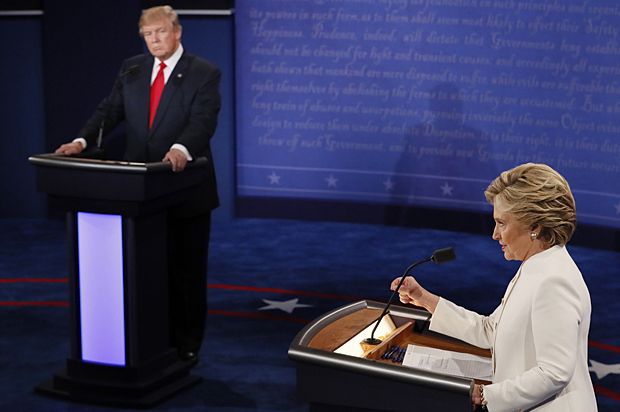
Yesterday, October 19th the third and final Presidential debate took place in Las Vegas, Nevada. This was the last opportunity Presidential candidates, Donald J. Trump, and Hillary R. Clinton, had to present their positions on various different issues, and make a final attempt to gain the support of undecided voters. The debate has left much to talk about, while many questions still remain unanswered. The moderator of the debate, Chris Wallace, of FOX news questioned the candidates on various different topics ranging from the Supreme Court nomination, economy, foreign policy, and more importantly the candidates’ positions on immigration reform.

On the subject of immigration, the moderator introduced his question on immigration by providing an overview of each candidate’s positions on immigration. Wallace discussed the fact that throughout his campaign, Donald Trump has staunchly advocated for mass deportations and the building of a more secure border, which he believes will successfully deter undocumented immigrants, criminals, and terrorists from entering the United States.

By contrast, Wallace highlighted the fact that Hillary Clinton has offered no specific plan on how she would secure our southern borders, where there is currently a massive influx of immigrants, specifically unaccompanied children from Central America, seeking refuge in the United States. Wallace reiterated Hillary Clinton’s commitment to offer a comprehensive immigration reform package within the first 100 days she is in office that includes a pathway to citizenship for undocumented immigrants, with proven ties to the United States.

Each candidate was asked to discuss why their immigration policy is the best, and why their opponent is wrong. Donald Trump was given the first opportunity to respond. Trump opened the conversation on immigration by taking the position that providing amnesty for undocumented immigrants would be a ‘disaster’ for various different reasons. First, he stated that it would be unfair for undocumented immigrants to be given a path to citizenship, while immigrants wishing to enter the United States legally, are forced to wait many years to obtain permanent residence. Second, he emphasized that securing our country’s borders is his number one priority. Trump bolstered his claim that strong borders are necessary, by referring to mothers he had met on the campaign trail, whose children were brutally killed by people he claims entered the country illegally. He also stated that for the first time ever he has been endorsed by 16,500 Border Patrol Agents, as well as ICE who share in his belief that our country needs strong borders. Third, Trump claims that strong borders are necessary to deter the thousands of people who are coming into the country illegally, and to prevent drugs from pouring into the United States. Lastly, he stated that the war on drugs is the biggest problem the United States is facing today, thus in his view this presents an even greater obligation to secure our borders. He blamed the Obama administration for its failure to deter illegal immigration, illicit drugs from coming into the United States, and for allowing criminals to enter the United States.

Continue reading

13107552985_8d0449c06f_z

In this segment, we bring you the latest immigration news. This month, the U.S. Department of Homeland Security released a status report on border security in the Southwestern border region. In other news we provide you with an update on the Proposed International Entrepreneur Rule, and finally we would like to remind our readers to tune into the final Presidential Debate on October 18th.

Department of Homeland Security Releases Report on Border Security for the Southwestern Border Region

On October 17, 2016 the Secretary of the U.S. Department of Homeland Security, Jeh Johnson, released a report on the state of border security in the Southwestern region of the United States for fiscal year 2016. The Secretary reported that the total apprehensions by border patrol on the southwestern border have increased, relative to the previous fiscal year. During fiscal year 2016 there were a total of 408,870 unlawful attempts to enter the United States border without inspection by a border patrol officer. Although the number of apprehensions during this fiscal year were higher than the previous year, the number of apprehensions in fiscal years 2013 and 2014 were much higher than fiscal year 2016.  Johnson also reported that illegal migration in this region has changed demographically. Today, there are fewer Mexican foreign nationals and adults attempting to cross the Southwestern border illegally. The problem now is that more families and unaccompanied children from Central America are making the dangerous trek from Central America to the United States, fleeing gang related violence, organized crime, and poverty. In 2014 for the first time in history, the number of Central Americans apprehended on the Southern border outnumbered Mexican nationals. The same phenomenon occurred during fiscal year 2016.

How is DHS dealing with the influx of undocumented immigrants from Central America?

DHS is struggling to deal with this humanitarian crisis. Thus far the United States has implemented an in-country referral program for foreign nationals of Honduras, El Salvador, and Guatemala. The program gives certain immigrants the opportunity to apply for refugee protection in the United States. DHS has also expanded the categories of individuals that may be eligible for the Central American Minors program, although adults may only qualify for this program if they are accompanied by a qualified child. The Government of Costa Rica and the United Nations High Commissioner for Refugees and the International Organization for Migration have developed a protection transfer agreement to relocate unaccompanied children and their families to safer regions. DHS was given $750 million in Congressional funds this fiscal year to provide support and assistance to this vulnerable population of migrants. Johnson recognized that there is much work to be done to secure and border, while at the same time addressing the need for comprehensive immigration reform.

Continue reading

16302668209_fe49a9859d_b

Image Courtesy of Scotland Shop

In this informational post we discuss the I-130 Consular Process for spouses. Consular processing refers to the process by which a U.S. Citizen immigrates their foreign spouse to the United States from abroad. Depending on the foreign spouse’s country of residence, and the volume of applications processed by USCIS, the National Visa Center, and the U.S. Consulate or Embassy where the foreign spouse will have their immigrant visa interview, the process to immigrate a spouse to the United States can take anywhere from 8 to 12 months. Consular processing is a complicated process. It is recommended that applicants obtain the assistance of an experienced attorney to file this type of application.

What is the first step involved in the process?

The first step involves filing the I-130 Petition for Alien Relative. This petition establishes that a relationship exists between the U.S. Citizen and intending immigrant. This petition thus is used for family-based immigration to the United States. A separate I-130 must be filed for each eligible relative that will immigrate to the United States including minor children of the foreign spouse. The filing and approval of the I-130 is the first step to immigrate a relative to the United States. Because this petition is filed by the U.S. Citizen petitioner, the foreign spouse does not need to wait until a visa number becomes available before applying for an immigrant visa at a U.S. Consulate/Embassy abroad. By contrast, if the petitioner is not a U.S. Citizen and is instead a Lawful Permanent Resident, an immigrant visa is not immediately available to the foreign spouse. Due to this, the foreign spouse must wait until their priority date becomes current according to the visa bulletin issued by the Department of State. The I-130 is accompanied by various supporting documents mostly biographical in nature. These documents include the signed forms, the filing fees, passport photographs of the petitioner and beneficiary, the petitioner’s proof of citizenship, a copy of the beneficiary’s passport ID page, copy of their birth certificate with a certified translation, and a copy of the marriage certificate. Once these documents have been compiled, the applicant mails them to USCIS for approval. USCIS takes approximately 4 months to process and approve this application. This time frame will depend on the volume of applications being processed by USCIS at the time of filing.

The National Visa Center Stage

Once the I-130 petition has been approved, USCIS will mail the petitioner a receipt notice known as the I-797 Notice of Action. This Notice of Action serves as proof that the I-130 petition has been approved, and more importantly indicates that the petition will be forwarded to the Department of State’s National Visa Center within 30 days. The National Visa Center is a government agency that conducts pre-processing of all immigrant visa petitions that require consular action. The National Visa Center requires the applicant to send various documents, before the application can be sent to the United States Consular unit where the foreign spouse will attend their immigrant visa interview. The NVC determines which consular post will be most appropriate according to the foreign spouse’s place of residence abroad, as indicated on the I-130 petition. Once the NVC has received all documents necessary to complete pre-processing of the immigrant application, the case is mailed to the consular unit abroad. From the date the I-130 has been approved, it takes approximately 30-45 days for the National Visa Center to receive the application from USCIS and begin pre-processing.

Continue reading