Articles Posted in Adjustment of Status

bulletin-board-3655760_1920

The Department of State has released the visa bulletin for June 2020 outlining the availability of immigrant visa numbers for the upcoming month.


NOTE: Adjustment of Status Filing Charts June 2020

For Family-Sponsored Filings:
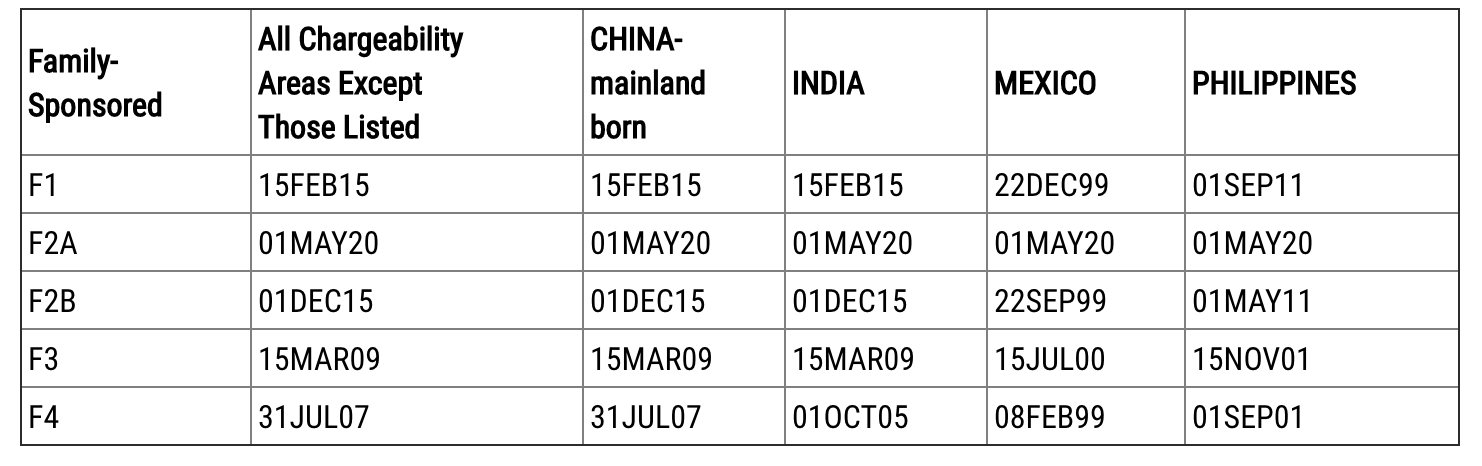
In the F2A category, there is a cutoff date on the Dates for Filing chart.  However, the category is “current” on the Final Action Dates chart.  This means that applicants in the F2A category may file for adjustment applications using the Final Action Dates chart for June 2020.

For all the other family-sponsored preference categories, you must use the Dates for Filing chart in the Department of State Visa Bulletin for June 2020

For Employment-Based Preference Filings:
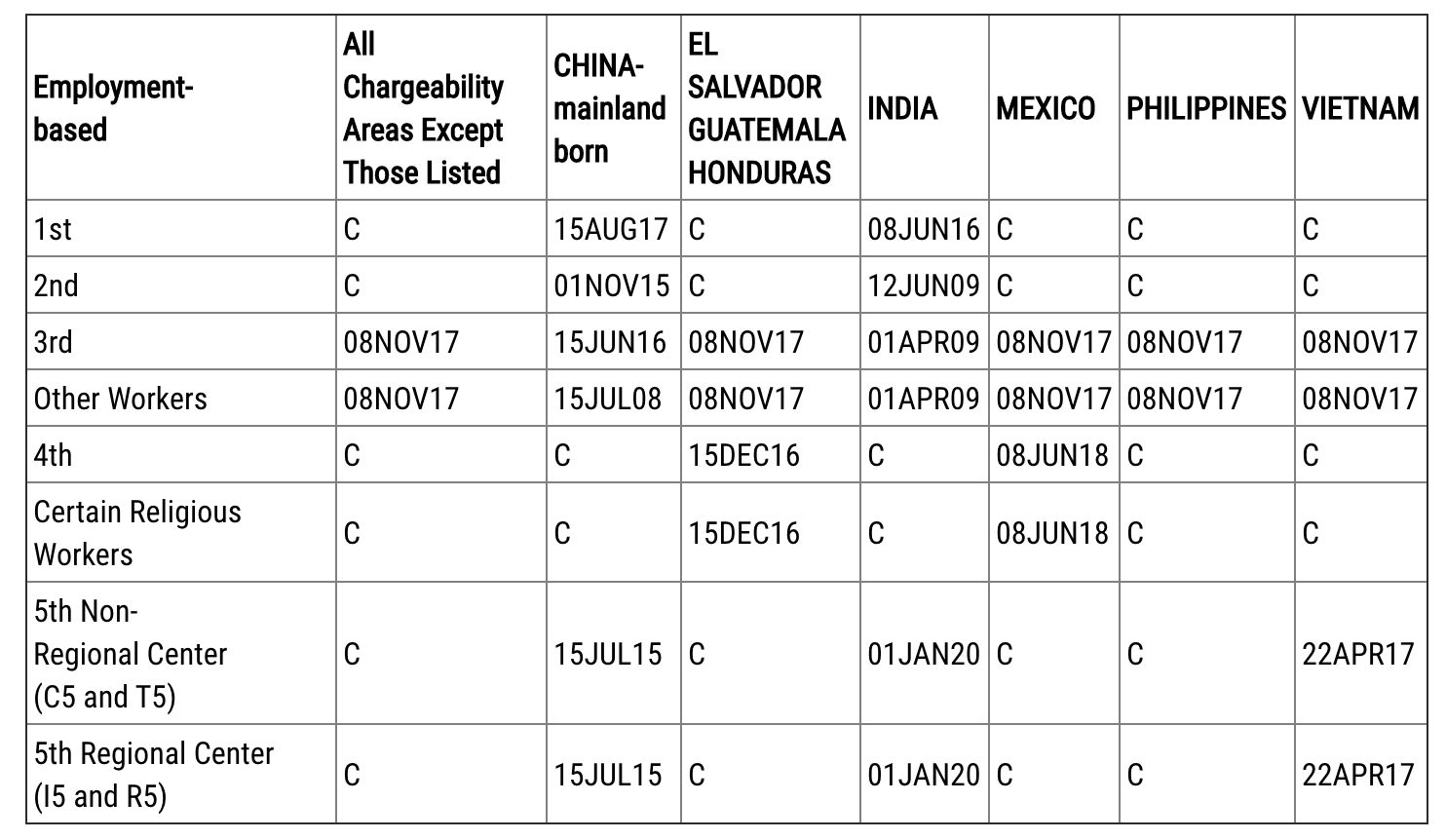
For all employment-based preference categories, you must use the Final Action Dates chart in the Department of State Visa Bulletin for June 2020.


June Visa Bulletin Cutoff Dates


Employment Based Categories

According to the Department of State’s June Visa Bulletin, the following cutoff dates will apply for the issuance of an immigrant visa for employment-based categories:

  • EB-1: All countries remain current during the month of June except for China and India. EB-1 China moved forward by one month to August 15, 2017, while EB-1 India moved forward by more than 10 months to June 8, 2016.
  • EB-2: All countries remain current during the month of June except for China and India. EB-2 China moved forward by one month to November 1, 2015, and India moved forward by 10 days to June 12, 2009.
  • EB-3 Professional and Skilled Workers: All countries remain current except for India and China. Except for India and China all countries moved forward by more than ten months to November 8, 2017. Cutoff dates for China and India advanced by one month, with China moving ahead to June 15, 2016, and India moving ahead to April 1, 2009.
  • EB-5: Most countries remain current. EB-5 China moved forward by two weeks to July 15, 2015; EB-5 India moved forward by three months to January 1, 2020; and Vietnam moved forward by three weeks to April 22, 2017.

Cutoff dates in the Dates for Filing Chart for June have remained mostly the same in comparison to the previous month, the only change is for EB-4 El Salvador, Honduras, and Guatemala which moved forward four and a half months to February 1, 2017.  USCIS will accept adjustment applications based on the Final Action Dates chart for June 2020, the same as last month.

Final Action Dates Charthttps://www.visalawyerblog.com/files/2020/05/Screen-Shot-2020-05-22-at-1.53.46-PM.png
 Family-Sponsored Categories

According to the Department of State’s June Visa Bulletin, the following cutoff dates will apply for the issuance of an immigrant visa for family-sponsored categories:

**Note only applicants in the F2A category may file using the Final Action Dates chart for June 2020 to file adjustment applications. All other family-sponsored preference categories must use the Dates for Filing chart.

Dates for Filing Charthttps://www.visalawyerblog.com/files/2020/05/Screen-Shot-2020-05-22-at-1.47.01-PM.png

Alert Regarding the April 22nd Presidential Proclamation


As you may be aware President Trump’s April 22nd presidential proclamation suspends the issuance of immigrant visas at U.S. Consulates worldwide for certain classes of immigrants until June 22, 2020, assuming the proclamation is not extended beyond this date. As Consulates worldwide begin to reopen, consular officers will enforce the presidential proclamation by refusing immigrant visas to those who were outside of the United States as of 11:59 p.m. EDT on April 23, 2020, have not been issued an immigrant visa or similar U.S. travel document, and are not otherwise exempt from the proclamation. The following types of immigrants have been specifically exempted from the proclamation and are eligible for visa issuance in June:

  • Applicants for EB-5 immigrant visas;
  • Spouses of U.S. citizens;
  • Children under 21 of U.S. citizens and prospective adoptees in the IR-4 or IH-4 visa classifications;
  • Foreign nationals seeking to enter on an immigrant visa as a physician, nurse or other healthcare professional, as well as their spouse and unmarried children under 21;
  • Foreign nationals whose entry would further important U.S. law enforcement objectives;
  • Members of the U.S. armed forces and the spouses and children of such individuals;
  • Foreign nationals seeking to enter as Special Immigrants in the SI or SQ classification, and the spouse and children of such individuals; and
  • Foreign nationals whose entry is in the U.S. national interest.

Continue reading

rainy-day-3332899_1920

The economic fallout of the coronavirus pandemic has been felt by nearly all sectors of the economy, but perhaps the most unexpected victim has been the United States Citizenship and Immigration Services (USCIS).

Unlike many other government agencies, USCIS does not depend on government funding to survive. Instead, the agency primarily relies on fees, charged to applicants and petitioners applying for immigration benefits, to remain in operation.

A spokesman for the agency recently revealed that the agency is strapped for cash. Americans nationwide have had to cut back on spending during this coronavirus pandemic, leaving little money to spare on the very expensive filing fees required for various types of immigration benefits, such as citizenship and green card applications. The agency is in such a precarious position that it has now asked the United States government for a $1.2 billion bailout to remain in operation.

USCIS has said that its revenue could plummet by more than 60 percent by the end of the fiscal year which ends on September 30, 2020. If the agency does not receive additional funding from the government, it will run out of money by the summertime.

In anticipation of its decreased revenue, USCIS is preparing to take drastic measures to stay afloat, such as adding a 10 percent “surcharge” to applications, on top of proposed filing fee increases. These additional fees could be imposed within the coming months.

Of course, an increase in fees is bad news for non-citizens who are already struggling to make ends meet.

Many have blamed President Trump’s restrictive policies on immigration for the decrease in revenue. The President’s most recent proclamations coupled with his restrictive immigration policies have made it more difficult for immigrants and non-immigrants alike to obtain immigration benefits. These policies have been designed to discourage foreign nationals from seeking immigration benefits because of the high rate of visa denials. In addition, the most recent proclamation has kept consular immigration at a standstill.

Continue reading

alexander-schimmeck-H_KabGs8FMw-unsplash-scaled

The government is yet again proposing sweeping changes to current immigration policy, this time targeting Form I-864, Affidavit of Support.

By law, petitioners seeking to immigrate their immediate relative to the United States are required to submit Form I-864 affidavit of support, to ensure to the government that the foreign national will not become a public charge once they have entered the country.

This is true regardless of whether the immigrant is applying for an immigrant visa overseas, or whether the immigrant is adjusting their status to lawful permanent resident in the United States.

The affidavit of support has recently been the subject of intense scrutiny by the Trump administration.

The President has been primarily concerned with alien’s obtaining government benefits that they are not entitled to receive and has sought to enforce a sponsor’s obligations to reimburse the government for any monies paid out to aliens.

Continue reading

jc-gellidon-UIp163xCV6w-unsplash-1-scaled

We are pleased to report the introduction of a brand-new Senate bill called the Healthcare Workforce Resilience Act, sponsored by Senators David Perdue, Todd Young, Dick Durbin, and Chris Coons. The purpose of the bill is to increase the number of health care workers available to meet the demand of the COVID 19 pandemic.

If passed, the Healthcare Workforce Resilience Act, would allow nurses and physicians with approved immigrant visas the ability to adjust their status, so that they can help our nation fight the coronavirus and have a durable immigration status.

As you know, there are currently thousands of nurses and doctors stuck overseas waiting in line for green cards to become available, despite a grave need for their services during this public health crisis. What’s worse is that many of these workers already have approved immigrant petitions but are prevented from serving our communities due to the long visa backlogs.

The bill would authorize the U.S. Citizenship and Immigration Services (USCIS) to “recapture” up to 25,000 immigrant visas for nurses and 15,000 immigrant visas for physicians. USCIS would also recapture immigrant visas for the families of these medical professionals.

These recaptured visas would be drawn from the pool of unused employment-based visas that Congress has previously authorized. These visas would be issued in order of priority date and would not be subject to the country caps. To facilitate timely action, premium processing would be applied to qualifying petitions and applications. Furthermore, the bill would direct the Department of Homeland Security and Department of State to prioritize visa appointments for fully qualified nurses and physicians to enter the United States as fast as possible.

Continue reading

board-1815980_1920


In this post, we bring you a late-breaking update regarding the President’s recent tweet announcing the temporary suspension of immigration into the United States by executive order.

While the President has not yet signed the executive order suspending immigration, in a press briefing held today, reporters had the opportunity to ask President Trump who will be most affected by his suspension.

kelly-sikkema-f_aHTIof44U-unsplash-scaled

Applying for adjustment of status just became a lot more difficult.

After announcing the nationwide implementation of the final rule “Inadmissibility on Public Charge Grounds” on February 24, 2020, USCIS unveiled a brand-new form (Form I-944) that must be filed with all applications for adjustment of status postmarked on or after February 24, 2020.

What is Form I-944?

This new Form I-944, Declaration of Self Sufficiency, will be used by USCIS to determine whether an applicant is likely to become a public charge at any time in the future based on several factors including receipt of public benefits, as well as the applicant’s age, health, family status, assets, resources, financial status, education and skills, prospective immigration status and period of stay, and the petitioner’s Form I-864 Affidavit of Support.

In general, a person is inadmissible based on public charge grounds if he or she is more likely than not at any time in the future to receive one or more public benefits for more than 12 months in the aggregate within any 36-month period.

Who is Exempt from Filing this Form?

Certain special classes of immigrants are not required to file the new Form I-944, Declaration of Self Sufficiency with an adjustment of status application such as: VAWA self-petitioners, special immigrant juveniles, certain Afghani or Iraqi nationals, asylees, refugees, victims of qualifying criminal activity (U Nonimmigrants), victims of human trafficking (T nonimmigrants), applicants applying under the Cuban Adjustment Act, Haitian Refugee Fairness Act, certain Parolees, Nicaraguans and other Central Americans of the Nicaraguan Adjustment and Central American Relief Act (NACARA), and other special classes of immigrants.

Continue reading

announce-3192838_1920
On February 21, 2020, the Supreme Court of the United States by a vote of 5-4 stayed the remaining statewide injunction issued by the U.S. District Court for the Northern District of Illinois, which prevented the government from enforcing the Inadmissibility on Public Charge Grounds rule also known as the “public charge” rule in the State of Illinois. A “stay” is a ruling made by a court to stop or suspend a proceeding or trial temporarily.

What this means

The Supreme Court’s ruling means that the government may now enforce the “public charge” rule in the state of Illinois, while it appeals the District Court’s decision.

board-157016_1280

In this blog post, we discuss visa bulletin trends and projections for the month of March. The U.S. Department of State (DOS) recently released the March 2020 Visa Bulletin revealing some good and bad news for employment based categories and family preference categories.

Adjustment of Status Filing Charts March 2020:

For Family-Sponsored Filings:
In the F2A category, there is a cutoff date on the Dates for Filing chart.  However, the category is “current” on the Final Action Dates chart.  Accordingly, applicants in the F2A category may file using the Final Action Dates chart for March 2020.

For all other family-sponsored preference categories, applicants must use the Dates for Filing chart in the Department of State Visa Bulletin for March 2020.

For Employment-Based Preference Filings:
For all employment-based preference categories, applicants must use the Dates for Filing chart in the Department of State Visa Bulletin for March 2020.

Employment-based Categories: The Highlights

China: This month, employment based categories for China experienced varying degrees of forward movement, with EB-3 experiencing the most advancement.

  • EB-1 China advanced ten days to June 1, 2017
  • EB-2 China advanced one month to August 15, 2015
  • EB-3 China advanced nearly three months to March 22, 2016

Continue reading

highway-1403977_1920

PLEASE NOTE: THE INFORMATION IN THIS POST NO LONGER APPLIES. ON FEBRUARY 21, 2020, THE SUPREME COURT ISSUED A RULING ALLOWING THE GOVERNMENT TO IMPLEMENT THE PUBLIC CHARGE RULE TO RESIDENTS IN THE STATE OF ILLINOIS. USCIS HAS ANNOUNCED THAT THE PUBLIC CHARGE RULE WILL BE IMPLEMENTED NATIONWIDE INCLUDING IN THE STATE OF ILLINOIS TO APPLICATIONS POSTMARKED ON OR AFTER FEBRUARY 24, 2020.

In this blog post we will discuss whether the public charge rule applies to individuals living in Illinois.

The Supreme Court’s decision on January 27, 2020 lifted all lower court injunctions preventing the government’s implementation of the public charge rule, with the exception of an injunction preventing the government from imposing the rule in the state of Illinois.

USCIS has clearly stated that although the agency will implement the public charge rule on February 24, 2020, the agency is prohibited from implementing the rule in the state of Illinois, where it remains enjoined by the U.S. District Court for the Northern District of Illinois.

Accordingly, at this time, the public charge rule does not apply to individuals living in the state of Illinois. In the event the injunction in Illinois is lifted the public charge rule may apply. If this occurs, USCIS will provide additional guidance for individuals residing in the state of  Illinois on its website.

The following frequently asked questions have been prepared to better inform applicants and petitioners living in the state of Illinois regarding the public charge rule.

Q: Does the rule apply to adjustment of status applicants in State of Illinois?

A: No. USCIS has clearly stated on its website that, “applicants for adjustment of status who live in Illinois and who are subject to the public charge ground of inadmissibility are not subject to the final rule.”

Continue reading

flag-1446423_1920

In this blog post we discuss the highlights of the newly updated Policy Manual guidance released by USCIS which addresses the Inadmissibility on Public Charge Grounds Final Rule. The Final Rule and guidance is effective as of February 24, 2020 and applies to all applications and petitions postmarked on or after February 24, 2020 (except for in the State of Illinois where the Final Rule remains enjoined by court order).

These highlights are broken down by volume. Volume 2 addresses public charge grounds of inadmissibility for non-immigrants, Volume 8 discusses the public charge ground of inadmissibility in great detail, and Volume 12 discusses how the public charge rule may apply to citizenship and naturalization applications postmarked on or after February 24, 2020.

Highlights:

Non-Immigrants Seeking Extension of Stay or Change of Status (Volume 2 Chapter 4)

This section of the policy guidance clarifies that although the public charge ground of inadmissibility does not apply to nonimmigrants seeking either an extension of stay (EOS) or change of status (COS) on Forms I-129 or Form I-539, these applicants are generally subject to the “public benefits condition,” unless specifically exempted by law.

What is the public benefits condition?

According to the policy manual, “the public benefits condition requires an applicant seeking EOS or COS on or after February 24, 2020 (postmarked or if applicable, submitted electronically on or after that date) to demonstrate that he or she has not received, since obtaining the nonimmigrant status he or she is seeking to extend or from which he or she seeks to change, one or more public benefits, or more than 12 months in the aggregate within any 36-month period (where, for instance, receipt of two public benefits in 1 month counts as 2 months).

USCIS only considers public benefits received on or after February 24, 2020 for petitions or applications postmarked (or, if applicable, submitted electronically) on or after that date.”

Continue reading