Articles Posted in Deferred Action and DREAM Act Students

61320634_2e4c8e752c_z

Every year USCIS receives and adjudicates approximately 6 million applications from foreign nationals seeking to immigrate to the United States, and U.S. companies seeking to employ foreign workers temporarily.  According to the Department of Homeland Security’s Office of Immigration Statistics, “an estimated 13.1 million lawful permanent residents (LPRs) were living in the United States on January 1, 2013.” Of these permanent residents, more than half–8.8 million–were eligible to apply for naturalization. Additionally, the United States issues approximately 700,000 temporary non-immigrant work visas for a variety of temporary workers including: highly skilled foreign workers employed in specialty occupations in the STEM fields, fashion models, internationally acclaimed athletes and entertainers, aliens of extraordinary ability, religious workers, intra-company transferees, treaty traders/investors, foreign media workers, and agricultural and seasonal workers.

The reason the issuance of temporary worker visas is so low, when compared to the issuance of permanent resident cards, is because most of the temporary foreign worker visa programs are subject to a congressional cap, that limits the amount of non-immigrants that can be admitted per fiscal year. Additionally, certain temporary nonimmigrant worker visa classifications are granted for a specified period of time, although in most cases at least one extension may be granted. The cap applies primarily to the H nonimmigrant worker classifications, and non-minister religious workers. The H visa category accounts for approximately 54% of all visas issued for temporary workers. That is why the H visas are the most talked about visas among politicians when discussing immigration reform. The cap does not apply to treaty traders/investors, aliens of extraordinary ability, intra-company transferees, NAFTA professionals (Canada and Mexico), and foreign media workers. In comparison to developed countries, the United States admits a relatively low number of temporary foreign workers. Foreign workers are typically admitted either to fill labor shortages in the American job market, or because of their exceptional, or highly technical skills, as is the case for the H-1B visa classification.  Only highly skilled foreign nationals, aliens of extraordinary ability, aliens holding advanced degrees, high capital investors, nurses and physical therapists, doctors in undeserved area, and recipients of national interest waivers, have the unique opportunity to obtain permanent residence based on employment.

The mammoth task of meaningful immigration reform will not be easy and it will not happen overnight. The presidential nominees have failed to outline a clear strategy to overhaul our immigration system. None of the presidential candidates have addressed the most contentious areas of immigration policy that must be revised, in order to repair our broken immigration system.


Continue reading

17285892371_bff2d240ff_z
This morning, President Obama announced his nominee to fill the vacant seat of Antonin Scalia on the Supreme Court. Contrary to what was believed, President Obama chose the most experienced and respected nominee among his top contenders, as opposed to the most progressive choice. The final decision came down to Chief Judge of the United States Court of Appeals for the District of Columbia, Merrick B. Garland. The President’s choice reflects political concerns to seat a Justice in time for oral arguments to begin in the case, United States v. Texas, a case that challenges the President’s modified Deferred Action for Childhood Arrivals (DACA) program and Deferred Action for Parents of Americans and Lawful Permanent Residents (DAPA) program. In the coming weeks, Judge Garland will need to face the Republicans in the Senate, who have vowed to block him from sitting on the Supreme Court. In order to be confirmed, he must receive votes from Republicans in the Senate.  It is expected that Republicans will vote in Garland’s favor since he is not inclined to take leading positions on ideological questions such as DACA/DAPA. If appointed, Garland is unlikely to take a progressive approach on the bench. Throughout his career, Garland has taken a centrist or neutral view of the law. The Supreme Court is expected to hear oral arguments for United States v. Texas in April. For more on DACA/DAPA please click here.

Profile: 

In this photo taken May 1, 2008, Judge Merrick B. Garland is seen at the federal courthouse in Washington, Thursday, May 1, 2008. Garland has been in this position before. The last time a seat opened up on the U.S. Supreme Court, in 2010, he was widely considered a top candidate for the job and interviewed with President Barack Obama. But the slot ultimately went to Justice Elena Kagan. (AP Photo/Charles Dharapak)
Chief Judge Garland was appointed to the United States Court of Appeals in April 1997 and became Chief Judge on February 12, 2013. He graduated summa cum laude from Harvard College in 1974 and magna cum laude from Harvard Law School in 1977. Following graduation, he served as law clerk to Judge Henry J. Friendly of the U.S. Court of Appeals for the Second Circuit and to U.S. Supreme Court Justice William J. Brennan, Jr. From 1979 to 1981, he was Special Assistant to the Attorney General of the United States. He then joined the law firm of Arnold & Porter, where he was a partner from 1985 to 1989 and from 1992 to 1993. He served as an Assistant U.S. Attorney for the District of Columbia from 1989 to 1992, and as Deputy Assistant Attorney General in the Criminal Division of the U.S. Department of Justice from 1993 to 1994. From 1994 until his appointment as U.S. Circuit Judge, he served as Principal Associate Deputy Attorney General, where his responsibilities included supervising the Oklahoma City bombing and UNABOM prosecutions.

The Obama administration may announce its choice for the Supreme Court nomination as early as this week. We have learned that there are three contenders being considered for the Supreme Court nomination. All three candidates serve as judges for the United States Court of Appeals for the District of Columbia, and are well respected by both parties. They include Sri Srinivasan, Merrick Garland, and Paul Watford, who is rumored to be at the top of the President’s list. The Supreme Court nominee will be required to face a Republican Senate, in order to be formally appointed to the Supreme Court. Senate Republicans have already warned the White House that they will not hold hearings for any Supreme Court nominee suggested by President Barack Obama. As soon as Republicans heard of the passing of Justice Antonin Scalia, they urged caution from the White House. Senate Republicans anticipate that the next President of the United States will be the party’s Presidential nominee. It is for this reason that they claim that the Supreme Court nomination should be made by the next President of the United States, and not by Barack Obama. In a televised announcement, following the death of Antonin Scalia, President Obama made it very clear that his intentions were to choose the Supreme Court nomination, despite warnings from Republicans. Senate Republicans responded by stating that they would block any of the President’s advancements.

President Obama will need to choose a Justice that will have a tendency to vote liberally in order for his expanded Deferred Action for Childhood Arrivals (DACA) program and new Deferred Action for Parents of Americans and Lawful Permanent Residents (DAPA) program to survive. The expanded DACA and new DAPA program were introduced in November 2014 as part of President Obama’s executive actions on immigration. These programs have been temporarily suspended following a federal court order filed by Texas and other states. The Supreme Court is expected to hear oral arguments in the case, United States v. Texas, this April with a final ruling made by summer time.

Continue reading

6000446155_1d67582412_z

The fate of the President’s executive actions on immigration now rests in the hands of eight justices on the Supreme Court, absent Justice Antonin Scalia. The Supreme Court will begin to hear oral arguments for the case, United States v. Texas on April 18th of this year, with a final ruling expected by summertime. Nearly a year and a half ago, President Obama announced a series of executive actions on immigration including the expanded Deferred Action of Childhood Arrivals (DACA) program, the new Deferred Action for Parents of Americans and Lawful Permanent Residents (DAPA) program, and other measures to enhance border security, prioritize deportations, and modernize the immigration system. USCIS was expected to begin accepting applications for the expanded DACA and DAPA program on February 18th. The excitement surrounding the expanded DACA and DAPA program however was very short lived. A federal court order filed by Texas and other states on February 16th temporarily suspended these programs from going into effect.

Since then, the federal government and the State of Texas have been battling one another in court. The Fifth Circuit court determined that Texas and at least 25 other states had sufficient ‘standing’ to challenge both programs from being implemented. The state of Texas along with other states, argue that these programs are not only outside the purview of the President’s constitutional power, but that the States would be substantially burdened, should the programs go into effect. Texas states that as a result of these programs, the State would suffer increased health-care, law enforcement, and educational costs which would come out of the State budget and more importantly the pockets of Texas residents, who do not take kindly to these programs. Additionally, Texas claims that it would suffer additional financial burden in having to issue more drivers’ licenses to individuals qualifying for expanded DACA and DAPA, a state-subsidized benefit. If the Supreme Court decides in favor of the federal government, nearly 5 million immigrants residing in the United States unlawfully will be shielded from deportation, and States will be forced to bear the costs to accommodate their new ‘deferred’ status. Deferred status will grant individuals the right to legally obtain employment, obtain a social security number, a driver’s license, and an education, but it is not a path to citizenship. As it stands, it is unlikely that a new Supreme Court Justice will be appointed before oral arguments begin in this case, especially with mounting political pressure from Republicans seeking to block the President from making a nomination.

Continue reading

4668514068_02942d6921_z

“He was a jurist of captivating brilliance and wit, with a rare talent to make even the most sober judge laugh. The press referred to his “energetic fervor,” “astringent intellect,” “peppery prose,” “acumen,” and “affability,” all apt descriptions. He was eminently quotable, his pungent opinions so clearly stated that his words never slipped from the reader’s grasp” -Ruth Bader Ginsburg

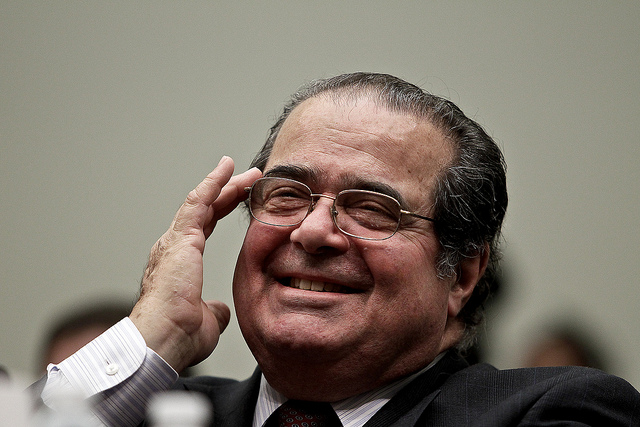
When news broke of the passing of the longest serving Justice on the Supreme Court, Antonin Scalia, a cloud of uncertainty lifted above the heads of Republican frontrunners vying for the Republican nomination for President of the United States. Indeed, the topic of conversation during the February 13th Republican Presidential Debate, which occurred on the day of Justice Scalia’s passing, focused on whether or not the current President should nominate the next Supreme Court Justice. Justice Antonin Scalia, nominated to the Supreme Court by President Ronald Reagan in 1986, was the most outspoken conservative on the bench, and not very well liked by liberal politicians and intellectuals, primarily due to the philosophy behind his jurisprudence. Scalia’s jurisprudence during his 29 years on the bench belonged to the Originalist school of thought. An Originalist’s interpretation of the Constitution denies the contention that the Constitution should be interpreted by the Court as a living, breathing document, a view that is typically shared by liberal Constructivist Justices like Ruth Bader Ginsburg. Instead, Originalists believe that the Constitution should be interpreted according to the original intent or meaning shared by the founders as it was written. This would require an Originalist to adhere to the spirit of the law as it was intended by the founders of our country, as well as an understanding of what was meant when the Constitution was originally drafted.

During his time on the bench, Scalia tenaciously criticized the liberal Constructivist view, calling this interpretation of the Constitution, judicial activism, which he viewed as inappropriate. In his view the Supreme Court must be insulated and not be swayed by the social concerns of the public. Throughout his trajectory, Scalia has gone down in history for handing down the most controversial dissents in the history of the Supreme Court, avidly supporting the right to bear arms, challenging the right to abortion, affirmative action, gay rights, and was ultimately instrumental in securing the Presidential nomination of George W. Bush in the 2000 case Bush V. Gore. Up until his untimely death, the Supreme Court held a conservative majority. The conservatives on the bench include Chief Justice, John G. Roberts Jr. nominated by President George W. Bush in 2005, Justice Clarence Thomas nominated by President George W. Bush in 1991, Justice Samuel Anthony Alito Jr nominated by President George W. Bush in 2006, Justice Anthony Kennedy, a moderate conservative swing vote nominated by President Ronald Reagan in 1988, and up until recently Antonin Scalia nominated by Ronald Reagan in 1986. Together, these conservative Justices established a 5-4 majority against liberal Justices: Ruth Bader Ginsburg, Stephen G. Breyer, and recently appointed Justices Elena Kagan and Sonia Sotomayor. Justice Antonin Scalia’s sudden death has now upset the conservative majority, creating a balance of power between conservative and liberal minds on the bench. With the death of Scalia, the bench is now evenly split ideologically 4-4 with a vacant seat ready to be filled by a liberal Justice, thereby creating a Liberal majority. This of course will not be easy, since the Senate is dominated by the Republican party, and the Senate will be in charge of vetting the President’s nominee.

Continue reading

3198083648_b5276e02c4_z

This morning, the Supreme Court announced that it would hear arguments for and against the extended Deferred Action for Childhood Arrivals (DACA) program and the new Deferred Action for Parents of U.S. Citizens and Lawful Permanent Residents (DAPA) program. If the government succeeds in its appeal, millions of undocumented immigrants will be granted temporary employment authorization, ‘deferred status’ meaning that these individuals will no longer need to fear deportation, and other benefits such as the ability to apply for a social security number. This decision is a victory for the Obama administration since it leaves open the possibility that the Supreme Court will lay down an important legal precedent in the midst of the presidential campaign and Obama’s exit from the White House.

  • To learn how expanded DACA is different than the initial DACA program click here.
  • To learn about the DAPA program click here.

3198083750_597c4a4e90_z
The Supreme Court justices are currently in deliberations, to decide the fate of Barack Obama’s expanded Deferred Action for Childhood Arrivals (DACA) and Deferred Action for Parents of U.S. Citizens and Lawful Permanent Residents (DAPA) announced November 2014, as part of the President’s executive actions on immigration. At issue is whether or not the Court will hear arguments for and against lifting the temporary court injunction, which prevented the expanded DACA program and the new DAPA program from moving forward as initially anticipated.

The extended DACA and DAPA provisions were scheduled to go into effect on February 18, 2015, but were quickly blocked by a temporary injunction filed by Texas and 26 other states, just three days before applications for extended DACA and DAPA would have been accepted by USCIS. What has resulted has been a near two-year legal battle between the federal government and the states in question.

Timeline of legal action between the federal government and plaintiffs:

katie

It is our pleasure to introduce our readers to our esteemed Paralegal and Case Manager Katie Foley who has worked at the Law Offices of Jacob J. Sapochnick since 2010. Ms. Foley, originally from Santa Cruz, California holds a Bachelor’s Degree in Liberal Studies from Cal State East Bay and her paralegal certificate from San Diego Miramar College. Throughout her career, Katie Foley has assisted our attorneys with various different types of immigration petitions including family-based petitions, employment based petitions (H-1B, E-2 etc.), deferred action, marriage visas, I-751 petitions, fiancé visas, consular processing, naturalization, temporary visas (B-1/B-2, J-1, F-1 etc), deportation and removal cases.  She has successfully processed hundreds of applications and in the process has formed long standing relationships with our clients. In her role as case manager, she assists our legal assistants with their case loads and provides direction as needed. Ms. Foley is an outstanding member of our firm for her impressive attention to detail, her understanding of the law, and the extensive guidance she provides our clients to ensure every case has a successful outcome. She provides all of our client’s strong personal support and comprehensive step-by-step instructions for each immigration process. If you are an international or out of state client, not to worry, Ms. Foley has perfected an easy online case processing system to assist clients with their immigration concerns no matter where they reside. In her free time, she enjoys lap swimming, barbecues, and gardening. To read more about Ms. Foley please click here.

For immigration questions please call our office. Your Immigration is our Passion.

3021087753_980feb0669_z

Yesterday night, in a 2-1 vote the United States Fifth Circuit Court of Appeals voted to uphold the lower court’s decision in Texas v. United States blocking President Obama’s extended Deferred Action for Childhood Arrivals (DACA) and Deferred Action for Parents of Americans and Lawful Permanent Residents (DAPA) programs from going into effect.

The expanded DACA and new DAPA provisions were announced November of last year as part of Obama’s executive actions on immigration giving eligible undocumented individuals a legal status in the United States. The expanded DACA program would have made millions of law abiding undocumented aliens (with no criminal history) eligible for employment authorization and social security benefits. To qualify, expanded DACA applicants would need to provide documented evidence proving their continuous physical presence in the United States from January 1, 2010 onward. In exchange, the United States government would recognize these individuals as law abiding residents and safeguard them against deportation. The move was significant since it would mean that undocumented individuals would no longer need to live on the fringes of society. By granting these individuals an immigration classification, insurance companies would become accessible to them for the first time ever.

Similarly, Obama’s DAPA program would have extended eligibility of deferred action to parents of US Citizens and Lawful Permanent Residents born or or before November 20, 2014 the date of the DAPA program’s announcement. As part of the application process, DAPA applicants would be required to undergo extensive background checks and prove continuous residence since January 1, 2010 among other provisions. Click here for more information on DAPA.

Continue reading

lupe

It is our pleasure to introduce our incredibly skilled operations manager and immigration consultant, Lupe Lopez. If you have called or stopped by our San Diego office for a consultation, chances are you have already met with her to discuss your needs. Throughout her immigration career, Ms. Lopez has assisted thousands of clients with their immigration concerns. There is no situation or immigration story she hasn’t heard and no shortage of extraordinarily challenging cases she has assisted with. Her compassion and empathy working with clients who have faced family separation and other adversities is unmatched.

Ms. Lopez holds over 12 years of experience in the field of immigration legal services. Her expertise includes filing waivers of inadmissibility, I-360 VAWA petitions, removal proceedings, nonimmigrant waivers, business, investment, and family immigration petitions. Ms. Lopez possesses a B.S. in Human Resource Management and a Certificate in Labor Relations. She is currently in the process of becoming Dale Carnegie certified. Aside from serving as an immigration consultant, Ms. Lopez is also our Operations Manager, ensuring that we deliver the highest level of customer service with proven results. She helps train, organize, and improve our operations systems which allow us to gain the customer trust, loyalty, and satisfaction. In her capacity as operations manager, she addresses both internal concerns and client concerns keeping our standards for excellence above our competitors.

Continue reading