Articles Posted in First Time Clients

9595278129_80e622a87a_z

Tis the season to file for one of the most popular visa types: The H-1B visa. Filings for cap-subject petitions will begin to be accepted by USCIS beginning April 2nd and the filing period will end on April 6, 2018. As many of you know, the odds of being selected in the H-1B visa lottery are slim, but even those who are selected in the visa lottery have to overcome yet another hurdle, the Request for Evidence. Since President Trump issued the executive order “Buy American, Hire American,” the United States Citizenship and Immigration Services (USCIS) began scrutinizing the adjudication of H-1B visa applications more closely.

Our attorneys witnessed this phenomenon first hand. The volume of requests for evidence increased significantly and USCIS began to be more demanding in the types of documentation requested to qualify for the program.

For this reason, we advise our clients and readers to be very careful this H-1B season and be mindful of the challenges they may face as they proceed with the H-1B visa process.

Common Types of RFE’s and how to avoid them:

  • Level One Wage: Executive Order “Buy American, Hire American” directs the Department of State to ensure that H-1B visas are awarded to the most-skilled or highest-paid petition beneficiaries. USCIS has increasingly issued RFEs in which the employer is paying the H-1B worker a level 1 wage. This has prompted USCIS to question why someone with a specialty occupation would be paid the level 1 wage, a wage that is typically reserved for entry-level positions and individuals who only have a basic understanding of the occupation. Thus, it would not be appropriate for someone who has an intermediate to advanced understanding of the occupation to be paid a level 1 wage. Situations in which a level 1 wage is inappropriate also include cases where the worker will take on a complex set of job duties.

Continue reading

40115765202_7e780f7ef7_z

During December of last year, the United States Citizenship and Immigration Services (USCIS), announced that the agency was beginning to take preliminary steps to terminate H-4 Employment Authorization for certain H-4 spouses, a privilege that has been available to eligible spouses of H-1B nonimmigrant workers since 2015. As it stands, the 2015 H-4 EAD rule allows certain H-4 dependent spouses of H-1B nonimmigrant workers the ability to obtain an employment authorization card (work permit), provided the H-1B nonimmigrant worker is in the process of obtaining an employment based green card.

Proposal to Amend the 2015 H-4 EAD Rule

On December 14, 2017, a rulemaking notice was first published in the Federal Register notifying the public that the Department of Homeland Security, in conjunction with USCIS, would be reviewing and possibly amending the 2015 H-4 EAD rule, following the issuance of Executive Order 13788, “Buy American, Hire American.”

According to the notice published in the Federal Register, DHS reserves the authority to amend the 2015 H-4 EAD rule under section 102 of the Homeland Security Act of 2002 and section 103(a) of the Immigration and Nationality Act (INA). These sections of the law give the Secretary of the Department of Homeland Security the discretionary power to amend the law so that it aligns with the policies set out in the President’s executive order.

Continue reading

7022830203_d8c85dc863_z

During the last few days, the Supreme Court has been very busy taking up the issue of immigration. On Tuesday in a 5-3 decision, the Supreme Court handed down a controversial ruling strengthening the power of the Trump administration to detain undocumented immigrants facing deportation proceedings for extended periods of time. The Court rejected the opinion of federal judges in California who had previously ruled that detained immigrants facing removal proceedings have a right to a bail hearing after six months in jail.

Today, the Court emphatically disagreed, ruling in the case Jennings v. Rodriguez, that those who face deportation will remain detained while their cases are being considered by an immigration judge. Justice Samuel Alito speaking for the Court said that federal immigration law does not require bail hearings, and that the Ninth Circuit Court has no authority to allow for such hearings.

The Court handed down this ruling after immigrants’ rights activists brought a class action suit representing thousands of non-citizens who had been arrested and held for deportation. Many of these individuals sought asylum in the United States based on a credible fear of persecution. Although the majority of these individuals eventually went on to win their cases in immigration court, they were detained for a year or longer while their cases remained pending. The Ninth Circuit Court of Appeal had previously ruled that such individuals should have a right to a bail hearing after 6 months, and a right to be released from detention provided they could prove to the Court that they are not a danger to the community or a flight risk.

Continue reading

37000244342_3e3936f3c1_z

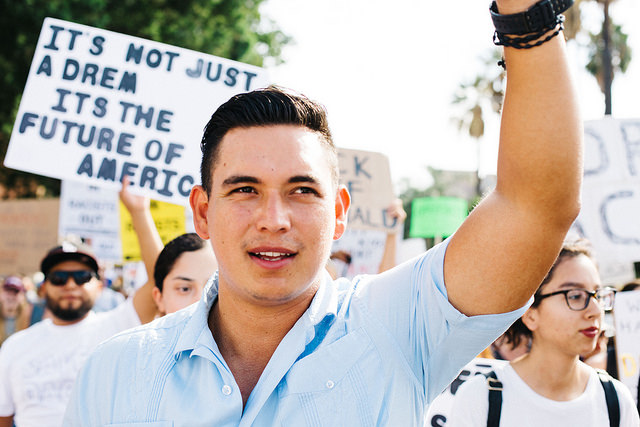
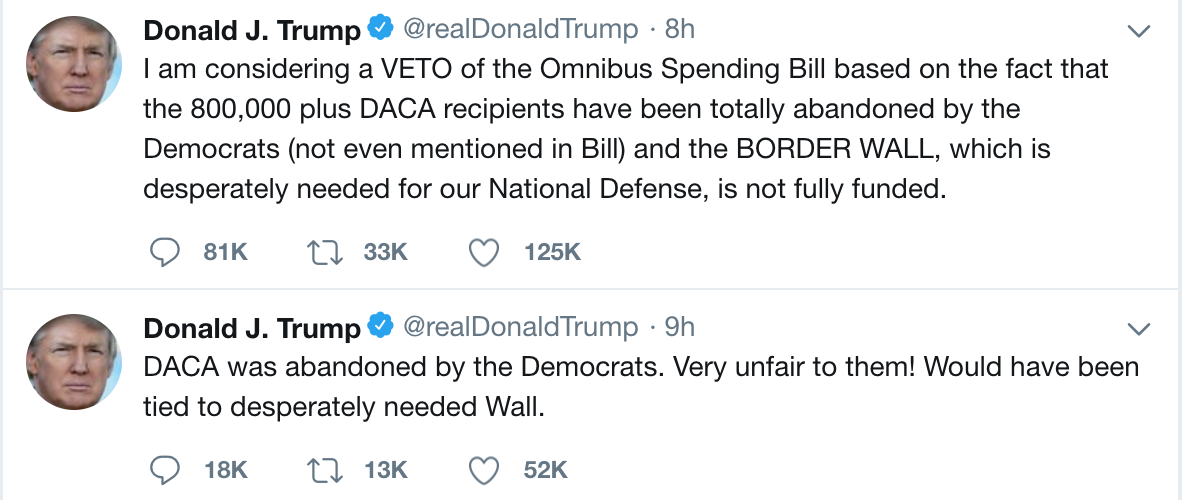
Last week, the United States Senate began much-anticipated debates to reach a deal on immigration before the March 5th deadline imposed by the President. Debates in the Senate last week however were unavailing with both parties blaming one another for their inability to come up with a solution that would protect thousands of DACA recipients from deportation. To make matters worse the President issued a firestorm of tweets attacking leaders of the Democratic party and criticizing sanctuary cities that protect undocumented immigrants from deportation. Should Congress fail to enact legislation to shield Dreamers from deportation by March 5th, thousands of young undocumented immigrants brought to the United States as children will begin to lose their protection from deportation and the ability to work legally in the United States.

In the weeks ahead, Congress must also focus their efforts to pass a spending bill to permanently fund the government. Currently, the government is running on a short-term spending bill which expires midnight on March 23rd. Failure to pass a spending bill that permanently funds the government would mean yet another government shutdown. This urgent need to pass a spending bill may present an opportunity for Congress to finally reach a solution on top immigration priorities and seal the future of DACA recipients. Top immigration priorities for Republicans include building a wall between the United States and Mexico, beefing up the presence of border patrol agents and law enforcement, ending “Chain-Migration,” the diversity visa lottery program, while Democrats remain focused on creating a path to citizenship for Dreamers, and strongly oppose ending “Chain-Migration.” However, it would not be surprising if Congress fails to safeguard the status of DACA recipients given that members of Congress have on previous occasions failed to come up with a bipartisan solution.

Since October, approximately 122 young undocumented immigrants have had their DACA-permits expire on a daily basis, which is expected to add up to 22,000 immigrants by March 5th. Approximately 668,000 immigrants have been issued work permits under DACA that will not expire until March 5th or later.

Continue reading

31192602946_34cf286a7f_z
In an effort to modernize and streamline the application process, the United States Citizenship and Immigration Services (USCIS) has finally announced that it will begin to accept payment via credit card for all 41 fee-based forms. Previously, applicants were required to make filing fee payments by personal check or money order for most fee-based forms. Now applicants will be able to use their credit cards to pay their filing fees using Form G-1450 Authorization for Credit Card Transaction.Accepted credit cards include Visa, MasterCard, American Express and Discover cards.  Applicants for naturalization and those renewing or replacing their Green Cards can pay via credit card using the e-file system.

Applicants filing any of the following forms with a USCIS Lockbox facility may now utilize the credit card payment option. Please remember to include Form G-1450 along with your application when filing by mail:

*Most frequently used forms appear in bold.

4518935071_1e1f2cfbbf_z

Various news media outlets are reporting that the Supreme Court will hold a closed-door meeting today Friday, February 16, 2018 to decide whether the Supreme Court will hear a challenge to a lower court opinion which temporarily blocked the President’s move to end the Obama era program, Deferred Action for Childhood Arrivals, making it possible for DACA recipients to apply for a renewal of their DACA benefits.

The closed-door meeting was prompted after the Justice Department formally asked the Supreme Court to review a federal judge’s January ruling, blocking the administration’s effort to end the Deferred Action for Childhood Arrivals program. The Justice Department in making such a request is seeking to bypass lower court proceedings, asking the Supreme Court for direct review, instead of appealing the lower court’s decision before a federal appellate court.

According to a law professor from the University of Texas School of Law, the court has not granted certiorari before judgment since the year 2004, and has not done so without a circuit-level ruling since 1988.

Continue reading

37171994385_4e0c9726f5_z

IMPORTANT UPDATE: On February 14, 2018 USCIS announced that due to federal court orders issued on January 9, 2018 and February 13, 2018, USCIS will resume accepting requests to renew a grant of deferred action under the DACA program. Please read our post below to determine whether you qualify for a renewal request. 

https://www.visalawyerblog.com/2018/01/17/file-daca-renewal-request-immediately/

26978486569_a495b9d7fd_z

On Sunday night, a group of Republican Senators met to draft the Republican party’s version of the President’s immigration framework, in preparation for a floor debate that will take place Monday night on immigration. The Republican bill is one of many proposals that will be considered by the Senate as part of the ongoing immigration debate. The proposed bill, known as the Secure and Succeed Act of 2018, drafted by Republican Senators Chuck Grassley, John Cornyn, James Lankford, Thom Tillis, David Perdue, Tom Cotton, and Joni Ernst, mirrors the Trump administration’s immigration framework.

Over the next few weeks Senators will vigorously debate and amend proposals on immigration with the goal of coming up with a piece of legislation that can garner at least 60 votes in the Senate to advance to the House of Representatives. The process will involve a free-for-all debate on the Senate floor that will allow Senators to propose amendments, with the goal of coming up with a bipartisan solution to shield Dreamers from deportation.

The GOP currently has a 51-49 majority in the Senate, making it necessary for Republicans to obtain support from Democratic Senators to reach the 60-vote threshold. Republicans have a large enough majority in the House of Representatives that they do not need a single Democratic vote to pass desired legislation.

Path to Citizenship for Dreamers

The Republican proposal focuses on providing a 12-year path to citizenship for up to 1.8 million people including DACA eligible recipients. Undocumented immigrants currently enrolled in DACA would receive a 2-year credit allowing them to obtain citizenship within 10 years. The criteria to obtain citizenship would require an individual to have:

Continue reading

36357540723_91152ede6d_z

In this post, we will discuss the limited circumstances in which applicants may request a fee exemption for Form I-765 filed in connection with a renewal request for consideration of Deferred Action for Childhood Arrivals (DACA).

In most cases the filing fee to request a renewal of Deferred Action for Childhood Arrivals cannot be waived, but fee exemptions are available in the following limited circumstances:

  • Applicants under 18 years of age who are homeless, in foster care, or otherwise lack parental or other familial support, with income that is less than 150% of the U.S. poverty level may seek a fee exemption
  • Applicants who cannot care for themselves because of a serious chronic disability with an income that is less than 150% of the U.S. poverty level may claim a fee exemption
  • Applicants, who at the time of their request, have accumulated $10,000 or more in debt in the past 12 months, as the result of unreimbursed medical expenses for themselves or family members, receiving an income that is less than 150% of the U.S. poverty level may claim an exemption of the filing fee

To determine whether your income is less than 150% of the U.S. poverty level please reference the chart below:

https://www.visalawyerblog.com/files/2018/02/Screen-Shot-2018-02-09-at-2.01.40-PM.png

In order to be considered for a fee exemption, applicants must submit a letter and supporting documentation demonstrating that they fall into one of the above-mentioned categories. Applicants must first file a request for a fee exemption and receive an approved fee exemption, before filing a request for consideration of deferred action on Form I-821D.  Applicants may not submit Forms I-821D, I-765, and I-765WS without a record that a fee exemption has been approved.

Continue reading

6104368494_6fd7405753_z

Now is the time to begin preparing for the upcoming H-1B visa lottery. USCIS will begin to accept H-1B cap-subject petitions for fiscal year 2019 beginning Monday, April 2, 2018. Please note: employers cannot file an H-1B petition for an employee more than 6 months before the employee’s intended start date. If accepted, H-1B visa workers can begin employment by October 1st. The H-1B visa is issued for up to three years but may be extended for another three years.

By law, a congressionally mandated cap exists which limits the issuance of H-1B visas to 65,000 per year. That is why the H-1B visa is commonly referred to as a ‘lottery’ visa.

Individuals (such as F-1 students) who hold advanced degrees (U.S. master’s or higher) are exempted from the 65,000 visa cap. Such applicant’s must demonstrate that they have obtained an American master’s degree or higher to be exempted from the cap, however only the first 20,000 petitions received by USCIS will benefit from this cap exemption. Initial H-1B petitions that are received by USCIS after that limit will count towards the regular 65,000 cap.

In order to qualify for an H-1B visa:

  • a foreign worker must possess both a theoretical or practical application of a body of highly specialized knowledge;
  • an employer-employee relationship must exist. Only a U.S. employer can petition the entry of a foreign employee by filing USCIS Form I-129 Petition for Non-immigrant Worker. An employer-employee relationship exists if the U.S. employer has the right to hire, pay, fire, supervise or control the work of the employee;
  • the foreign worker must possess a bachelor’s degree, its foreign equivalent, or relevant work experience. If the foreign worker does not have formal education, but has at least 12 years of relevant work experience related to the specialty occupation, they may still qualify for an H-1B visa;
  • the foreign worker must be employed in a specialty occupation related to their field of study. A specialty occupation is an occupation that requires a bachelor’s degree or its equivalent;
  • the foreign worker must be paid at least the prevailing wage for the specialty occupation in the area of intended employment;

Continue reading