Articles Posted in Green card

nafinia-putra-Kwdp-0pok-I-unsplash-scaled

In this post we would like to address some of our clients frequently asked questions regarding the Payment Protection Program, a loan forgiveness program created by the CARES Act (Coronavirus Aid, Relief, and Economic Security Act).

In response to the Coronavirus pandemic, the United States government recently passed a bill providing emergency financial relief to individuals, families, and small businesses. As you know, the majority of states nationwide have issued stay-at-home orders requiring the public to avoid all nonessential outings and stay at home as much as possible. Non-essential businesses have also been ordered to close their facilities to the public until further notice. Essential businesses have been allowed to continue to operate such as grocery stores, pharmacies, health care facilities, banking, law enforcement, and other emergency services.

One of the main provisions of the bill, known as the CARES Act (Coronavirus Aid, Relief, and Economic Security Act), allocates billions of dollars in loans to small businesses who are feeling the economic impact of the stay-at-home orders. The CARES Act specifically authorized the Small Business Administration (SBA) to create the Payment Protection Program for the purpose of providing financial assistance to small businesses nationwide that have been adversely impacted by the COVID-19 crisis. SBA lenders began accepting loan applications from small business owners on April 3, 2020. Applications will continue to be accepted until June 30, 2020. It is important for business owners to apply for these loans as soon as possible.

  1. What is the Payment Protection Program?

In a nutshell, the Payment Protection Program is a loan forgiveness program that allows small businesses (of 500 or fewer employees) to apply for loans of (1) $10 million or (2) 2.5x the average total monthly payments of the company’s payroll costs, whichever is less.

Loans under this Paycheck Protection Program (PPP) will be 100 percent guaranteed by SBA, and the full principal amount of the loans will qualify for loan forgiveness provided that:

(1) the business was in operation on February 15, 2020 and either had (a) employees for whom you paid salaries and payroll taxes or (b) paid independent contractors as reported on Form 1099;

(2) all employees are kept on the payroll for 8 weeks and;

(3) the money is used for payroll costs, rent, mortgage interest, or utilities (at least 75% of the forgiven amount must have been used for payroll).

Continue reading

free-to-use-sounds-1xT5Yz2Am0M-unsplash-scaled

It has been nearly two weeks since the President of the United States declared a public health emergency for COVID-19, forcing the American economy to come to a screeching halt. Thereafter, states enacted their own measures requiring non-essential businesses across the country to shutter temporarily until the virus has been contained. Although these measures have been undoubtedly necessary to prevent the rapid spread of the virus, the majority of Americans nationwide have lost their livelihoods overnight.

This past week lawmakers have been busy drawing up legislation that would provide emergency financial assistance for individuals, families, and businesses in the United States.

This afternoon Congress approved the Coronavirus Aid, Relief and Economic Security Act (CARES), and the bill now heads to the President’s desk for signature.

Although this legislation is sweeping in scope, this post will specifically discuss financial relief for individuals and families, and more importantly which individuals will qualify to receive financial assistance.

What does the CARES Act do for individuals and their families?

Under the Act, most single individuals earning less than $75,000 can expect to receive a one-time payment of $1,200. Married couples filing jointly (earning less than $150,000), would each receive a check ($2,400) and families would receive $500 per child. For example, a family of four earning less than $150,000 can expect to receive $3,400.

Rebates would begin to phase out at $75,000 for singles, $112,500 for heads of household, and $150,000 for joint taxpayers at 5 percent per dollar of qualified income, or $50 per $1,000 earned. Rebates phase out completely at $99,000 for single taxpayers with no children and $198,000 for joint taxpayers with no children.

Continue reading

test-4481925_1920-1

In this post, we will discuss Form DS-5540, a mandatory public charge questionnaire that must be completed by all foreign nationals seeking an immigrant visa at a U.S. Consulate or Embassy abroad and some non-immigrant visa applicants.

What is Form DS-5540, Public Charge Questionnaire?

Shortly after the publication of the public charge rule in the Federal Register, the government published a separate rule requiring applicants seeking immigrant visas, including diversity visas, at a Consulate abroad, to complete Form DS-5540, except for certain types of immigrants exempt from the public charge ground of inadmissibility such as self-petitioners under the Violence Against Women Act (VAWA) and Afghan and Iraqi interpreters applying for special immigrant visas.

In addition, the government has given consular officers broad discretion to require nonimmigrant visa applicants to complete DS-5540, if for example the officer determines more information is needed regarding the applicant’s ability to financially support themselves following entry into the United States, without depending on the government’s assistance, or if the consular officer is not satisfied with the information provided by the applicant.

Therefore, consular officers have the power to request nonimmigrant visa applicants to complete DS-5540.

The DS-5540 solicits information that helps consular officers determine whether applicants are subject to the public charge visa ineligibility ground (section 212(a)(4) of the Immigration and Nationality Act) and will not rely on certain specific public resources upon entering the United States.

Continue reading

kelly-sikkema-f_aHTIof44U-unsplash-scaled

Applying for adjustment of status just became a lot more difficult.

After announcing the nationwide implementation of the final rule “Inadmissibility on Public Charge Grounds” on February 24, 2020, USCIS unveiled a brand-new form (Form I-944) that must be filed with all applications for adjustment of status postmarked on or after February 24, 2020.

What is Form I-944?

This new Form I-944, Declaration of Self Sufficiency, will be used by USCIS to determine whether an applicant is likely to become a public charge at any time in the future based on several factors including receipt of public benefits, as well as the applicant’s age, health, family status, assets, resources, financial status, education and skills, prospective immigration status and period of stay, and the petitioner’s Form I-864 Affidavit of Support.

In general, a person is inadmissible based on public charge grounds if he or she is more likely than not at any time in the future to receive one or more public benefits for more than 12 months in the aggregate within any 36-month period.

Who is Exempt from Filing this Form?

Certain special classes of immigrants are not required to file the new Form I-944, Declaration of Self Sufficiency with an adjustment of status application such as: VAWA self-petitioners, special immigrant juveniles, certain Afghani or Iraqi nationals, asylees, refugees, victims of qualifying criminal activity (U Nonimmigrants), victims of human trafficking (T nonimmigrants), applicants applying under the Cuban Adjustment Act, Haitian Refugee Fairness Act, certain Parolees, Nicaraguans and other Central Americans of the Nicaraguan Adjustment and Central American Relief Act (NACARA), and other special classes of immigrants.

Continue reading

announce-3192838_1920
On February 21, 2020, the Supreme Court of the United States by a vote of 5-4 stayed the remaining statewide injunction issued by the U.S. District Court for the Northern District of Illinois, which prevented the government from enforcing the Inadmissibility on Public Charge Grounds rule also known as the “public charge” rule in the State of Illinois. A “stay” is a ruling made by a court to stop or suspend a proceeding or trial temporarily.

What this means

The Supreme Court’s ruling means that the government may now enforce the “public charge” rule in the state of Illinois, while it appeals the District Court’s decision.

board-157016_1280

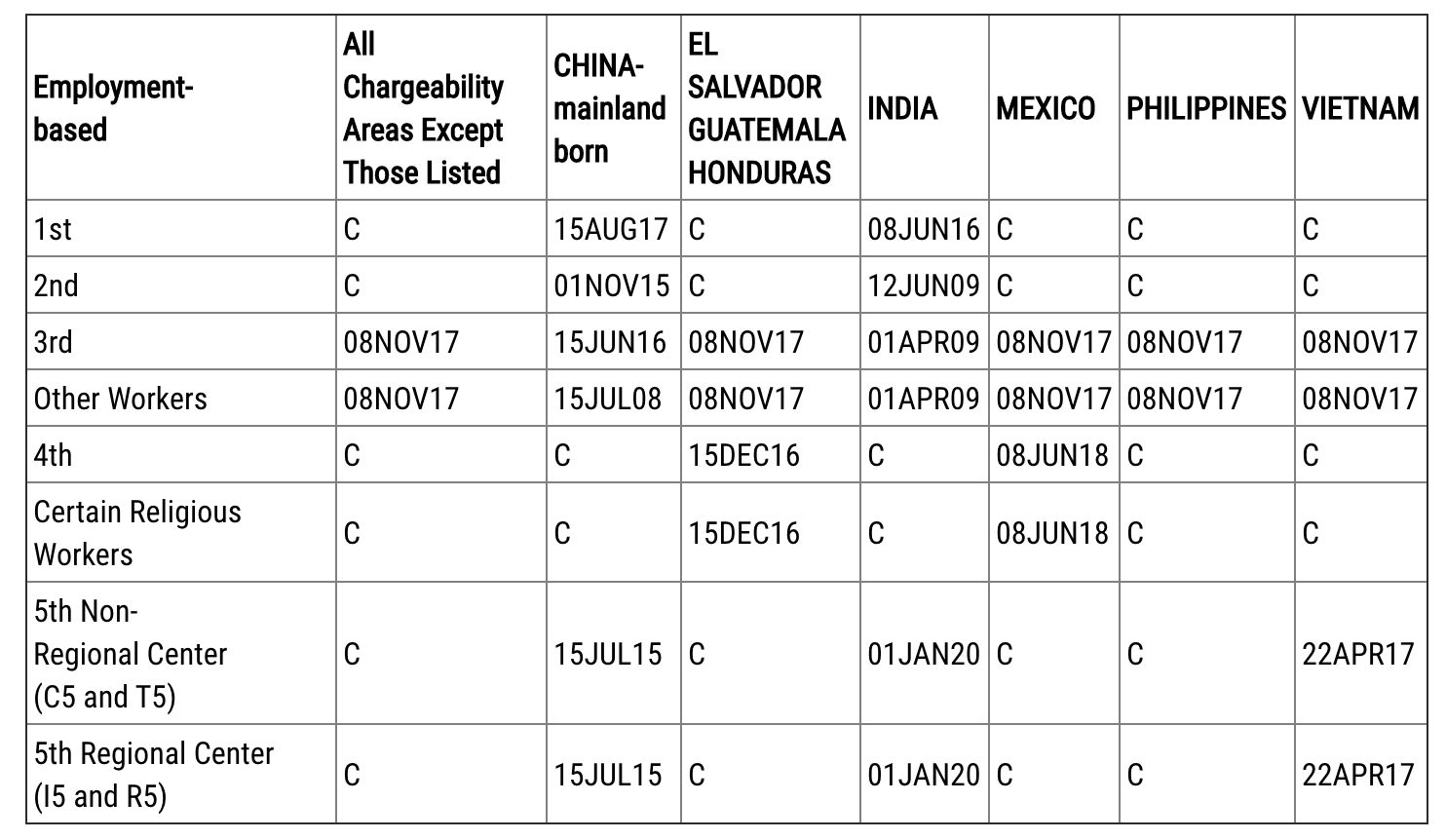
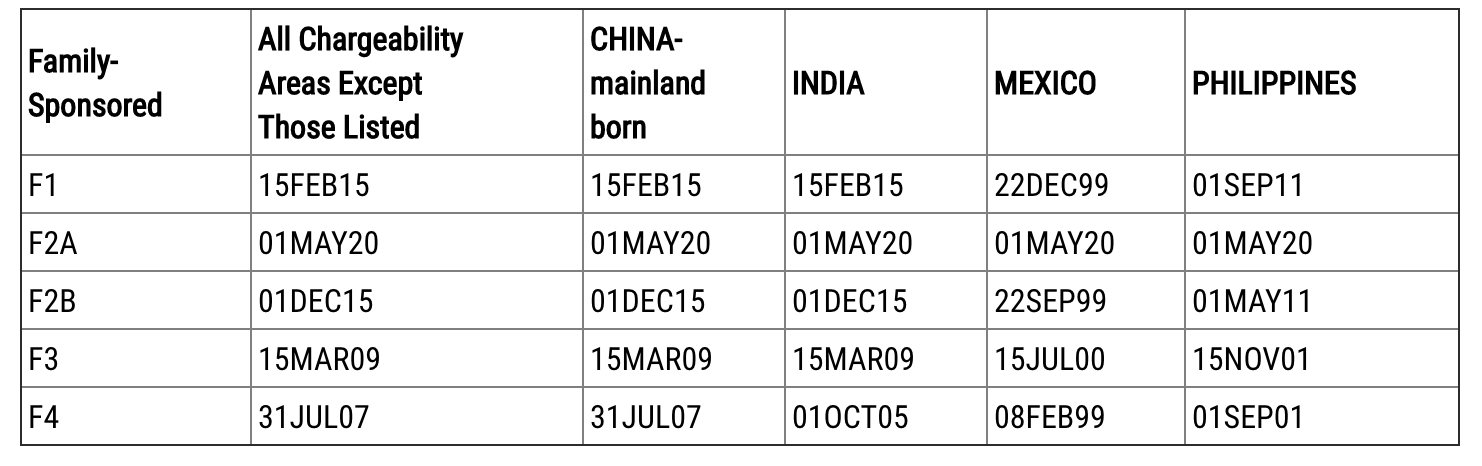
In this blog post, we discuss visa bulletin trends and projections for the month of March. The U.S. Department of State (DOS) recently released the March 2020 Visa Bulletin revealing some good and bad news for employment based categories and family preference categories.

Adjustment of Status Filing Charts March 2020:

For Family-Sponsored Filings:
In the F2A category, there is a cutoff date on the Dates for Filing chart.  However, the category is “current” on the Final Action Dates chart.  Accordingly, applicants in the F2A category may file using the Final Action Dates chart for March 2020.

For all other family-sponsored preference categories, applicants must use the Dates for Filing chart in the Department of State Visa Bulletin for March 2020.

For Employment-Based Preference Filings:
For all employment-based preference categories, applicants must use the Dates for Filing chart in the Department of State Visa Bulletin for March 2020.

Employment-based Categories: The Highlights

China: This month, employment based categories for China experienced varying degrees of forward movement, with EB-3 experiencing the most advancement.

  • EB-1 China advanced ten days to June 1, 2017
  • EB-2 China advanced one month to August 15, 2015
  • EB-3 China advanced nearly three months to March 22, 2016

Continue reading

highway-1403977_1920

PLEASE NOTE: THE INFORMATION IN THIS POST NO LONGER APPLIES. ON FEBRUARY 21, 2020, THE SUPREME COURT ISSUED A RULING ALLOWING THE GOVERNMENT TO IMPLEMENT THE PUBLIC CHARGE RULE TO RESIDENTS IN THE STATE OF ILLINOIS. USCIS HAS ANNOUNCED THAT THE PUBLIC CHARGE RULE WILL BE IMPLEMENTED NATIONWIDE INCLUDING IN THE STATE OF ILLINOIS TO APPLICATIONS POSTMARKED ON OR AFTER FEBRUARY 24, 2020.

In this blog post we will discuss whether the public charge rule applies to individuals living in Illinois.

The Supreme Court’s decision on January 27, 2020 lifted all lower court injunctions preventing the government’s implementation of the public charge rule, with the exception of an injunction preventing the government from imposing the rule in the state of Illinois.

USCIS has clearly stated that although the agency will implement the public charge rule on February 24, 2020, the agency is prohibited from implementing the rule in the state of Illinois, where it remains enjoined by the U.S. District Court for the Northern District of Illinois.

Accordingly, at this time, the public charge rule does not apply to individuals living in the state of Illinois. In the event the injunction in Illinois is lifted the public charge rule may apply. If this occurs, USCIS will provide additional guidance for individuals residing in the state of  Illinois on its website.

The following frequently asked questions have been prepared to better inform applicants and petitioners living in the state of Illinois regarding the public charge rule.

Q: Does the rule apply to adjustment of status applicants in State of Illinois?

A: No. USCIS has clearly stated on its website that, “applicants for adjustment of status who live in Illinois and who are subject to the public charge ground of inadmissibility are not subject to the final rule.”

Continue reading

flag-1446423_1920

In this blog post we discuss the highlights of the newly updated Policy Manual guidance released by USCIS which addresses the Inadmissibility on Public Charge Grounds Final Rule. The Final Rule and guidance is effective as of February 24, 2020 and applies to all applications and petitions postmarked on or after February 24, 2020 (except for in the State of Illinois where the Final Rule remains enjoined by court order).

These highlights are broken down by volume. Volume 2 addresses public charge grounds of inadmissibility for non-immigrants, Volume 8 discusses the public charge ground of inadmissibility in great detail, and Volume 12 discusses how the public charge rule may apply to citizenship and naturalization applications postmarked on or after February 24, 2020.

Highlights:

Non-Immigrants Seeking Extension of Stay or Change of Status (Volume 2 Chapter 4)

This section of the policy guidance clarifies that although the public charge ground of inadmissibility does not apply to nonimmigrants seeking either an extension of stay (EOS) or change of status (COS) on Forms I-129 or Form I-539, these applicants are generally subject to the “public benefits condition,” unless specifically exempted by law.

What is the public benefits condition?

According to the policy manual, “the public benefits condition requires an applicant seeking EOS or COS on or after February 24, 2020 (postmarked or if applicable, submitted electronically on or after that date) to demonstrate that he or she has not received, since obtaining the nonimmigrant status he or she is seeking to extend or from which he or she seeks to change, one or more public benefits, or more than 12 months in the aggregate within any 36-month period (where, for instance, receipt of two public benefits in 1 month counts as 2 months).

USCIS only considers public benefits received on or after February 24, 2020 for petitions or applications postmarked (or, if applicable, submitted electronically) on or after that date.”

Continue reading

thinker-28741_1280

In this blog post we answer your frequently asked questions regarding the public charge rule.

Overview:

On October 10, 2018, the Department of Homeland Security first published the final rule “Inadmissibility on Public Charge Grounds” which dramatically changes the way in which an individual is determined to be a “public charge.” Although five separate courts issued injunctions to stop the government from implementing the final rule, on January 27, 2020, the Supreme Court of the United States ruled in favor of the Trump administration, allowing the government to implement the public charge rule, except in the state of Illinois where a state-wide injunction remains in place.

The new regulations will make it more difficult for certain adjustment of status and immigrant visa applicants to prove that they are not likely to become a public charge to the United States government.

The following frequently asked questions have been prepared to better inform our readers and address concerns regarding the effect of the public charge rule.

Q: When will the public charge rule take effect?

A: Shortly after the Supreme Court’s ruling, USCIS formally announced on its website that the public charge rule will affect all applications for adjustment of status (green card applications) postmarked on or after February 24, 2020 (except in the state of Illinois, where the rule remains enjoined by a federal court).

Q: Who does the public charge rule apply to?

A: In general, all applicants for admission to the United States are subject to the public charge ground of inadmissibility under INA § 212(a)(4) unless specifically exempted.

The following non-citizens are affected by the public charge rule:

  • Applicants for adjustment of status in the United States
  • Applicants for an immigrant visa abroad
  • Applicants for a nonimmigrant visa abroad
  • Applicants for admission at the U.S. border who have been granted an immigrant or nonimmigrant visa, and
  • Nonimmigrants applying for an extension or change of status within the United States (new policy under the final rule).

Applicants seeking lawful permanent resident status (applicants for adjustment of status) based on a family relationship are most affected by the public charge rule.

Continue reading

update-1672349_1920

In this post, we would like to provide our readers with an important update released by the United States Citizenship and Immigration Services (USCIS) with respect to the public charge rule.

Given the Supreme Court’s recent ruling in favor of the government, the United States Citizenship and Immigration Services (USCIS) has announced that they will begin implementing the “Inadmissibility on Public Charge Grounds” rule on February 24, 2020, EXCEPT for in the State of Illinois, where the rule remains enjoined for the time being by a federal court.

That means that EXCEPT for in the State of Illinois, USCIS will begin to apply the Final Rule to applications and petitions postmarked (or submitted electronically) on or after February 24, 2020.

The postmark date for all applications and petitions sent by commercial courier (UPS/FedEx/DHL) is the date reflected on the courier receipt.

The public charge rule will NOT apply to applications or petitions postmarked before February 24, 2020 and petitions that remain pending with USCIS.

Prepare for Changes: USCIS to update all Adjustment of Status Forms

USCIS has announced that the agency will be updating all forms associated with the filing of adjustment of status, its policy manual, and will be providing updated submission instructions on its website this week to give applicants and their legal representatives enough time to review filing procedures and changes that will apply to all applications for adjustment of status postmarked on or after February 24, 2020.

Failure to submit forms with the correct edition dates and/or abide by the new filing procedures will result in the rejection of an application or petition.

The Final Rule provides that adjustment of status applicants subject to the public charge grounds of inadmissibility will be required to file Form I-944 Declaration of Self-Sufficiency along with Form I-485, as part of the public charge inadmissibility determination to demonstrate they are not likely to become a public charge. Therefore, we expect USCIS to provide instructions regarding the submission of Form I-944 with adjustment of status applications.

Continue reading