Articles Posted in Temporary Visas

6731529767_bb975c2f64_b

A recent working paper published by Harvard economist, William R. Kerr, and Wellesley economist, Sari Pekkala Kerr, is making waves on the subject of immigrant entrepreneurship. The study asks: just how important are foreign-born entrepreneurs to our economy? Are their contributions truly significant?

The study’s abstract reads as follows:

We examine immigrant entrepreneurship and the survival and growth of immigrant-founded businesses over time relative to native-founded companies. Our work quantifies immigrant contributions to new firm creation in a wide variety of fields and using multiple definitions. While significant research effort has gone into understanding the economic impact of immigration into the United States, comprehensive data for quantifying immigrant entrepreneurship are difficult to assemble. We combine several restricted-access U.S. Census Bureau data sets to create a unique longitudinal data platform that covers 1992-2008 and many states. We describe differences in the types of businesses initially formed by immigrants and their medium-term growth patterns. We also consider the relationship of these outcomes to the immigrants’ age at arrival to the United States.

The study is important because it forces members of Congress to conduct a cost-benefit analysis, in order to determine whether or not it is beneficial for the United States to create more opportunities for highly-skilled entrepreneurs and professionals. Regrettably, the immigration debate has largely centered around illegal immigration to the United States, ignoring calls to create more flexibility for highly-skilled immigrants and immigrant entrepreneurs. As it stands today, immigrant entrepreneurs can only obtain a green card via sponsorship from a United States employer. The majority of entrepreneurs are forced to remain in the United States on a temporary ‘dual intent’ nonimmigrant visa, until a U.S. employer agrees to sponsor their green card. Visa options are very limited for highly-skilled immigrants. Even for the most brilliant of entrepreneurs, this process requires time and patience. Our current immigration laws are doing us a disservice since they are keeping out some of the most talented entrepreneurs in the world. Immigrant entrepreneurs are increasingly important because the number of businesses and American jobs they create is on the rise.

Here are some of the study’s findings:

  • As of 2008, at least one in four entrepreneurs among start-up companies are foreign-born. Similarly, at least one in four employees among new firms are foreign-born
  • 37% of new firms had at least one immigrant entrepreneur working for the company
  • At least 1 in 3 start-up firms were founded by an immigrant entrepreneur, with an increasing rate from 1995-2008
  • The share of immigrants among all employees working for start-up companies is on the rise
  • Immigrant employees in low-tech positions comprise about 22.2% of start-up companies, while 21.2% of immigrants work in high-tech positions in start-up companies
  • Among new start-ups backed by venture capitalists, 60% had at least one immigrant entrepreneur
  • Immigrant employees working for a start-up company backed by venture capitalists have higher mean average quarterly earnings

Continue reading

6848823919_724f516a05_z

On May 04, 2016 the Department of Homeland Security published a proposed rule in the Federal Register, announcing that filing fees for many USCIS petitions and applications are expected to increase for U.S. employers and foreign nationals. The proposed regulation stipulates that filing fees may be adjusted for certain immigration and naturalization benefit requests by USCIS. The increase in filing fees was considered after USCIS conducted a comprehensive review of its fees and found that the current fees do not cover the cost of services provided by USCIS. According to USCIS, in an effort to fully recover costs and maintain adequate services, “an adjustment to the fee schedule will be necessary”. According to the regulation, fees for most employment-based petitions and applications would be raised by an average of 21%, though other types of petitions may experience a higher increase in filing fees.

According to DHS, the higher fees will more accurately reflect the current cost of processing immigration applications and petition. A portion of the increased fees would provide additional funding for refugee and citizenship programs as well as system support for interagency immigration status verification databases.  The increase in filing fees will not take effect until the federal government approves the regulation, which is expected to take several months following the close of the 60-day comment period on July 5, 2016.

According to the new fee schedule under consideration, employment-based petitions would be the most impacted by the increase in filing fees. The filing fee for Form I-129, Petition for a Nonimmigrant Worker, would increase by 42% to a fee of $460, from the current rate of $325.  Similarly, the filing fee for Form I-140, Immigrant Petition for Alien Worker, would increase by 21% to a fee of $700, from the current rate of $580. The complete fee schedule under consideration has been provided below for your reference.

The EB-5 Immigrant Investor Visa Program is expected to be the most heavily affected by the new fee schedule. The filing fee for Form I-924, Application for Regional Center Under the Immigrant Investor Pilot Program, would increase by a rate of 186% requiring Regional Centers seeking designation under the program to pay a filing fee of $17,795 instead of the current rate of $6,230. In addition, Regional Centers would be required to pay a $3,035 annual fee to certify their continued eligibility for the designation. Currently, there is no fee in place for annual certification. The filing fee for the I-526 Immigrant Petition by Alien Entrepreneur, an application associated with the EB-5 visa program, would also increase to a rate of $3,675, a 145% increase up from the current rate of $1,500. The filing fee for an investor’s petition to remove conditions on residence would remain unchanged under these new regulations.

Continue reading

5086531784_ed4e1a8a69_z
For this blog we are answering 5 questions we have recently received through our social media platforms and our website. Please remember that every case is different and every immigration journey is unique. You should not compare your situation to anyone else’s. We hope that our answers will provide you with further guidance while you embark on your immigration journey. If you have any further questions, please call our office for a free legal consultation. We serve international clients and domestic clients in all 50 states. We thank you for your continued trust and interest in our law office.

Change of Status B-2 to F-1

Q: I need advice regarding my change of status. I am currently in the United States on a B-2 tourist visa. I have filed a change of status application to change my status to F-1 student. My B-2 duration of stay will expire today and my change of status application to F-1 student is still pending with USCIS. I informed my school that I will be postponing my classes and was notified that I need to file a new I-20 and provide some missing information. I have time to make adjustments to my application but I would like to know the steps to correct any missing information. I also wanted to know if I need to leave the United States immediately since my F-1 application is still pending. Please assist.

The Waitress
This morning, USCIS made the announcement that it has met the H-2B Cap for temporary nonagricultural workers, beginning employment during the first half of fiscal year 2016. A congressionally mandated cap, limits the number of H-2B visas that can be issued per fiscal year to 66,000. The first half of these visas are issued to workers who will begin employment in the first half of the fiscal year (from October 1 to March 31) and the other half are issued to workers who will begin employment in the second half of the fiscal year (from April 1 to September 30). The deadline to file an H-2B worker petition, with an employment start date beginning prior to April 1, 2016, was March 15, 2016. New H-2B petitions received by USCIS after the deadline, requesting an employment start date before April 1, 2016 will be rejected by USCIS. USCIS will continue to accept and process applications for temporary nonagricultural workers who are considered cap-exempt.

The following H-2B petitions are considered cap-exempt:

  • Petitions filed for “returning workers” that have already been counted towards a previous H-2B cap in fiscal years 2013, 2014, or 2015;

8516269783_79248f4ba2_c

Presently, the Employment and Training Administration’s (ETA) Office of Foreign Labor Certification (OFLC) is experiencing significant delays in processing employer H-2B certification applications.  These delays are owed to various factors. The most important includes a mandatory 17-day certification pause that took place at the Chicago National Processing Center, for the purpose of implementing revisions of the H-2B prevailing wage and other standards required by law. Additionally, the OFLC announced that the amount of H-2B certification applications received has doubled in comparison to the previous year. Lastly, the electronic filing system iCERT, experienced significant technical problems, slowing the certification process down significantly for employers of H-2B workers. Unfortunately, these delays have diminished an employer’s ability to hire foreign workers during a time of need, and have had an adverse affect on small businesses who depend on these temporary and seasonal workers to perform work that cannot be readily filled by American workers.

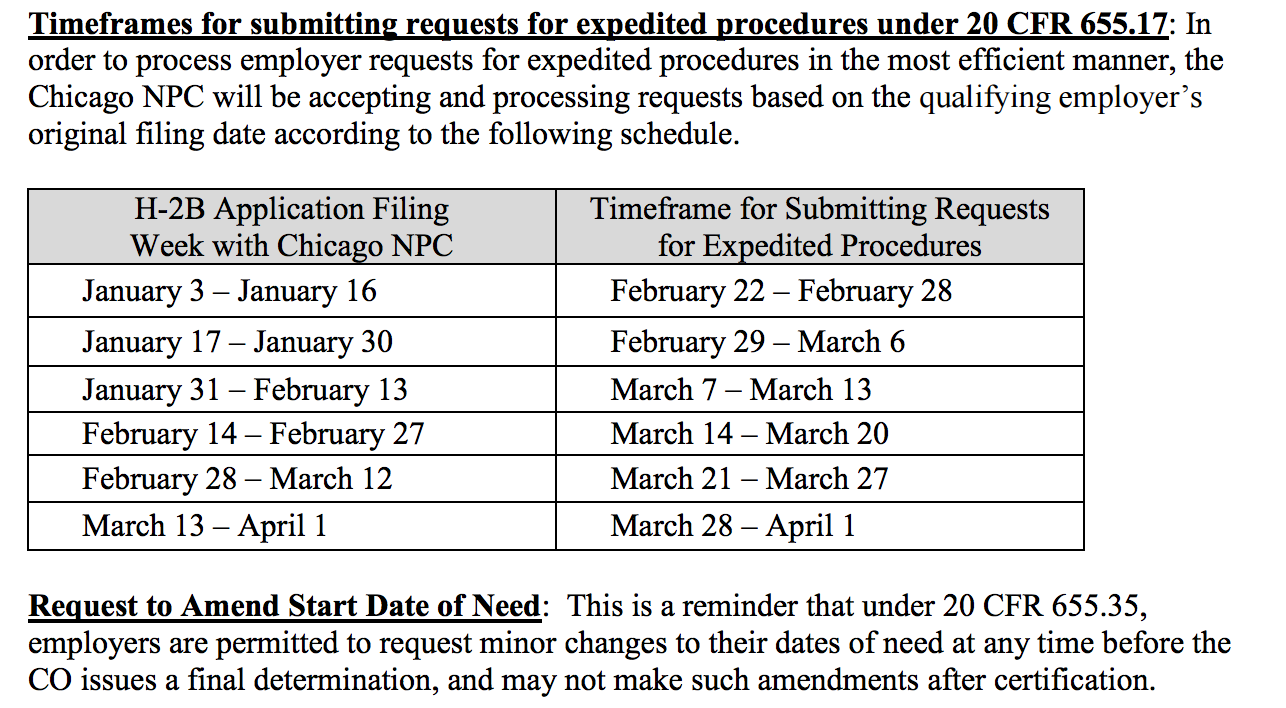
To alleviate the certification backlogs, the Chicago National Processing Center has announced that employers may file an emergency request for expeditious handling of their applications under 20 CFR 655.17.

Expeditious Requests for Emergency Procedures under 20 CFR 655.17:

  • Based on the factors causing the backlogs, the OFLC has determined that employers are entitled to request expeditious emergency procedures for their currently pending applications for certification, under 20 CFR 655.17, on the basis of good and substantial cause. Emergency requests are warranted given that the backlogs caused by the delays in the application process are considered outside of the employers’ control, that employers have suffered unforeseen changes in market conditions because of the delays, amid a climate of uncertainty.

Employers with pending H-2B applications for certification must submit their expedite requests for emergency procedure, by email to the Chicago NPC at ER.H2B.Chicago@dol.gov beginning Monday February 22, 2016 (12:01 AM) through Friday April 1, 2016 (at 12:00 midnight). Requests may also be made by fax (312) 886-1688 or by US mail to:

ATTN: H-2B Request for Emergency Handling

U.S. Department of Labor ETA OFLC

Chicago NPC

11 West Quincy Court

Chicago, IL 60604-2105

The NPC may extend this emergency request period beyond April 1, however at this time no such extension has been announced.  Filing a new H-2B application is not necessary for an expedite request.

Employers filing for emergency treatment under 20 CFR 655.17 must request that the pending application for certification and proposed job order be “incorporated by reference” into the request made under 20 CFR 655.17, and state the withdrawal of the prior application. The procedure for submitting an expedite requested will be listed below.

Screen Shot 2016-02-22 at 2.57.07 PM

Continue reading