Articles Posted in EAD

1190

Last week our very own managing attorney Jacob Sapochnick, Esq., and associate attorney Yingfei Zhou, Esq. had the pleasure of attending the 2016 American Immigration Lawyers Association (AILA) Conference on Immigration Law in Las Vegas, Nevada. Together, they bring you the most up to date information on the new N-400 online filing system and new N-400 form, the new customer service tool EMMA—a computer-generated virtual assistant, information regarding delays in adjudication of H-1B extension/transfer applications and Employment Authorization applications, filing tips for H-1B extensions, updates on EB-1C Multinational Executive/Manager green cards, Employment Authorization eligibility for spouses of E-2 and L-1 visa holders, and updates on Administrative Appeals Office (AAO) Decisions.

New Naturalization Form and N-400 Online Filing System

  1. USCIS recently published a new N-400 form on 04/13/2016. Applicants may use the previous 09/13/2013 version until 08/09/2016. Any naturalization applications received on or after 08/10/2016 containing the old form with revision date 09/13/2013 will be rejected and returned to the sender.
  1. USCIS is currently testing a new N-400 online filing system. This system will be available to applicants without legal representation and will eventually become available to applicants represented by an immigration attorney.

New Customer Service Tools EMMA

  1. USCIS is introducing a new customer service tool called EMMA – a computer-generated virtual assistant who can answer your questions and even take you to the right spot on the USCIS website. EMMA is USCIS’ version of ‘Siri’ and is designed to help you navigate the USCIS website. EMMA is available in the Spanish language. So far, EMMA has managed to answer 80% of questions asked.

Continue reading

6855902540_2e5c5034a1_z

Throughout the next few months, USCIS will begin the process of returning H-1B petitions that were not selected in the H-1B lottery for fiscal year 2017. Each package will contain the respective H-1B petition along with a rejection notice specifying that the petition was not selected in the lottery. If you would like a copy of your rejection notice, please contact your employer or the attorney that filed your petition with USCIS. If you were not selected in the H-1B lottery for fiscal year 2017, there are a few visa options you may want to consider applying for. As always you can visit our website to read about the various different visa types that may be available to you. To discuss your options moving forward, please contact us for a consultation. Do not despair. Many applicants that were not selected in the H-1B lottery in previous years, have been chosen in subsequent years.

Long Term Options for Employment

Employment-Based Green Card

Typically, the employment-based green card application is the most permanent long term option for employment. The drawback is that obtaining an employment-based green card is a very long process that will require you to maintain another nonimmigrant status, while your green card application is pending. For more information on employment-based green cards please click here.

Family-Based Green Card (Adjustment of Status within the United States)

If you are the spouse, parent or child of a U.S. citizen, you may be eligible for family-based permanent residency. The green card application includes the application for employment authorization, which is granted within 3 months of filing. Employment authorization allows the applicant to work while their application is in process. Please be aware that the 3-month time frame for employment authorization is only for applicants applying for adjustment of status from within the United States. For more information about this process please click here.

Continue reading

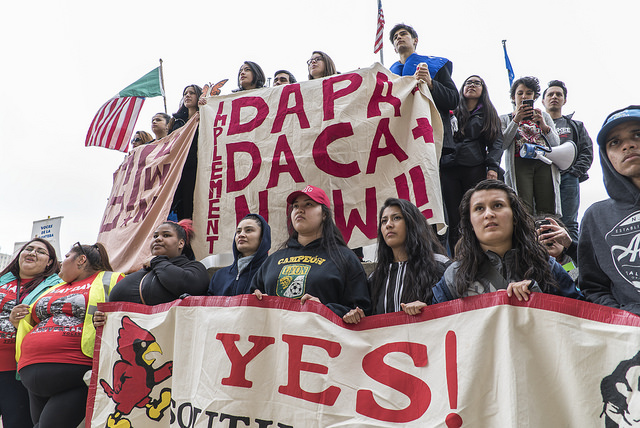
26762616905_3855617f27_zAs previously reported, the Department of Justice is currently facing off in court against a federal judge from the State of Texas, who has accused federal prosecutors of misrepresenting, and withholding information in federal court, related to the implementation of the expanded Deferred Action for Childhood Arrivals (DACA) program and new Deferred Action for Parents of Americans and Lawful Permanent Residents (DAPA) program that was scheduled to take effect on February 18, 2015, as part of President Barack Obama’s executive actions on immigration. All of that changed, when Judge Hanen filed a temporary injunction in court, blocking these executive orders from taking effect, just days before February 18, 2015. Judge Hanen is asking the court to punish federal prosecutors working for the Department of Justice by forcing them to attend mandatory ethics courses.

In addition, Hanen has requested that the Department of Homeland Security hand over the names, addresses, and other information of individuals who were unlawfully granted immigration benefits under these programs. On Friday, a group of undocumented individuals came forward, asking an appellate court to respect their privacy by not turning over their personal information to the State of Texas, and other interested parties. This group of undocumented individuals is currently being represented by the American Civil Liberties Union (ACLU) and the National Immigration Law Center (NILC). Attorneys for the group are expected to argue before the U.S. Court of Appeals for the Fifth Circuit in order to block Judge Hanen’s order.

Continue reading

5086531784_ed4e1a8a69_z
For this blog we are answering 5 questions we have recently received through our social media platforms and our website. Please remember that every case is different and every immigration journey is unique. You should not compare your situation to anyone else’s. We hope that our answers will provide you with further guidance while you embark on your immigration journey. If you have any further questions, please call our office for a free legal consultation. We serve international clients and domestic clients in all 50 states. We thank you for your continued trust and interest in our law office.

Change of Status B-2 to F-1

Q: I need advice regarding my change of status. I am currently in the United States on a B-2 tourist visa. I have filed a change of status application to change my status to F-1 student. My B-2 duration of stay will expire today and my change of status application to F-1 student is still pending with USCIS. I informed my school that I will be postponing my classes and was notified that I need to file a new I-20 and provide some missing information. I have time to make adjustments to my application but I would like to know the steps to correct any missing information. I also wanted to know if I need to leave the United States immediately since my F-1 application is still pending. Please assist.

6000446155_1d67582412_z

The fate of the President’s executive actions on immigration now rests in the hands of eight justices on the Supreme Court, absent Justice Antonin Scalia. The Supreme Court will begin to hear oral arguments for the case, United States v. Texas on April 18th of this year, with a final ruling expected by summertime. Nearly a year and a half ago, President Obama announced a series of executive actions on immigration including the expanded Deferred Action of Childhood Arrivals (DACA) program, the new Deferred Action for Parents of Americans and Lawful Permanent Residents (DAPA) program, and other measures to enhance border security, prioritize deportations, and modernize the immigration system. USCIS was expected to begin accepting applications for the expanded DACA and DAPA program on February 18th. The excitement surrounding the expanded DACA and DAPA program however was very short lived. A federal court order filed by Texas and other states on February 16th temporarily suspended these programs from going into effect.

Since then, the federal government and the State of Texas have been battling one another in court. The Fifth Circuit court determined that Texas and at least 25 other states had sufficient ‘standing’ to challenge both programs from being implemented. The state of Texas along with other states, argue that these programs are not only outside the purview of the President’s constitutional power, but that the States would be substantially burdened, should the programs go into effect. Texas states that as a result of these programs, the State would suffer increased health-care, law enforcement, and educational costs which would come out of the State budget and more importantly the pockets of Texas residents, who do not take kindly to these programs. Additionally, Texas claims that it would suffer additional financial burden in having to issue more drivers’ licenses to individuals qualifying for expanded DACA and DAPA, a state-subsidized benefit. If the Supreme Court decides in favor of the federal government, nearly 5 million immigrants residing in the United States unlawfully will be shielded from deportation, and States will be forced to bear the costs to accommodate their new ‘deferred’ status. Deferred status will grant individuals the right to legally obtain employment, obtain a social security number, a driver’s license, and an education, but it is not a path to citizenship. As it stands, it is unlikely that a new Supreme Court Justice will be appointed before oral arguments begin in this case, especially with mounting political pressure from Republicans seeking to block the President from making a nomination.

Continue reading

3198083648_b5276e02c4_z

This morning, the Supreme Court announced that it would hear arguments for and against the extended Deferred Action for Childhood Arrivals (DACA) program and the new Deferred Action for Parents of U.S. Citizens and Lawful Permanent Residents (DAPA) program. If the government succeeds in its appeal, millions of undocumented immigrants will be granted temporary employment authorization, ‘deferred status’ meaning that these individuals will no longer need to fear deportation, and other benefits such as the ability to apply for a social security number. This decision is a victory for the Obama administration since it leaves open the possibility that the Supreme Court will lay down an important legal precedent in the midst of the presidential campaign and Obama’s exit from the White House.

  • To learn how expanded DACA is different than the initial DACA program click here.
  • To learn about the DAPA program click here.

3198083750_597c4a4e90_z
The Supreme Court justices are currently in deliberations, to decide the fate of Barack Obama’s expanded Deferred Action for Childhood Arrivals (DACA) and Deferred Action for Parents of U.S. Citizens and Lawful Permanent Residents (DAPA) announced November 2014, as part of the President’s executive actions on immigration. At issue is whether or not the Court will hear arguments for and against lifting the temporary court injunction, which prevented the expanded DACA program and the new DAPA program from moving forward as initially anticipated.

The extended DACA and DAPA provisions were scheduled to go into effect on February 18, 2015, but were quickly blocked by a temporary injunction filed by Texas and 26 other states, just three days before applications for extended DACA and DAPA would have been accepted by USCIS. What has resulted has been a near two-year legal battle between the federal government and the states in question.

Timeline of legal action between the federal government and plaintiffs:

mayaFor this month’s staff spotlight, we invite you to learn more about Paralegal, Maya Elkain.

Ms. Elkain began her journey with the Law Offices of Jacob J. Sapochnick in 2014 as an intern. She quickly learned the ins and outs of employment based immigration law and was offered a position. Today, she assists attorneys with the preparation of H-1B applications, E-2 investor visas, L-1A visas, O visas, National Interest waivers, provisional waivers of unlawful presence, and much more. Ms. Elkain specializes in employment-based immigration and investor petitions. With her assistance, our law office has been able to receive affirmative decisions in numerous cases.

“The best part of my job is having the opportunity to make a difference and actually help our clients succeed in their immigration process. It is the most rewarding feeling.”

8000143255_e02292c05d_z

What is the H-1B Visa? The H-1B visa is a work visa that is awarded on a lottery basis. The H-1B visa program allows American companies and/or qualifying organizations to employ foreign workers to fill specialty occupations temporarily. The foreign worker must posses a combination of education, specialized training, and/or experience that is equivalent to training acquired by the attainment of a U.S. bachelor’s or higher. The H-1B program was first enacted by Congress with the intention of helping American employers seek out distinguished foreign workers, possessing the skills and abilities necessary to perform the duties of the specialty occupation. The H-1B program has remained popular because it has allowed American employers to remain competitive and provides highly skilled foreign workers a path to permanent residence.

The provisions of the H-1B visa program allow qualified foreign workers to attain temporary employment having met specific requirements. H-1B visa recipients typically work in the STEM fields as scientists, engineers, computer programmers, software developers, business analysts, etc. although fashion models are also classified under the H-1B category.

USCIS will begin to accept H-1B cap-subject petitions for fiscal year 2017 beginning April 1, 2016. April 7, 2016 is the absolute deadline to file an H-1B cap-subject petition. Please note: employers cannot file an H-1B petition for an employee more than 6 months before the employee’s intended start date. If accepted, H-1B visa workers can begin employment by October 1st. The H-1B visa is issued for up to three years but may be extended for another three years.

Continue reading

9033805851_a19992134e_z

On Thursday, December 31, 2015 the Department of Homeland Security published a new proposed rule affecting highly skilled immigrant and non-immigrant workers alike. The proposed rule, introduced in last week’s federal register, aims to improve the ability of American employers to hire and retain highly skilled workers waiting to receive their employment-based lawful permanent residence in the visa bulletin backlogs. Additionally, the proposed rule aims to enhance opportunities for such workers allowing them to be more easily promoted, to accept lateral positions with their current employers, change employers, and pursue other employment. While the proposed rule is not groundbreaking, it does address important challenges employers and their highly skilled workers have faced as the law stands today and makes recommendations for such relief. The proposed rule will be open for comment until February 29, 2016.

You may remember that on November 20, 2014 the President highlighted, as part of his executive actions on immigration, that the employment-based immigration system needed to be amended to modernize, improve, and clarify immigrant and nonimmigrant visa programs in order to create more jobs, foster innovation at home, retain a highly skilled workforce that would allow the United States to compete with other countries, and to stimulate the American economy overall.  In order to modernize the employment based immigration system, USCIS would be required to work with the Department of State to modernize and simplify the immigrant visa allocation process. Part of this process would require the Department of State to make reasoned projections of employment-based immigrant visa availability on the visa bulletin, that could be relied upon by employers and their highly skilled workers.

Presently, immigrant workers from India and China are experiencing extraordinary delays in the employment-based queue for permanent residence, while other highly skilled workers are forced to wait over a five-year period to receive company sponsorship and lawful permanent residence. Furthermore, such workers are forced to remain on temporary employment-sponsored visas in the United States while waiting for an immigrant visa to become available to them. This puts the immigrant worker in a predicament giving the employer the upper hand, while restricting the employee from seeking advancement and discouraging new employment, since this would require the employer to file a new petition and incur the expensive fees required for filing. Highly skilled works facing extortionate delays in the visa backlogs have experienced hindered employer/employee career advancement and job mobility. The new rules will provide limited relief in this area.

Continue reading