 Visa Lawyer Blog
We would like to wish you and your families a very Happy Independence Day on behalf of our office! Have a safe and relaxing weekend!



We would like to wish you and your families a very Happy Independence Day on behalf of our office! Have a safe and relaxing weekend!

Last week our very own managing attorney Jacob Sapochnick, Esq., and associate attorney Yingfei Zhou, Esq. had the pleasure of attending the 2016 American Immigration Lawyers Association (AILA) Conference on Immigration Law in Las Vegas, Nevada. Together, they bring you the most up to date information on the new N-400 online filing system and new N-400 form, the new customer service tool EMMA—a computer-generated virtual assistant, information regarding delays in adjudication of H-1B extension/transfer applications and Employment Authorization applications, filing tips for H-1B extensions, updates on EB-1C Multinational Executive/Manager green cards, Employment Authorization eligibility for spouses of E-2 and L-1 visa holders, and updates on Administrative Appeals Office (AAO) Decisions.
New Naturalization Form and N-400 Online Filing System
New Customer Service Tools EMMA

If you have filed your green card application with USCIS, you are probably asking yourself whether you can travel internationally (yes we mean Mexico too) while your application is in process. After all, filing the green card application is admittedly a stressful process for both the applicant and petitioner. Accomplishing this achievement is worth celebrating. To reward yourself you may be aching to celebrate your newfound immigration status by going on holiday or taking that important business trip you and your business partners have been discussing.
Travel Authorization for Re-entry
Not so fast!! You cannot travel internationally unless you have received a travel authorization document from USCIS, known as an advance parole document. You are required to obtain such travel authorization if you seek to re-enter the United States after temporary foreign travel. To do so, you must file Form I-131 Application for Travel Document with USCIS. For applicants filing a green card application based on their marriage to a U.S. Citizen, the I-485 and I-131 application is typically filed concurrently. There is no fee for the I-131 application if it is submitted along with Form I-485. It takes approximately 90 days, from the date the I-131 application is received, for USCIS to issue this travel authorization. Once the travel authorization is received, it would no longer be worth traveling outside of the country, because applicants typically receive their “interview notice” in the mail during this time frame. The interview notice will contain the date, time, and location of the green card interview and require the applicant to be physically present in the United States. In emergency situations, it is possible to reschedule the green card interview although this will obviously delay receipt of the green card.
Emergency Expedite Requests
Although it is possible to request an expedited advance parole document in emergency situations, there are important reasons why you should not do so. Firstly, the process for expediting an advance parole document is extremely difficult. You must have a legitimate reason for making an expedite request. Attending a business conference, your best friend’s wedding, or going on your honeymoon are not legitimate reasons for making an expedite request. Even in emergency situations such as the death or serious illness of a relative, we have seen immigration officers repeatedly deny expedite requests. Secondly, you are required to be physically present in the United States in order to attend your biometrics appointment for fingerprinting (within 3-4 weeks of filing the green card application) and later to attend your in person green card interview before an immigration officer (within 3-4 months of filing your application).
Taking these factors into consideration, it is important for applicants to plan accordingly. Never make any travel commitments until you have at least received your travel authorization/advance parole document from USCIS. Keep in mind that you will be required to return to the United States in order to attend your in person green card interview. If you do not appear on your scheduled interview date your application will be denied. Do not let this happen to you.

Today the Supreme Court of the United States dealt a strong blow to President Barack Obama’s executive actions on immigration issuing a single one-line decision on the ruling “the judgment of the lower court is affirmed by an equally divided court.” Nearly two years ago, President Obama announced a series of executive actions on immigration after the Republican controlled House of Representatives refused to tackle the issue of comprehensive immigration reform. As part of his executive actions on immigration, President Obama announced the expansion of the Deferred Action for Childhood Arrivals (DACA) program, and introduced a new program known as Deferred Action for Parents of Americans and Lawful Permanent Residents, (DAPA) designed to shield nearly five million undocumented immigrants from deportation. Following these initiatives, USCIS announced that applications for expanded DACA and the new DAPA program would begin to be accepted on February 18, 2015.
The DACA program would have expanded the population eligible for the Deferred Action for Childhood Arrivals (DACA) program to people of any current age who entered the United States before the age of 16 and lived in the United States continuously since January 1, 2010, and extending the period of DACA and work authorization from two years to three years. The new DAPA program would have granted parents of U.S. Citizens and lawful permanent residents the opportunity to request deferred action and employment authorization for a three year period, on the condition that they have lived in the United States continuously since January 1, 2010 and pass required background checks.
On February 16, 2015 just two days before the programs were scheduled to go into effect, Texas along with 25 other states, filed a temporary court injunction ultimately suspending both programs from going into effect. This action prompted the Obama administration to intervene. For months, the federal government and the State of Texas battled one another in federal court. The court ultimately determined that Texas and at least 25 other status had sufficient ‘standing’ to challenge these programs. In response, the federal government filed an emergency motion to stay, however the motion was eventually denied by the court. This led the government to file a writ of certiorari before the Supreme Court. The fate of Obama’s executive actions grew all the more uncertain with the sudden death of conservative Supreme Court Justice Antonin Scalia on February 13th. President Obama made desperate attempts to fill the vacated seat by nominating Merrick Garland to the Supreme Court, the Chief Judge of the United States Court of Appeals for the District of Columbia. Efforts to fill the seat were unsuccessful as Republicans vowed to keep Garland from sitting on the bench. Thus, Scalia’s death left behind an eight-person bench, and with no one to fill his seat, the growing possibility of a deadlock within the Supreme Court.
 A new lawsuit has been filed in federal court challenging the Department of Homeland Security’s authorization of the Optional Practical Training (OPT) for STEM students in the United States. The Washington Alliance of Technology Workers is seeking an end to the STEM OPT program because they claim the program is putting American technology workers at a competitive disadvantage. As previously reported, the Washington Alliance of Technology Workers had been battling the Department of Homeland Security in court for the past year asking a federal judge to invalidate 17-month OPT extensions granted to STEM students, because DHS violated the notice and comment requirements of the Administrative Procedure Act (APA).
In response, the federal judge had ordered the Department of Homeland Security to publish a new final OPT rule to allow certain F-1 students with degrees in science, technology, engineering, or mathematics to obtain employment authorization. DHS published the final rule earlier this year, replacing the previous 17-month STEM extension rule that had been in place since 2008. The new rule published by DHS allows certain F-1 students to apply for 24-month extension of their optional practical training program (OPT) in order to continue working in the United States following the completion of their studies. This new rule went into effect on May 10, 2016. The same plaintiffs who challenged DHS are coming forward yet again, this time questioning DHS policy, and alleging that the STEM OPT program is putting businesses first instead of protecting American technology workers.
The Washington Alliance of Technology Workers is a labor union that represents the interests of American technology workers, who they claim are losing out on jobs to foreign workers because of guest worker programs. The Immigration Reform Law Institute (IRLI) and the labor union are working together to dismantle the program which they say circumvents American labor protections in favor of cheap labor. In a recent statement the IRLI claims that the DHS exceeded its authority by allowing the STEM OPT program to exist. According to them, “not only does the OPT program create more competition for suitable unemployed and underemployed American workers, but it creates a tax incentive for unscrupulous employers to hire foreign labor over American workers because aliens on student visas and their employers do not have to pay Medicare and Social Security taxes.”

Did you know that if you fail to provide USCIS written notice of a change of address, within 10 days of moving to your new address, you may be convicted of a misdemeanor crime? If you currently have a case pending with USCIS, and you fail to provide written notice of a change of address to USCIS, within 10 days of moving, you could face a fine of up to $200, imprisonment up to 30 days, or both if convicted. If you are an alien (non U.S. Citizen) you could also face removal from the United States for non-compliance (INA Section 266(b)).
It is extremely important for applicants to notify USCIS immediately upon moving to a new address. Filing a change of address with USCIS is easy and it’s free. Applicants may change their address online by visiting the USCIS website and completing Form AR-11 online. In order to file a change of address online, you must know the Receipt Number (appearing on the Notice of Action) associated with your application, if your application is currently pending with USCIS. A Receipt Number is also known as the case number, identifying the petition submitted. The Receipt Number typically begins with three letters and is followed by ten digits.
The first three letters of the Receipt Number indicate the USCIS service center which is processing the petition, as follows:
– EAC – Vermont Service Center;
– WAC – California Service Center;
– LIN – Nebraska Service Center; and
– SRC – Texas Service Center
If you have filed more than one petition with USCIS (as in cases of adjustment of status for spouses of U.S. Citizens) you must provide the receipt number of each petition you have filed, when submitting the change of address online. If you do not have your receipt notice or have lost it, you should contact USCIS National Customer Service Center by telephone for assistance:
Our number is: 1 (800) 375-5283
Our TTY number is: 1 (800) 767-1833
If you are outside the United States and have filed an application or petition with a USCIS Service Center, you can call 212-620-3418 to check the status of your case.

Throughout the next few months, USCIS will begin the process of returning H-1B petitions that were not selected in the H-1B lottery for fiscal year 2017. Each package will contain the respective H-1B petition along with a rejection notice specifying that the petition was not selected in the lottery. If you would like a copy of your rejection notice, please contact your employer or the attorney that filed your petition with USCIS. If you were not selected in the H-1B lottery for fiscal year 2017, there are a few visa options you may want to consider applying for. As always you can visit our website to read about the various different visa types that may be available to you. To discuss your options moving forward, please contact us for a consultation. Do not despair. Many applicants that were not selected in the H-1B lottery in previous years, have been chosen in subsequent years.
Long Term Options for Employment
Employment-Based Green Card
Typically, the employment-based green card application is the most permanent long term option for employment. The drawback is that obtaining an employment-based green card is a very long process that will require you to maintain another nonimmigrant status, while your green card application is pending. For more information on employment-based green cards please click here.
Family-Based Green Card (Adjustment of Status within the United States)
If you are the spouse, parent or child of a U.S. citizen, you may be eligible for family-based permanent residency. The green card application includes the application for employment authorization, which is granted within 3 months of filing. Employment authorization allows the applicant to work while their application is in process. Please be aware that the 3-month time frame for employment authorization is only for applicants applying for adjustment of status from within the United States. For more information about this process please click here.
 Conditional Permanent Residence
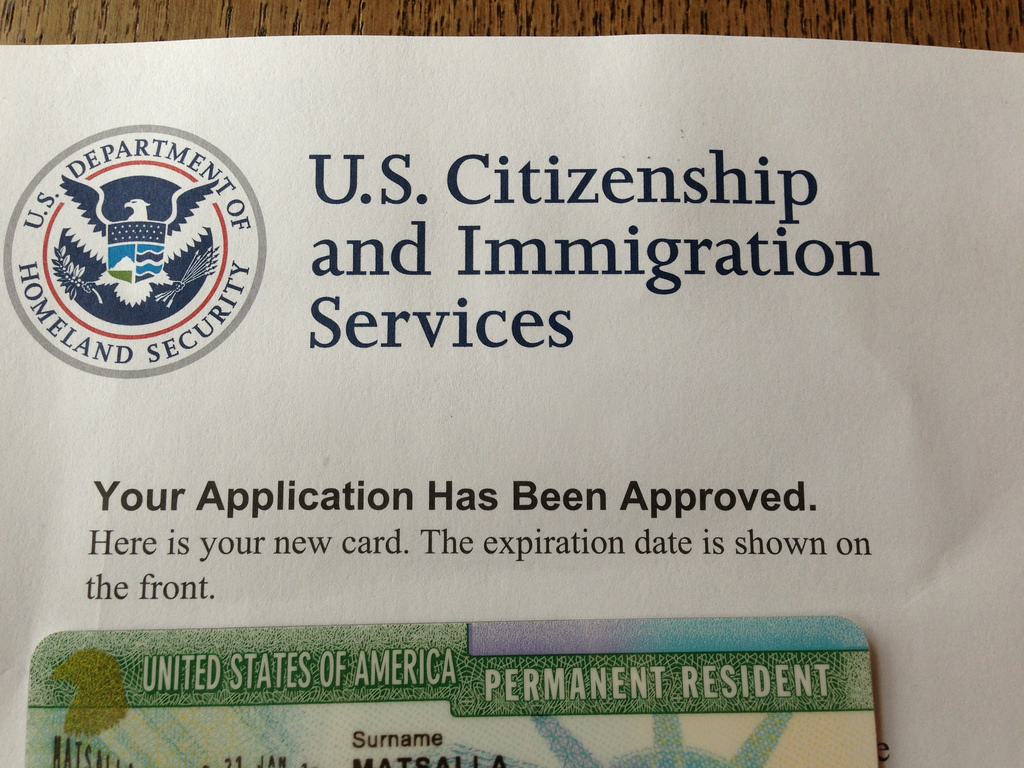
If you have received a two-year conditional permanent resident card, based on your marriage to a United States citizen, you are required to remove the conditions on your green card before the expiration date, by filing the Form I-751 Application for Removal of Conditions jointly with your spouse. Many clients often ask, “how do I know if I am a conditional permanent resident?” You will know if you are a conditional permanent resident if your green card contains the abbreviations ‘CR’ under the immigrant ‘category.’ Foreign spouses of US Citizens will be able to locate the abbreviation ‘CR 6’ on their green cards. If this abbreviation applies to you, you must file the I-751 removal of conditions application jointly with your spouse, within the 90-day window immediately before your conditional green card expires. For example, if your two-year green card expires on August 7, 2016, the earliest day to file your removal of conditions application would be May 9, 2016 up to the date of expiration. If you are no longer married to the US Citizen spouse through which you gained conditional permanent residence, you may seek a waiver of the joint filing requirement and file the application alone.
Proper and Timely Filing of the I-751 Removal of Conditions Application
USCIS must receive your properly completed removal of conditions application along with the filing fee, during this 90-day window, otherwise your application will be rejected if you do not have a legitimate reason for filing your application outside the deadline. If you are unsure of the time period in which you must file your I-751 application, you should consult with a licensed immigration attorney early on in the process. If you have decided to file the I-751 application on your own, without the assistance of an attorney, you must read the I-751 Form Instructions VERY CAREFULLY and contact the USCIS National Customer Service Line with questions.
Why do I need to file the removal of conditions application?
USCIS grants two-year conditional green cards to foreign spouses of U.S. Citizens, if the foreign spouse has been married to the US Citizen spouse for less than two years (on the date that they are granted permanent residence). Foreign spouses who have been married to their US Citizen spouse for more than two years (on the date they are granted permanent residence), receive permanent ten-year green cards. Permanent residents, as opposed to conditional permanent residents, do not need to file the I-751 removal of conditions application, because they already have been granted the ten-year green card.
Clients typically ask us; why must I file the removal of conditions application if I have already gone through the rigorous green card process with my spouse?
USCIS requires you to jump yet another hurdle in order to ensure that you have entered your marriage in good faith, and not to gain an immigration benefit. The I-751 therefore, is a fraud prevention mechanism for newly married couples, requiring them to prove that they did not get married to evade the immigration laws of the United States. As part of the removal of conditions application process, the couple must provide documented evidence showing that they have been living together from the date of marriage to the present (joint lease agreement), that the couple has commingled their finances during their marriage (joint income tax returns, joint bank accounts, joint insurances, joint loans, etc.), that the couple shares joint responsibility of assets and liabilities within the household (joint utility bills, joint insurance policies, joint financial responsibilities), and that the couple spends time together on a regular basis (photographs of the couple from date of marriage to present, phone records, e-mails, text-messages, social media correspondence, hotel/flight reservations, evidence of joint trips taken together, affidavits from friends and family members, etc.)
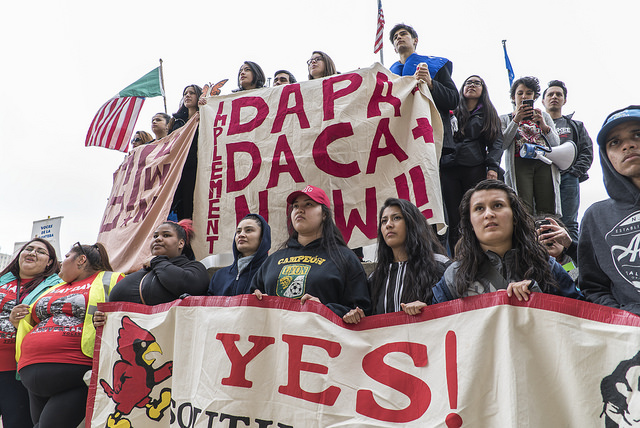 As previously reported, the Department of Justice is currently facing off in court against a federal judge from the State of Texas, who has accused federal prosecutors of misrepresenting, and withholding information in federal court, related to the implementation of the expanded Deferred Action for Childhood Arrivals (DACA) program and new Deferred Action for Parents of Americans and Lawful Permanent Residents (DAPA) program that was scheduled to take effect on February 18, 2015, as part of President Barack Obama’s executive actions on immigration. All of that changed, when Judge Hanen filed a temporary injunction in court, blocking these executive orders from taking effect, just days before February 18, 2015. Judge Hanen is asking the court to punish federal prosecutors working for the Department of Justice by forcing them to attend mandatory ethics courses.
In addition, Hanen has requested that the Department of Homeland Security hand over the names, addresses, and other information of individuals who were unlawfully granted immigration benefits under these programs. On Friday, a group of undocumented individuals came forward, asking an appellate court to respect their privacy by not turning over their personal information to the State of Texas, and other interested parties. This group of undocumented individuals is currently being represented by the American Civil Liberties Union (ACLU) and the National Immigration Law Center (NILC). Attorneys for the group are expected to argue before the U.S. Court of Appeals for the Fifth Circuit in order to block Judge Hanen’s order.

Massachusetts Governor Charlie Baker has proposed a new policy that will allow State Police to contact federal immigration authorities for the purposes of verifying the immigration status of suspects already in custody on state criminal charges. In taking this step, Governor Baker, a Republican, is undoing the actions of his Democratic predecessor, ex-governor Deval Patrick. This new proposal will be put in place to allow federal law enforcement officials to better combat terrorism, gangs, and other activity of a criminal nature in the state of Massachusetts. This policy will affect undocumented immigrants, as well as legal permanent residents, with extensive criminal records or those convicted of serious crimes of moral turpitude.
State police will not be able to apprehend individuals based on immigration violations alone. Instead, as a result of this new policy, state troopers will be able to contact Immigration and Customs Enforcement (ICE) and inquire with ICE whether a person in custody is considered a ‘priority target.’ A ‘priority target’ is someone who has extensive criminal history or poses a security risk. By law, state police cannot enforce federal immigration law, but they will be able to assist federal law enforcement officials in detaining individuals in custody who pose a significant threat to the country’s national security.