Articles Posted in Court Orders

cityscape-5351686_1280A federal judge has issued a court order requiring that immigrants detained at a U.S. Immigration and Customs Enforcement (ICE) processing center in downtown Los Angeles be granted access to their attorneys in a timely manner.

The ruling comes after lawyers reported that detainees were frequently denied phone access, had in-person meetings canceled, and faced pressure to sign legal documents without private counsel.

The B‑18 facility, originally designed as a short-term holding space, lacks basic amenities such as beds, showers, and adequate medical services. Advocates say ICE has effectively turned it into a long-term detention site, restricting detainees’ ability to communicate with the outside world.

bike-7071098_1280
On November 12, 2025, a federal court ruling in the case Moody et al. v. Mayorkas et al. granted relief to new investors in the EB-5 program by halting the increased application fees introduced by the U.S. Citizenship and Immigration Services (USCIS) on April 1, 2024.


What fees were increased?


Here’s a quick breakdown of the fee changes that were challenged:

ai-generated-8775233_1280On October 3, 2025, a coalition of labor unions, healthcare providers, academic institutions, and religious groups, filed a lawsuit urging a federal court to strike down the $100,000 fee imposed on new H-1B petitions by the Trump administration for workers outside the United States.

What the Lawsuit Says


The lawsuit, filed in the U.S. District Court for the Northern District of California, argues that the fee which took effect September 21, violates both the Immigration and Nationality Act and the Administrative Procedure Act. Plaintiffs claim the President lacks authority to unilaterally impose a fee of this kind, especially one designed to raise revenue or direct government spending.

The Trump administration’s sudden rollout of the H-1B fee caused immediate disruptions:

  • Workers abroad scrambled to return to the United States, paying steep travel costs.
  • Others inside the U.S. canceled planned international travel.
  • Some even asked to deplane midflight upon hearing the news.

The fee is seen by critics as a threat to institutions that rely heavily on skilled foreign workers—such as universities, health systems, and religious groups—particularly in fields already facing staffing shortages.

Continue reading

us-1978465_1280Last week, the U.S. Supreme Court handed down a troubling decision that could strip legal status from hundreds of thousands of Venezuelans currently living in the United States under Temporary Protected Status (TPS).

On Friday, the Court granted the Trump administration’s request to halt a lower court ruling that found the administration’s cancellation of TPS protections for Venezuelans unlawful. The unsigned order from the Court effectively allows the government to proceed, for now, with its plans to revoke temporary protections that had shielded Venezuelan nationals from deportation and granted them employment authorization.

TPS was created in 1990 as a humanitarian safeguard for individuals whose home countries are experiencing extraordinary crises such as armed conflict, environmental disasters, or other temporary but severe disruptions. Venezuela was designated for TPS in 2021 under President Biden, in response to the country’s severe economic collapse, widespread human rights abuses, and political instability.

Since then, approximately 300,000 Venezuelans have relied on that protection to live and work legally in the U.S., building lives, paying taxes, and raising families.

Trump Administration Moves to Strip Venezuela’s TPS Designation


But the political tides have shifted. When the Trump administration returned to office, it appointed Kristi Noem as Secretary of Homeland Security. Earlier this year, Noem moved to revoke Venezuela’s TPS designation, arguing that conditions in the country had improved and that continuing the program was no longer in the national interest. That decision sparked immediate legal challenges. A coalition of Venezuelan TPS recipients and advocacy groups sued, claiming the administration’s actions were arbitrary, rushed, and in violation of federal law.

Continue reading

36952236081_5179c7d2d3_z

Source: Flickr Creative Commons Attribution mollyktadams

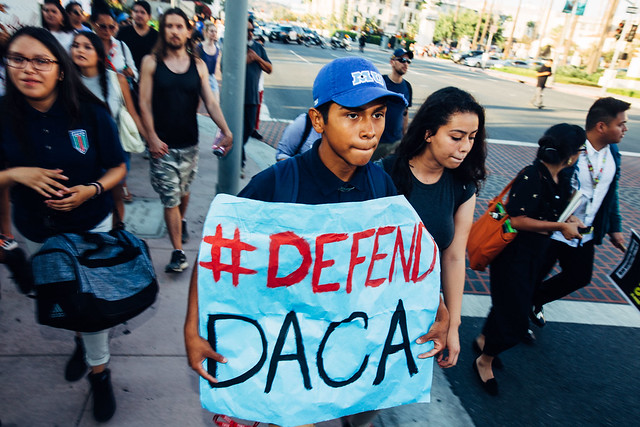
Recent court documents submitted by the government in the case, State of Texas v. United States of America (1:18-cv-00068), reveal that the U.S. Citizenship and Immigration Services (USCIS) may soon resume processing initial DACA applications for individuals living outside of Texas.

Since 2021, new DACA requests had been halted due to a court order which was later applied only to the state of Texas.

Under the proposed plan, USCIS would process initial applications for applicants residing outside of Texas. For those living in Texas, the government would only grant deferred action, without employment authorization or recognition of lawful presence. Moving to Texas could jeopardize a DACA recipient’s work authorization.

The government’s plan still requires court approval, and USCIS has not yet shared any timeline or implementation details if it moves forward.

DACA Refresher


Deferred Action for Childhood Arrivals (DACA) is a program that allows individuals who were brought to the United States as children to remain in the United States temporarily and apply for work permits. While it does not grant legal status, it offers protection from deportation.

Those eligible for DACA include individuals who entered the country as children before their 16th birthday, were under 31 years old as of June 15, 2012, and have not been convicted of a felony, a significant misdemeanor, or three misdemeanors.

Continue reading

people-4009327_1280On September 24, 2025, the Department of Homeland Security (DHS) issued a proposed rule that would change the current selection process for selecting H-1B visa petitions subject to the annual numerical limits established by the Immigration and Nationality Act.

Under the proposed rule, the current random lottery system would be replaced with a wage-based selection process that prioritizes the selection of H-1B workers offered higher salaries by sponsoring employers.

The goal is to better align the H-1B program with U.S. labor market needs by increasing the chances of selection for higher-paid, and presumably higher-skilled, foreign workers. This change aims to reduce the potential for abuse in the system, discourage mass low-wage registrations, and ensure that the most economically valuable positions are filled through the H-1B program.

What may change


Currently, the U.S. government selects H-1B visa petitions through a randomized lottery system due to the annual numerical cap on available visas. Employers first submit electronic registrations for each prospective H-1B worker during a designated registration period, typically held in March. Because the demand for H-1B visas consistently exceeds the supply, the U.S. Citizenship and Immigration Services (USCIS) conducts a lottery to determine which petitions can proceed with applying for H-1B visas.

There are two separate caps under the H-1B program: the regular cap of 65,000 visas and an additional 20,000 visas reserved for individuals who hold advanced degrees from U.S. institutions (commonly referred to as the master’s cap). All registered beneficiaries, including those with U.S. advanced degrees, are first entered into the regular cap lottery. After 65,000 are selected, those with U.S. master’s degrees who were not chosen in the initial round are entered into a second lottery for one of the 20,000 advanced degree slots.

This current system does not prioritize applicants based on wage levels, qualifications, or skills. Selection is purely random as long as the minimum eligibility requirements are met.

However, the Department of Homeland Security (DHS) is proposing changes that would shift the selection process to favor higher-paid workers.

Continue reading

ai-generated-9069946_1280The legal immigration landscape was shaken once again late Friday evening when the President issued a new proclamation barring new H-1B workers from entering the United States—unless their employers pay a $100,000 fee for each sponsored employee.

The proclamation took effect at 12:01 a.m. EDT on Sunday, September 21, and will remain in effect until a court order halts its implementation.

Emergency Litigation


A surge of emergency lawsuits is expected to be filed by impacted H-1B workers and their sponsoring employers, seeking a nationwide injunction to stop the implementation of the executive order. A court could issue an injunction as early as Monday. We will provide litigation updates as they develop in the coming days.

Highlights of the Executive Order


  • Effective today September 21, 2025, certain H-1B workers will be denied entry into the United States unless their employer pays a $100,000 fee on their behalf, according to the proclamation signed by President Trump late Friday.
  • Application: The ban on entry and the associated fee requirement applies only to any new H-1B visa petitions submitted after 12:01 a.m. eastern daylight time on September 21, 2025. This includes the 2026 lottery, and any other H-1B petitions submitted after 12:01 a.m. eastern daylight time on September 21, 2025.
  • The proclamation does not apply to:
    • any previously issued H-1B visas, or any petitions submitted prior to 12:01 a.m. eastern daylight time on Sept. 21, 2025.
    • does not change any payments or fees required to be submitted in connection with any H-1B renewals. The fee is a one-time fee on submission of a new H-1B petition.
    • does not prevent any holder of a current H-1B visa from traveling in and out of the United States.
  • Misuse of B Visas: The proclamation warns that individuals with approved H-1B petitions should not misuse B visas to enter the U.S. for jobs that start before October 1, 2026.
  • National Interest Exemptions: The proclamation grants the Department of Homeland Security authority to issue exemptions for individuals, specific employers, or workers in designated industries—if the agency determines that the H-1B employment serves the national interest and poses no threat to U.S. security or public welfare.
  • Termination: Absent a court order, this restriction will remain in effect for 12 months but may be extended based on recommendations from federal immigration agencies. An extension would continue the ban for individuals approved under the FY 2027 H-1B cap.
  • Changes to the Prevailing Wage: Besides restricting H-1B entry, the proclamation directs the Department of Labor to revise prevailing wage levels and prioritize H-1B approvals to high-skilled, high-paid H-1B workers.

In the hours after the proclamation was issued, chaos unfolded as H-1B visa holders, advised by their employers and legal counsel, abandoned flights and canceled international travel due to uncertainty about how the proclamation would be enforced at the U.S. border.

Adding to the uncertainty was the absence of clear guidance from immigration authorities, including the Department of Homeland Security (DHS) and Customs and Border Protection (CBP), about how the proclamation is to be enforced against current H-1B visa holders and approved beneficiaries.

Continue reading

judge-8779957_1280In a significant victory for civil rights and immigrant advocacy groups, a federal appeals court has upheld a lower court’s decision to temporarily block federal immigration agents from conducting immigration-related arrests in Los Angeles without reasonable suspicion.

The Ninth Circuit Court of Appeals issued the ruling late Friday, marking a major legal development in the ongoing battle over immigration enforcement and constitutional protections.

At the heart of the case is the question of whether federal agents can detain individuals based solely on generalized characteristics such as race, ethnicity, or language. The appeals court was clear: they cannot.

A Firm Rejection of Racial Profiling

The three-judge panel ruled that U.S. Immigration and Customs Enforcement (ICE) and other federal agents cannot use factors like “apparent race, ethnicity, speaking Spanish or speaking English with an accent, particular location, and type of work” as the basis for reasonable suspicion to stop an individual. Even taken together, the court stated, these characteristics form only a broad profile and fail to meet the legal standard required for a lawful stop.

“We agree with the district court that…these factors do not demonstrate reasonable suspicion for any particular stop,” the panel wrote, emphasizing the constitutional protections that apply to all individuals, regardless of immigration status.

Continue reading

motherhood-7114294_1280Last month, the Supreme Court ruled that lower courts cannot issue nationwide injunctions blocking the Trump administration’s executive order limiting birthright citizenship, except in class action lawsuits.

Prior to the Supreme Court’s ruling, at least three different lawsuits had secured nationwide injunctions protecting all individuals potentially affected by Trump’s executive order restricting birthright citizenship. However, the Court’s ruling scaled back those protections, potentially leaving some children unprotected.

To safeguard all families across the country and address any gaps left by prior legal actions, the American Civil Liberties Union (ACLU) filed a class-action lawsuit, Barbara v. Donald J. Trump to stop the government’s enforcement of the order against all current or future babies born or after February 20, 2025, where:

(1) that child’s mother was unlawfully present in the United States and the child’s father was not a United States citizen or lawful permanent resident at the time of said child’s birth, or

(2) that child’s mother’s presence in the United States was lawful but temporary, and the child’s father was not a United States citizen or lawful permanent resident at the time of said child’s birth.

The U.S. District Judge Joseph Laplante agreed with the plaintiffs and issued a class-wide preliminary injunction blocking Trump’s executive order from being enforced against any affected baby born in the United States after February 20th.

Continue reading

Gavin_Newsom_by_Gage_Skidmore

Attribution: Gage Skidmore

On Friday July 11, 2025, a federal judge ruled that the government’s ongoing immigration raids in Southern California and its denial of legal counsel to detained immigrants likely violates the Constitution.

In so ruling, the court issued two temporary restraining orders (TROs) barring the Department of Homeland Security (DHS) and other federal agencies from continuing these actions in the counties of Los Angeles, Orange, Ventura, Riverside, San Bernardino, Santa Barbara and San Luis Obispo. (Pedro Vasquez Perdomo v. Kristi Noem (2:25-cv-05605)

The first TRO prohibits immigration agents from stopping individuals without reasonable suspicion and bars law enforcement from relying solely on the following factors—alone or in combination—to form reasonable suspicion for a stop including (1) apparent race or ethnicity (2) speaking Spanish or English with an accent (3) presence in a particular location like a bus stop, car wash, day laborer pick up site, or agricultural site, or (4) the type of work the person does.

The second TRO orders DHS to provide access to counsel on weekdays, weekends, and holidays for those who are detained in B-18, the basement of a federal building in downtown Los Angeles located at 300 North Los Angeles Street.

It further requires immigration officials to develop guidance on how agents and officers should determine whether “reasonable suspicion” exists when conducting stops and to implement training for officers involved in immigration operations.

In addition to immigration officers, the TROs apply to the FBI and Justice Department, who are named in the lawsuit and are involved in immigration enforcement actions.

Continue reading