Articles Posted in Green Card Interview

donald-trump-4539866_1280

On Friday October 11, 2019, three Federal courts in California, New York, and Washington issued three temporary injunctions blocking the Trump administration from enforcing the Public Charge rule on a nationwide basis, which was set to go into effect on October 15, 2019.

The decision to block the government from enforcing the Public Charge rule is sure to set off a contentious legal battle that is just beginning to unfold.

California’s Injunction

In California, the City of San Francisco, State of California, and La Clinica de La Raza, a health care provider, joined together as plaintiffs to sue the United States Citizenship and Immigration Services (USCIS), the U.S. Department of Homeland Security (DHS), and the President of the United States to prevent the Public Charge rule from going forward.

U.S. District Judge Phyllis Hamilton granted the Plaintiffs a preliminary injunction bringing a temporary stop to the government’s plans to enforce the rule, in states falling under the purview of the U.S. District Court of Appeals for the Ninth Circuit.

Judge Hamilton wrote that in seeking to enforce the final rule, the government failed to consider the impact the rule would have on local and state governments when immigrants chose to leave public health benefit program, “[DHS] made no attempt, whatsoever, to investigate the type or magnitude of harm that would flow from the reality which it admittedly recognized would result—fewer people would be vaccinated,”

Washington’s Injunction

Similarly in a separate but related lawsuit, the States of Washington, Colorado, Delaware, Hawaii, Illinois, Maryland, Massachusetts, Minnesota, Nevada, New Jersey, New Mexico, and Rhode Island joined together as Plaintiffs to sue the United States Citizenship and Immigration Services (USCIS), the U.S. Department of Homeland Security (DHS), the heads of these agencies, and the President of the United States.

The Washington injunction was more sweeping in scope in that the Federal Judge in that case, Rosanna Malouf Peterson, ordered a nationwide injunction forcing the government to refrain from implementing or enforcing the rule on a temporary but nationwide basis. In her decision Judge Peterson wrote, “the Court declines to limit the injunction to apply only in those states within the U.S. Court of Appeals for the Ninth Circuit.”

As a result, the broad scope of the injunction prevents the government from enforcing the Public Charge rule on a nationwide basis.


Continue reading

wei-ding-ndMOb0OBCx0-unsplash

The Trump administration’s controversial rule making certain foreign nationals inadmissible to receive permanent residence on public charge grounds, will become effective beginning October 15, 2019.

First, and foremost let’s recap what this rule is about and who it will apply to:

Under immigration law, an individual who, in the opinion of DHS is likely at any time to become a public charge is (1) ineligible for a visa (2) ineligible for admission to the United States and (3) ineligible for adjustment of status (permanent residence).

This means that the rule applies to foreign nationals applying for a U.S. visa, foreign nationals seeking admission through a port of entry, and individuals applying for adjustment of status.

When an individual applies for any immigration benefit with the government, (whether a U.S. visa or green card application), the official adjudicating the petition must determine whether that individual is or will likely become a public charge. This determination is referred to as a “public charge determination.”

What makes someone a public charge in the eyes of immigration?

A person is a “public charge” if they are primarily dependent on the Government for subsistence, as demonstrated by either the receipt of public cash assistance for income maintenance or institutionalization for long-term care at Government expense.

Continue reading

tyler-nix-V3dHmb1MOXM-unsplash
The process of getting a visa for a family member can be stressful.

The immigration system is complex. Being separated from your family can be painful and visa processing times frustrating. The law seems to change so often, it can be hard to keep track of what rules you’re supposed to follow.

Recently, the United States Department of State changed the family sponsored visa numbers for several countries. They released these new numbers in the September 2019 Visa Bulletin.

trump-1822121_1920-1

Immigration Raids Cancelled for Two Weeks

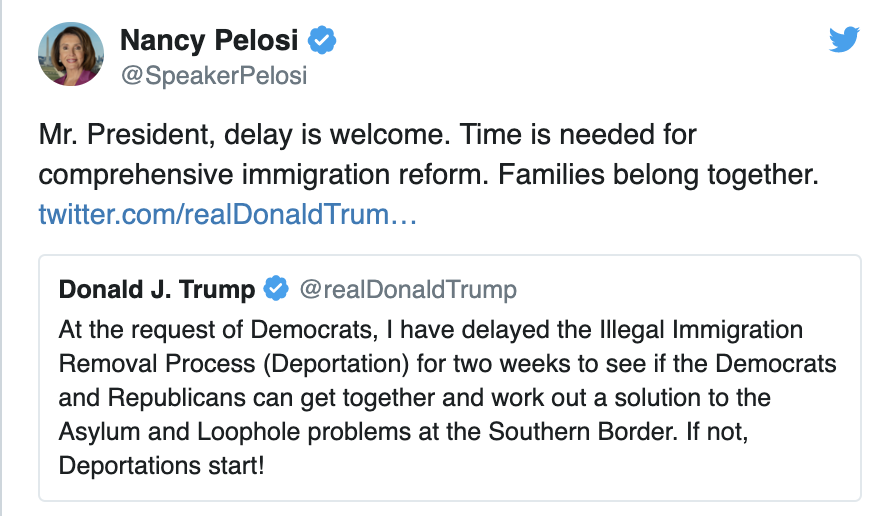
In a new turn of events, President Trump announced on Saturday, June 22, 2019, that he would delay the immigration raids that were set to begin on June 23, 2019, for a period of two weeks to give Congress more time to make changes to existing asylum law.

On the eve of the immigration raids, the Speaker of the House, Nancy Pelosi brokered a deal in which she asked the President to cancel the planned immigration raids. On Saturday the President tweeted that at the request of the Democrats, the raids would be pushed back for two weeks giving both parties time to roll out proposals regarding immigration reform.

For the time being the immigration raids will not be going forward as originally planned.

https://www.visalawyerblog.com/files/2019/06/Screen-Shot-2019-06-25-at-4.46.13-PM.png

Digitized FOIA System

USCIS has announced that its FOIA System is now digitized. Users will now be able to submit, track, and receive FOIA requests digitally. This is great news because this option will speed up the process of requesting a FOIA and also speed up the form of delivery. Previously, applicants were required to submit a request by mail and would receive the results of the FOIA request by mail in compact disc form. Now, applicants will be able to access their documents digitally.

Applicants will simply need to create a USCIS online account to take advantage of this new and improved system.

Continue reading

interview-2207741_1920
Today, June 17, 2019, the United States Citizenship and Immigration Services (USCIS), announced a new strategy aimed at reducing the processing times for applications for naturalization and adjustment of status. This new strategy will attempt to equalize the processing times for citizenship and adjustment applicants who live in a jurisdiction that has been burdened by higher than normal demand.

USCIS has issued a press release indicating that during fiscal years 2016 and 2017 the agency received a higher than expected volume of applications. Unfortunately, the increase in applications received throughout this period has burdened some field offices more than others, resulting in the disparities we are seeing in processing times across field offices.

To decrease the processing times in hard hit regions, USCIS will now be shifting citizenship and adjustment of status cases between different field offices to better distribute the workload and increase efficiency. This strategy should result in a decrease in processing times in regions that were previously experiencing higher than normal processing times.

29936853911_6774afae33_z

Photo: CafeCredit

The Trump administration is mobilizing to strictly enforce laws that require the reimbursement of funds from an alien’s financial sponsor, where the alien has requested certain types of public benefits from a government agency.

The White House has issued a memorandum stating that, “Financial sponsors who pledge to financially support a sponsored alien in the event the alien applies for or receives public benefits will be expected to fulfill their commitment under the law.”

Financial sponsors are required to sign Form I-864 Affidavit of Support for most family-based immigrant petitions, as well as some employment-based petitions to show that the intending immigrant has adequate means of financial support and will not become a public charge on the United States government.

The White House has directed various government agencies including the Department of labor, housing, health and human services, etc. to hold sponsors accountable for making a financial commitment to sponsor an alien in the United States, who receives forms of government assistance they are not entitled to receive.

Such benefits that will require reimbursement from a financial sponsor are benefits received from the Supplemental Nutrition Assistance Program (SNAP) which provides food stamps, Medicaid, and Temporary Assistance for Needy Families (TANF).

Continue reading

martin-brosy-758535-unsplash
Good News for Adjustment of Status Applicants! The United States Citizenship and Immigration Services (USCIS) is updating its policy, extending the validity of Form I-693 Report of Medical Examination and Vaccination Record, submitted along with an application for an immigration benefit (such as an I-485 Application for Adjustment of Status).

Effective November 1, 2018, Form I-693 will be valid for a maximum period of 2 years from the date of the civil surgeon’s signature on Form I-693, provided that the civil surgeon signs the medical examination 60 days before the date the applicant files an application for an underlying immigration benefit with USCIS.

Previously, Form I-693 was only valid for a period of one year from the date of the civil surgeon’s signature.

chester-town-hall-3546932_1920

Several months ago, we reported that the United States Citizenship and Immigration Services (USCIS) amended its policy regarding the issuance of Notice to Appear (NTA) documents in removal proceedings.

During the month of June, USCIS released a policy memorandum indicating the agency’s intent to revise NTA policy to better align with the President’s Executive Order 13768 “Enhancing Public Safety in the Interior of the United States.” NTAs are documents that are issued to alien’s subject to removal from the United States. Issuance of an NTA initiates the process of removing an individual from the United States.

Specifically, the Executive Order 13768 called on DHS to “prioritize the removal of aliens described in INA §§ 212(a)(2), (a)(3), (a)(6)(C), 235, and 237(a)(2) and (a)(4) … who are removable based on criminal or security grounds, fraud or misrepresentation, and aliens subject to expedited removal.”

In addition, the Executive Order called for the removal of individuals who:

  • (a) Have been convicted of any criminal offense;
  • (b) Have been charged with any criminal offense that has not been resolved;
  • (c) Have committed acts that constitute a chargeable criminal offense;
  • (d) Have engaged in fraud or willful misrepresentation in connection with any official matter or application before a governmental agency;
  • (e) Have abused any program related to receipt of public benefits;
  • (f) Are subject to a final order of removal, but have not departed; or
  • (g) In the judgment of an immigration officer, otherwise pose a risk to public safety or national security

Continue reading

rawpixel-567016-unsplash

In this post, we will discuss our top ten tips to help you survive the marriage fraud interview also known as the “STOKES” interview. An applicant filing for adjustment of status to permanent residence may be scheduled for a second interview, known as the “STOKES” interview if the immigration officer is not convinced at the initial I-485 interview that the applicant has a bona fide marriage.

  1. Be Honest

Our first tip to avoid being scheduled for a second interview also known as the STOKES interview is simple. Be honest with yourself, with your partner (the U.S. Citizen or LPR spouse), and your attorney if you have one. Before walking into your initial I-485 interview you should be careful not to misrepresent the facts in your relationship and ensure that you and your partner are both being honest and truthful regarding all aspects of your marriage. If you or your spouse misrepresent any facts about your relationship, the immigration officer will presume that you do not have a bona fide/genuine marriage, and it will be very difficult to overcome this presumption at the second interview.

  1. Preparation

The second tip to avoid the STOKES interview is to be well prepared. You and your spouse should prepare all of your documentation proving bona fide marriage well in advance of your I-485 interview, so that you have enough time to review your documentation with your spouse and your attorney in preparation of your interview. This well make you feel more confident and prepared when it comes time to your I-485 interview.

  1. Never Lie, Misrepresent, or Provide False Information

If you do not know the answer to a question asked by an immigration officer, DO NOT under any circumstances LIE, MISREPRESENT, or provide FALSE information. If you do not know the answer, simply tell the officer that you do not know. Always be honest. If you are not honest with an immigration officer this will indicate not only that you are a person of bad moral character, but that you are committing fraud in order to obtain an immigration benefit. Do not under any circumstances, invent facts that are not true. Remember that immigration has various tools to uncover fraud including the ability to visit you and your spouse at your home unexpectedly if they believe that you are lying or are not being honest about your marriage.

Continue reading

cartoon-2897720_1920

If you have applied for the I-130/485 based on marriage to your US Citizen spouse, chances are you are anxiously awaiting an interview. In this post we will cover the documentation you need to provide at the I-485 interview to prove the bona fides of your relationship. The most common question clients ask is, what a bona fide marriage is and how do I prove that I have a bona fide marriage.

A bona fide marriage is one that was entered in good faith and not with an intention to deceive. A green card applicant does not have a bona fide marriage if he or she entered the marriage solely to receive an immigration benefit from USCIS. Immigration officers are trained to identify fraudulent or “sham” marriages where either party or both parties have entered the marriage simply for the green card applicant to obtain his or her permanent residence in the United States, without any sincere intention to live together in the same household or form a marital bond.  Immigration officers search for inconsistencies in any answers provided by either party to the marriage, and carefully scrutinize supporting documentation provided by the couple with the initial I-485 filing.

There are various forms of documentation that are strong evidence proving the bona fides of a relationship. Generally speaking, evidence of cohabitation, joint ownership of assets and joint responsibility for liabilities, and birth certificates of children born to the marriage are strong evidence proving that a marriage is genuine.

Cohabitation: One of the most important aspects of proving bona fide marriage is to show cohabitation—that you are living with your spouse. You can show evidence of cohabitation by providing a copy of your lease agreement showing both of your names on the lease if you are renting an apartment. If your spouse maintains ownership of a private residence, your spouse can provide a copy of the deed including both of your names, or if the green card applicant’s name is not yet on the deed, the petitioner can provide a statement as evidence of cohabitation. Other documents that can be shown to prove cohabitation include joint utility bills such for gas and electricity, water, internet bills, phone bills, etc. that contain both of your names. In addition, any mail sent to your residential address containing both of your names may be used as evidence of cohabitation. The strongest evidence showing cohabitation however is a copy of the lease agreement or deed containing both names.

Continue reading