Articles Posted in Inadmissability

14306017036_931628b92f_z

For persons who have entered the United States illegally or who have accrued unlawful presence after having overstayed their visa, the possibility of obtaining lawful permanent residence (a green card) is very limited. In the United States there are generally two ways to adjust status to permanent residence. With few exceptions, a green card may generally be obtained through employment-based sponsorship, or family sponsorship based on a qualifying family relationship, such as a U.S. Citizen or Legal Permanent Resident relative. Unlawful presence is a very serious immigration offense that is subject to punishment depending on the amount of time a person has accrued unlawful presence in the United States.

Undocumented immigrants who accrue unlawful presence in the United States, and subsequently leave the country, and attempt to re-enter the United States lawfully, may be subject to either a 3- or 10-year bar, based on the amount of time they have accrued unlawful presence in the United States. Specifically, under the Immigration and Nationality Action Section §212(a)(9)(B)(i)(I) a person who has accrued more than 180 days of unlawful presence in the United States, is subject to a 3-year bar automatically triggered once the person departs the United States. The bar would thereby prevent a person from being re-admitted into the United States, depending on the amount of time they were previously unlawfully present in the country. Similarly, under the Immigration and Nationality Act §212(a)(9)(B)(i)(II), a person who has accrued one year or more of unlawful presence in the United States, is subject to a 10-year bar preventing a person from being re-admitted to the United States, once they have departed from the United States.

Continue reading

16204909498_c2948b5c85_z

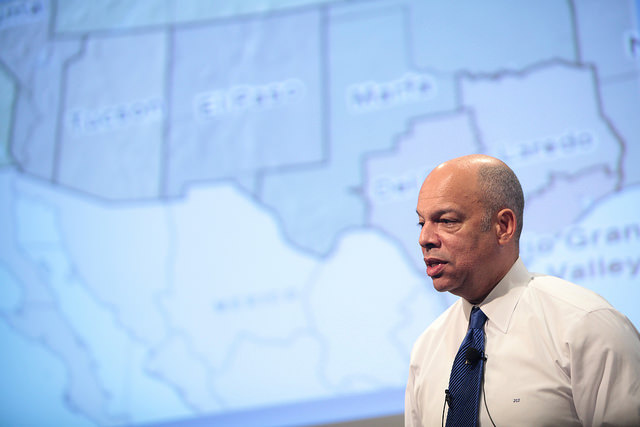
The U.S. Department of Homeland Security is expected to run a study to determine whether privately run detention facilities are unsafe for migrants. The Secretary of the Department of Homeland Security, Jeh Johnson, has stated that the administration will evaluate whether or not the agency will end the practice of privatizing immigration detention facilities, issuing a recommendation by November 30th of this year.

The announcement comes following reports that private immigration detention facilities have unlawfully withheld proper mental health and medical care from persons being detained in their immigration facilities. Presently, the two major private companies running ICE immigration detention facilities across the United States are the Corrections Corporation of America and the GEO Group. Together these private companies hold lucrative state and federal government contracts. It is estimated that the Corrections Corporation of America has earned $689 million alone from its contracts with ICE dating back to 2008, while the GEO Group has earned an estimated $1.18 billion from these contracts during that same period.

Continue reading

7301111628_dd7c4e3fb0

Q: What qualifies as a bar of “Unlawful Presence?”

A: If you have accrued more than 180 days of unlawful presence in the United States, you are subject to a 3-year bar preventing you from being re-admitted to the United States under the Immigration and Nationality Action Section §212(a)(9)(B)(i)(I). The bar is triggered once you have departed the United States.

If you have accrued one year or more of unlawful presence in the United States, you are subject to a 10-year bar preventing you from being re-admitted to the United States under §212(a)(9)(B)(i)(II).

If upon your entry to the United States, you were not inspected, admitted, or paroled by a U.S. Customs Official, then you are ineligible to adjust your status to lawful permanent resident (LPR) within the United States, even if you have an approved visa petition. This means that in order to legalize your status, you are required to depart the United States and apply for an immigrant visa at a United States embassy or consulate abroad. Your departure from the United States will then trigger a 3- or 10-year bar to readmission, preventing you from returning to the United States, depending on the amount of “unlawful presence” you accrued prior to your departure.

There are ways to waive these 3- and 10-year bars to readmission only if you can demonstrate that your refusal of admission to the United States would cause an “extreme hardship” to your U.S. Citizen immediate relative or Legal Permanent Resident spouse or parent.

Q: Can I apply for the provisional waiver if I was previously deported, removed, or excluded from the United States?

If you received a final order of removal, deportation, or exclusion you may apply for a provisional waiver of unlawful presence, however you must first apply for the I-212 Application for Permission to Reapply for Admission into the United States After Deportation or Removal, and the application must be conditionally approved.

If ICE or CBP has reinstated a prior removal order under 8 CFR §241.8, before filing of the provisional waiver application or while the application is in process, you are no longer eligible to receive a provisional waiver of unlawful presence. A provisional waiver approval would be automatically revoked if the applicant is found inadmissible under INA §212(a)(9)(C) for unlawful return to the United States after prior removal or prior unlawful presence.

Continue reading

6991805074_a31fb26d22_c

The United States Citizenship and Immigration Services (USCIS) has published a new final rule that will expand the class of individuals who are eligible to apply for a ‘provisional’ waiver of certain grounds of inadmissibility (Form I-601A) based on their accrual of unlawful presence in the United States.

The provisional unlawful presence waiver allows certain individuals, unlawfully present in the United States, to request a provisional waiver before departing the United States for consular processing of their immigrant visas.

Previously, only immediate relatives of U.S. Citizens were eligible for this waiver. The provisional waiver is beneficial because it does not require the applicant to wait until the consular interview, to apply for a waiver, as in the case of the I-601 waiver. Provisional waivers also substantially reduce the time of separation between the applicant and his or her U.S. Citizen or legal permanent resident (LPR) relatives.

The rule was published in order to improve efficiency and reduce the amount of time that a U.S. Citizen/LPR spouse or parent is separated from his or her relatives while the relative completes the immigrant visa process. According to the 2013 rule, parents, spouses and children of U.S. Citizens were eligible to apply for provisional waivers of the 3- and 10-year unlawful presence bars before departing the United States for their immigrant visa interviews. The new rule expands upon the 2013 rule extending that benefit to family members of LPRs.

Who benefits?

The rule will expand the provisional waiver process to certain individuals who are family members of U.S. Citizens and lawful permanent residents (LPRs) who meet the statutory requirements to be eligible for an immigrant visa. The rule will expand eligibility to all individuals statutorily eligible for the waiver. In order to qualify, applicants must be able to establish that their U.S. Citizen or LPR spouse or parent would experience an “extreme hardship” if the applicant was not allowed to remain in the United States. The final rule will take effect on August 29, 2016.

Continue reading

5395896627_d7714ee637_z

What is Adjustment of Status?

Adjustment of Status is the process by which a foreign national can change their immigration status from a temporary nonimmigrant to an immigrant (permanent resident), while in the United States. There must be a basis under which a foreign national can apply for adjustment of status. In most cases the foreign national must have an immediate relative who is a U.S. Citizen or have an employer willing to file an immigrant petition on their behalf.

Generally, a foreign national can apply for adjustment of status, if they were inspected by a customs official at a United States port of entry and admitted or paroled into the United States, and meets all requirements to apply for a green card (permanent residence). The Immigration and Nationality Act (INA) allows an eligible foreign national already living in the United States with their U.S. Citizen spouse, to obtain permanent resident status without having to return to their home country to apply for an immigrant visa at a United States consulate abroad. Spouses of U.S. Citizens are eligible for adjustment of status to permanent residence once the US Citizen spouse files a petition on their behalf called the I-130 Petition for Alien Relative. The I-130 Petition for Alien Relative is typically filed at the same time (concurrently) as the I-485 Application to Register Permanent Residence or Adjust Status. For immigration purposes, the intending immigrant (or foreign national) is referred to as the ‘beneficiary’ of the application, while the U.S. Citizen spouse is referred to as the ‘petitioner’ of the I-130 application. The petitioner allows the beneficiary to apply for adjustment of status on the basis of their marital relationship (established with the filing of the I-130 Petition).

In general, most immigrants become eligible for permanent residence once an immigrant petition is filed on their behalf by either a qualifying family relative (I-130 Petition) or through an employer (I-140 Petition) although there are special categories of green card applicants that exist. Unlike distant relatives of U.S. Citizens and alien workers, spouses and immediate relatives of U.S. Citizens are not subject to any visa limitations. This means that they do not need to wait in line to receive permanent residence; an immigrant visa is immediately available to them and there are no quotas. The process of immigrating a foreign spouse through adjustment of status takes approximately 4-6 months depending upon the volume of adjustment of status application being processed by USCIS at the time of filing, and the amount of applications waiting in line for an interview at your local field office.

Spouses of U.S. Citizens residing abroad are not eligible for adjustment of status

For spouses of U.S. Citizens residing abroad, adjustment of status is not an option because the intending immigrant and U.S. Citizen spouse must be living together in the United States in order to apply. Instead, spouses of U.S. Citizens who are living abroad must resort to consular processing, in order to obtain an immigrant visa and permanent residency. Consular processing is also utilized to immigrate a foreign spouse who is ineligible to adjust status, for example in the case where the foreign spouse entered the United States illegally.

Continue reading

Screen Shot 2016-05-26 at 2.59.40 PM

The state of Colorado is set to pass a new bill known as HB16-1391 that will prosecute non-attorneys posing as licensed immigration attorneys or legal representatives in matters relating to immigration. Colorado Senator Dan Pabon, first introduced the bipartisan bill, HB 16-1391 the Immigration Consultants Deceptive Trade Practice, before the Colorado Senate earlier this year. The focus of HB16-1391 is to crackdown on “notarios” targeting the Hispanic community, who are not licensed to practice law in the United States. The word “notario” in some Latin American countries refers to a person that is either highly trained to conduct legal matters or is an attorney. The word notary in the United States takes on a different meaning. A notary public in the United States is not an attorney and cannot conduct legal matters. They cannot provide legal advice nor represent individuals before court. Instead, a notary public can attest or certify writings to make them authentic. Notary publics are typically involved in the certification of affidavits, depositions, and other negotiable documents. In the United States they witness the making of documents and sign in order to attest that documents are authentic. The Hispanic community is often misled by these “notarios” who advertise themselves as authorized legal representatives and/or attorneys for compensation. Despite the fact that these “notarios” are not authorized to offer legal consultations, they often do causing irreparable damage to the people they serve. They often give false hope to people in the United States unlawfully and mislead them into applying for an immigration benefit they are not eligible to receive, prompting their removal from the United States. The bill, Immigration Consultants Deceptive Trade Practice, will prohibit non-attorneys from conducting consultations, receiving compensation, and providing legal services to individuals related to immigration.

Continue reading

1a233a6

In this segment, we answer 4 of your most frequently asked questions received on our social media platforms and our website. Please remember that every case is different and every immigration journey is unique. You should not compare your situation to anyone else’s. We hope that our answers will provide you with further guidance while you embark on your immigration journey. If you have any further questions, please call our office to schedule a free first time consultation. We serve international clients and domestic clients in all 50 states. We thank you for your continued trust in our law office. For more information on the services we offer please click here.

Consular Report of Birth Abroad (CRBA) and the Affidavit of Support

Q:  I am a US Citizen married to a foreign national. We have a child together. We recently moved to the United States from abroad.  My husband and son entered the United States on a B-2 visa and we are planning to apply for their adjustment of status. My question is regarding the Form I-864 Affidavit of Support. I have just secured employment and will be able to sponsor my family. I want to know what documents are required in support of the Affidavit of Support as proof that I have sufficient income to support my family. At the moment I do not have pay stubs. I plan to start my employment next month.

A: Thank you for your question. If your child was born abroad, your child may acquire U.S. Citizenship by filing for a Consular Report of Birth Abroad (CRBA, Form FS-240) before your child reaches their 18th birthday. To do so, the U.S. Citizen parent must report the birth of the child at their nearest U.S. Embassy or Consulate. Anytime that a child of a U.S. Citizen parent is born abroad, the parent must report the birth to nearest U.S. Consulate as soon as possible. This will allow the Consulate to issue a Consular Report of Birth Abroad as an official record of your child’s claim to U.S. Citizenship. The CRBA may be used as proof of your child’s U.S. Citizenship and allows the child to obtain a U.S. passport. A child with a consular report of birth abroad receives the same privileges as a child born in the United States. It is recommended that you first contact your closest U.S. embassy or Consulate before filing a petition for your son, because it is likely that you will not need to go through the immigration process for your son.

Continue reading

14301886764_524229d763_z

The Supreme Court is expected to hear oral arguments for United States v. Texas, a lawsuit challenging the President’s executive actions on immigration, on Monday April 18th.  We have learned that attorneys representing the Republican led House of Representatives will be given 15 minutes to argue against Obama’s executive actions on immigration, included the expanded Deferred Action of Childhood Arrivals (DACA) program, and the Deferred Action for Parents of Americans and Lawful Permanent Residents (DAPA) program. This move comes after the House of Representatives voted in favor of filing a brief before the Supreme Court challenging the executive actions on immigration. The court has also authorized a group of undocumented mothers of U.S. Citizen children to speak before the Supreme Court for 10 minutes. The Obama administration is currently at a disadvantage, given that only eight Supreme Court justices will ultimately be handing down one of the most important decisions of our generation come June. Obama had hoped that the House of Representatives would hold hearings in consideration of his Supreme Court pick, Chief Judge of the District of Columbia Court of Appeals, Merrick Garland, by the time oral arguments would begin. Unfortunately, this has not been the case. Republicans have refused to hold hearings in consideration of Judge Garland. It is likely that they will continue to delay hearings until the next President of the United States takes office next year.

Oral arguments on April 18th will be no more than 90 minutes long. The majority of the time will be divided by the Obama administration and attorneys representing Texas and 25 other states challenging the constitutionality of Obama’s executive actions on immigration. United States v. Texas is unique because it will finally put to rest the issue of whether or not the executive action on immigration is within the President’s constitutional powers. This case is also unique because it will be one of the few times that the Supreme Court has addressed the issue of illegal immigration and the rights of unlawful immigrants under the constitution.

Continue reading

5086531784_ed4e1a8a69_z
For this blog we are answering 5 questions we have recently received through our social media platforms and our website. Please remember that every case is different and every immigration journey is unique. You should not compare your situation to anyone else’s. We hope that our answers will provide you with further guidance while you embark on your immigration journey. If you have any further questions, please call our office for a free legal consultation. We serve international clients and domestic clients in all 50 states. We thank you for your continued trust and interest in our law office.

Change of Status B-2 to F-1

Q: I need advice regarding my change of status. I am currently in the United States on a B-2 tourist visa. I have filed a change of status application to change my status to F-1 student. My B-2 duration of stay will expire today and my change of status application to F-1 student is still pending with USCIS. I informed my school that I will be postponing my classes and was notified that I need to file a new I-20 and provide some missing information. I have time to make adjustments to my application but I would like to know the steps to correct any missing information. I also wanted to know if I need to leave the United States immediately since my F-1 application is still pending. Please assist.

3198083750_597c4a4e90_z
The Supreme Court justices are currently in deliberations, to decide the fate of Barack Obama’s expanded Deferred Action for Childhood Arrivals (DACA) and Deferred Action for Parents of U.S. Citizens and Lawful Permanent Residents (DAPA) announced November 2014, as part of the President’s executive actions on immigration. At issue is whether or not the Court will hear arguments for and against lifting the temporary court injunction, which prevented the expanded DACA program and the new DAPA program from moving forward as initially anticipated.

The extended DACA and DAPA provisions were scheduled to go into effect on February 18, 2015, but were quickly blocked by a temporary injunction filed by Texas and 26 other states, just three days before applications for extended DACA and DAPA would have been accepted by USCIS. What has resulted has been a near two-year legal battle between the federal government and the states in question.

Timeline of legal action between the federal government and plaintiffs: